We all have moments when our creativity fails us.
 This happens when I have an idea, but the words won’t come. Or when they do, they feel stilted, awful. It happens to every writer at some point, and we feel alone in that experience. The words are supposed to flow from our fingers, but the well is dry and nary a drop fills our cup.
Some people call this writer’s block, and when I first began writing, I did too.
Now, twenty years on, I know it’s only a temporary, irritating, supremely frustrating lull in my creativity.
I’m experiencing such a moment right now. The world is in a spin, which is worrying enough. But more immediately, my husband has suffered yet another health crisis and has spent most of the last week in the hospital.
 I have learned to write my way through these dry spells. Usually, the work I produce in this frame of mind is awful, and I wouldn’t share it with anyone. But I am a professional writer, and writing every day keeps me fit and in the habit of working.
Writing is like participating in sports or playing a musical instrument. I did both, and one thing I learned first is this: we must practice if we want to be good at it.
For me, succeeding at sports, music, or writing requires discipline. I’m a grandma and lost my ability to play hockey many years ago, and am no longer too musically inclined. If I allow it, I will lose momentum and purpose if I stop writing for any reason.
I don’t want to lose that feeling of passion for my work.
Nevertheless, there are times when we come to a place where we can’t think of what to write.
It happens to everyone, and we each handle it differently.
I will share how I deal with lulls in creativity, and believe me, I know it’s not a one-size-fits-all solution.
First, I suggest you save the file you are working on, the one you can’t seem to make headway on. Close it, and delete nothing. You will be able to continue or use this work later, so file it properly.
- Sometimes, the problem is that your mind is on a different project that wants to be written, and you can’t focus on the job at hand.
If that is the case, work on the project that is on your mind. Let that creative energy flow, and you can reconnect with the first story once the new idea is out of the way.
I have mentioned this before, but for me, writer’s block is not a block per se. It’s an inability to visualize a scene I must write to advance a story. If I can’t picture it, I can’t describe it.
Unfortunately, some people have a different experience, one where they have no words whatsoever. They try, they struggle, and nothing comes to them.
This creates a kind of trauma. Once a person has experienced that moment of complete inability, the fear of being unable to write can magnify the problem until it paralyzes them.
Frustrating, yes. Do I question my choice of profession? Yes. Will I chain myself to my desk until I get it written?
 No, but I will make avocado toast and read a cozy mystery until I decide to stop feeling pathetic and do what I know works for me.
So, what do I do when the words don’t come?
Jennifer Lauck is an American fiction and non-fiction author, essayist, speaker, and writing instructor. She offers great seminars on writing, and I have learned a great deal about writing and a writer’s life from her.
What follows is me passing what I have learned from her on to you:
First, I open a new document. At the top of this document, I type “Where I Am Today.”
- I look around myself and see the room I am in, trying to see it with a stranger’s eyes.
- I briefly describe what the stranger might see on entering that room.
- Then I describe how I feel sitting in that place at that moment in time.
I write two or three paragraphs just to prove I can do it.
 Next, I go somewhere else and take my notebook or a scrap of paper, just something to write on.
I am the stranger there, so I write three more paragraphs detailing how I fit into that new space and how it makes me feel. You could do this at the mall, a coffee shop, or in the supermarket parking lot. Just go somewhere that is not your usual space and do it.
When I am stuck for words, the most important thing I do is sit somewhere quiet and let my mind wander.
Or not. Sometimes an activity I’ve been avoiding, such as cleaning a bathroom or doing laundry can jar an idea loose. It’s work that allows for creative thinking and I feel incredibly productive at the same time.
The last exercise is my favorite part: Where do I want to be? I visualize it and describe my imaginary scene as if I am looking at it.
I want to walk along the high-tide mark on a foggy beach. I want to hear the gulls and the waves. I want to feel at peace again.
I know it’s a little unusual, but this exercise works for me. Writing about nothing in particular is like doodling. It is a form of mind-wandering, or daydreaming. Random ideas and thoughts can come to you, seemingly from nowhere. With perseverance, you will be able to write your other work again.
 Everyone has family, jobs, and demands on their time and energy. Reality intrudes on our writing time, something no one is immune to.
Sometimes the crazy politics and asinine cruelties of this world get in the way of writing.
We might feel unwell or have too many things to accomplish and not enough time to get them all done. Someone you love may be facing a debilitating illness, or worse.
In my real life, all of these things sap my creativity.
But I sit down and get at least 100 words on paper, random ideas written just to prove to myself that I can. This usually leads to a more productive writing session. But if it doesn’t, I don’t beat myself up.
After all, I just wrote 100 words, so I’m still a writer.
In the meantime, here is the picture of an amazing stump that I found in a garden at the local hospital. Perhaps it will inspire a few ideas for you!
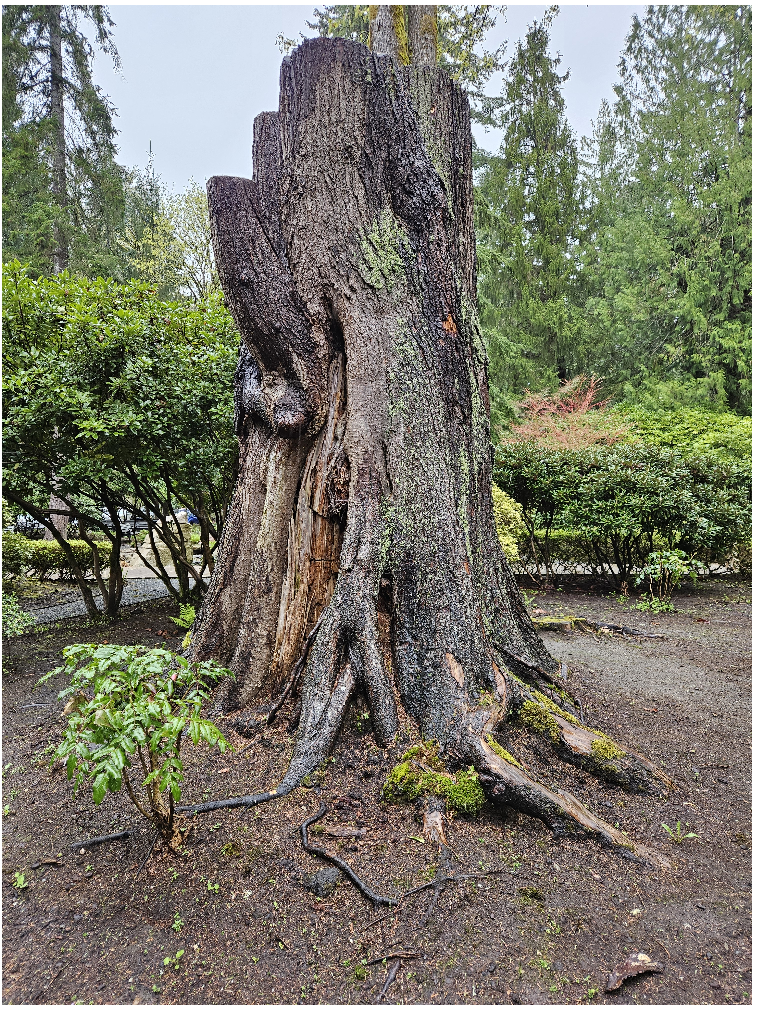
Giant Stump © Connie J. Jasperson 2026
 I have been busy on the domestic side of things and enjoying life as a Townie. Lovely Instacart delivers my groceries from any store I choose. If we have to be out after dark and it’s raining, I can’t see well, so Uber does the driving. We are living a life of luxury and grateful for it. I have a “passel” of grandbabies and great-grandbabies, so when I have nothing to write, I have needlework projects to keep me busy.
 And speaking of fancy, we had a chance to spend time with two great-grandbabies this weekend. The best part of being a grandma is when the little one starts crying or needs changing, someone else takes over, and grandma shuffles off to the kitchen to stir the soup and make another cup of tea. Yay for old age!
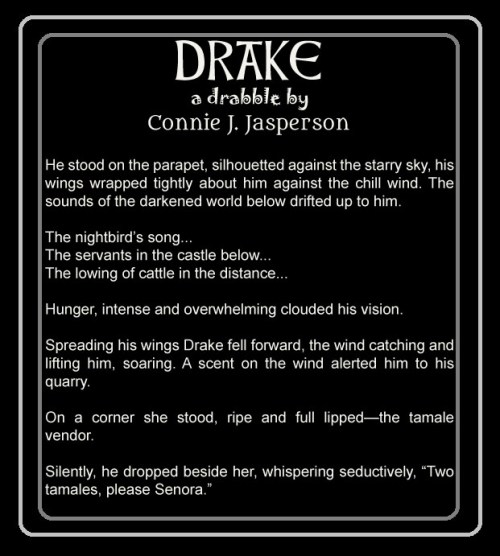
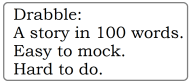 Writing drabbles means your narrative will be limited to one or two characters. There is no room for anything that does not advance the plot or affect the story’s outcome. Also, while a 100-word story takes less time than a 3,000-word story, all writing is a time commitment. I will spend an hour or more getting a drabble to fit within the 100-word constraint.