
When laying down the first draft of a work in progress, I always give every walk-on a name, right down to the dog. I generally write with an outline, but during NaNoWriMo, my stream of consciousness takes over, and the story veers away from the outline.
 Once NaNoWriMo is over, I try to shave my cast of thousands down to a reasonable level.
What is the optimal number of characters for a book? Some say only four, others fifteen. I say introduce however many characters it takes to tell the story but use common sense.
I now have 3 hard and fast rules for deciding who should be named and who should not. Sometimes I am good at following them. Other times—not.
- Is this character someone the reader should remember?Even if they offer information the protagonist and reader must know, it doesn’t necessarily mean they must be named. Throw-away characters provide clues to help our protagonist complete their quest. Also, they can show us something about the protagonist and give hints about their personality or past.
- Does the person return later in the story, or are they just set dressing? Are they part of the scenery of, say, a coffee shop or a store? They don’t need a name if they are only a component of world-building.
- Only give names to characters who advance the plot.
In my experience as a reader, the pacing an author is trying to establish comes to a halt when a character who is only included for the ambiance has too much time devoted to them. If they are set dressing, they should be nameless.
When we are writing a scene, ask yourself these questions:
- Do these people advance the plot?
- Do they help or hinder the protagonist in some crucial way?
- Do they provide essential background information we won’t get any other way?
- Is their presence a necessary part of world-building?
 Take a second look at the characters in each scene and remove those with no real purpose. (Save everything you cut in a separate file—you might want to reuse these characters someday.)
This is true of a novel, a screenplay, or a short story. Names alert us, telling us a character will have an important role in the story.
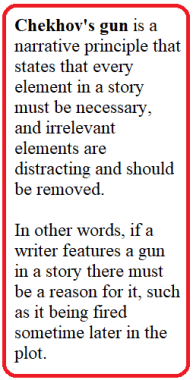
- Ask yourself if the character is an example of “Chekhov’s Gun.”
- Does this character serve a purpose the reader must know? If not, don’t give them a name.
Novelists can learn a lot about writing a good, concise scene from screenwriters.
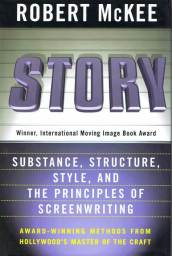
- An excellent book on craft, and one I highly recommend, is Story by Robert McKee.
We want the reader to stay focused on the protagonist(s) and their story. In the second draft, we hunt for the distractions we may have inadvertently introduced in our first draft. Having too many named characters in a scene is easy to fix.
- We remove side characters from the scene if they have nothing to contribute.
- Walk-on characters can be identified in general terms. The reader will move on and forget about them.
When Joley entered the café, all the seats were taken but one at the counter between a man in paint-stained coveralls and a woman with a briefcase at her feet. She caught Nathan’s eye, and he brought her a coffee. “We need to talk,” she whispered.
“I get off at four,” he replied. He refilled several coffees at the counter, then carried the pot to the tables.
The tendency to make every character a memorable person is one we can’t indulge. The reader will become confused if too many characters are named.
When I first began writing full-time, I learned a lesson the hard way about naming characters. I have a main character named Marya in one of my early novels, and she’s central to the series. Also, in the first book, a side character was important enough to have a name, but my mind must have been in a rut when I thought that one up. For some stupid reason, I named her Marta.
You can probably see where this is going—the two names are nearly identical.
 What is even worse, halfway through the first draft of the second book in the series, Marta suddenly was a protagonist with a significant storyline. She actually becomes Marya’s mother-in-law in the third book. Fortunately, I was in the final stage of editing book one for publication. I immediately realized I had to make a major correction: Marta was renamed Halee.
But how do names play out in real life? In my family, “Robert” is a recurring name.
My father was named Robert, and my two brothers are both named Robert (with different middle names). My mother’s younger brother is also a Robert. My younger brother’s son is named Robert, as is his son. We have a Bob, a Little Bob, a Rob, a Bobby, a Robby, and a Quatro. Two Bobs are no longer with us, but the confusion continues with each new generation of Roberts in our family.
I took this absurdity to an extreme in Billy Ninefingers. In Waldeyn, the most common boy’s name is William, which is why Billy MacNess embraces the name his mercenaries give him after the injury – Billy Ninefingers. In that novel, anyone named William generally goes by their last name or their trade. Think Mason, Sawyer, etc., etc.
Other than Billy Ninefingers, where the overuse of one name was intentional and integral to the story, my personal rule is to NEVER name two characters so that the first and last letters of their names are the same.
I try never to have two names that begin with the same letter, but that becomes difficult.
But in a scene, who should go and who should stay? And what is the optimal number of characters for a book? Some say only four, others fifteen.
I feel an author should introduce however many characters it takes to tell the story but should also use common sense.
One last thing to consider: how will that name be pronounced when read aloud? You may not want to get too fancy with the spelling, so a reader can easily read that name aloud. You may not think that matters, but it does.
I read Tad Williams’ Memory Sorrow and Thorn series aloud to my youngest daughter when she was old enough to appreciate and understand it. (I was too cheap to pay for cable television, and it kept my teenager from being bored.) I will just say that while his narrative is brilliant and engrossing, many of those names took some practice to say without stumbling.
 Names are also a component of world-building. While recording Tales from the Dreamtime, a novella consisting of three fairy tales, my narrator had trouble pronouncing the names of two characters. This happened because I had written the names so they would feel foreign and look good on paper.
Despite my experience of reading fantasy books aloud to my children, it didn’t occur to me that the names were unpronounceable as they were written. We ironed that out, but that hiccup taught me to spell names the way they’re pronounced whenever possible.
In conclusion, don’t confuse your readers by giving unimportant walk-on characters names.
Never give two characters names that are nearly identical.
Do consider making your spellings of names and places pronounceable just in case you decide to have your novel made into an audiobook.
 When I begin writing a first draft, I try to approach writing each scene as if I were shooting a movie. We know that each conversation is an event that must advance the story, but it must also give us glimpses of who each person is.
 Having the fundamentals of the conversation to work with sharpens the scene in my mind, enabling me to frame it properly. Once I know what they are talking about and have the rudimentary dialogue straight, I add the scenery. Then, I insert the props and add the speech tags. The interaction grows, shedding more light on their relationship.
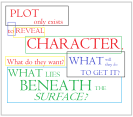 My above sample is not perfect, as it is from the first draft of a short story I never actually finished, but you get the idea. We learn more about the characters’ relationship with each other and see their place in this environment. The layers that form this scene are:
 Set dressing (the props you place in the scene) shows the immediate environment. Having characters interact with props provides opportunities to insert hints that a deeper backstory exists. However, only have them interact with props that are organic or crucial to the story. This eliminates the problem of
  By beginning with the conversation and envisioning each scene as if I were filming a movie, I can flesh it out and show everything the reader needs to hang their imagination on. The reader’s mind will supply the details of the immediate setting depending on the clues I give.
 In many thrillers and cyberpunk novels, the faceless behemoth of corporate greed is the overarching antagonist. It can be represented by characters who are portrayed as utterly committed to doing their job and loyal to their employer. In many cyberpunk novels, the antagonists tend to be goons-in-suits, enforcers who work for the corporation.
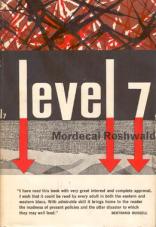 Level 7 is a 1959 science fiction novel by the Ukrainian-born Israeli writer
 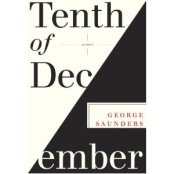 This type of psychopathic antagonist is explored exceedingly well in George Saunders’ brilliant sci-fi short story,
  When evil is a behemoth on the order of a mega-corporation or a military coup, the villains who represent it all have reasons for their loyalty. They’re like the hero; they care intensely, obsessively about something or someone. They have logical motives for supporting what we are portraying as the enemy. Our job as authors is to make those deeply held justifications the driving force behind their story.
 The emergence of these traits is exciting, fueling the passion they have for their stories.
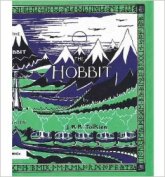 Bilbo’s sudden irrational decision to accept the task of Burglar sets him on a path that becomes a personal pilgrimage, a search for the courage he always possessed but had never needed.
 In one of my current works in progress, my protagonist is a soldier of the Bull God’s world of Serende, an enemy sworn to conquer the goddess’s world of Neveyah. He undergoes a religious conversion, and his story takes him on a physical and spiritual journey.


 Life in the Realm of Fantasy