Tag Archives: Claude Monet

#FineArtFriday: Summer, field of poppies by Claude Monet 1875

Artist: Claude Monet (1840–1926)

Title: Français : L’été. Champ de coquelicots

English: Summer, field of poppies

Deutsch: Sommer. Klatschmohnfeld

Date:   1875

Medium: oil on canvas

Dimensions: height: 60 cm (23.6 in); width: 81 cm (31.8 in)

Collection: Private collection

What I love about this painting:

Claude Monet’s gift for bringing in the beauty of nature shines in this painting. He shows us a warm day in high summer, with fluffy white clouds sailing across blue skies. The wild poppies have taken root in a fallow field, and are mingled in with the tall field-grass. A woman and two children have come to pick wildflowers in the meadow. One can almost hear the buzzing of bees as they go about their business mingling with the occasional birdsong.

I would love to have walked in that field.

About the Artist, via Wikipedia:

Oscar-Claude Monet: 14 November 1840 – 5 December 1926) was a French painter and founder of Impressionism painting who is seen as a key precursor to modernism, especially in his attempts to paint nature as he perceived it.[1] During his long career, he was the most consistent and prolific practitioner of Impressionism’s philosophy of expressing one’s perceptions of nature, especially as applied to plein air (outdoor) landscape painting.[2] The term “Impressionism” is derived from the title of his painting Impression, soleil levant, which was exhibited in 1874 at the First Impressionist Exhibition, initiated by Monet and a number of like-minded artists as an alternative to the Salon.

Monet was raised in Le HavreNormandy, and became interested in the outdoors and drawing from an early age. Although his mother, Louise-Justine Aubrée Monet, supported his ambitions to be a painter, his father, Claude-Adolphe, disapproved and wanted him to pursue a career in business. He was very close to his mother, but she died in January 1857 when he was sixteen years old, and he was sent to live with his childless, widowed but wealthy aunt, Marie-Jeanne Lecadre. He went on to study at the Académie Suisse, and under the academic history painter Charles Gleyre, where he was a classmate of Auguste Renoir. His early works include landscapes, seascapes, and portraits, but attracted little attention. A key early influence was Eugène Boudin, who introduced him to the concept of plein air painting. From 1883, Monet lived in Giverny, also in northern France, where he purchased a house and property and began a vast landscaping project, including a water-lily pond.

Monet’s ambition to document the French countryside led to a method of painting the same scene many times so as to capture the changing of light and the passing of the seasons. Among the best-known examples are his series of haystacks (1890–1891), paintings of Rouen Cathedral (1892–1894), and the paintings of water lilies in his garden in Giverny, which occupied him for the last 20 years of his life. Frequently exhibited and successful during his lifetime, Monet’s fame and popularity soared in the second half of the 20th century when he became one of the world’s most famous painters and a source of inspiration for a burgeoning group of artists. [1]


Credits and Attributions:

IMAGE: Wikimedia Commons contributors, “File:Claude Monet – L’été – Champ de coquelicots.JPG,” Wikimedia Commons, https://commons.wikimedia.org/w/index.php?title=File:Claude_Monet_-_L%27%C3%A9t%C3%A9_-_Champ_de_coquelicots.JPG&oldid=1017229638 (accessed June 19, 2025).

[1] Wikipedia contributors, “Claude Monet,” Wikipedia, The Free Encyclopedia, https://en.wikipedia.org/w/index.php?title=Claude_Monet&oldid=1295997578 (accessed June 19, 2025).

1 Comment

Filed under #FineArtFriday

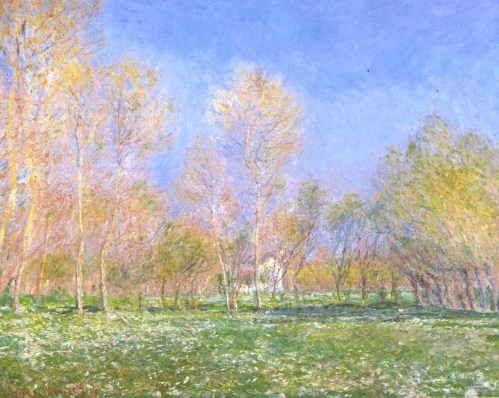
#FineArtFriday: Spring in Giverny by Claude Monet 1890

Monet_-Spring_in_GivernyArtist: Claude Monet  (1840–1926)

Title: Spring in Giverny

Date: 1890

Medium: oil on canvas

Dimensions: height: 64.8 cm (25.5 in); width: 81 cm (31.8 in)

Inscriptions: Signature and date bottom left: Claude Monet 90

What I love about this painting:

The fruit trees are flowering in the part of the world where I live. All along the streets, in back yards, and public areas, apple, cherry, and flowering plum trees are covered in buds, their branches tinted with shades of pink and white. The Pacific Northwest is bursting into color. The streets in our town are lined with trees of pink and white.

Yellow forsythia is blooming, and dogwood brightens each neighborhood. Flowering trees and ornamental shrubs bring swathes of welcome color to the gray and rainy days of March.

Monet’s trees show us the appreciation the artist had for nature. His fruit trees and ornamental trees make me happy too. We need the color, need the sunshine.

Thank you, Claude Monet, for sharing this moment in time with us.

About the Artist, via Wikipedia:

Oscar-Claude Monet 14 November 1840 – 5 December 1926) was a French painter and founder of impressionist painting who is seen as a key precursor to modernism, especially in his attempts to paint nature as he perceived it. During his long career, he was the most consistent and prolific practitioner of impressionism’s philosophy of expressing one’s perceptions of nature, especially as applied to plein air (outdoor) landscape painting.  The term “Impressionism” is derived from the title of his painting Impression, soleil levant, exhibited in 1874 (the “exhibition of rejects”) initiated by Monet and his associates as an alternative to the Salon. [1]

Read the rest of the article at Claude Monet – Wikipedia


Credits and Attributions:

IMAGE: Wikimedia Commons contributors, “File:Monet – Frühling in Giverny.jpg,” Wikimedia Commons, https://commons.wikimedia.org/w/index.php?title=File:Monet_-_Fr%C3%BChling_in_Giverny.jpg&oldid=654964112 (accessed March 21, 2024).

[1] Wikipedia contributors, “Claude Monet,” Wikipedia, The Free Encyclopedia, https://en.wikipedia.org/w/index.php?title=Claude_Monet&oldid=1213738859 (accessed March 21, 2024).

4 Comments

Filed under writing

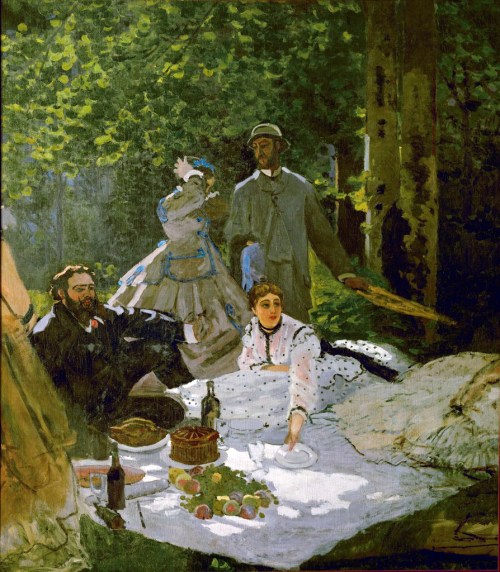
#FineArtFriday: Le Déjeuner sur l’herbe (Luncheon on the Grass) by Claude Monet ca. 1865

Monet_dejeunersurlherbeArtist: Claude Monet (1840–1926)

Title: French: Déjeuner sur l’herbe (English: Luncheon on the Grass) Central panel

Depicted people:

Date: between 1865 and 1866

Medium: oil on canvas

Dimensions: height: 248 cm (97.6 in) width: 217 cm (85.4 in)

Collection: Musée d’Orsay

Place of creation: Chailly-en-Bière

What I love about this painting:

This painting may be unfinished, but in this section, the central panel, Monet gives us a beautiful day, sunny and warm. It’s a perfect day for a picnic with friends, to forget the stresses of life and just enjoy the beauty of the world around you. It’s the perfect counterfoil to my often-gloomy Pacific Northwestern winter, the kind of day that gives me hope that a pleasant spring waits just a few weeks away.

Thank you, Monsieur Monet. I needed this glimpse of summer.

About this painting via Wikipedia:

Le Déjeuner sur l’herbe (English: Luncheon on the Grass) is an 1865–1866 oil on canvas painting by Claude Monet, produced in response to the 1863 work of the same title by Édouard Manet. It remains unfinished, but two large fragments (central and left panels) are now in the Musée d’Orsay in Paris, whilst a smaller 1866 version is now in the Pushkin Museum in Moscow.

Monet included the artist Gustave Courbet in the painting.

The painting in its whole form shows twelve people. They are clothed in Parisian clothing which was fashionable at that time. They are having a picnic in near a forest glade. All the people are gathered around a white picnic blanket, where food as fruits, cake or wine is located. The mood in this natural space is primarily created by the play of light and shadow, which is created by deciduous tree above them. [1]

About the Artist, via Wikipedia:

Oscar-Claude Monet 14 November 1840 – 5 December 1926) was a French painter and founder of impressionist painting who is seen as a key precursor to modernism, especially in his attempts to paint nature as he perceived it. During his long career, he was the most consistent and prolific practitioner of impressionism’s philosophy of expressing one’s perceptions before nature, especially as applied to plein air (outdoor) landscape painting. The term “Impressionism” is derived from the title of his painting Impression, soleil levant, exhibited in 1874 (the “exhibition of rejects”) initiated by Monet and his associates as an alternative to the Salon.

His last time exhibiting with the Impressionists was in 1882—four years before the final Impressionist exhibition.

Monet, Renoir, Pissarro, Morisot, Cézanne and Sisley proceeded to experiment with new methods of depicting reality. They rejected the dark, contrasting lighting of romantic and realist paintings, in favour of the pale tones of their peers’ paintings such as those by Jean-Baptiste-Camille Corot and Boudin. After developing methods for painting transient effects, Monet would go on to seek more demanding subjects, new patrons and collectors; his paintings produced in the early 1870s left a lasting impact on the movement and his peers—many of whom moved to Argenteuil as a result of admiring his depiction. [2]


Credits and Attributions:

IMAGE: Le Déjeuner sur l’herbe (Luncheon on the Grass) by Claude Monet ca. 1865 Wikimedia Commons contributors, “File:Monet dejeunersurlherbe.jpg,” Wikimedia Commons, the free media repository, https://commons.wikimedia.org/w/index.php?title=File:Monet_dejeunersurlherbe.jpg&oldid=711036251 (accessed February 16, 2023).

[1] Wikipedia contributors, “Le Déjeuner sur l’herbe (Monet, Paris),” Wikipedia, The Free Encyclopedia, https://en.wikipedia.org/w/index.php?title=Le_D%C3%A9jeuner_sur_l%27herbe_(Monet,_Paris)&oldid=1134534732 (accessed February 16, 2023).

[2] Wikipedia contributors, “Claude Monet,” Wikipedia, The Free Encyclopedia, https://en.wikipedia.org/w/index.php?title=Claude_Monet&oldid=1137970938 (accessed February 16, 2023).

3 Comments

Filed under #FineArtFriday