Tag Archives: commas and conjunctions

Self-editing part one – 7 easy-to-remember rules of punctuation #writing

Many authors are just starting out in the craft and have never written anything longer than a memo or a social-media post before the novel they just finished. Once their manuscript is revised to their satisfaction, they might try to self-edit it rather than hire a freelance editor.

This can work if they took writing courses or had an education that included creative writing.

But I don’t recommend it. We see what we believe is there, not what is there.

A majority of new writers haven’t written since they left school. They don’t remember how to write a readable sentence or what a paragraph should (or should not) contain.

I certainly didn’t retain those skills. However, while I couldn’t afford to go back to college, I did go out of my way to educate myself.

First, we must think of punctuation as the traffic signal that keeps the words flowing and the intersections manageable.
Trying to learn from a grammar manual is daunting, to say the least. I learned by looking things up in the Chicago Manual of Style (CMoS), which is the rule book for American English, and from working with my editor. Most editors in the large traditional publishing houses refer to the CMoS when they have questions.

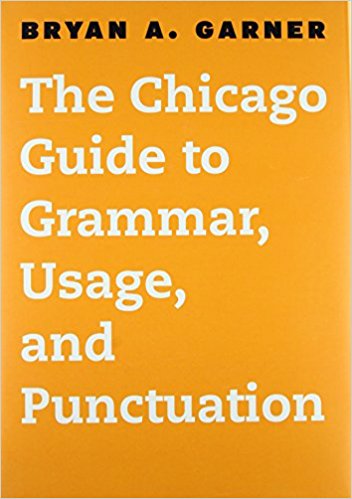
I use Bryan A. Garner’s “the Chicago Guide to Grammar, Usage, and Punctuation.”

Maybe (like me) you came up in the world of business before the computer revolution. If so, you may be familiar with several other grammar style guides. Each is tailored to a particular kind of writing:

  • The AP manual is for journalism.
  • The Gregg manual for business writing.
  • The CMoS is specifically for creative writing, such as fiction, memoirs, and personal essays, but also includes business and journalism rules.
You don’t need to know everything in the CMoS. If you know the fundamentals and are consistent with how you use them, your writing will pass most tests.

Punctuation appears complicated when one is new to it. This confusion occurs because some advanced usages are open to interpretation. The way you habitually use them is your voice.

One thing remains clear: the foundational laws of comma use are not open to interpretation.

If you consistently follow seven simple rules, your work will look professional.

Rule one: commas and the fundamental rules for their use exist for a reason. If we want the reading public to understand our work, we need to follow them. Let’s get the “don’ts” out of the way:

  • DO NOT insert commas “where you take a breath” because that many commas are unnecessary, and the habit creates run-on sentences.
  • DO NOT insert commas where you think a sentence should pause because every reader sees the pauses differently.

Rule two: Commas can join two independent but related clauses with the aid of a conjunction. (I repeat: independent but related with the help of a conjunction.)

The independent clause is a complete standalone sentence.

  • Boris worships the ground I walk on. His adoration tires me. (Two sentences.)
  • Boris worships the ground I walk on, but his adoration tires me. (One sentence.)

Dependent clauses are unfinished and can’t stand on their own. Join them in the sentence with a conjunction and omit the comma this way:

  • Boris worships the ground I walk on and brings me margaritas by the pool. (And is a conjunction, a joining word.)
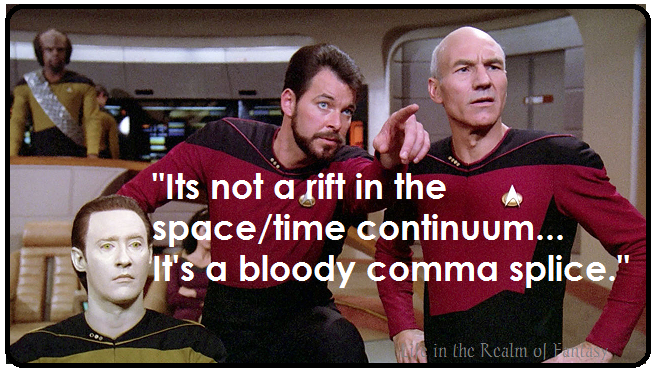
You do not join unrelated independent clauses (clauses that can stand alone as separate sentences) with commas as that creates a rift in the space/time continuum: the Comma Splice.

  • Boris kissed the hem of my garment, Woofer, my dog, likes to ride shotgun.

What we have there is a wandering, run-on sentence created by the casual use of the comma splice. The dog has little to do with Boris other than the fact they both worship me. They should not be in the same paragraph, much less the same sentence. Here is the same thought, written correctly:

Boris kissed the hem of my garment.

Woofer, my dog, likes to ride shotgun.

  • The dog riding shotgun is an independent clause and does not relate at all to Boris and his adoration of me. It is a different idea and should be in a separate paragraph. If you want Boris and the dog in the same sentence, you must rewrite it:

Boris and Woofer worship me and fight for the right to ride shotgun.
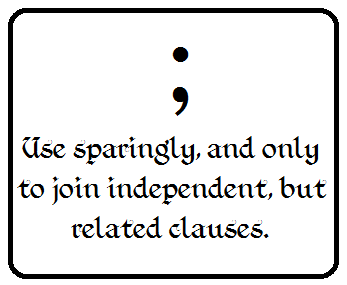
Rule three: a semicolon in an untrained hand is a dangerous thing. Some people (including Microsoft Word) think a semicolon signifies an extra-long pause but not a hard ending. The Chicago Manual of Style says that belief is wrong. Don’t blindly accept what Spellcheck or the AI editor app tells you!

So, when do we use them? We only use them when two clauses are short, complete sentences that relate to each other. Here are two brief sentences that would be too choppy if left separate.

  • The door swung open at a touch. Light spilled into the room. (2 related short standalone sentences.)
  • The door swung open at a touch; light spilled into the room. (2 related short sentences joined by a semicolon.)
  • The door swung open at a touch, and light spilled into the room. (1 compound sentence made from 2 related standalone clauses joined by a comma and a conjunction.) (A connector word.)

All three of the above sentences are technically correct. The usage you habitually choose is your voice.

I don’t hate semicolons, although some editors do. However, I generally look for alternatives to them.

Rule four: Colons. These tidbits of punctuation commonly head lists found in technical writing. Colons are rarely needed in narrative prose. In technical writing, you might say something like:

For the next step, you will need:

  1. four nails,
  2. two feet of rope,
  3. one banana, whole and unpeeled.

I have no idea what they are building, but I can’t wait to see it.
Rule five:  Oxford commas, also known as serial commas. This is the one war authors will never win or find common ground, a true civil war.

When listing a string of things in a narrative, we separate them with commas to prevent confusion. I like people to understand what I mean, so I always use the Oxford Comma/Serial Comma.

If there are only two things in a list, they do not need to be separated by a comma. If there are more than two items, separate them with a comma.

We sell dogs, cats, rabbits, and birds.

Why do we need clarity? You might know what you mean, but not everyone thinks the same way.

  • I accept this award and thank my late parents, Tad Williams and Poseidon.

That sentence might make sense to some readers, but not all. The intention of it is to thank my late parents, my favorite author, and the god of the sea. If I don’t thank Poseidon, my next fishing trip could end badly.

  • I accept this award and thank my late parents, Tad Williams, and Poseidon.

Regardless of which stance you take on the Oxford/serial comma, choose your poison and be consistent.

Rule six: We use commas after introductory clauses.

After dark, Boris changes into his bat form and goes hunting for enchiladas.

Rule seven: When writing dialogue, all punctuation goes inside the quotation marks.

  1. A comma follows the spoken words, separating the dialogue from the speech tag.
  2. The clause containing the dialogue is enclosed, punctuation and all, within quotes.
  3. The speech tag is the second half of the sentence, and a period ends the entire sentence.

The editor said, “I agree with those statements.”

  1. When dialogue is split by the speech tag, do not capitalize the first word in the second half.

“I agree with those statements,” said the editor, “but I wish you’d stop repeating yourself.”

If you follow these seven simple rules, your work will be readable. If your story is as original as you think it is, it will be acceptable to acquisitions editors.

Next week, we will continue our look at effective self-editing.
5 Comments

Filed under writing

Snares in the Depths #amwriting

Something lurks in the depths of the Word Pond that is our story, snares waiting to drown the unwary author.

An early trap is confusion: At first, we don’t know what to do with commas. Some frustrated authors will decide to do without them altogether.

This decision leads to chaos and an unreadable manuscript.

I’ve said this before, but it bears repeating:

Commas are to clauses what traffic signals are to streets. They govern the flow of traffic, although, in the case of sentences, the traffic is comprised of words, not cars.

  • Commas follow introductory words and clauses. Instead, they took a left turn.
  • Commas set off “asides.” Her sister, Sara, brought coffee.
  • Commas separate words in lists: We bought apples, oranges, and papayas for the salad.
  • Commas join two complete sentences, and once joined, they form one longer sentence. When used too freely, linked clauses can create run-on sentences.
  • Commas frequently precede conjunctions, but only when linking complete clauses. When connecting a dependent clause to a complete clause, don’t insert a comma. “I intended to go back to London but found myself here instead.”

Another early snare the new author must avoid is the long-winded sentence. How often do you link several clauses together with the word and? Conjunctions are the gateway to run-on sentence hell.

If you are deliberate in your use of conjunctions, em dashes, and hyphens, you will also use fewer commas. Craft your prose but use grammatical common sense. Brevity usually strengthens prose.

Another trap waiting for the unwary is descriptive TMItoo much information.

Don’t waste words describing every insignificant change of expression and mood. Consider this hot mess of fifty-one words that make no sense:

Eleanor looked at Gerard with concern. His voice changed so much in the telling of the story as his emotions came to the surface that it still seemed so raw, as if Timmy’s death had happened only days ago. In addition, his expressions also changed and his current one was akin to despair.

That waste of ink could be cut down to fourteen (14) words that convey the important parts of the sentence: Gerard’s raw despair concerned Eleanor, seeming as if Timmy’s death had happened only days before.

Using too many words mingled with catchphrases and acronyms to express simple concepts is a common requirement of corporate emails and documents for project managers. If you are coming from that environment, you must learn to write a lean narrative. Readers don’t want fluffy, meaningless prose littered with clichés and obscure words in their literature.

What does “Kill your darlings” really mean? All it means is don’t write self-indulgent drivel.

We all fall in love with our characters. Why make the point that people fall over themselves drooling at the beauty of the protagonist? Why make that point in every other paragraph? Is it that important to the narrative?

If it isn’t important to that scene, don’t include it. Gerard’s handsome visage and grace should be mentioned occasionally, but only where his god-like magnetism and charisma impacts the story.

Really–in real life, how often does that happen? However, if Gerard’s looks and charisma cause trouble wherever he goes, then it becomes a key part of the action and can be used to set up other scenes.

We write because we love words, but simplicity is usually best. Consider this morsel of “yuck.”

Delicious sounds captivated their eardrums.

Please, just say it sounded amazing. If music touches the protagonist’s soul, it’s good to say so.

We want to convey the fact the music was beautiful, and we don’t want to be boring. However, when we get too artful we are at risk of creating awkward visuals.

Odors and sounds are part of the background, the atmosphere of the piece, and while they need to be there, we don’t want them to be obtrusive, in-your-face.

This is an instance of prose working better when it isn’t fancy.

I hope these thoughts help get your writing week started.

Now, go! Write like the wind!

15 Comments

Filed under writing

#Amwriting: The Coordinating Conjunction

In grammar, a conjunction is a connection: a part of speech that connects words, phrases, or clauses.

What are coordinating conjunctions and why should you care? For one thing, conjunctions are like any other essential part of English grammar. They have a particular use, and when they are used correctly, they blend into the background.

The Fount of All Knowledge, Wikipedia, says:

Coordinating conjunctions, also called coordinators, are conjunctions that join, or coordinate, two or more items (such as words, main clauses, or sentences) of equal syntactic importance. In English, the mnemonic acronym FANBOYS can be used to remember the coordinators for, and, nor, but, or, yet, and so. These are not the only coordinating conjunctions; various others are used, including “and nor” (British), “but nor” (British), “or nor” (British), “neither” (“They don’t gamble; neither do they smoke”), “no more” (“They don’t gamble; no more do they smoke”), and “only” (“I would go, only I don’t have time”). Types of coordinating conjunctions include cumulative conjunctions, adversative conjunctions, alternative conjunctions, and illative conjunctions.

Here are some examples of coordinating conjunctions in English and what they do:

For – presents rationale (“They do not gamble or smoke, for they are ascetics.”)

And – presents non-contrasting item(s) or idea(s) (“They gamble, and they smoke.”)

Nor – presents a non-contrasting negative idea (“They do not gamble, nor do they smoke.”)

But – presents a contrast or exception (“They gamble, but they don’t smoke.”)

Or – presents an alternative item or idea (“Every day they gamble, or they smoke.”)

Yet – presents a contrast or exception (“They gamble, yet they don’t smoke.”)

So – presents a consequence (“He gambled well last night, so he smoked a cigar to celebrate.”)

We use and, or, and but as connectors of words, phrases, clauses, or sentences of equal rank.

  • apples and oranges
  • apples or oranges
  • apples, but not oranges

In a sentence, we can use “and” and “or” to join strings of nouns or strings of verbs:

  • Apples and oranges and bananas (are tasty).
  • Wash and dry (the dishes).
  • Apples or bananas or oranges
  • Apples and oranges, but not bananas
  • I love cooking and my pets and my family.

I would prefer to use serial commas to connect my string rather than conjunctions:

  • Apples, bananas, or oranges
  • Apples, bananas, and oranges
  • I love cooking, my pets, and my family.

Yes, I said I would use a serial comma. I’ve seen people launch into rants against serial commas, claiming it’s too many and looks awful.

That argument is hogwash.

For whom are you writing? Are you writing only yourself or are you writing for an unknown reader who may one day buy your book? If you are writing for your own eyes only, do whatever you like. But if you expect others to enjoy your work, you need to think about the reader. Using serial commas will make your work easy for the reader to understand what you are saying. Other aspects of commas may escape me at times, but the serial comma, also known as the Oxford comma, is one I adhere to in my own work, and heartily wish other authors would too.

But enough about the commas–let’s get back to conjunctions.

The word “but” is a little different from “and” or “or.”  It is a coordinating conjunction, and we use “but” to join two words:”

  • (I want you to) sing, but loudly.

“But” is also a connector that indicates contrast.

  • I like black but not white.

“But” can connect just about any kind of word or phrase that “and” and “or” can connect, with one difference: it can’t connect nouns in phrases.

  • Consider Betty and Judy (went shopping). We wouldn’t say Betty but Judy (went shopping).

However, “but” can connect noun phrases to other phrases:

  • Betty and Judy (went shopping) but I don’t know who drove.

When I speak, I have a habit of beginning my sentences with the conjunctions “and,” “but,” “because,” and “so.” Because these words are conjunctions, connector words, some people will say this is wrong.  I disagree with them, for this reason: in this case, these conjunctions are connecting ideas.

On page 257, The Chicago Manual of Style says this rule has “no historical or grammatical foundation.” The CMOS further points out that William Shakespeare, Mark Twain, and the authors of America’s Declaration of Independence freely began sentences with those four conjunctions.

These people were well educated, and we can assume they understood grammar as well as anyone. Consider the following sentence, written by Abraham Lincoln:

“But, in a larger sense, we can not dedicate, we can not consecrate, we can not hallow this ground.” (Abraham Lincoln’s Gettysburg Address)

As he was a lawyer as well as a respected public speaker, we know Abe was a well-educated man.

Get It Write Online says:

“Most likely, many people believe they should not start a sentence with a coordinating conjunction because their grammar teachers in grade school discouraged them from doing so. Yet such a rule is completely unjustifiable. When grammar teachers teach youngsters the essentials of sentence structure, they most likely explain that coordinating conjunctions are used to hold together elements within a sentence. Therefore, they may discourage students from starting sentences with coordinating conjunctions because they are trying not only to explain conjunctions but also to help their students learn to avoid sentence fragments like this one:

She was a nice girl. And smart, too.

In this example, using “and” after the period is wrong because the second “sentence” is not really a sentence at all: it has neither a subject nor a verb.

So, just like the ubiquitous (but often unnecessary) “comma before the word because” and the silly debate over the incredibly important serial comma, we will likely have this disagreement for many generations to come.


Sources and Attributions:

Wikipedia contributors, “Conjunction (grammar),” Wikipedia, The Free Encyclopedia, https://en.wikipedia.org/w/index.php?title=Conjunction_(grammar)&oldid=771179901  (accessed March 28, 2017).

Weird Coordinating Conjunctions: Yet, For, and So, © Mignon Fogarty, Grammar Girl, July 10, 2014, http://www.quickanddirtytips.com/education/grammar/weird-coordinating-conjunctions-yet-for-and-so, (accessed Mar. 28, 2017).

University of Chicago (2010). The Chicago Manual of Style (16th ed.). Chicago: Univ. of Chicago Press. p. 257. ISBN 978-0-226-10420-1.

Starting Sentences with “And” or “But,” © 03/26/2001 Nancy Tuten,  Get It Write, http://www.getitwriteonline.com/archive/032601startsentandbut.htm  (accessed Mar. 28, 2017).

23 Comments

Filed under Self Publishing, writing

#amwriting: Commas: Morsels of madness or necessary evils?

commaNothing gets certain people jacked up more than misplaced commas. Why this rabid hysteria? Personally, I have no energy to waste, so I’m selective about my frenzies.

But commacentric grammarians do raise a few salient points. Commas and the rules for their use exist for a reason, and if we want the reading public to understand our work, we need to follow them.

I am a decent structural editor, but I don’t claim to have any special knowledge about commas.

However, I do know a couple of things:

  1. Never insert commas “where you take a breath” because everyone breathes differently.
  2. Do not insert commas where you think it should pause, because every reader sees the narrative differently.

Commas are the rules of the road for writing. They are the universally acknowledged pausing and joining symbol. Readers expect to find their pauses between clauses and commas are sometimes the signifiers of those pauses.

One rule I had to unlearn the first time I sent my work to a professional line editor:

  1. Do not place a comma before ‘because’ unless the information that follows is necessary to the sentence.

What? That’s not what I was taught in school!

The Chicago Manual Online gives this example (and I quote):

He didn’t run, because he was afraid.

He didn’t run because he was afraid.

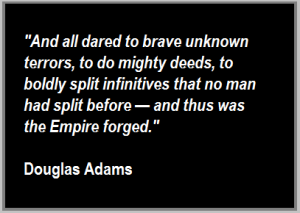
Douglas Adams quote, split infinitivesIn the first sentence, “because he was afraid” isn’t necessary. The main thing is that he didn’t run, and the reason is incidental. The second sentence, which omits the comma, is unclear. It might mean that he ran, but fear was not the reason he did so.

Mignon Fogarty, the Grammar Girl, explains this well. “You don’t automatically put a comma before the word because, but sometimes you need a comma there to make sure your meaning is clear.”

We do use commas to set off introductory clauses:

  1. In the first sentence, “because he was afraid” isn’t necessary.

I italicized the introductory clause in the above sentence to show that it is not a stand-alone sentence. This clause introduces the clause that follows it, and its meaning is dependent on that following clause.

Another thing I had to unlearn:

  1. Do not automatically place a comma before the conjunction ‘and.’

Compound sentences combine two separate ideas (clauses) into one compact package. A comma should be placed before a conjunction only if it is at the beginning of an independent clause. So use the comma before the conjunction (and, but, or) if the clauses are actually standalone sentences. If one of them is not a standalone sentence, it is a dependent clause, and you do not add the comma.

Take these two sentences: She is a great basketball player. She prefers swimming.

  1. If we combine them this way we add a comma: She is a great basketball player, but she prefers swimming.
  2. If we combine them this way, we don’t: She is a great basketball player but prefers swimming.

I hear you saying, “Now wait a minute! Mrs. Downing very clearly taught us to use commas to join clauses, and she was right.”

I’m sorry, but Mrs. Downing probably  explained that. It just didn’t stick in your memory.

Two complete ideas can be joined with ‘and.’ Did I just contradict myself?

Sort of.

Think of it like a list: if there are only two things (or ideas) in a list, they do not need to be separated by a comma. If there are more than two ideas, the comma should be used to separate them, with a comma preceding the word ‘and’ before the final item/idea.

Dogs, cats, rabbits, and birds.

Oh YES, we DO use serial commas to prevent confusion! You’ve all seen the meme:

serial commas meme, martha stewartOn a personal level, I do love cooking, my pets, and my family. (But not in the same pot.) They’re happy that I use serial commas.

One of my favorite personal failings is the notorious comma splice. Apparently it’s bad form to join two independent clauses with a simple comma. This error is called a comma splice.

I have it on good authority that a comma splice will not cause a tear in the space-time continuum. But since this breach of humanity occasionally sends commacentrics into a frothing frenzy, we will use the conjunction and give these poor wretches a break.

From Wikipedia, the fount of all knowledge: “A comma splice is the use of a comma to join two independent clauses. For example: It is nearly half past five, we cannot reach town before dark. Although acceptable in some languages and compulsory in others (e.g., Bulgarian or French), comma splices are usually considered style errors in English.”

chicago manual of styleCommas and their proper use can drive you crazy when you are trying to get your work in order. And quite frankly, the rules are a little confusing.

Consistency is critical. UK usage can vary from US usage in some ways. Find a style guide that you can understand and consult it. Once you have a guide you can work with, use those suggestions consistently in all your work.

I use the Chicago Manual of Style for my work because I am a US citizen, and for creative writing, this is the most comprehensive manual and is what publishers and editors use. If you are strapped for cash, you can often buy secondhand copies of this manual through Amazon.

Commas can easily get out of control for me because I have a tendency to hit the comma key whenever I pause in my thinking when I am in the first draft phase. At that point, I am more concerned with just getting the words down than I am form and style.

However, proper form and style must come into play when we get into the later drafts. Using established protocols for punctuation is important if you want your readers to understand what you meant when you wrote that amazing piece of literature.

14 Comments

Filed under writer, writing