Tag Archives: descriptors and modifiers

Making Effective Revisions: Power Words part one #writing

The events we imagine as we begin to write a story have the power to move us because we see each scene fully formed in our minds. We are under the illusion that what we have written conveys to a reader the same power that moved us. Once we’ve written “the end” it requires no further effort, right?

I don’t know about your work, but usually, at that stage my manuscript reads like it was written by one-hundred monkeys at a writers’ workshop.  

The trick is to understand that, while the first draft has passages that shine, most of what we have written is still in the proto-stage. It contains the seeds of what we believe we have written.

Like Michaelangelo sculpting David, we must work to shave away the detritus and reveal the truth of the narrative.

One way we do this is by injecting subtly descriptive prose into our narrative. Properly deployed, power words can serve as modifiers and descriptors, yet don’t tell the reader what to feel.

Think of these commonly reviled words like falling leaves in autumn. A sentence made of a noun and a verb weighs nothing, feels like nothing: She runs.

Put those leaves in a pile, add a day or two of October rain, and they have weight. She runs through the leaves.

Our words gain weight when we incorporate descriptors into the narrative. If we are careful, our modifiers and descriptors add to the prose, coming together to convey a sense of depth.

And yes, modifiers and descriptors are also known as adjectives and adverbs.

Modifiers are like any other medicine: a small dose can cure illnesses. A large dose will kill the patient. The best use of them is to find words that convey the most information with the most force.

Let’s consider a story where we want to convey a sense of danger, without saying “it was dangerous.” What we must do is find words that shade the atmosphere toward fear.

Power words can be found beginning with every letter of the alphabet, but words that begin with consonants convey strength. What are some “B” words that convey a hint of danger, but aren’t “telling” words?

  • Backlash
  • Blinded
  • Blood
  • Blunder

When you incorporate any of the above “B” words into your prose, you are posting a road sign for the reader, a notice that “ahead lies danger.” Mingle them with other power words, and you have an air of danger.

As authors, it is our job to convey a picture of events.

But words sometimes fail us. I look at each instance of a modifier and see how it fits into that context. If a word or phrase weakens the narrative, I rewrite the sentence. I either change it to a more straightforward form or remove it. For example, bare is an adjective, as is its sibling, barely. Both can be used to form a strong image depending on context.

Revising your manuscript seems like an overwhelming task, but it isn’t. The best resource you can have in your personal library is a dictionary of synonyms and antonyms. Your word processing program may offer you some synonyms when you right-click on a word to open the thesaurus.

For most genre work, I suggest you don’t use “highfalutin” words or use acronyms and technical jargon.

But don’t dumb it down. Readers like it when you assume they are intelligent and aren’t afraid to use a variety of words. Yes, sometimes one must use technical terms, but I appreciate authors who assume the reader is new to the terminology and offer us a meaning.

The book of synonyms and antonyms is full of words we’re familiar with and which we often forget are available for our use when we want to convey an overall mood.

Let’s look at the emotion of discontent and how we can shape the overall mood of a scene and reinforce a character’s growing dissatisfaction without saying “they were discontented.”. The following words can serve as descriptors. If you are sparing about adding suffixes [ly or ing], they’re not fluffy. But you must work harder to compose showing sentences when you avoid mushy suffixes.

  • Aggression [noun] aggressive [adjective]
  • Awkward [adjective]
  • Disgust [verb or noun, depending on context]
  • Denigrate [verb}
  • Disparage [verb]

How we incorporate words into our prose is up to each of us. We all sound different when we speak aloud even when we speak the same language and the same dialect. The same is true for our writing voice.

We can tell the story using any mode or narrative tense we choose but the opening lines on page one must hook the reader, must hint at what they are in for if they stick with the story.

I meant to run away today.

If that were the opening line of a short story or novel, I would continue reading. Two words, run away, hit hard in this context, feel a little surprising as an opener. The protagonist is the narrator and is speaking directly to us, which is a bold choice. Right away, you hope you are in for something out of the ordinary.

That single sentence comprised of five words indicates intention, implies a situation that is unbearable, and offers us a hint of the personality of the narrator.

Some lines from a different type of story, one told from a third person point of view:

The battered chair creaked as Angus sat back. “So, what’s your plan then? Are we going to walk up to his front door and say, ‘Hello. We’re here to kill you’?”

This is a conversation, but it shows intention, environment, and personality in thirty-one words. Battered is a power word and so is creaked.

And here is one final scene, one told from a close third person point of view and uses a form of free indirect speech. This is a style of third-person narration which uses some of the characteristics of third-person along with the essence of first-person direct speech; it is also referred to as free indirect discourse, or free indirect style. The paragraph ends a scene, showing yet another way to incorporate world building along with subtle power words into the prose:

Sara saw the vine-covered ruins of Marlow as an allegory of herself. The core of her, the essence of her that was Josh had been burned away. She’d been destroyed but was coming back to life in ways she’d never foreseen.

The power words are ruinsburned awaydestroyed.

When we are consumed with just getting the story down, we often lean too heavily on one word that says what we mean. This is hard for us to spot in our own work, but a friend of mine uses word clouds to show her crutch words.

When we turn a document into a word cloud, the words we use most frequently show up as the largest. Word clouds are a great way to discover where we need to consult the thesaurus and expand our word choices. Free Word Cloud Generator.

6 Comments

Filed under writing

Active prose #writing

Verbs are the engines that power our prose. They can push the action outward from their nouns or pull it back inward. Verbs show the action but have shades of mood and tone.

Verbs there is no tryWhen I am writing poetry, I look for words that contrast vividly against each other. I choose action words that begin with hard consonants and emotion words that begin with softer sounds.

If I can do this for poetry, I should be able to do this for narrative prose. Unfortunately, my poetic brain goes on vacation when I am trying to write a first draft.

Writing the first draft is difficult enough, but when that draft is finished, the real work begins. At that point, I must turn a choppy mess of a manuscript into something worth reading. There will be good passages, but they are interspersed with bald statements of action and response.

This stage of the process involves working on several layers:

  • prose
  • plot
  • character arc

So, besides ironing out plot holes, beefing up scene transitions, and fine-tuning character arcs, I must focus on the prose. I must use my words as creatively as possible to show the most with the least.

oxford_dictionaryVerb choices and the use of contrast in descriptors are crucial at this stage.

Power verbs push the action outward from a character. Other verbs pull the action inward. The two forces, push and pull, create a sense of opposition and friction. Dynamism in word choices injects a passage with vitality, vigor, and energy.

When we employ verbs that push the action outward from a character, we make them appear authoritative, competent, energetic, and decisive.

Conversely, verbs that pull the action in toward the character make them appear receptive, attentive, private, and flexible.

Concise writing can be difficult for those of us who love words in all their glory. So, I must use action words to set the mood. To do that, I must use contrasts.

  • dwell on / ignore
  • embrace / reject
  • consent / refuse
  • agony / ecstasy

A part of my life was burned away. I was destroyed, but now I was reborn in ways I’d never foreseen.

My action words are burn, destroy, and birth. The above character’s entire arc is encapsulated in those three words. In the opening pages, his verbs are darker, his actions more inward, and his demeanor sometimes brooding.

ozford american writers thesaurusAt the end of his story, events and interactions have changed him despite his wish for a calm life. His journey through the darkness brings about a renaissance, a flowering of the spirit.

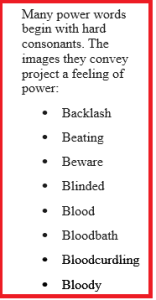
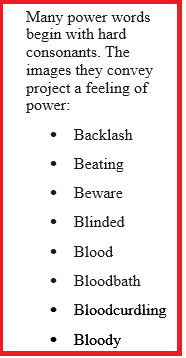
Many power words begin with hard consonants. The following is a short list of nouns and adjectives that start with the letter B. The images they convey when used to describe action project a feeling of power:

  • Backlash
  • Beating
  • Beware
  • Blinded (adjective)
  • Blood
  • Bloodbath
  • Bloodcurdling (adjective)
  • Bloody (adjective)
  • Blunder

Some of the nouns are also verbs, such as beating or blunder.

When things get tricky, and the characters are working their way through a problem, verbs like stumble and blunder offer a sense of chaos and don’t require a lot of modifiers to show the atmosphere.

When you incorporate any of the above “B” words into your prose, you are posting a road sign for the reader, a notice that ahead lies danger.

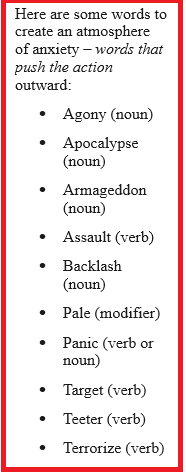
Quill_pen smallIf I want to create an atmosphere of anxiety, I would use words that push the action outward:

  • Agony (noun)
  • Apocalypse (noun)
  • Armageddon (noun)
  • Assault (verb)
  • Backlash (noun)
  • Pale (modifier)
  • Panic (verb or noun)
  • Target (verb)
  • Teeter (verb)
  • Terrorize (verb)

If I want to show the interior workings of a character without resorting to a dump of italicized whining, I could write their internal observations using words that draw us in:

  • Delirious (modifier)
  • Depraved (modifier)
  • Desire (verb)
  • Dirty (modifier)
  • Divine (modifier)
  • Ecstatic (modifier)

So why are verbs so crucial in shaping the tone and atmosphere of a narrative?

Think about this sentence: Selwyn walked away.

We have three words indicating someone has departed, but they don’t show his mood.

Selwyn is a person (noun). He performs an action (verb).

steampunk had holding pen smallThat action affects both Selwyn and his objective: leaving. Away is an adverb (modifier) denoting distance from a particular person, place, or thing. It modifies the verb, giving Selwyn a direction in which to go.

We can write it several different ways still using only three words, and each indicates that Selwyn has left the scene. Each time we substitute a synonym for the word walked, we change the atmosphere of that scene.

  • Selwyn sauntered away. (He departed in a carefree, leisurely manner.)
  • Selwyn strode away. (He walked decisively in a particular direction.)
  • Selwyn stomped away. (Selwyn left the scene in a bad mood.)
  • Selwyn ambled away. (He walked slowly.)
  • Selwyn slogged away. (He departed but had to work at it.)
  • Selwyn slipped away. (Selwyn departed in a stealthy manner.)

Many verbs cannot impact a character or object directly. These are called intransitive verbs. They are as crucial as transitive verbs because they show a mood or condition, a state of being, or a reflex (automatic response).

Consider the word “mope.” Mope is an intransitive verb that means discouraged and apathetic. It’s an action word that goes nowhere.

  • Selwyn moped. (He was dejected and apathetic.) (Boring.)

We can have our character in a bad mood but with variations:

  • Selwyn pouted. (He was whiney, and we don’t want to read anything more about him.)
  • Selwyn languished. (He did nothing and stagnated, and we still don’t care.)
  • Selwyn sulked. (He was angry and self-pitying, and we will close the book on him.)
  • Selwyn fretted. (He was in a neurotic mood, and we tell our friends the book sucks.)

Some intransitive verbs in the family of “mope” are more robust and carry greater force:

  • Brood (a dark, obsessive mood.)
  • (Obsessively thinking about it, suffering.)

We can perk Selwyn up when we add a strong intransitive verb to a powerful transitive verb. Then, we have action and mood:

  • Selwyn strode away, brooding. (He left the scene, and someone will suffer.)

So, verbs and nouns must have modifiers and connectors to show a scene in the most visual and evocative way possible.

oxford_synonym_antonymThe trick is to choose the descriptors and the verb forms that have the most impact. The selection of modifiers and connecting verbs can enhance contrasts or weaken a sentence.

Making revisions is a lot of work. But taking the time to examine the layers of plot, prose, and character arc is required to take your manuscript from first draft to finished novel.

I suggest keeping a thesaurus on hand. I also have a dictionary of synonyms and antonyms because I want my words to say what I envision. Having a list of word forms and their synonyms enables me to express my ideas with fewer modifiers.

2 Comments

Filed under writing

Modifiers, descriptors, and crutch words #writing

Note to self: write dynamic prose and avoid crutch words.

MyWritingLife2021BOne thing I notice when listening to an audiobook is crutch words. One of my favorite authors uses the descriptor “wry” in all its forms, just a shade too frequently. As a result, I have scrubbed it from my own manuscript, except for one instance.

Wry is a modifier. It means using or expressing dry, especially mocking, humor: “a wry smile.”

“Sardonic,” a word he also uses a bit too frequently, is a relative of the word “wry” and means grimly mocking or cynical.

Both are good words, but they are easily overused when we are trying to show a character’s mood in a bleak situation.

Grin and smile are also first draft crutch words we use to show a mood. I do a global search and then tear my hair out trying to show my protagonist’s mood without getting hokey.

The way we use modifiers and descriptors (and their frequency) plays a significant role in how our work is received by a reader.

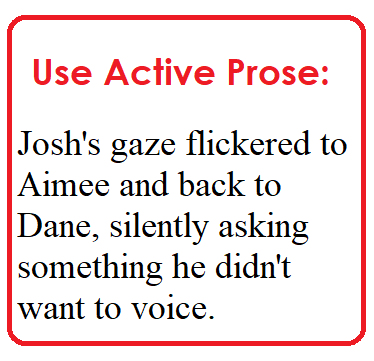
Use Active ProseThe words authors choose add depth and shape their prose in a recognizable way—their voice. They “paint” a scene showing what the point-of-view character sees or experiences.

And yes, in order to do that, they must use modifiers and descriptors, also known as adjectives and adverbs.

Modifiers are like any other medicine: a small dose can cure illnesses. A large dose will kill the patient. The best use of them is to find words that convey the most information with the most force.

What do we mean when we refer to modifiers?

A modifier is any word that modifies (alters, changes, transforms) the meaning and intent of another word. These words change, clarify, qualify, or limit a particular word in a sentence to add emphasis, explanation, or detail.

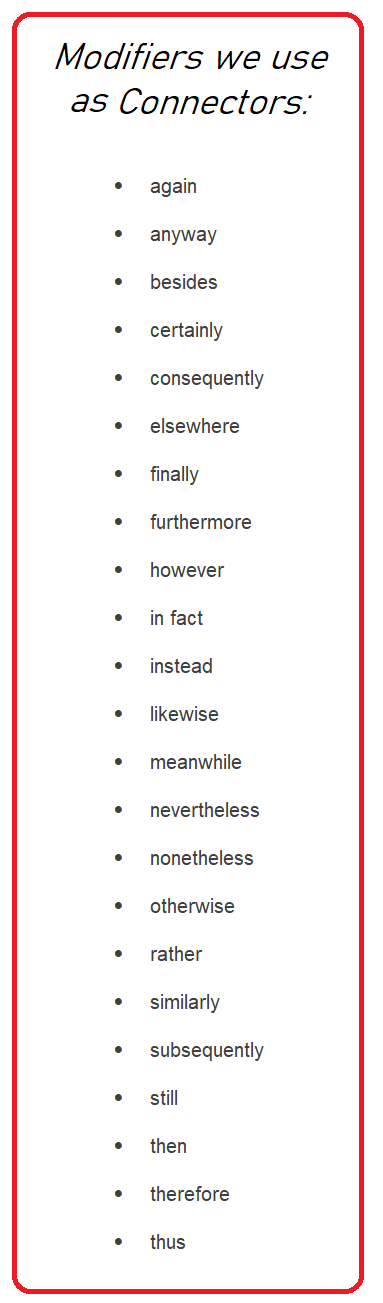
Some of these words are useful as conjunctions, words to connect thoughts: “otherwise,” “then,” and “besides.”

poetry-in-prose-word-cloud-4209005What are descriptors? Adverbs and adjectives, known as descriptors, are helper nouns or verbs—words that help describe other words.

What is a quantifierThey are nouns (or noun phrases) meant to convey a vague number or an abstract impression, such as very, a great deal ofa good deal ofa lot, many, much. The important word there is abstract. It is a thought or idea describing something without physical or concrete existence.

Modifiers, descriptors, and quantifiers are easily overused, so these words are often reviled by authors armed with a little dangerous knowledge.

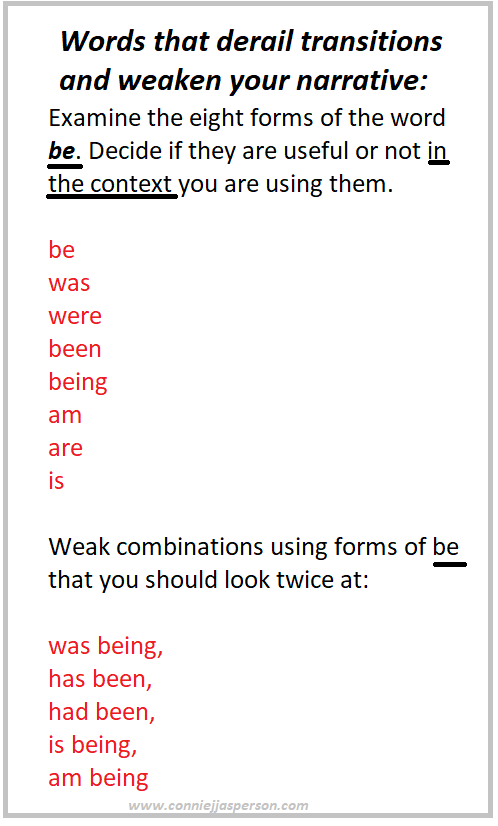
One of the cautions those of us new to the craft frequently hear are criticisms about the number of “ly” words we habitually use. The forms we use can weaken our narrative.

First, examine the context. Have you used the word “actually” in a conversation? You may want to keep it, as dialogue must sound natural, and many people use that word when speaking.

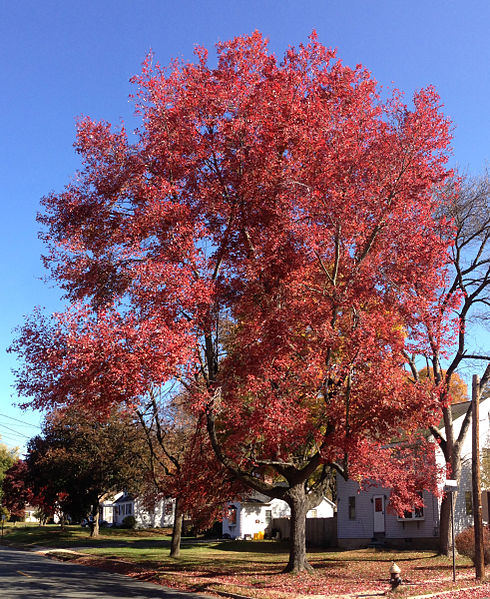
490px-2014-10-30_11_09_40_Red_Maple_during_autumn_on_Lower_Ferry_Road_in_Ewing,_New_JerseyHowever, if you have used “actually” to describe an object, take a second look to see if it is necessary.

  • The tree was actually covered in red leaves.

Would the sentence be stronger without it?

  • Red leaves covered the tree.

Some descriptors are easy to spot, especially those ending in “ly.” When I begin revising a first draft, I do a global search for the letters “ly.” A list will pop up in my lefthand margin. My manuscript will become a mass of yellow highlighted words.

This is where I look at each instance because “ly” words are code words the subconscious mind uses in the first draft. They are a kind of mental shorthand that tells us what we need to expand on to fully explore the scene we envisioned.

Or they tell me something needs to be cut.

Context is everything. Please take the time to look at each example of the offending words and change them individually. I’ve said this many times, but I like to nag: You have already spent months writing that novel. Why not take a few days to do the job well?

Sentence structure mattersThe placement of an adjective in relation to the noun it describes affects a reader’s perception. Modifiers often work best when showing us what the point-of-view characters see, hear, smell, touch, and taste.

Sunlight glared over the ice, a cold fire that cast no warmth but burned the eyes.

In the above sentence, the essential parts are structured this way: noun – verb (sunlight glared), adjective – noun (cold fire), verb – adjective – noun (cast no warmth), and finally, verb – article – noun (burned the eyes).

So, we try to lead with the action or noun, followed by a strong modifier (one without the “ly” ending). The sentence conveys what is intended. It has modifiers but isn’t weakened by them.

ok to write garbage quote c j cherryhThe scene I detailed above could be shown in many ways. I took a paragraph’s worth of world-building and pared it down to 19 words, three of which are action words.

So, now you know what occupies most of my attention during revisions.

As writers, we all want to be accepted and have others like our work, which means we must meet our reader’s expectations.

Writers must write from the heart, or there is no joy in writing.

That means using modifiers, descriptors, or quantifiers when they are needed. It’s a balancing act. We must be mindful of the form and the context of how a modifier fits into our phrasing.

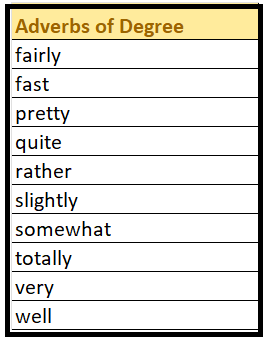
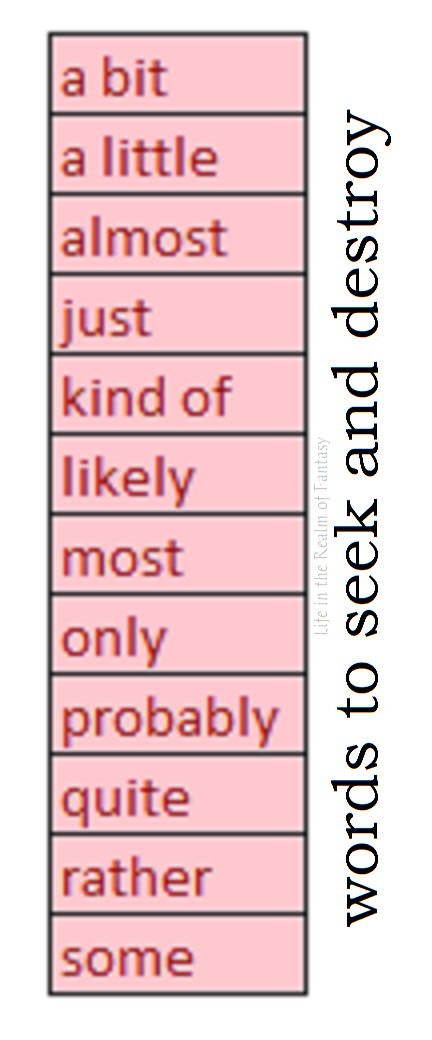
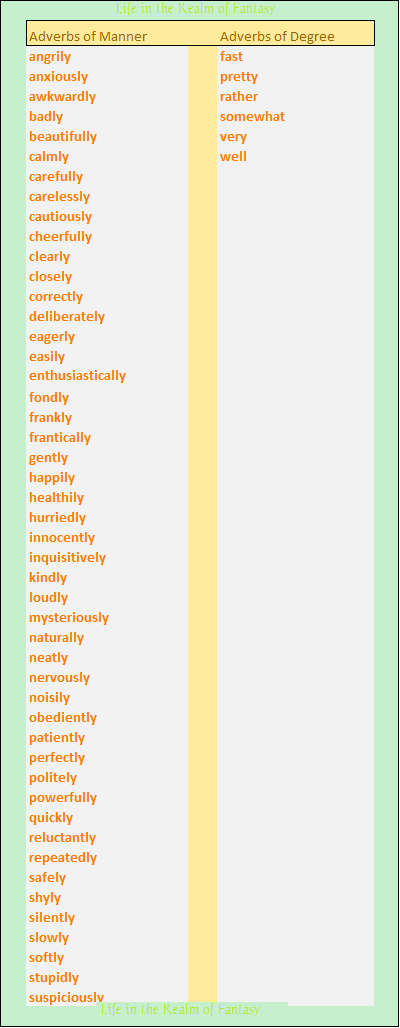
Below are two images. They are lists of code words I seek out and re-examine when I begin revising a first draft. Some words are quantifiers. They are adverbs of degree, words that describe how much of something, such as “I’m dreadfully unhappy.” Quantifiers (also known as adverbs of degree) have their place but can weaken a sentence. So, they are code words for you to look closely at when you get to the revision stage.  

Adverbs_of_degree

“Adverbs of manner” are qualifiers, words that “qualify the manner of what we are talking about.” They can intensify or decrease the degree of something, such as “I rarely go out.”

Adverbs_of_Manner

It seems like an overwhelming task, but it isn’t. I look at each instance of a modifier and see how it fits into that context. If a word or phrase weakens the narrative, I rewrite the sentence. I either change it to a more straightforward form or remove it. For example, bare is an adjective, as is barely. Both can be used to form a strong image, depending on the words we surround them with.

I have found that participating in a critique group has been crucial to my growth as an author. Most writing groups are made up of people who love reading and want your work to succeed. They won’t micromanage your manuscript because they are aware that too much input can remove the author’s unique voice from a piece.


Credits and Attributions:

IIMAGE: Wikimedia Commons contributors, “File:2014-10-30 11 09 40 Red Maple during autumn on Lower Ferry Road in Ewing, New Jersey.JPG,” Wikimedia Commons, https://commons.wikimedia.org/w/index.php?title=File:2014-10-30_11_09_40_Red_Maple_during_autumn_on_Lower_Ferry_Road_in_Ewing,_New_Jersey.JPG&oldid=751843290 (accessed April 28, 2024).

4 Comments

Filed under writing

Layers of depth: The use and abuse of modifiers #amwriting

Depth in a narrative is created by many layers. One layer we must look at involves prose, words we use, and how we phrase things. The way we use modifiers and descriptors plays a significant role in how our work is received by a reader.

depthPart1revisionsLIRF05252021In writing, we add depth and contour to our prose by how we choose and use our words. We “paint” a scene using words to show what the point-of-view character is seeing or experiencing. Yes, we do need to use some modifiers and descriptors.

Modifiers are like any other medicine: a small dose can cure illnesses. A large dose will kill the patient. The best use of them is to find words that convey the most information with the most force.

When we refer to modifiers, what do we mean?

Any word that modifies (alters, changes, transforms) the meaning and intent of another word is a modifier. Modifiers change, clarify, qualify, or limit a particular word in a sentence to add emphasis, explanation, or detail.

We also use them as conjunctions to connect thoughts: “otherwise,” “then,” and “besides.”

What are descriptors? Adverbs and adjectives, known as descriptors, are helper nouns or verbs—words that help describe other words. They are easily overused, so these words are often reviled by authors armed with a little dangerous knowledge.

What is a quantifier? They are nouns (or noun phrases) meant to convey a vague number or an abstract impression, such as: very, a great deal ofa good deal ofa lot, many, much. The important word there is abstract, which I think of as a thought or idea describing something without physical or concrete existence.

modifying-conjunctions-04262022One of the cautions those of us new to the craft frequently hear are criticisms about the number of modifiers (adjectives and adverbs) we habitually use. This can hurt, especially if we don’t understand what the members of our writing group are trying to tell us.

Perhaps the number of modifiers isn’t the problem, but the forms we use fluff up our narrative.

Perhaps you have been told you use too many “ly” words or descriptors. Examine the context. Have you used the word “actually” in a conversation? You may want to keep it, as dialogue must sound natural, and people use that word when speaking.

However, if you have used “actually” to describe an object, check to see if it is necessary. Is the sentence stronger without it?

  • The tree was actually covered in red leaves.
  • Red leaves covered the tree.

Many descriptors are easy to spot, often ending with “ly.” When I begin revising a first draft, I do a global search for the letters “ly.” A list will pop up in my lefthand margin. My manuscript will become a mass of yellow highlighted words.

  • “ly” words are code words – a kind of mental shorthand in a first draft. In the revision process, they tell us what we need to expand on to fully explore the scene as we originally envisioned.

It’s a daunting task, but I look at each instance and see how they fit into that context. If a word or phrase weakens the narrative, I change it to a simpler form or remove it and rewrite the sentence.
Think about it – bare is an adjective, as is barely.

Context is everything. Take the time to look at each example of the offending words and change them individually. You have already spent months writing that novel. Why not take a few days to do the job well?

Sentence structure matters. Where you place an adjective relative to the noun they are describing affects a reader’s perception. Adjectives work best when showing us what the point-of-view characters see, hear, smell, touch, and taste.

Sunlight glared over the ice, a cold fire in the sky that cast no warmth but burned the eyes.

Timid WordsIn the above sentence, the essential parts are structured this way: noun – verb (sunlight glared), adjective – noun (cold fire), verb – adjective – noun (cast no warmth), and finally, verb-article-noun (burned the eyes). Lead with the action or noun, follow with a strong modifier, and the sentence conveys what is intended but isn’t weakened by the modifiers.

The above scene could be shown in many ways, but a paragraph’s worth of world-building is pared down to 19 words, three of which are action words. This is an area I struggle with, and it occupies most of my attention during revisions.

Shakespeare understood the beauty and the power that contrasting modifiers can add to ordinary prose without making it artificial. Consider this line from his play, As You Like It, written in 1599:

It strikes a man more dead than a great reckoning in a little room. As You Like It, Wm. Shakespeare, 1599.
What brilliant imagery Shakespeare handed us—strong words with powerful meaning: dead, great, reckoning, little. His prose moves us as we read or hear it spoken because he uses words with visual impact.

Most writers know that participating in a critique group requires delicacy and dedication. They know it involves restraint and the ability to allow other authors to write their own work. Most groups don’t micromanage a manuscript because they know how too much input and direction can remove the author’s unique voice from a piece.

These are dedicated people who love reading and want your work to succeed.

As writers, we all want to be accepted and have others like our work, but we must write from the heart. That means using modifiers, descriptors, or quantifiers when they are needed. It’s a balancing act. We must be mindful of the form and the context of how a modifier fits into our phrasing.

The following image is a list of code-words I seek out and re-examine when I begin revising a first draft. Each word points me in the right direction. All I have to do is rephrase that sentence with stronger forms of the “ly” word.

List of common adverbs

12 Comments

Filed under writing

Context and adverbs #amwriting

New writers embarking on the journey of learning the craft are bombarded with rules:

~Show, don’t tell,

~Simplify, simplify,

~Don’t write long sentences

~Avoid abstraction

~Don’t use big words.

These are necessary rules, but can be taken to an extreme. The most important rules are

~Trust yourself, and

~Trust your reader.

~Write what you want to read.

Whether you are self-editing or editing for another writer, it’s important to understand balance. Editing is a job that requires delicacy and dedication. It’s far too easy for a ham-fisted editor to remove the joy, the life, the author’s voice from a piece.

As writers, we all want to be accepted and have others like our work, but we owe it to ourselves to write from the heart.

Chuck Wendig, in his post The Danger of Writing Advice from Industry Professionals, says,

And so the advice really should be, don’t use adverbs or adjectives when they sound awkward, or when they fail to tell us something that we need to know.

We know that certain words and phrases don’t add to the narrative and only serve to increase the wordiness. Used too freely, they separate the reader from the experience.

For me, especially in my first draft, these words are like tics–they fall out of my fingers and into my keyboard randomly, and out of my voluntary control. I don’t self-edit as I go because at that point I’m just trying to get the story down. The second and third drafts are where I shape my grammar and phrasing.

All of my three current manuscripts are genre fiction. This means I must write active prose, so I don’t want to use words with no power behind them. However, I will not blindly remove every ‘ly’ word, because that would be ridiculous.

Consider adverbs, words that are sometimes reviled and banned by writing groups armed with a little dangerous knowledge. Descriptors frequently end with the letters ‘ly.’ I do a global search for these letters and a list will pop up in my left margin. My manuscript will become a mass of words with yellow highlighted “ly’s.” It’s a daunting task, but I look at each instance and see how they fit into that context. If they weaken the narrative, I change or remove them.

When it comes to adverbs, many times simply removing them strengthens the prose. If they are necessary, I leave them. As Chuck Wendig said, words like “later,” or “everywhere,” or “never” or “alone” are also adverbs.

Personally, I don’t see myself reading a book written with no adverbs whatsoever.

I seek out adverbs, descriptors, qualifiers, and other “weed words,” look at how they are placed in the context of the sentence, and decide if they will stay or go. Many will go, but some must stay.

Sometimes I feel married to a certain passage, but if it doesn’t add to the story, it must go to the outtakes file, my tears notwithstanding.

Before I bother a professional editor with my work, I want to make the process as smooth as possible. I seek out the words I would flag as an editor, making what is called a “global search.”

Caution: if you are hasty or impatient a global search can be dangerous and can mess up an otherwise good manuscript. Be aware: This is a boring, time-consuming task.

You can’t take shortcuts. If you get hasty and choose to “Replace All” you run the risk of making a gigantic mess of your work.

The word ‘very’ comes in for a lot of abuse in writing groups and writers’ chat rooms. Suppose you decide to simply eliminate every instance of the word “very” because you have discovered you overuse it. You open the navigation pane and the advanced search dialog box. In the ‘Replace With’ box you don’t key anything, thinking this will eliminate the problem.

Before you click ‘replace all’ consider three common words that have the letters v-e-r-y in their makeup:

  • Every
  • Everyone
  • Everything

Deleting every instance of ‘very’ could mess things up on an incredibly large scale.

If you have decided something is a ‘weed word,’ examine the context. Have you used the word “actually” in a conversation? If so, you may want to keep it, as dialogue must sound natural, and people use that word in conversation. If you have used it in the narrative to describe an object, it’s probably not needed.

Context is everything. Take the time to look at each example of the offending words and change them individually. You have already spent a year or more writing that novel, so why wouldn’t you take a few days to do the job right.

It’s unfortunate, but there is no speedy way to do this. Every aspect of getting your book ready for the reading public must be done with the human eye, patience, and attention to detail.

As I have mentioned before, editing programs are out there, some free, and some for an annual fee. Your word processing program has spell check which can help or hinder you. Grammarly is an editing program I use for checking my own work, but the problem is, these programs are unable to see the context of the work they are analyzing:

  • “The tea was cool and sweet, quenching her thirst.
  • Grammarly suggested replacing quenching with quenched.I have no idea why.

Context is defined as the parts of a written or spoken statement that precede or follow a specific word or passage, usually influencing its meaning or effect. 

A person with a limited knowledge of grammar will not benefit from relying on Grammarly or any other editing program for advice. This is because these programs operate by finite rules and will often strongly suggest you insert an unneeded article or change a word to one that is clearly not the right one for that situation. New writers should invest in the Chicago Guide to Grammar, Usage, and Punctuation, and learn how grammar works.

Currently, at this stage in our technology, understanding context is solely a human function. Because context is so important, I am wary of relying on these editing programs for anything other than alerting you to possible comma and spelling malfunctions.

I don’t mind taking the time to visit each problem and resolve them one at a time. I see this as part of my job, just what an author does to make sure her work is finished to the best of her ability.


Credits and Attributions:

The Danger of Writing Advice from Industry Professionals, by Chuck Wendig, Terribleminds,  The Ramble, http://terribleminds.com/ramble/2017/12/12/the-danger-of-writing-advice-from-industry-professionals/  ©2017. Accessed 12 Dec 2017.

4 Comments

Filed under writing

#amwriting: creating lean but descriptive prose

wordsSome work is written so starkly it may as well be a phone-book. This tells me that author X has really taken to heart the much-bandied, amateurish idea of no adverbs and adjectives, ever.

That concept is flawed.

It is true that when we carve away unneeded modifiers, we move from telling the story to showing it, which is the goal of every author. But the key here is the word ‘unneeded.’

Some modification of your verbs and nouns is necessary, or you have a ‘Dick and Jane” novel.

See Jane. See Jane run.

Even if the concept for the plot has some merit, a stark, completely bare-bones approach won’t make it worth reading. The idea behind the novel might intrigue me, and I could be curious as to where the author is going with the idea.  But despite being curious, if I don’t enjoy reading the narrative I won’t finish it.

gibberish-american businesses onlineWe all know fluffed-up prose (A.K.A. ‘purple’ prose) is daunting and hides the action, but don’t let a knee-jerk reaction to a bad beta-read by an armchair critic make you go the route of completely eliminating modifiers and descriptors. A well-written narrative is sparing with descriptors and modifiers, this is true—but modifiers and descriptors do exist within every good narrative and are there for a reason.

Sometimes a thought requires a little description: An old man carries his groceries home in a snowstorm, fearing he will slip and fall. This idea could be told several ways, and here are two, off the top of my head, one less wordy than the other. Both use modifiers and descriptors:

Snow fell softly. Holding a bag of groceries, he gazed at the stairs leading from the walk to the front door, fearing a layer of ice lurked beneath the pristine whiteness.

He gazed at the icy stairs leading from the un-shoveled walk to the front door, his bag of groceries growing heavier.

There is a reason that descriptors and modifiers exist in the English language. They add flavor, spicing up a flat wall of words.  Just like salt in the soup, too much is too much and too little is not enough.  We are looking for that happy medium where the prose flows in such a way that the reader forgets they are reading and lives the story.

I read a lot of work that begins with a great concept, but has no substance. If only the author had been had been brave enough to tell a good story these novels could have been great. Instead I was given a laundry list of characters acting and reacting to events with no passion or emotion.

It could have meant something to me as a reader, but it didn’t.

Good prose requires choosing words that convey your ideas in the least amount of space. Modifiers and descriptors do that for us, but need to be chosen carefully, and used only when nothing else will do.

i read because memeIf you are writing a novel you want the reader to live your story and react to the ideas and emotions that you are conveying instead of stumbling over limpid pools of velvet blue eyes or falling flatly into skeletal accounts of boredom. It’s our task to find the middle ground that exists between purple prose and lack of soul.

We want to get the reader immersed in the story, and make them forget the real world for a short time. As a reader, I love it when that happens.

7 Comments

Filed under Publishing, Uncategorized, writing