
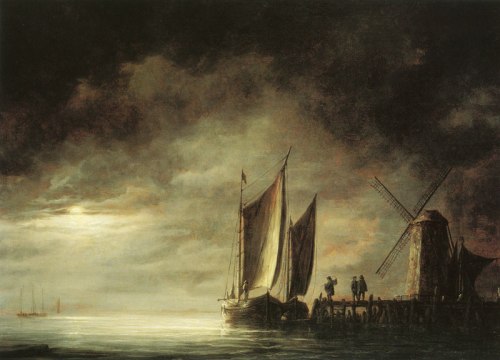
 Artist: Aelbert Cuyp (1620–1691)
Title: Dordrecht Harbor by Moonlight
Genre: landscape art
Date: 1643
Medium: oil on panel
Dimensions: height: 76.5 cm (30.1 in); width: 106.5 cm (41.9 in)
Collection: Wallraf–Richartz Museum
What I like about this scene:
Aelbert Cuyp’s paintbrush tells a story. But what kind of story is he showing us?
A ship is docked beside a mill at Dordrecht Harbor. Night has fallen, and a full moon, veiled by clouds, lights the scene. On the wharf, three figures stand, talking, perhaps making a deal. What could be so important that these men must discuss it in the dark?
The moonlight casts a pale glow over the scene, casting shadows and illuminating the mist rising in the distance. It adds to the mystery of the scene, conveying a feeling of clandestine conversations.
It’s 1643. The Eighty Years War, a revolution and quest for independence is still ongoing. It’s a battle for religious freedom as well as for the rights of the Dutch people to govern themselves.
Yes, indeed … some conversations by moonlight are best kept secret.
About Dordrecht in the 17th Century:
Dordrecht (Dutch: ) historically known in English as Dordt (still colloquially used in Dutch, pronounced) or Dort, is a city and municipality in the Western Netherlands, located in the province of South Holland.
During the Eighty Years’ War merchants from Dordrecht were involved in taking control and founding sugar cane plantations in the West Indies. At the end of the 17th century this led to a stable sugar refining industry in Dordrecht. This flourished in the 18th century, when Dordrecht had 16 sugar refineries, as opposed 120 in Amsterdam and 40 in Rotterdam. Dordrecht still has a few buildings purposely designed as a sugar refinery, e.g. the imposing Sugar Refinery Stokholm.
Overall, the economic importance of Dordrecht began to wane in the 18th century, and Rotterdam became the main city in the region. [1]
The Eighty Years’ War or Dutch Revolt (Dutch: Nederlandse Opstand) (c. 1566/1568–1648) was an armed conflict in the Habsburg Netherlands between disparate groups of rebels and the Spanish government. The causes of the war included the Reformation, centralization, taxation, and the rights and privileges of the nobility and cities.
An end was reached in 1648 with the Peace of Münster (a treaty part of the Peace of Westphalia), when Spain retained Southern Netherlands and recognized the Dutch Republic as an independent country.[2]
About the Artist:
Aelbert Jacobszoon Cuyp or Cuijp (20 October 1620 – 15 November 1691) was one of the leading Dutch Golden Age painters, producing mainly landscapes. The most famous of a family of painters, the pupil of his father, Jacob Gerritszoon Cuyp (1594–1651/52), he is especially known for his large views of Dutch riverside scenes in a golden early morning or late afternoon light. He was born and died in Dordrecht.
Little is known about Aelbert Cuyp’s life. Even Arnold Houbraken, a noted historian of Dutch Golden Age paintings and the sole authority on Cuyp for the hundred years following his death, paints a very thin biographical picture.
His period of activity as a painter is traditionally limited to the two decades between 1639 and 1660, fitting within the generally accepted limits of the Dutch Golden Age’s most significant period, 1640–1665. He is known to have been married to Cornelia Bosman in 1658, a date coinciding so directly with the end of his productivity as a painter that it has been accepted that his marriage played a role in the end of his artistic career.
The year after his marriage, Cuyp became the deacon of the reformed church. Houbraken recalled that Cuyp was a devout Calvinist and the fact that when he died, there were no paintings of other artists found in his home. [3]
Credits and Attributions:
IMAGE: Dordrecht Harbor by Moonlight by Aelbert Cuyp, 1643. Wikimedia Commons contributors, “File:Aelbert Cuyp – Dordrecht Harbor by Moonlight 4168.jpg,” Wikimedia Commons, https://commons.wikimedia.org/w/index.php?title=File:Aelbert_Cuyp_-_Dordrecht_Harbor_by_Moonlight_4168.jpg&oldid=782562344 (accessed September 28, 2023).
[1] Wikipedia contributors, “Dordrecht,” Wikipedia, The Free Encyclopedia, https://en.wikipedia.org/w/index.php?title=Dordrecht&oldid=1169436434 (accessed September 28, 2023).
[2] Wikipedia contributors, “Eighty Years’ War,” Wikipedia, The Free Encyclopedia, https://en.wikipedia.org/w/index.php?title=Eighty_Years%27_War&oldid=1177125376 (accessed September 28, 2023).
[3] Wikipedia contributors, “Aelbert Cuyp,” Wikipedia, The Free Encyclopedia, https://en.wikipedia.org/w/index.php?title=Aelbert_Cuyp&oldid=1177164314 (accessed September 28, 2023).


 Life in the Realm of Fantasy