Tag Archives: dragons

What I’ve learned from Piers Anthony

200px-PiersAnthony_ASpellForChameleonThe book, A Spell for Chameleon, first published in 1977 was my introduction to Piers Anthony. I was immediately bewitched by his fantastical vision of a truly magical world, and I loved the fact that he placed it in Florida.  His world of Xanth was a world where magic is as intrinsic to life as is oxygen, and that notion has intrigued me ever since. The concept of making magic a fundamental requirement for life is one that makes complete sense to me.  Not only that, he did it with laugh-out-loud humor using puns and hokey jokes that were transformed into hilarious prose under his pen.

At the beginning of the novel Bink is facing exile from the magical land of Xanth and separation from his fiancée Sabrina for his lack of a magic talent. All human residents of Xanth possess some unique form of magic that ranges from incredibly powerful (such as the current King Aeolus’s ability to summon and control storms) to relatively useless (such as the ability to make a spot appear on a wall). In the hopes of discovering his talent Bink sets out to see the Good Magician Humfrey, a magician whose talent has to do with the gathering of information. Of course, things don’t go the way Bink hopes–it wouldn’t be a good story if they did!

Bink meets three women: Wynne who is pretty but stupid, Dee an average girl and also the sorceress Iris, whose power is the200px-Dragon_on_a_Pedestal creation of illusions. Wynne and Dee are actually different aspects of the same woman, Chameleon, although Bink does not realize this at the time. Chameleon’s intelligence and beauty vary inversely according to the time of the month and she has been unable to find a man who is willing to be with her through all 3 phases.  He also meets the Evil Magician Trent, and discovers that he actually likes him.

This book is one of the better books I had ever read, and I began a lifelong love affair with the works of Piers Anthony. Besides the witty prose and creative plots in this series, the COVERS of his books were AWESOME.  I have been well-known as a person who will buy a book for the cover, and that is exactly how I stumbled onto this series. The Xanth series is one long running pun after another.

I bought A Spell for Chameleon for the same reason I purchase any book–I saw it on the rack in my local Albertson’s grocery store and fell in love with the cover.

I learned several things from Piers Anthony and his Xanth series, the first of which is that Great Covers Sell Books.  I also saw that a true artist can take the most common, overused puns and turn them into the framework for a really fun adventure. I admit I did lose interest at about book ten, but even so, Piers Anthony still manages to have fun with it, and he still sells books.  The Xanth series is incredibly popular, and deservedly so.

SplitInfinityThe series Anthony wrote that really captured my imagination, and which in my mind still reigns as his best works is the Apprentice Adept series, beginning with Split Infinity, Blue Adept and Juxtaposition.

This man has had one of the most prolific and highly regarded writing careers ever, with more than 150 published works to his credit. His sharp wit and amazing gift for world building are legendary, and he has won numerous awards for his work.

But what reading his incredible body of work and following his career has taught me is that even when things around you have gone to hell (as things are wont to do) the writer has the craft of writing fantasy to provide his mind with an escape from the TRUE weirdness of real life.  Anyone who has read his official Wikipedia biography knows that Piers Anthony has had a long life with many personal challenges, through all of which I am sure writing was and is his refuge.  This gives me hope and the impetus to just keep on doing what I can, trying to make silk purses from the sows’ ears of my work when I feel a bit discouraged.

Writing is a journey and you never know what lies around the corner.

If a writer is lucky, his works will eventually be beautifully covered and on sale in the racks at the local Albertson’s store, just waiting for a girl like me to pick it up for the art.

3 Comments

Filed under Adventure, Books, Dragons, Fantasy, Humor, Literature, writing

Mucking out after the dragon

MH900053412I thought I had The Last Good Knight all cleaned up. I was SURE I had it as straight as could be! Many eyes have looked at it, and still there are places that need attention!  Fortunately, Carlie Cullen is applying her red pen to the hitches and halts in the flow, without changing the story or the structure since it has been published for so long.  It’s a good story, probably my favorite but it has had a rough life.

This is the one tale that never had a real line-edit, and I was so new to this business that I thought the brief once-over my former publisher gave it was a true edit.  They were new at the business too, and were learning a lot as they went along. It was a good edit, in that it cleaned up certain obvious things, but it was very quick and not a true, in-depth edit. I was not involved in the actual edit, as the changes that were made were not offered to me for my approval. Thus, getting that book re-edited so that it reads more easily is somewhat like mucking out after a dragon.  Just about the the time I think it’s all done, there is another steaming pile of…goodness…look at the time, I should be cooking dinner.

Having worked with two editors since leaving the former publisher, I now see what was NOT done for The Last Good Knight the first time, and thank god, one of my editors, Carlie Cullen is giving it her attention. The biggest challenge is dealing with these things and moving on, instead of banging my head on my desk in frustration when she points out something I should have seen.

But that is why these sorts of edits are SO critical. We, as authors, only see what we THINK we wrote. This is something I can’t stress strongly enough–get an independent eye on your work.  If you have a friend who has worked as a paralegal for her entire career, proof-reading lawyers briefs as Irene Luvaul did, even better!  If you can’t find an editor you can afford, you can do this: Print your work out one chapter at a time, and sit down with the yellow high-lighter. take an envelope and go down the page one line at a time. You will catch a great deal that way!

I don’t feel nearly so badly about TLGK once I take a close look at my earlier works though – those tales who began their lives on performa-630-192the old Mac  in the mid nineties. Once they were transferred to disc and then transferred again to PC they were put away and forgotten.  Some have great storylines, and really fun characters, but I would have to completely rewrite them in order to make a silk purse out of the sow’s  ear they are right now.  There must be an entire library of badly written prose on those old mac floppies.

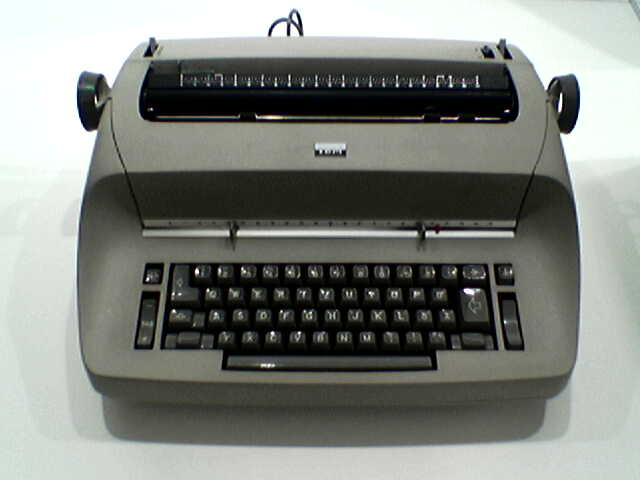
There are many flaws in my earlier works, especially the ones going back to my days of pecking them out on the old IBM Selectric.They are rife with misspellings, poor grammar, clichés, head-hopping, and hokey dialogue.  But underneath all the bad fluff I see the bones of the story I was so proud of having written in the first place, and I realize that there was spark there.  This is why I say don’t be discouraged by your first initial draft of any work.  All it needs is a lot more attention from you and the eye of an editor.

IBM_SelectricI was once a singer in a heavy metal band, and the opening lines of one of the songs I wrote went like this:

“It’s a cold and lonely morning, the sky dawns bland and white.

The emptiness inside my heart is as chilling as the night.”

It was cheerful little tune (NOT!) but with my ex-husband’s awesome guitar solos it was quite popular among our friends. We were very hip and very serious about the craft when we played. Of course I was 26 at the time, and quite sure I was the next female Ronnie James Dio. The band as a whole took ourselves far too seriously, and it soon got to the point where it wasn’t fun anymore.    It was a long time before I realized exactly why we fell apart the way we did, when we were having such a good time playing  small gigs as a local band. We became too caught up with the art of the music, instead of getting on with it and we forgot why we were doing it in the first place.

I admit that I don’t need serious anymore.  I don’t need to take my writing so seriously that it’s not fun.

With that said, I do need to turn out the best finished product I am able to do, and that means allowing someone I trust to look at it and say, “This just doesn’t read right. Maybe if you change this a little….”   I am not married to my prose, although I am sure it is the finest prose  in the world. Oh, look…more dragon poo.

3 Comments

Filed under Adventure, Books, Dragons, Fantasy, Humor, Literature, mythology, writer, writing

Building the Beast

Anne_Anderson05 - Beauty sat down to dinner with the Beast illustration PDArt - Wikimedia CommonsI have been suffering with a cold for the last week and so my writing output has dwindled to nearly nothing.  I have gotten some work done, but not the amount I had hoped for.

I worked on a scene requested by my editor, Irene Luvaul, for Huw the Bard, one to liven up a dull stretch just a bit.  I didn’t want to put Huw through the wringer again when he has already suffered so much, and he was so close to making his way to Billy’s Revenge, but she was right – a bit of tension would add to the interest.

So I alternately thought and slept on it for more than a week, trying to force my plague-ridden body peck out a few lines with merit to them.

I couldn’t think of anything.

But then a passing paragraph toward the end of Billy’s Revenge I – The Last Good Night (under revision again, cleaning up the manuscript, thank you Carlie Cullen for volunteering) gave me the idea for a strange creature with which I could freak out poor naive Huw. (Having the right editor in the first place solves SO many problems further down the road.)

Firesprites.

But this meant – you guessed it – Building the Beast.  The only trouble was, I didn’t really know what one looked like – after all they were only mentioned in passing as being a nuisance.

Now, I only had three passing references in BR1 that talked about these creatures, but those few sentences told me quite a bit about them, actually.

So when I thought about it I realized I did have enough to build one. I just needed to assemble the parts.

1. They are either  elemental creatures, or poisonous creatures, one or the other. I say this because they are called ‘FIREsprites’. Yet, logic tells me they can’t be made of fire, or there would be no forest. Therefore, they must be poisonous, and the poison must be an acid that burns like fire.

2. They must be small. Otherwise King Henri’s horse would not have stepped into a nest of them and thrown his rider.

3.  Something about them makes people think of fire, and it must be something bad, because Lackland and the people of Waldeyn feel compelled to kill the entire nest when they find them, sort of like fire ants only bigger and badder.  But they must be something that one lone woman (Lady Mags) could deal with, with only the aid of an amulet.

I always think it’s better when the folks who actually have to deal with them tell me what they look like, so here is what Matt St. Couer told Huw and I about firesprites.

Matt said, “Now we need to herd them to the center of the nest and get them bunched up in as tight a group as we can.  Don’t touch them, whatever you do. The slime on their skin will burn you like the hottest fire, and there’s no stopping it from eating your flesh away. That’s why they’re called firesprites. The wounds keep putrefying, and amputation is the only remedy. Water helps but only if you get the water on the affected area right away, before the poison has done too much damage. I’m talking minutes here, and you have to really sluice the wounds to get the poison off. Sadly, they never seem to nest near water.”

Ulleen said, “They like to nest along roads because there’s not so much foliage and they get more sun there.  The sun heats their nests and hatches their eggs.”

“They don’t look much like a sprite, do they,” Huw said, thinking they were interesting but not really fairy-like.  “At least, not what I always thought a sprite should look like. They look more like naked chipmunks with hairless tails. But their skin is pretty, all shiny and coppery like that.”

“I think they were named that because when they’re looking for grubs and such all you see is a little flash of copper as they disappear into the brush,” Ulleen replied. “I’ve always wondered about that too.”

Now as far as actually building the beast goes,  I have quite a lot of dragon parts lying around my office, and I can assemble a dragon in no time at all. I will even stick wings on it, if you like your dragons airborne. But dragon parts are far too large for this project, so I’ll have to look elsewhere.

Somewhere in here I have a box with everything one might need to assemble a demon.

I think this is the box.

Yes!

I’m partial to waterdemons. They’re quite fun to put into a fight-scene and some of their components will be perfect for the job. Clear, gelatinous skin is exactly what these little guys need, and I have a lot of it in this box. If I take some of that and turn it all coppery, it will actually be kind of pretty, in a hairless chipmunk sort of way. With the addition of a really strong acid to the gelatinous goo I think we’ll have a cute little firesprite!

I love arts and crafts time!

4 Comments

Filed under Adventure, Books, Dragons, Humor, knights, mythology, writing

On Editing, part II; guest post by Carlie Cullen

Today we continue with the second half of Carlie M.A. Cullen’s absolute gem of a post on Editing.

Here is where the principle she expressed in Monday’s Post are put into action.

Her Comments will be in Red and my response will be in Blue!

Comments:

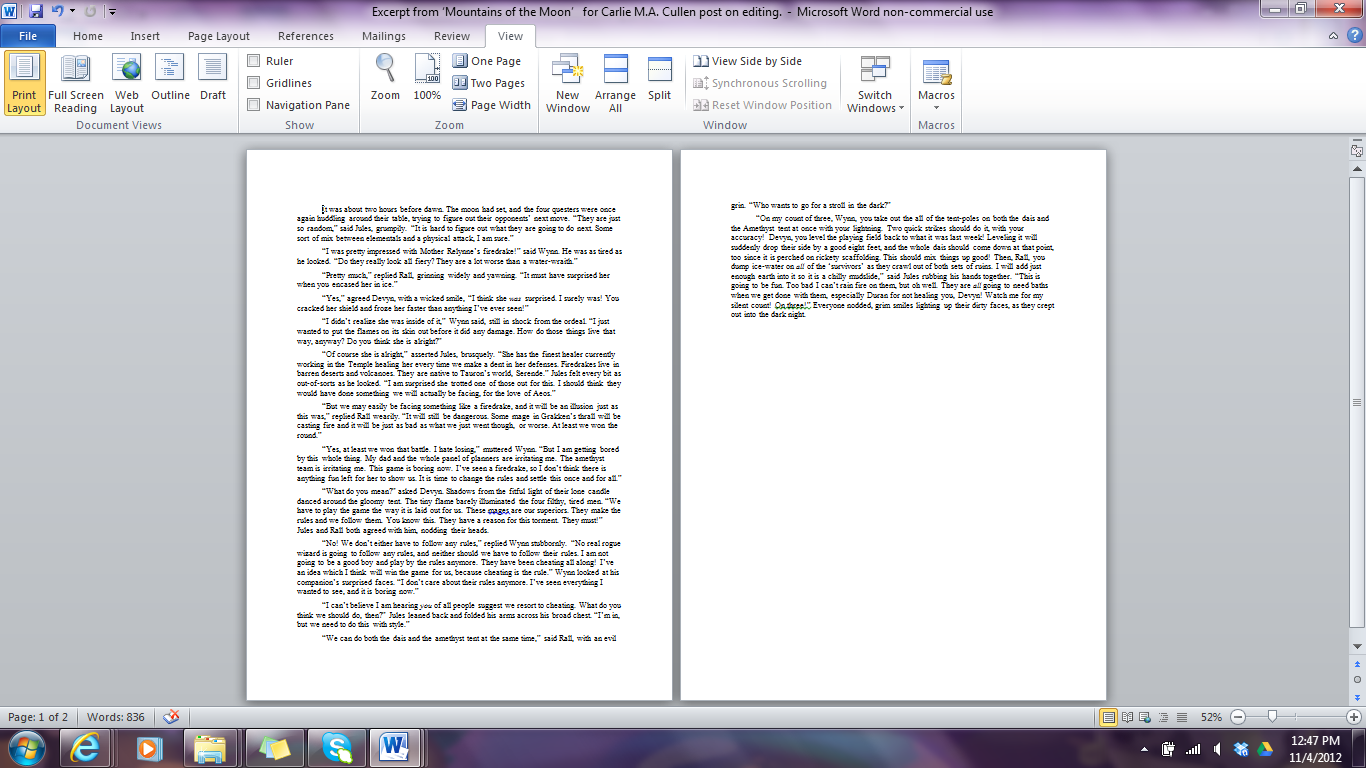
When I edit a manuscript, I always request it in Word. I use the Review tab and insert comments which appear on the right of the document. If there are too many comments to fit on the page, the comment box will show ‘. . .’ in a small box; clicking on this will bring the comment up in full on the left of the document. By selecting the word or phrase and highlighting with the cursor, then pressing ‘New Comment’ it allows me to show the author the exact part they need to look at (see the screen print of the document I have edited for this post).

I always try to gently guide my authors. They have spent countless hours and poured a great deal of themselves into their work and I’m not in the business of trashing their self-esteem. In addition, I fully recognize they have the final say and I can only make recommendations.

The content of the comments made depend on what the problem is with the manuscript. Some comments are only one or two words long, i.e. ‘delete’ or ‘insert comma’, while others are much longer. Let’s take a moment to look at the comments on the screen print.


Comment C1 – just says remove comma”. This comma has been placed in a position where it is not needed and therefore incorrect. An author wouldn’t expect a ten line explanation of why the comma needs removing so it’s quite acceptable to have remove comma”  (done)

Comment C2 – this is a longer comment and showcases my point about realistic dialogue. The comment says Do you mean for the dialogue to be so precise here? You’ve used contractions in other places so I would suggest you change this to ‘They’re’ (done)

Comments C3, C4 and C5 – these also refer to comment C2 and the author, having read comment C2, will not expect an editor to type out the whole message for each case therefore, for these three comments I ask the author to Consider it’s / they’re / I’m(done)

Comment C6 – this comment has been showcased above when I spoke about inconsistencies. My message to the author here is If Wynn has seen a firedrake, surely he knows whether they look fiery or not. I suggest you reconsider this question.” This gives the author an opportunity to re-think and re-word. (Wynn has not seen a fire-drake.  The point of the exercise was to get him acquainted with beasts he had not encountered before.  However, Carlie has only seen this excerpt and doesn’t know this.)

Comment C7 – this relates directly to C6 as it answers the question which I believe to be inconsistent. Depending on how you handle comment C6, this may have to change or be deleted.” (left it in)

Comment C8 – in this case, I have a small issue with sentence structure. My comment, This doesn’t flow very smoothly. I suggest you consider changing the order to ‘put out the flames on its skin’”, tells the author what the problem is and gives a suggestion of how to fix it. (done)

Comment C9 – Consider changing to ‘she’s’”. This again is a dialogue issue and use of contractions. C10 – See comment C9”. There is no need for me to go into long explanations when I can refer the author to a previous point made. (done)

Comment C11 – sentence structure and the flow of it is the problem here. My comment, Having ‘healer’ and ‘healing’ in the same sentence doesn’t sound right. Consider changing ‘healing’ to something like curing/restoring, shows the author what I consider is wrong and suggests alternative words they can use. (done)

Comment C12 – deals with repetition of a phrase. You’ve used this type of phrasing above when talking about how tired Wynn was, so the repetition doesn’t work very well. If you want to emphasize how Jules looks and feels, I suggest re-wording or changing this around. Consider something like ‘Jules felt really out-of-sorts and looked quite rough’”. Using phrase repetitions, especially on the same page, annoys some readers and it doesn’t show the authors grasp of vocabulary as well as it might. By rephrasing, it removes the repetition and makes the story flow better and my suggestion gives the author another way of looking at it. (done)

Comment C13 – is to do with contractions in dialogue again. However, I can see there might be a reason why the author would not want to do so. Therefore, my comment, Consider contracting to ‘I’m’ unless you want to emphasize the ‘am’ in which case it should be in italics”, provides two possible solutions. (changed to italics)

Comment C14 – sentence structure and flow is the problem here so the comment, This is clunky and doesn’t flow at all well. Consider changing to something like ‘Shouldn’t they have challenged us with something we’ll actually be facing…?’ or similar”, explains the issue and suggests an alternative. (done)

Comment C15 – repetition. You’ve used ‘facing’ on the previous line. I suggest replacing with something like confronting / tackling / meeting”. This identifies the problem and offers a solution. (done)

Comments C16 and C17 – using contractions in dialogue. C 16, As this is dialogue, consider contracting to ‘it’ll’”. C17, “See comment C16”. (done)

Comment C18 – this comment covers two problems; repetitions and contractions in dialogue. It’s difficult for an editor (unless they are very familiar with an author’s work) to suggest changes to dialogue other than use of contractions as each author has their own ‘voice’. To get around this, I point out the problem and leave it for the author to fix, like so, You’ve used ‘it will’ 3 times in this paragraph. Consider rewording at least one of them (see also comment C16/17)”. (done)

Comments C19, C22, C23, C25, C30, C32, C34 and C35 – these again deal with use of contractions in dialogue and the comments made are almost identical to those used above. (done)

Comments C20 and C21 – both of these deal with repetitions &/or sentence structure/flow. As you can see, both comments offer suggestions for alternatives. C20, Repetition – you’ve just used ‘irritating in the previous sentence. Consider changing to something like annoying / infuriating / aggravating”. C21, “You’ve used ‘bored’ on the 1st line so this is like a repetition & doesn’t sound right. Consider replacing with tedious / monotonous / tiresome / repetitive, or similar”.  (done)

Comment C24 – because of the dialogue used, I feel there is a need for the author to show emotion in the speaker’s voice. The comment reads What inflection is in his voice? Annoyance? Exasperation?”.  (done)

Comment C26 – this is another emotive section where the character needs to come alive for the reader. I prompt the author thus, Consider what expression is on Devyn’s face and the inflection in his voice. You need to show a little something here”. (done)

Comments C27 and C36 – extraneous words have been used so a simple delete suffices. (done)

Comment C28 – You have 6 repetitions of ‘rules’ in this one paragraph. Delete this Pretty self-explanatory, I think. Comments C29, C31 and C33 deal with the other instances of the repetition within the paragraph. C29 states Delete”, C31 reads Change to ‘their directions / conventions / instructions / decrees’ or similar”, and C33, “Consider either removing this bit or changing to something like ‘… about what they want…’”.  (done)

Comment C37 – Repetition from previous paragraph. I would switch things around and remove ‘both’”, identifies the problem and offers a solution. (done)

Comment C38 – sentence structure and flow. Using ‘level’ and ‘leveling’ in the same line spoils the flow. Consider changing to flattening / razing / demolishing”. (done)

Comments C39 and C40 – incorrect punctuation. C39 states, “Remove comma and C40 reads, Insert comma”.  (done)

Comments C41, C42 and C43 – using contractions in dialogue. Comments are as previously shown.(done)

Comment C44 – showing. The reader needs to connect not only to the character in this part, but also the scene. The comment recommends, Is there a smug smile on his face? A hint of devilment in his eyes? What inflection is in his voice? Is there an aura of amusement around him? Your readers need to ‘see’ the scene”.  (I will work on it.  I don’t really do ‘devilment’, lol)

Comment C45 – punctuation can be over-used just like words can and this is a perfect example. The comment, “Too many exclamation marks – 3 in 3 sentences! Replace 1st exclamation with comma, change ‘O’ to lowercase and replace last exclamation with period”, shows how to rectify this. (What!!! er… Done)

Comment C46 – inappropriate descriptive word. This particular example was covered in the first section of this post. My comment is, Would the smiles be grim? Also, grim smiles wouldn’t light up their faces. This is payback as far as they are concerned so I would have thought there would be excitement / devilment or similar in their smiles. I suggest you look at this again and change this word to something more appropriate to the occasion”. (I will work on it)

The above comments show how I try to guide my author by posing questions and offering solutions to the identified problems.

Editing is a very time-consuming yet rewarding job; taking a raw manuscript and honing it until it shines is as much as labour of love for the editor as it is for the author. They have to work closely together for a prolonged period of time to achieve a common goal. The end result, the published book, gives an editor as much joy and satisfaction as the author.

I hope you have found the foregoing informative and interesting. As Connie’s editor, I have to say she is a consummate professional throughout the editing process and wonderful to work with. It makes a huge difference to an editor when their client approaches editing with an open mind and a positive attitude; it results in a wonderful piece of literature both parties can be proud to put their name to.

 >>><<<

 Carlie, thank you for your long hours of work doing the edit of this segment.  I know you took time away from your own work to do this, and it means more to me than you know!

And for those of you who are wondering why a proper editing is so very expensive, there were only 836 words in this snippet, and it took her every bit as long to edit it as it did for me to write it, perhaps longer.  A good editor is very much worth the price – but I warn you absolutely must be able to work closely with your editor and you must be willing to consider and act on the changes they suggest. Your manuscript is the child of your creativity, and as such you must be very careful who you allow to care for it. If you have a contract with a publisher, be sure you have final say on all changes before publication.  It doesn’t matter how much you pay, if your editor is not willing to allow you to make the changes on your own ms. It is only through making these changes and thinking outside of your normal mindset that you will really grow as an author.

6 Comments

Filed under Adventure, Books, Humor, Literature, Uncategorized, writer, writing

On Editing part 1, guest post by Carlie M.A. Cullen

I’ve asked Carlie Cullen, author of Heart Search, and one of my editors on the Tower of Bones series to write a guest post detailing what an editor looks for when they receive a manuscript for the first editing. I also asked her to take a hitherto unedited bit of a current work in progress and to edit it for this post in the way she will when it actually goes to her sometime next year. The following is her post and the commentary.   To the left here, I’ve inserted  a screen shot of the unedited ms. At the bottom of this post is the screenshot of what the ms looks like now she’s sent it back to me.

What I hope you will all gain from this is (a) the importance of an impartial eye on your work, and (b) the understanding that criticism is a necessary part of growth.

I take each of her comments, and I analyze it with as fair an eye as I can.  Then I make the changes, but I do them my own way. I don’t do heavy descriptors, and Carlie’s own work is very descriptive. This is why we work well together. She brings out the places where I’ve skimped on the descriptors too much, and forces me to be more forthcoming with showing the emotions of the scene.

Today I bring you part one of Carlie M.A. Cullen on editing!

>>><<< 

Editing a raw manuscript is like dealing with an overgrown garden full of weeds; you need to cut back the long stuff before you can see the weeds choking the plants. This analogy is why editors generally do more than one round of editing, as they need to get some semblance of order to the manuscript before they can look at structure and the development of a story.

An editor has to look for a large number of things as they go through each line. As well as spelling, grammar (including correct use of tenses) and punctuation, which is the first thing I look at, there are the following:

  • ·         Sentence structure. If a sentence doesn’t flow there’s something wrong with it and an editor needs to identify what it is and give suggestions as to how to put it right.
  • ·         Consecutive sentences beginning with the same word. A couple of sentences beginning with ‘I’ for example, you can get away with, but more than that and it becomes repetitive.
  • ·         Repetition of words. This is a classic mistake every author makes and there are certain words which stick out like a sore thumb. The most common one I come across is ‘that’. In addition, I look for repetitive phrases. In the example, there is one paragraph which has ‘it will’ repeated three times.
  • ·         Dialogue. The dialogue has to be realistic otherwise the characters don’t come to life. This is more than just the actual words they say it’s also how they say it. Everybody uses contractions when they speak in everyday life (don’t / can’t / it’ll / I’m / I’ve / you’re / it’s – you get the drift) so these need to be reflected in your work. Also too many tags (he said / she said) can interrupt the flow.
  • ·         Inconsistencies. Again if we look at the example (comment C6), you will see some dialogue where Wynn is talking about seeing a firedrake and he then asks if they ‘look all fiery’. He’s already seen one so he shouldn’t be asking a question he already knows the answer to. This is just one example of how an inconsistency can occur.
  • ·         Timelines. In my first book I had an issue with a woman’s pregnancy and got the number of weeks muddled up, which thankfully, my editor picked up. An editor has to ensure the timelines are true to the story so it flows.
  • ·         Incorrect descriptive words. You will see towards the end of the example piece where the author used ‘grim smiles’. This doesn’t accurately reflect what’s happening in the story so the use of the word ‘grim’ is incorrect.
  • ·         Distinguishing ‘thoughts’ from text. Thoughts should be shown in italics to separate them from the general text and should be written in present tense, regardless of what voice is being used.

All the above is what I would normally do on a first round of editing – the cutting back of the long stuff to get to the plant-choking weeds. Then on the second round, I double check all the items above once more to ensure nothing has been missed, plus I begin the structural and developmental part of the edit. These are the sorts of things I look at:

  • ·         Imagery. A powerful analogy can help a reader picture a scene more clearly. This is where a writer can be particularly creative as using lots of clichés makes the writing boring and predictable. Also clever use of descriptive phrases can make something come alive.
  • ·         Showing not telling. This is mainly for character connection. Readers want to see expressions, gestures and mannerisms which give the character a three-dimensional quality. They want to be able to see and feel what the characters are feeling and seeing. They don’t want to be told someone is crying, they want to see the tears rolling down the cheeks and the anguish in someone’s eyes.
  • ·         Cutting extraneous text. When writing, it’s very easy to get carried away and add in all manner of superfluous detail. An editor needs to be able to isolate this extraneous text and suggest removal whilst ensuring the story isn’t compromised in any way.
  • ·         Actions reflecting character’s state of mind. Sometimes, writers give mixed messages about their characters. Their protagonist could be suffering a high state of anxiety yet their actions are portrayed as those of someone who is calm. This isn’t realistic. Therefore an editor needs to be able to identify these types of issues and suggest how to rectify the problem.
  • ·         Inflections. Think for just a moment about how people around you talk. Do they constantly talk in a monotone? When you’re out shopping and you overhear conversations, are the voices flat and devoid of any emotion whatsoever? No, and characters shouldn’t be either. By writing inflections in their voices, you are making them more rounded and real. It’s not called for in every bit of dialogue you write, but at a particularly emotive scene, whether it is anger, frustration, fear or sorrow, showing an inflection in the voice again helps the reader to connect with the characters.
  • ·         Story structure. This is where an editor looks at the story as a whole. Sometimes the starting place for the story isn’t strong enough (on the basis that you want to grip your readers early on to encourage them to continue reading). Sometimes the starting point would be better moved to another part of the book. Occasionally different P.O.V.’s (point of view) found in the same chapter can be confusing if not separated correctly. This point needs to be identified fairly early on in the editing process.
  • ·         Character development. A close look at how each character is written can reveal a great deal. Is it realistic for a character to be meek one minute and a raving psychopath the next if there is no trigger point or mention/hint of mental illness? There needs to be consistency, a journey for the character to take through the story and wild variations don’t work.
  • ·         Consistency. If a writer states in chapter two that Fred is the uncle of Lisa’s husband, he can’t be portrayed in chapter six as Lisa’s uncle. If a home is shown as being in Baltimore in chapter three, it can’t suddenly up sticks and walk to Florida in chapter twelve.

At the end of these processes and when the author has made any relevant changes, the editor has to final check the manuscript, to ensure it’s a polished gem, before it goes out for beta reading and subsequent publishing.

Thank you Carlie!  On Wednesday we will see what the lovely, colorful commentary on the finished ms above means!

3 Comments

Filed under Battles, Books, Humor, Literature, Uncategorized, writer, writing

NaNoWriMo – the first 6 hours

YES!!!  We survived the invasion of the 3 ½ foot tall Zombies. There was enough chocolate to go around, with plenty for my hubby and I to—er—examine.  But now another Apocalypse looms on the horizon.  Today is the first day of NaNoWriMo.  Now I must write 1666 words per day to have my 50,000 words by Nov. 30, 2012.  I will have no trouble. I managed to wake up at 2 a.m. and got the first 1538 words down.  Now it’s full steam ahead and no stopping for tourist distractions.

This blog will be the temporary home of eminent guest bloggers such as J.D. Hughes, Carlie Cullen, and Maria Johnson along with others as yet to be lassoed!  I can’t wait to see what they pull out of their incredibly creative minds for this!

Also, Alison DeLuca is having a blog tour for her fabulous Steampunk series, the  Crown Phoenix Series this month, and she will be visiting more than once, I hope!

So, to get you all started, these are the first paragraphs of what I did at 2:00 A.M.!

Excerpt from Valley of Shadows

The day John Farmer left home began as any typical winter day, rainy and cold. Only the day previously he’d turned fifteen making him legally an adult. His father had given him a new bow with a quiver full of arrows he’d forged especially for him, warning him to use them wisely. Other than that, nothing in John Farmer’s life had changed to mark his passage into adulthood. He still planned to try to get into town, and see Marjean Baker, if he could.  She was a friendly-girl down at the Boar’s Head tavern, and was five years his senior, but she really liked him, and he’d most definitely enjoyed her favors, the two times he’d managed to sneak off with her.

Unfortunately, he’d dallied with her too long the last time, returning home a bit too late the previous Restday, and his father discovered his secret arrangement with Marjean. John was now unlikely to get into town, unless he could figure out a way to sneak away without Wynn finding out—also unlikely as Wynn had taken to popping in and ‘checking’ on him at odd hours, making sure he was still there. His dad had even taken the precaution of hiding the saddle and bridle, so John would have to ride bareback if he did manage to sneak off.

He’d no idea why his father was so upset about such a minor thing. Unbonded men often had relationships with friendly-girls. No one thought twice about it. From what his dad’s old army friend, Jules Brendsson, said when he’d passed through Markett during Harvest, his dad had been the next best thing to a pleasure-boy as a young man, so Wynn’s attitude was hypocritical, in John’s opinion.  It’s not like I want to bond with her or anything, we’re just having fun. People expect you to have fun with friendly-girls, but Dad acts like it’s the end of the world.  

>>><<< 

It has a long way to go!  But it’s 30 days of straight on keying and no looking back until December 1st.  If I can just get the whole tale down from start to finish in that time, I will be able to spend the next half-year expanding on it.  Fortunately, I know these people and their world better than I know anything else right now, so I should be able to do it.

I will pop in and keep everyone posted on my progress. In the meantime I can’t wait to see what posts my friends will be making here during the month of November!


Comments Off on NaNoWriMo – the first 6 hours

Filed under Adventure, Battles, Books, Dragons, Humor, Uncategorized, writer, writing