Tag Archives: Dramatic scenes

The potential for drama #writing

Last week, we talked about transition scenes. We talked about how the resolution of one event takes us to a linking point that takes us further into the story. We talked about how, without transition scenes to link them, moments in time appear random, as if they don’t go together. They push the plot forward. Action, transition, action, transition—this is pacing.

MyWritingLife2021BBut how do we recognize when a moment of action has true dramatic potential? We try to inject action and emotion into our scenes, but some dramatic events don’t advance the story.

  • How do we recognize when an action scene is not crucial, not central to the overall plot arc?

I find that my writing group is essential in helping me eliminate the scenes that don’t move the plot forward, even though they might be engaging stories within the story.

It’s easy to be so attached to a particular scene that we don’t notice that it’s a side quest to nowhere.

If that happens to you, don’t throw it out! Save it in a file labeled “outtakes,” and with a few minor changes, you can reuse that idea elsewhere. A side quest might slow down the pacing of one story. But that quest, with different characters and places, could be the seed of an entirely different story.
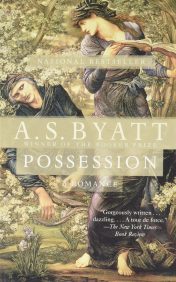
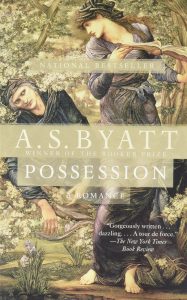
Possession_ASByatt_coverRecognizing where the real drama begins is tricky. Let’s have a look at the novel Possession: A Romance by A.S. Byatt (pen name of the late Dame Antonia Susan Duffy DBE), winner of the 1990 Booker Prize.

The story details two complex relationships viewed across time. The modern relationship begins in an unexpected way. The novel opens in a library, a place of silence and solitude where one would think the only opportunity for drama is within the pages of the tomes lining the shelves.

But Byatt saw the potential for real drama in that quiet, dusty place. Her protagonist, Roland Michell, a scholar and professional man of high morals, commits a crime. There isn’t anything exciting about a professor sitting in a library and researching the lives of dead poets—that is, until he pockets the original drafts of letters he has come across in his research.

A person unfamiliar with academic research might not understand how such a small, seemingly inconsequential theft could possibly have a dire outcome.

  • This is the moment that has the potential of ruining his career, destroying everything he has worked for.
  • The consequences of this act hang over him to the end.

About the book, via Wikipedia:

The novel follows two modern-day academics as they research the paper trail around the previously unknown love life between famous fictional poets Randolph Henry Ash and Christabel LaMotte. Possession is set both in the present day and the Victorian era, contrasting the two time periods, as well as echoing similarities and satirizing modern academia and mating rituals. The structure of the novel incorporates many different styles, including fictional diary entries, letters and poetry, and uses these styles and other devices to explore the postmodern concerns of the authority of textual narratives. The title Possession highlights many of the major themes in the novel: questions of ownership and independence between lovers; the practice of collecting historically significant cultural artifacts; and the possession that biographers feel toward their subjects.

AS. Byatt, in part, wrote Possession in response to John Fowles‘ novel The French Lieutenant’s Woman(1969). In an essay in Byatt’s nonfiction book, On Histories and Stories, she wrote:

“Fowles has said that the nineteenth-century narrator was assuming the omniscience of a god. I think rather the opposite is the case—this kind of fictive narrator can creep closer to the feelings and inner life of characters—as well as providing a Greek chorus—than any first-person mimicry. In ‘Possession’ I used this kind of narrator deliberately three times in the historical narrative—always to tell what the historians and biographers of my fiction never discovered, always to heighten the reader’s imaginative entry into the world of the text.” [1]

So, Byatt changes narrative point of view in this tale when necessary, as a means to better explore an aspect of the story. That is a neat trick, if done right, which she does. (Done wrong, it has the potential of adding chaos to the narrative.)
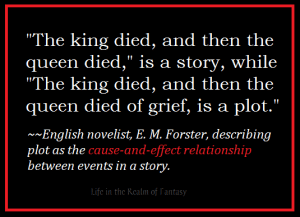
e.m. forster plot memeI admire the audacity of having Michell, a protagonist who considers his professional reputation as his most prized possession, commit such a catastrophic action as stealing those original letters. It proves there is potential for drama in the least likely places.

I have been known to spend months writing the wrong story.

Instead of following the original outline, I took the plot off on a tangent and wrote myself into a corner. Then, once I admitted to myself that there was no rescuing it, I moved on to something else.

Most writers don’t see where they’ve gone awry until someone else points it out, or they step away from it for a while.

Once I give up and set a work that is stalled aside for a month or two, these things are easier to see. In the case of one novel, I cut it back to the 20,000-word mark and made a new, more logical outline. Writing went well after that, and so far, I’m getting good, useable feedback.

Creators see their work the way parents see their children. We tend to think every scene is golden. Unfortunately, some events I might believe are necessary—aren’t.

In reality, they lead the story nowhere.

desk_via_microsoft_stickers

courtesy Office 360 graphics

But I love my children, even the unruly ones. Nothing is a waste of time, and those scenes become the basis of novellas and short stories.

The ability to recognize the potential for a crucial dramatic moment is a matter of perspective. It is the ability to see the story arc as a whole before it is fully formed.

It is also the knack of knowing what kind of drama the story needs and where it should fit within the plot arc.


Credits and Attributions:

[1] Wikipedia contributors, “Possession (Byatt novel),” Wikipedia, The Free Encyclopedia, https://en.wikipedia.org/w/index.php?title=Possession_(Byatt_novel)&oldid=1189753614 (accessed March 19, 2024).

1 Comment

Filed under writing

Scene Framing, or how worldbuilding helps tell the story #writing

When I am reading, I become invested in the characters and their problems. The authors I like best use the environment to highlight the characters’ moods and darken or lighten the atmosphere. Their worldbuilding conveys a perception of drama with minimal exposition.

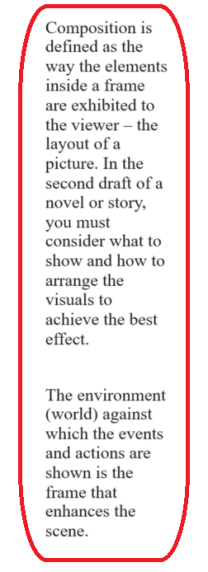
ScenesIn a novel or story, each scene occurs within the framework of the environment.
I think of the written narrative as a camera and visualize my narrative as a movie. The challenge of writing for me is discovering how to best use the set dressing to underscore the drama.

Scene framing is a necessary skill for writers of all stripes. Directors will tell you they focus the scenery so it frames the action. Their intent is that viewer’s attention is drawn to the subtext the director wants to convey.

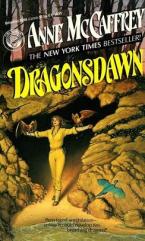
An example of how this works in literature is one I’ve used before, a pivotal scene from Anne McCaffrey’s 1988 novel Dragonsdawn

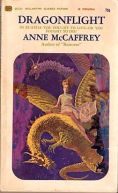
AnneMcCaffrey_DragonflightThe Dragonriders of Pern series is considered science fiction because McCaffrey made clear at the outset that the star (Rukbat) and its planetary system had been colonized two millennia before, and the protagonists were their descendants.

Some elements of the narrative are considered fantasy because they feature dragons and telepathy.

The early novels detail the gradual rediscovery of lost technology and the revelation of their forgotten history. The stand-alone novel I’m discussing today, Dragonsdawn, is a how-it-all-began novel, and it reinforces the science fiction nature of the series.

  • It explains the science behind McCaffrey’s dragons and why they were genetically engineered to be what they are.

The story follows several POV characters, giving us a comprehensive view of the colony’s successes and failures. For the first ten years, the planet Pern seemed a paradise to its new colonists, who were seeking to return to a less technologically centered, agrarian-based way of life. They believe Pern is the place where they can leave their recent wars and troubles behind.

A decade after arriving on the planet, however, a new threat appears. It is a deadly, unstoppable spore that periodically rains from the skies in the form of a silvery Thread that mindlessly devours every carbon-based thing it touches.

Plot-exists-to-reveal-characterThe scenes we are looking at today have two distinct environments to frame them. In both settings, the surroundings do the dramatic heavy lifting. This chapter is filled with emotion, high stakes, and rising dread for the sure and inevitable tragedy that we hope will be averted.
  • While there is high drama in Sallah Telgar‘s direct interaction with Avril Bitra, the visuals and sensory elements of each environment reinforce the perception of impending doom.

The story at this point: We are at the halfway point of the book. Before the advent of Thread, Avril disappeared, gathering resources and intending to leave the planet with as much treasure as she can carry. She has been pretty much forgotten by the others but has an agenda and refuses to be thwarted.

In the first scene of this chapter, we are focused on Sallah, one of our protagonists. We see her leaving her children at the daycare. Such a common, ordinary thing, dropping off your children on your way to work.

The focus zooms out, and we see Kenjo, the pilot, putting the last of the precious fuel into the only working shuttle, the Mariposa. This shuttle has been refitted for one last science expedition: to discover the source of the deadly Threads. He is to retrieve a sample, knowing that if this mission fails, there will be no other.

The focus returns to Sallah, who observes a woman she recognizes as Avril Bitra slipping through the abandoned shuttles on the landing grid.

Sallah wonders what Avril is up to. The view widens again as we see Avril following the pilot, Kenjo, who vanishes. We then see her entering the Mariposa alone.

Sallah makes a spur-of-the-moment decision to follow Avril to see what she’s up to. This plot point is an example of a point of no return, which we discussed last week,

Here is where the sparse visual mentions of the environment become crucial as they emphasize the stark reality of Sallah’s situation.

compositionANDsceneFramingLIRF03092024Sallah enters the shuttle just as the airlock door closes, catching and crushing her heel. She manages to pull it out so that she isn’t trapped, but she is severely injured.
Later, the dark, abandoned interior of the Yokohama reinforces Sallah’s gut-wrenching realization that her five children will grow up without a mother.

Something we haven’t talked about is subtext.

Subtext is what lies below the surface. It is the hidden story, the hints and allegations, the secret reasoning we infer from the narrative. It’s conveyed by the images we place in the environment and how the setting influences our perception of the mood and atmosphere.

Subtext supports the dialogue and gives purpose to the personal events.

Scene framing is the way we stage the people and visual objects. What furnishings, sounds, and odors are the visual necessities for that scene?

Whatever you mention of the environment focuses the reader’s attention when the characters enter the frame.

  • In this chapter of Dragonsdawn, we see the junk and scrap on the grid and the decaying shuttles.
  • Two shuttles have been dismantled and parted out. Their components are crucial in keeping the few cargo sleds that have been converted to Thread-fighting gunships in working order.
  • Only one shuttle remains in usable condition.
  • On the Yokohama, it is dark and frigid, and the interior has been partially gutted. Anything that could be carried away has been taken to the ground and repurposed.

Sensory details are vital, showing how the environment affects or is affected by the characters.

  • Conversely, not mentioning the scenery during a conversation brings the camera in for a close-up, focusing solely on the speaker or thinker.

A balance must be struck in how your characters are framed in each scene. We flow from wide-angle, seeing Salla floating in freefall, blood pooling in her boot. The camera moves in, a close-up showing Avril’s rage at the fact that she can’t control the course of the Mariposa, which is programmed to dock at the Yokohama.

We are there when Avril taunts Sallah for her matronly body. A feeling of helplessness comes over us as Avril ties a cord to Sallah’s crushed foot and forces her to make the navigational calculations for Avril’s escape. The camera moves in, and we hear the interaction.

Sallah pretends to do as Avril asks. But really, she sets her enemy’s doom in action. The camera moves to the wider view again, seeing her at the controls in the dark, using the last of her energy. Worst of all, we know she is dying, and she understands there is no rescue for her.

  • We hear the interaction with her frantic husband on the ground.

Dragonsdawn_coverThis is an incredibly emotional scene: we are caught up in her determination to seize this only chance, using her last breaths to get the information about the thread spores to the scientists on the ground.

We learn how to write from reading the masters. We learn by observing how others use the setting to support and reinforce the subtext of the conversations and events.

Scene framing is a cornerstone of worldbuilding, and when it is done right, it can make a scene feel powerful.

Next up: Transitions

6 Comments

Filed under writing

The Inferential Layer Revisited: Drama #amwriting

Today I am flying a kite on a beach somewhere south of here. In honor of that, we are revisiting my post on DRAMA, something I try to avoid in real life! This post originally appeared here on August 26, 2019.


Whether you are writing a screenplay, a short story, or a novel, you are writing something that you hope will resonate with the reader and move them. A lesson that screenwriters learn early on is that each scene must be viewed as a mini-story; a complete story within the larger story. They learn this early because they don’t have the luxury of space that we who write novels have. The entire story of a screenplay must be told within a finite framework of time, so the writer must wring the most emotional impact out of the least amount of words.

I’m still working on this, myself. But I’m getting there.

So, where do we start? We begin with the most fundamental reason people purchase books or go to plays and movies—drama. The inferential layer of the Word-Pond we call Story is all about the drama, and I’m not talking over-the-top hysterics here. We combine emotional highs and lows with action and reaction in each passage to create dramatic scenes that leave a mark on the reader.

Of course, we understand large, emotionally charged, outwardly noisy dramatic scenes. They impact us and leave us reeling. But the only way those events have power is if they have context. They must be balanced by quieter, more introspective moments.

Drama can happen in the mildest of scenes, places where it looks as if nothing important is happening. The follow-up/regrouping scenes are places where you have the opportunity to waylay the reader with something unexpected. This is where you show the reader what is happening beneath the surface, the inner demons and fears the characters now face.

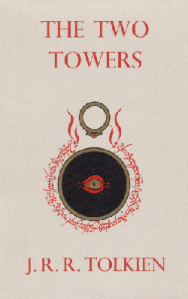
Consider  The Two Towers by J.R.R.Tolkien. Let’s look at the emotional impact of the scene that takes place in Shelob’s Lair. Frodo and Sam have survived incredible hardships and have made it to Cirith Ungol.  The passage is an excellent example of the dramatic story within a story that advances the overall plot.

Drama is the hope we feel in the moment when Frodo faces Shelob with the Phial of Light. Drama is the moment Frodo fails, the moment he is stung.

It is the shock, the horror, the moment where Sam reluctantly takes up Frodo’s sword, Sting.

It is triumph when Shelob impales herself on Sting, a weapon made of Mithril and a sword in the hands of a hobbit. But really, Sting is only a long-knife, and despite its mythic properties, it is not long enough to kill the giant arachnid, Shelob.

Still, she is wounded and scuttles away.

Drama is in the despair, the quiet moment afterward, where Samwise realizes that everything they have just endured was for nothing.

Drama is the moment of sharp introspection, the internal conversation when Sam fears his own weakness; the moment when his faith is not just shaken—it is lost. It is that moment of profound despondency in Shelob’s Lair, the dark night of the soul where Sam believes the spider has killed Frodo.

What about love? Few emotions have as much dramatic potential as that of love. It has many shades, from friendship to affection, to desire, to passion, to obsession, to jealousy, to hate.

Let’s look at the Pulitzer Prize winning short story, Brokeback Mountain, by Annie Proulx (synopsis via Wikipedia):

In 1963, two young men, Ennis del Mar and Jack Twist, are hired for the summer to look after sheep at a seasonal grazing range on the fictional Brokeback Mountain in Wyoming. Unexpectedly, they form an intense emotional and sexual attachment, but have to part ways at the end of the summer. Over the next twenty years, as their separate lives play out with marriages, children, and jobs, they continue reuniting for brief liaisons on camping trips in remote settings.

Ennis and Jack are tied to each other, but they love their wives and children. They are products of their society, and their personal reactions to the intensity of their relationship are both hurtful and understandable in the context of their time and situation. People have love affairs in books all the time, and we often find them forgettable. It is the complexity of external societal pressure and deep, confusing emotion that makes Ennis and Jack’s attachment memorable.

Then there is the novel, Possession, by A.S. Byatt, winner of the 1990 Booker prize. This is a complex relationship that begins in a rather boring manner – it opens in a library when Roland Michell, a scholar and professional man of high morals commits a crime: he steals the original drafts of letters he has come across in his research. This act has the potential of becoming his professional suicide. The synopsis via Wikipedia:

(Roland Mitchell) begins to investigate. The trail leads him to Christabel LaMotte, a minor poet and contemporary of Ash, and to Dr. Maud Bailey, an established modern LaMotte scholar and distant relative of LaMotte. Protective of LaMotte, Bailey is drawn into helping Michell with the unfolding mystery. The two scholars find more letters and evidence of a love affair between the poets (with evidence of a holiday together during which – they suspect – the relationship may have been consummated); they become obsessed with discovering the truth. At the same time, their own personal romantic lives – neither of which is satisfactory – develop, and they become entwined in an echo of Ash and LaMotte. The stories of the two couples are told in parallel, with Byatt providing letters and poetry by both of the fictional poets.

Love, whether unacknowledged or returned, physical or platonic, is complicated. The sections of movies, books, and short stories where the arc of the scene showcases true emotional complexity stick with me. I find myself contemplating them long after the story has ended.

In all three literary examples, The Lord of the Rings, Brokeback Mountain, and Possession, it is the interpersonal relationships entwined with the action that illuminates the drama. Action scenes require some sort of emotion to give them context, to shape them into an arc:

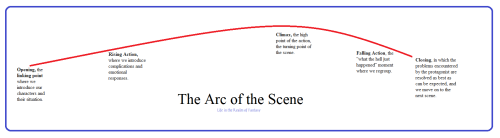
  1. Opening, the linking point where we introduce our characters and their situation.
  2. Rising Action, where we introduce complications and emotional responses.
  3. Climax, the high point of the action, the turning point of the scene.
  4. Falling Action, the “what the hell just happened” moment where we regroup.
  5. Closing, in which the problems encountered by the protagonist are resolved as best as can be expected, and we move on to the next scene.

The resolution of one scene is the linking point to the next, the door that takes us further into the story. The dramatic arc of each scene ends at a higher point in the overall story arc.

The emotions surrounding the drama in our literature attracts us, captivates us, keeps us interested. In every story, drama is the moment you, the reader, realize you must take up the hero’s task; you must carry the evil One Ring to Mount Doom.

Drama done well can take the reader from joy to despair to resignation and back to hope within the arc of the scene. This is good pacing and urges the reader to keep turning the page to see what is coming next.


Credits and Attributions:

The Inferential Layer: Drama, © 2019  Connie J. Jasperson  https://conniejjasperson.com/2019/08/26/the-inferential-layer-drama-amwriting/ (accessed August 16, 2020)

Wikipedia contributors, “Brokeback Mountain (short story),” Wikipedia, The Free Encyclopedia, https://en.wikipedia.org/w/index.php?title=Brokeback_Mountain_(short_story)&oldid=902058091 (accessed August 24, 2019).

Wikipedia contributors, “Possession (Byatt novel),” Wikipedia, The Free Encyclopedia, https://en.wikipedia.org/w/index.php?title=Possession_(Byatt_novel)&oldid=909067002 (accessed August 24, 2019).

The Two Towers, by J.R.R. Tolkien, first edition cover, Publisher George Allen & Unwin, © 11 November 1954, Fair Use.

Possession by A.S. Byatt, first edition cover, Publisher Chatto and Windus, © 1990, Fair Use.

2 Comments

Filed under writing

The Inferential Layer: Drama #amwriting (reprise)

Today’s post is a reprise of one first posted August 26, 2019. Circumstances beyond my control meant I didn’t have a post ready for today–sorry! The reason I chose this post to reprise is that it deals with drama, and how we instill it into our work. I feel it dovetails nicely with the discussions we’ve had recently regarding poetry. We want to instill emotion and impact into our work so the words we use must be powerful.


Whether you are writing a screenplay, a short story, or a novel, you are writing something that you hope will resonate with the reader and move them. A lesson that screenwriters learn early on is that each scene must be viewed as a mini-story; a complete story within the larger story. They learn this early because they don’t have the luxury of space that we who write novels have. The entire story of a screenplay must be told within a finite framework of time, so the writer must wring the most emotional impact out of the least amount of words.

I’m still working on this, myself. But I’m getting there.

So, where do we start? We begin with the most fundamental reason people purchase books or go to plays and movies—drama. The inferential layer of the Word-Pond we call Story is all about the drama, and I’m not talking over-the-top hysterics here. We combine emotional highs and lows with action and reaction in each passage to create dramatic scenes that leave a mark on the reader.

Of course, we understand large, emotionally charged, outwardly noisy dramatic scenes. They impact us and leave us reeling. But the only way those events have power is if they have context. They must be balanced by quieter, more introspective moments.

Drama can happen in the mildest of scenes, places where it looks as if nothing important is happening. The follow-up/regrouping scenes are places where you have the opportunity to waylay the reader with something unexpected. This is where you show the reader what is happening beneath the surface, the inner demons and fears the characters now face.

Consider  The Two Towers by J.R.R.Tolkien. Let’s look at the emotional impact of the scene that takes place in Shelob’s Lair. Frodo and Sam have survived incredible hardships and have made it to Cirith Ungol.  The passage is an excellent example of the dramatic story within a story that advances the overall plot.

Drama is the hope we feel in the moment when Frodo faces Shelob with the Phial of Light. Drama is the moment Frodo fails, the moment he is stung.

It is the shock, the horror, the moment where Sam reluctantly takes up Frodo’s sword, Sting.

It is triumph when Shelob impales herself on Sting, a weapon made of Mithril and a sword in the hands of a hobbit. But really, Sting is only a long-knife, and despite its mythic properties, it is not long enough to kill the giant arachnid, Shelob.

Still, she is wounded and scuttles away.

Drama is in the despair, the quiet moment afterward, where Samwise realizes that everything they have just endured was for nothing.

Drama is the moment of sharp introspection, the internal conversation when Sam fears his own weakness; the moment when his faith is not just shaken—it is lost. It is that moment of profound despondency in Shelob’s Lair, the dark night of the soul where Sam believes the spider has killed Frodo.

What about love? Few emotions have as much dramatic potential as that of love. It has many shades, from friendship to affection, to desire, to passion, to obsession, to jealousy, to hate.

Let’s look at the Pulitzer Prize winning short story, Brokeback Mountain, by Annie Proulx (synopsis via Wikipedia):

In 1963, two young men, Ennis del Mar and Jack Twist, are hired for the summer to look after sheep at a seasonal grazing range on the fictional Brokeback Mountain in Wyoming. Unexpectedly, they form an intense emotional and sexual attachment, but have to part ways at the end of the summer. Over the next twenty years, as their separate lives play out with marriages, children, and jobs, they continue reuniting for brief liaisons on camping trips in remote settings.

Ennis and Jack are tied to each other, but they love their wives and children. They are products of their society, and their personal reactions to the intensity of their relationship are both hurtful and understandable in the context of their time and situation. People have love affairs in books all the time, and we often find them forgettable. It is the complexity of external societal pressure and deep, confusing emotion that makes Ennis and Jack’s attachment memorable.

Then there is the novel, Possession, by A.S. Byatt, winner of the 1990 Booker prize. This is a complex relationship that begins in a rather boring manner – it opens in a library when Roland Michell, a scholar and professional man of high morals commits a crime: he steals the original drafts of letters he has come across in his research. This act has the potential of becoming his professional suicide. The synopsis via Wikipedia:

(Roland Mitchell) begins to investigate. The trail leads him to Christabel LaMotte, a minor poet and contemporary of Ash, and to Dr. Maud Bailey, an established modern LaMotte scholar and distant relative of LaMotte. Protective of LaMotte, Bailey is drawn into helping Michell with the unfolding mystery. The two scholars find more letters and evidence of a love affair between the poets (with evidence of a holiday together during which – they suspect – the relationship may have been consummated); they become obsessed with discovering the truth. At the same time, their own personal romantic lives – neither of which is satisfactory – develop, and they become entwined in an echo of Ash and LaMotte. The stories of the two couples are told in parallel, with Byatt providing letters and poetry by both of the fictional poets.

Love, whether unacknowledged or returned, physical or platonic, is complicated. The sections of movies, books, and short stories where the arc of the scene showcases true emotional complexity stick with me. I find myself contemplating them long after the story has ended.

In all three literary examples, The Lord of the Rings, Brokeback Mountain, and Possession, it is the interpersonal relationships entwined with the action that illuminates the drama. Action scenes require some sort of emotion to give them context, to shape them into an arc:

  1. Opening, the linking point where we introduce our characters and their situation.
  2. Rising Action, where we introduce complications and emotional responses.
  3. Climax, the high point of the action, the turning point of the scene.
  4. Falling Action, the “what the hell just happened” moment where we regroup.
  5. Closing, in which the problems encountered by the protagonist are resolved as best as can be expected, and we move on to the next scene.

The resolution of one scene is the linking point to the next, the door that takes us further into the story. The dramatic arc of each scene ends at a higher point in the overall story arc.

The emotions surrounding the drama in our literature attracts us, captivates us, keeps us interested. In every story, drama is the moment you, the reader, realize you must take up the hero’s task; you must carry the evil One Ring to Mount Doom.

Drama done well can take the reader from joy to despair to resignation and back to hope within the arc of the scene. This is good pacing and urges the reader to keep turning the page to see what is coming next.


Credits and Attributions:

Wikipedia contributors, “Brokeback Mountain (short story),” Wikipedia, The Free Encyclopedia, https://en.wikipedia.org/w/index.php?title=Brokeback_Mountain_(short_story)&oldid=902058091 (accessed August 24, 2019).

Wikipedia contributors, “Possession (Byatt novel),” Wikipedia, The Free Encyclopedia, https://en.wikipedia.org/w/index.php?title=Possession_(Byatt_novel)&oldid=909067002 (accessed August 24, 2019).

The Two Towers, by J.R.R. Tolkien, first edition cover, Publisher George Allen & Unwin, © 11 November 1954, Fair Use.

Possession by A.S. Byatt, first edition cover, Publisher Chatto and Windus, © 1990, Fair Use.

Comments Off on The Inferential Layer: Drama #amwriting (reprise)

Filed under writing

The Inferential Layer: Drama #amwriting

Whether you are writing a screenplay, a short story, or a novel, you are writing something that you hope will resonate with the reader and move them. A lesson that screenwriters learn early on is that each scene must be viewed as a mini-story; a complete story within the larger story. They learn this early because they don’t have the luxury of space that we who write novels have. The entire story of a screenplay must be told within a finite framework of time, so the writer must wring the most emotional impact out of the least amount of words.

I’m still working on this, myself. But I’m getting there.

So, where do we start? We begin with the most fundamental reason people purchase books or go to plays and movies—drama. The inferential layer of the Word-Pond we call Story is all about the drama, and I’m not talking over-the-top hysterics here. We combine emotional highs and lows with action and reaction in each passage to create dramatic scenes that leave a mark on the reader.

Of course, we understand large, emotionally charged, outwardly noisy dramatic scenes. They impact us and leave us reeling. But the only way those events have power is if they have context. They must be balanced by quieter, more introspective moments.

Drama can happen in the mildest of scenes, places where it looks as if nothing important is happening. The follow-up/regrouping scenes are places where you have the opportunity to waylay the reader with something unexpected. This is where you show the reader what is happening beneath the surface, the inner demons and fears the characters now face.

Consider  The Two Towers by J.R.R.Tolkien. Let’s look at the emotional impact of the scene that takes place in Shelob’s Lair. Frodo and Sam have survived incredible hardships and have made it to Cirith Ungol.  The passage is an excellent example of the dramatic story within a story that advances the overall plot.

Drama is the hope we feel in the moment when Frodo faces Shelob with the Phial of Light. Drama is the moment Frodo fails, the moment he is stung.

It is the shock, the horror, the moment where Sam reluctantly takes up Frodo’s sword, Sting.

It is triumph when Shelob impales herself on Sting, a weapon made of Mithril and a sword in the hands of a hobbit. But really, Sting is only a long-knife, and despite its mythic properties, it is not long enough to kill the giant arachnid, Shelob.

Still, she is wounded and scuttles away.

Drama is in the despair, the quiet moment afterward, where Samwise realizes that everything they have just endured was for nothing.

Drama is the moment of sharp introspection, the internal conversation when Sam fears his own weakness; the moment when his faith is not just shaken—it is lost. It is that moment of profound despondency in Shelob’s Lair, the dark night of the soul where Sam believes the spider has killed Frodo.

What about love? Few emotions have as much dramatic potential as that of love. It has many shades, from friendship to affection, to desire, to passion, to obsession, to jealousy, to hate.

Let’s look at the Pulitzer Prize winning short story, Brokeback Mountain, by Annie Proulx (synopsis via Wikipedia):

In 1963, two young men, Ennis del Mar and Jack Twist, are hired for the summer to look after sheep at a seasonal grazing range on the fictional Brokeback Mountain in Wyoming. Unexpectedly, they form an intense emotional and sexual attachment, but have to part ways at the end of the summer. Over the next twenty years, as their separate lives play out with marriages, children, and jobs, they continue reuniting for brief liaisons on camping trips in remote settings.

Ennis and Jack are tied to each other, but they love their wives and children. They are products of their society, and their personal reactions to the intensity of their relationship are both hurtful and understandable in the context of their time and situation. People have love affairs in books all the time, and we often find them forgettable. It is the complexity of external societal pressure and deep, confusing emotion that makes Ennis and Jack’s attachment memorable.

Then there is the novel, Possession, by A.S. Byatt, winner of the 1990 Booker prize. This is a complex relationship that begins in a rather boring manner – it opens in a library when Roland Michell, a scholar and professional man of high morals commits a crime: he steals the original drafts of letters he has come across in his research. This act has the potential of becoming his professional suicide. The synopsis via Wikipedia:

(Roland Mitchell) begins to investigate. The trail leads him to Christabel LaMotte, a minor poet and contemporary of Ash, and to Dr. Maud Bailey, an established modern LaMotte scholar and distant relative of LaMotte. Protective of LaMotte, Bailey is drawn into helping Michell with the unfolding mystery. The two scholars find more letters and evidence of a love affair between the poets (with evidence of a holiday together during which – they suspect – the relationship may have been consummated); they become obsessed with discovering the truth. At the same time, their own personal romantic lives – neither of which is satisfactory – develop, and they become entwined in an echo of Ash and LaMotte. The stories of the two couples are told in parallel, with Byatt providing letters and poetry by both of the fictional poets.

Love, whether unacknowledged or returned, physical or platonic, is complicated. The sections of movies, books, and short stories where the arc of the scene showcases true emotional complexity stick with me. I find myself contemplating them long after the story has ended.

In all three literary examples, The Lord of the Rings, Brokeback Mountain, and Possession, it is the interpersonal relationships entwined with the action that illuminates the drama. Action scenes require some sort of emotion to give them context, to shape them into an arc:

  1. Opening, the linking point where we introduce our characters and their situation.
  2. Rising Action, where we introduce complications and emotional responses.
  3. Climax, the high point of the action, the turning point of the scene.
  4. Falling Action, the “what the hell just happened” moment where we regroup.
  5. Closing, in which the problems encountered by the protagonist are resolved as best as can be expected, and we move on to the next scene.

The resolution of one scene is the linking point to the next, the door that takes us further into the story. The dramatic arc of each scene ends at a higher point in the overall story arc.

The emotions surrounding the drama in our literature attracts us, captivates us, keeps us interested. In every story, drama is the moment you, the reader, realize you must take up the hero’s task; you must carry the evil One Ring to Mount Doom.

Drama done well can take the reader from joy to despair to resignation and back to hope within the arc of the scene. This is good pacing and urges the reader to keep turning the page to see what is coming next.


Credits and Attributions:

Wikipedia contributors, “Brokeback Mountain (short story),” Wikipedia, The Free Encyclopedia, https://en.wikipedia.org/w/index.php?title=Brokeback_Mountain_(short_story)&oldid=902058091 (accessed August 24, 2019).

Wikipedia contributors, “Possession (Byatt novel),” Wikipedia, The Free Encyclopedia, https://en.wikipedia.org/w/index.php?title=Possession_(Byatt_novel)&oldid=909067002 (accessed August 24, 2019).

The Two Towers, by J.R.R. Tolkien, first edition cover, Publisher George Allen & Unwin, © 11 November 1954, Fair Use.

Possession by A.S. Byatt, first edition cover, Publisher Chatto and Windus, © 1990, Fair Use.

Comments Off on The Inferential Layer: Drama #amwriting

Filed under writing