Tag Archives: Dutch Art

#FineArtFriday: Rembrandt and Saskia in the Parable of the Prodigal Son by Rembrandt van Rijn 1635

Rembrandt and Saskia as the Prodigal Son.

Artist: Rembrandt (1606–1669)

Title: Rembrandt and Saskia in the parable of the Prodigal Son

Depicted people: Rembrandt and his wife, Saskia van Uylenburgh

Date: 1635

Medium: oil on canvas

Dimensions: height: 161 cm (63.3 in) width: 131 cm (51.5 in)

Current location: Staatliche Kunstsammlungen Dresden

What I love about this painting:

This was done during the best years of Rembrandt’s life, the years when he was a popular young artist, a time when he was financially secure. He was deeply in love with his wife and at the time of this painting, the future looked bright.

In many ways, Rembrandt was the embodiment of the traditional view of the parable of the prodigal son. He was fond of luxuries that he couldn’t quite afford, sure of his talents, and determined to have his own way in life regardless of the accepted morality of his society.

The two people shown in this painting were happy and knew how to celebrate life, which is clearly shown in this self-portrait.

About this painting via Wikipedia:

It portrays two people who had been identified as Rembrandt himself and his wife Saskia. In the Protestant contemporary world, the theme of the prodigal son was a frequent subject for works of art due to its moral background. Rembrandt himself painted a Return of the Prodigal Son in 1669.

The left side of the canvas was cut, perhaps by the artist himself, to remove secondary characters and focus the observer’s attention on the main theme. [1]

About the Artist, via Wikipedia:

Rembrandt Harmenszoon van Rijn; 15 July 1606 – 4 October 1669), known as Rembrandt, was a Dutch Golden Age painterprintmaker, and draughtsman. He is generally considered one of the greatest visual artists in the history of Western art. It is estimated that Rembrandt’s surviving works amount to about three hundred paintings, three hundred etchings, and several hundred drawings.

Unlike most Dutch painters of the 17th century, Rembrandt’s works depict a wide range of styles and subject matter, from portraits and self-portraits to landscapes, genre scenes, allegorical and historical scenes, biblical and mythological subjects and animal studies. His contributions to art came in a period that historians call the Dutch Golden Age. [2]

To learn more about this artist and his remarkable (and often sad) life, go to Rembrandt – Wikipedia.

For an excellent biography on the life and works of Rembrandt van Rijn via YouTube, go to: Rembrandt van Rijn: Tragedy, Genius and the Art of Light | Full Documentary


Credits and Attributions:

IMAGE: Wikipedia contributors, “The Prodigal Son in the Brothel,” Wikipedia, The Free Encyclopedia, https://en.wikipedia.org/w/index.php?title=The_Prodigal_Son_in_the_Brothel&oldid=1292671149 (accessed January 1, 2026). [1]

Wikipedia contributors, “Rembrandt,” Wikipedia, The Free Encyclopedia, https://en.wikipedia.org/w/index.php?title=Rembrandt&oldid=1329139620 (accessed January 1, 2026). [2]
1 Comment

Filed under #FineArtFriday

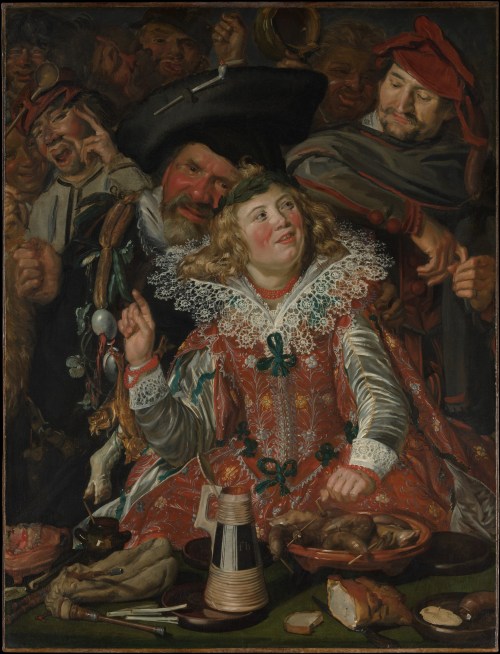
#FineArtFriday: Shrovetide Revelers by Frans Hals ca. 1616

Frans_Hals,_Merrymakers_at_Shrovetide,_The_Metropolitan_Museum_of_ArtArtist: Frans Hals  (1582/1583–1666)

Title: Shrovetide Revelers

Genre: genre painting

Date: circa 1616–17

Medium: oil on canvas

Dimensions: 51 ¾ × 39 ¼ in. (131.4 × 99.7 cm)

Collection: Metropolitan Museum of Art

What I think about this painting:

This was a lurid scene at the time it was painted and is still lurid today. The sole female portrayed is a girl dressed in the finest of garments, surrounded by men. She is well-fed, has abundant blonde hair, and represents the concept of “plenty.” The party will go on for as long as she lasts–when she is gone, the party is over.

The color of her hair is gold, an allegory for an abundance of coins. The men posed around her represent the human tendency toward gluttony, drunkenness, and greed.

Frans Hals depicted the embroideries on the fabric of her dress and the intricate lace at her neck and cuffs with exquisite care and attention to detail. The sheen of her satin sleeves gleams in the candlelight, showing off the strings of beads at her neck and wrist. Perhaps the beads are carnelians. Her brightly flushed cheeks give evidence to her inebriation.

All the characters, including the serving man, are shown as having overindulged. The foods on the table are those any person could acquire, but they are shown being wasted, used as decorations for fools.

Food was an incredibly popular subject for paintings during the renaissance–still lifes were exceedingly good sellers for most artists. Food of all varieties was carefully staged and shown with superb realism and minute detail. Those artists we now call the Dutch and Flemish masters used food as an allegory, and even in genre paintings, they loved to paint lavish food displays.

As in the scene above, the foods depicted in scenes of drunkenness and revelry conveyed symbolic meanings, often implying immorality and debauchery.

Mostly, the imagery was intended to be a reminder that great wealth can vanish overnight. Also, they show us that gluttony is both unappealing to look at and unhealthy for the glutton.

But when I see an image such as this painting, I have to think these artists, whose own morals were often quite elastic, were exercising their broad senses of humor.

About this painting, via The Met Museum:

Shrovetide, now better known as Mardi Gras, is the traditional period of indulgence before the fasting and self-discipline of Lent. In the seventeenth-century Netherlands, it was also the occasion for theatrical performances by the painters’ guilds.

Here, Hals depicts two stock figures from these plays, Hans Wurst, with a sausage dangling from his cap, and Pekelharing, who sports a garland of salted fish and eggs.

They flank a richly dressed girl (probably a boy in drag, as women were not permitted to perform on these occasions).

Still life elements litter the foreground, evoking both the traditional foods of the festival and an abundance of erotic innuendo. [1]

About this painting, via Wikipedia:

Shrovetide Revellers, also known as Merrymakers at Shrovetide, is a painting by the Dutch Golden Age painter Frans Hals, painted in around 1616–17. It is one of the earliest surviving works by Hals, and has been held by the Metropolitan Museum of Art, New York City since 1913. The painting shows people festivities at Shrovetide (DutchCarnaval), an annual carnival of food and jollity which takes place before the Christian fasting season of Lent.

The painting shows the face of an elegantly dressed smiling woman raising her right finger to make a point, while a man grabs her shoulder to whisper in her ear: he has a string of herring, eggs and mussels around his neck, with a pig’s trotter and a fox tail, symbols of gluttony and foolishness respectively. Another amused gentleman, with a wurst hanging from his cap, leans on the first man’s shoulder and listens to their banter. Some claim these are the Baroque theatre characters Peeckelhaeringh and Hans Wurst. Behind them other people are talking and laughing. The flagon Bears the initials “fh”. [2]


Credits and Attributions:

[1] Shrovetide Revellers or Merrymakers at Shrovetide by Frans Hals, Met Museum Contibutors © 2000–2022 The Metropolitan Museum of Art. Frans Hals | Merrymakers at Shrovetide | The Metropolitan Museum of Art (metmuseum.org) (Accessed April 14, 2022).

[2] Wikipedia contributors, “Shrovetide Revellers,” Wikipedia, The Free Encyclopedia, https://en.wikipedia.org/w/index.php?title=Shrovetide_Revellers&oldid=1070869013 (accessed April 14, 2022).

4 Comments

Filed under #FineArtFriday, writing