
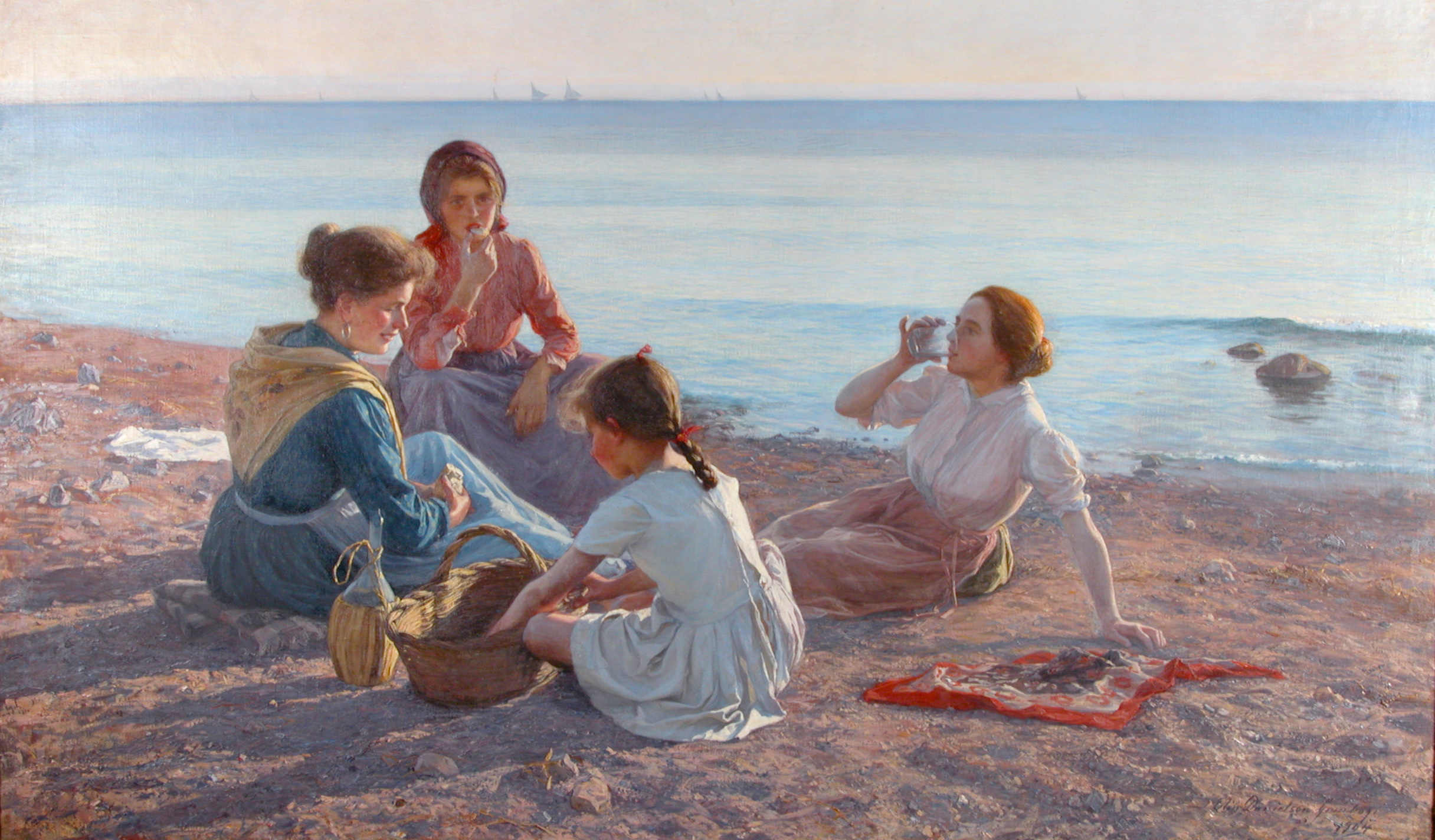
 Artist: Elin Danielson-Gambogi (1861–1919)
Title: By the Sea – The Snack (La Merenda)
Date: 1904
Medium: oil on canvas
Dimensions: height: 102 cm (40.1 in)
Collection: K. H. Renlund art collection
What I love about this painting:
Elin Danielson-Gambogi gives us a perfect afternoon for an afternoon picnic by the sea with friends. An afternoon beside the surf and the company of friends—it doesn’t get any better.
The good years just prior to the outbreak of WWI seem golden in many ways. Women’s work was never done but they have the luxury of a little leisure time, and they are enjoying it. Two women have removed their headscarves as if they don’t care if they get a little sun-browned. The cast-off squares of cloth lie on the rocky beach as if blown by the wind.
The girl is very likely the artist’s niece, as she and her mother figure prominently in many of Elin’s paintings. I like to think she is pleased to have been included in the picnic, proud to be serving the snacks.
There is a pleasant warmth to this image, the peace of a Goldilocks day, that rare summer’s afternoon that is just right.
About the Artist, via Wikipedia:
Elin Kleopatra Danielson-Gambogi (3 September 1861 – 31 December 1919) was a Finnish painter best known for her realist works and portraits. Danielson-Gambogi was part of the first generation of Finnish women artists who received professional education in art, the so-called “painter sisters’ generation”. The group also included Helene Schjerfbeck (1862–1946), Helena Westermarck (1857-1938), and Maria Wiik (1853-1928).
In 1883 Danielson received a grant and moved to Paris. While there, she took lessons at the Académie Colarossi under Gustave Courtois and painted in Brittany during the summertime. A few years later she returned to Finland and lived with her relatives in Noormarkku and Pori. In 1888 she opened an atelier in Noormarkku. During the 1880s and 1890s she worked as a teacher in several art schools around Finland. She also attended the artists’ colony Önningeby in Ålands.
In 1895, she received a scholarship and traveled to Florence, Italy. A year later she moved to the village of Antignano in Livorno where she met an Italian painter 13 years younger than herself, Raffaello Gambogi (1874–1943). They began working together and got married on February 27, 1898. They held exhibitions in Paris, Florence (where she was awarded an art prize by the city) and Milan, and in many Finnish cities, and their paintings were also included in the 1900 World’s Fair in Paris, where she again won bronze medal. She also got to second place in the 1901 national portrait painting competition organized by the Finnish state. In 1899, King Umberto purchased a painting from her. That same year, she participated in the Venice Biennale.
Their marriage was strained when Raffaello had an affair with Danielson’s Finnish friend Dora Wahlroos. While the affair quickly ended, it had a lasting impact on the Gambogis’ marriage. She moved to Finland for a while but returned to Antignano in 1903. Because of World War I, her connection to her homeland was cut, and by the time she died, of pneumonia, at Antignano in 1919, she had been mostly forgotten in Finland.
Because of her choice of rare subject matters that often even caused some offence, Danielson is now seen as one of the central artists of the Golden Age of Finnish Art. Danielson-Gambogi was included in the 2018 exhibit Women in Paris 1850-1900. [1]
Credits and Attributions:
IMAGE: Wikimedia Commons contributors, “File:Elin Danielson-Gambogi – La Merenda (1904).jpg,” Wikimedia Commons, https://commons.wikimedia.org/w/index.php?title=File:Elin_Danielson-Gambogi_-_La_Merenda_(1904).jpg&oldid=848460780 (accessed June 20, 2024).
[1] Wikipedia contributors, “Elin Danielson-Gambogi,” Wikipedia, The Free Encyclopedia, https://en.wikipedia.org/w/index.php?title=Elin_Danielson-Gambogi&oldid=1203975014 (accessed June 20, 2024).


 Life in the Realm of Fantasy