
The transition scene is the hardest part of a story for me to figure out when writing the first draft. I get stuck, trying to decide what information needs to come out and what should be held back. I forget that the first draft is only the foundation.
 In my work, the first draft is really more of an expanded outline, a series of scenes that have characters doing things. But those scenes need to be connected so each flows naturally into the next without jarring the reader out of the narrative.
My first draft manuscript is finished in the regard that it has a beginning, middle, and ending. But it’s only a skeleton, a pile of bones I’ve unearthed, waiting for the anthropologist’s forensic reconstruction. It still needs muscles and heart and flesh.
In a story, muscle is applied to the bones in the form of the transition scene. Transition scenes propel the weight of the narrative, pushing things forward. Action, transition, action, transition—this is called pacing.
Pacing of a story is created by the rise and fall of action. We have our characters do a little something, then they show something, then they tell us something, and it begins again.
I picked up my kit and looked around. No wife to kiss goodbye, no real home to leave behind, nothing of value to pack. Only the need to bid Aeoven and my failures goodbye. The quiet snick of the door closing behind me sounded like deliverance.
The character in the above transition scene completes an action in one scene and moves on to the next event. It reveals his mood and some of his history in 46 words and propels him into the next scene.
He does something: I picked up my kit and looked around.
His emotional state is shown through his thoughts: No wife to kiss goodbye, no real home to leave behind, nothing of value to pack. Only the need to bid Aeoven and my failures goodbye.
The scene is concluded with one last thought and an action that pushes him to the next event: The quiet snick of the door closing behind me sounded like deliverance. The door has closed, there is no going back, and he is now in the next action sequence. We find out who and what is waiting for him on the other side of that door.
 We are always told, “Don’t waste words on empty scenes.” I find this part of the revision process the most difficult. Frankly, I have a million words at my disposal, and wasting them is my best skill.
Most fiction has one thing in common regardless of genre and tropes: characters we can empathize with are thrown into chaos-with-a-plot.
To make an enjoyable story out chaos, we must have an underlying foundation of order in the layout of the narrative. This is pacing, and it’s subliminal. But without it, the book is either flat and boring or too chaotic and confusing.
Pacing looks like this:
- Processing the action.
- Action again.
- Processing/regrouping.
Our scenes have an arc, one that is as defined as the overarching arc of the story. A transition scene reveals something new and pushes the characters toward something unknown and unavoidable. It pushes us forward and lays the groundwork for what comes next.
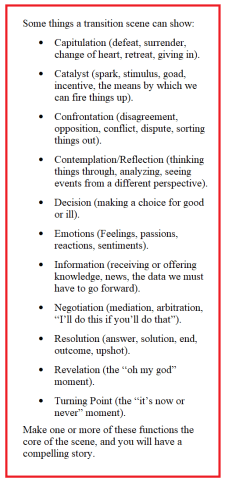 If you ask a reader what makes a memorable story, they will tell you that the emotions it evoked are why they loved that novel. They were allowed to process the events, given a moment of rest and reflection between the action. Our characters can take a moment to think, but while doing so, they must be transitioning to the next scene.
The narrative is driven by the characters who have information that must come out. This information must only be given at a certain point in the storyline, and only to those who must have that knowledge in order to accomplish their goal.
These information scenes are transitions and are vital to the reader’s understanding of why these events occur. They show us what must be done to resolve the final problem. The fact that some characters must work with limited information creates roadblocks and raises tension in the reader.
The transition is also where you ratchet up the emotional tension. As I showed in the example above, introspection offers an opportunity for clues about the characters to emerge. It opens a window for the reader to see who they are and how they react. It illuminates their fears and strengths. It makes them seem real and self-aware.
Characters’ thoughts must illuminate their motives at a particular moment in time and explore information not previously discussed. Keep the moments of mind wandering brief. Go easy if you use italics to set your thoughts off. A wall of italics is hard to read, so don’t have your characters “think” too much if you use them.
Internal monologues should humanize our characters and show them as clueless about their flaws and strengths. It should even show they are ignorant of their deepest fears and don’t know how to achieve their goals.
With that said, we must avoid “head-hopping.” The best way to avoid confusion is to give a new chapter to each point-of-view character. (Head-hopping occurs when an author describes the thoughts of two point-of-view characters within a single scene.)
 Visual Cues: In my own work, when I come across the word “smile” or other words conveying a facial expression or character’s mood, it sometimes requires a complete re-visualization of the scene. I’m forced to look for a different way to express my intention, which is a necessary but frustrating aspect of the craft.
Fade-to-black is a time-honored way of moving from one event to the next. However, I don’t like using fade-to-black scene breaks as transitions within a chapter. Why not just start a new chapter once the scene has faded to black?
One of my favorite authors sometimes has chapters of only five or six hundred words, keeping each character thread separate and flowing well. A hard scene break with a new chapter is my preferred way to end a nice, satisfying fade-to-black.
Chapter breaks are transitions. I have found that as I write, chapter breaks fall naturally at certain places.
Writing isn’t the simplest occupation I could have chosen. I struggle, trying to make each scene as emotionally powerful as possible without going overboard. In my case, walking the line between monotonous and melodramatic is a balancing act.


 Life in the Realm of Fantasy

.jpg&oldid=225700063)