
Book launch: Forbidden Road by Connie J Jasperson.
I was priveleged to be interviewed on Carlie M.A. Cullen’s fine blog, and we talked about the launch of my book, Forbidden Road. Stop on by and check it out!
Book launch: Forbidden Road by Connie J Jasperson.
I was priveleged to be interviewed on Carlie M.A. Cullen’s fine blog, and we talked about the launch of my book, Forbidden Road. Stop on by and check it out!
![Pageflex Persona [document: PRS0000032_00050]](https://conniejjasperson.com/wp-content/uploads/2011/03/forbidden-road-bookcover5_25x8_cream_480-474-pages.jpg) On friday, February 1, 2013 the kindle version of Forbidden Road, Book II in the Tower of Bones series will launch, followed closely by the print version. The print version may be delayed if there are any formatting issues, but it should be through the process by February 15th at the latest.
On friday, February 1, 2013 the kindle version of Forbidden Road, Book II in the Tower of Bones series will launch, followed closely by the print version. The print version may be delayed if there are any formatting issues, but it should be through the process by February 15th at the latest.
In print form these books are the size of good doorstops, but not quite as big as most of the Wheel of Time series by Robert Jordan and Brandon Sanderson.
Someone asked me how I could write a book a year, and that made me laugh. I suppose it LOOKS like that’s what I have done, but in actuality I began writing Tower of Bones in March of 2009. I have two manuscripts going at all times so they do seem to roll out at the rate of one per year, but I was actually two or more years in the writing process for each book before they went to publication.
Tower of Bones began its life as the walk-through for an old-school style RPG along the lines of Final Fantasy Mystic Quest. My nephew Ryan and I thought would be fun to build something we could play and perhaps market as there is a large community of player who enjoy the old games. The game fell through but I liked the storyline and made it into a novel. But, by 2010 I realized it was never going to fly in the form I had originally created it.
In its first incarnation, Tower of Bones read in the “He is; he does; he goes” style of a Brady walk-through. Not real  easy to get into as a reader! Present tense: The events of the plot are depicted as occurring now—at the current moment—in real-time. (e.g. “They drive happily. They have found their way and are now preparing to celebrate.”) In English this tense, known as the “historical present”, is more common in spontaneous conversational narratives than in written literature. A recent example of this is the Hunger Games trilogy by Suzanne Collins.
You don’t even want to know the agony that I went through in changing the viewpoint of the entire 150,000 word ms from that awkward present tense point of view to the standard third person point of view. Not only that, I had begun Forbidden Road in the same style! Oh, my goodness–2010 was the year in which Grandma could frequently be heard exclaiming things like, “Sassafras! And Dirty Words!”
Alison DeLuca and my sister Sherrie DeGraw pored over that ms trying to help me clean it up, and finally by the end of 2011 it was done.
Now, three years after I began Forbidden Road it is in the grinder at Amazon, and the launch day approaches. It just looks like I am chugging them out one a year. I have already been working on Huw the Bard for 15 months, and Mountains of the Moon has been in the works for 18 months (and is still not finished.) Valley of Sorrows (book 3 in Tower of Bones series) has been in the works since November and NaNoWriMo
2010 was also the year I began The Last Good Knight as a NaNoWriMo project. I allowed myself to rush into publishing it when it was not ready. It is now readable, largely to the assistance of both Rachel Tsoumbakos and Carlie Cullen. I admit that my view of my own work is skewed by my growing as an author and gaining experience as an editor. It may be that I see my work in a worse light than the casual reader would, but in my opinion there were enough speed bumps in Billy’s Revenge 1 – TLGK to gag the dog.
One thing I have been working on is dealing with (if I may descend into technical terms) is Hinky Formatting Issues and VooDoo Readability. Anyone who has ever read an e-book knows what I am talking about, although they may not realize what has caused the strange appearance of random question marks where apostrophes should be. Strange formatting issues are also responsible for the way paragraphs will randomly lose their indentations, making a page look like a wall of words.
Unfortunately several wordprocessing programs are rife with hidden formatting, so if your ms began life in Open Office, you will need to strip all the formatting out of your work and reformat it, saving it as a .RTF. It gets even more complicated if you switched to using Word halfway through. As a rule, I strip all the formatting and completely reformat all my manuscripts before I upload them now, it saves time and curse words later. Rich Text Format files (signified by the extension .rtf) can also be argued to be safer than Word documents, (or .doc and .docx.) This is also, again, because .rtf uses text-based encoding. In simple terms, it’s pretty much impossible for Word to mess up .rtf files, because they are text-based: if there is a mistake while opening the file, the worst that will happen is that Word will open it as a text file, which will look like this:
\par A question that may often come to the mind of people who watch Mexican soap
operas is, \ldblquote Who the heck invented this ridiculous plot that consists
of the love af
fair between a rich guy and a poor girl who end up getting
married in the end despite all the adversity??\rdblquote This idea,
overexploited and completely clich\’e9
If there is a failure in .rtf you can at least read it. BUT the optimal goal is to have NO Formatting Failures so never rush to publish. If you are an indie you can simply move your launch date back until you have straightened out your issues. Use the option to review it in the handy reader KDP provides when you publish with them. B&N for Nook also has this option. Order proofs from your print-publisher and make sure your book looks the way you want it by going over every page of the proof copies line by line before you hear back from your friends that your book is a mess.
In the end I am responsible for what my work looks like so I have to do the footwork and make sure my formatting issues are all solved before the launch date. This requires both a calendar and the will to use it. Plan for a week of playing with your uploads to Kindle and CreateSpace before your projected launch date, and hopefully your work will go smoothly enough that you won’t need the extra time. Authors are notorious for leaving everything to the last-minute but I do suggest you don’t procrastinate in this endeavor. Random things go sideways and need to be redone. You’ll be much happier if you do the responsible thing and leave yourself plenty of wiggle-room during the crazy week leading up to your launch.
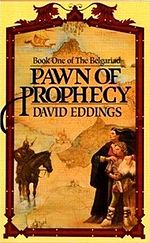 In 1982 I picked up Pawn of Prophecy by the late David Eddings. This was an amazing, eye-opening book for me, as both a reader and an author. Eddings had the ability to convey a sense of place in a few well-chosen words. The book opens in the kitchen of a farmhouse with Garion’s memories of playing under the table in a kitchen as small child.
This is the first book in the 5 volume series, the Belgariad and chronicles the childhood of an orphaned boy, Garion, who is being raised by his Aunt Pol who works as the cook on a prosperous farm in a place called Sendaria. Garion has friends, and as time progresses he even has a wistful almost-romance with one of the girls there. But all is not as it appears, and Garion knows nothing of the reality of his family or the world he lives in.
He has other friends; Durnik the smith who is in love with Garion’s Aunt Pol, and a strange old traveling storyteller, Mr. Wolf whom his aunt seems to know well and whom she grudgingly tolerates despite his strange attire and love of ale.
What David Eddings does in the first chapters of this book is truly magical. He immediately drew me in and within two paragraphs I was immersed in this world–I could smell the smell scents of the kitchen and visualize the people who worked there so companionably in the generous employ of Farmer Faldor. I felt I knew them, and I felt I knew that farm.
I am not a boy, but Eddings put me inside a boy’s mind and I understood that boy on a personal level. Garion’s confusion and dismay as everything he takes for granted begins to crumble around him is real and I felt his anger, his hurt and confusion. I understood his need to stand on his own and I knew fear when he did.
Eddings managed to draw me into that world with an economy of prose. He gives the reader just enough detail to fire the imagination, and the reader’s own mind does the rest, unencumbered by too much of the author’s personal vision of the scene. He does this by describing what the boy remembers of the kitchen, and more emphasis is placed on the emotions evoked by scents and memories of conversations, supported by the merest framework of the scene. Edding’s world is filtered through the eyes of the people who live in it.
Garion’s earliest memories are of being a toddler–the sound of knives deftly dicing vegetable, his aunt keeping him corralled and happy under the table while she works, the sparkle of the gleaming pots and kettles high on the wall lulling him to nap.
“And sometimes in the late afternoon when he grew tired, he would lie in a corner and stare into one of the flickering fires that gleamed and reflected back from the hundred polished pots and knives and long-handled spoons that hung from pegs along the whitewashed walls and, all bemused, he would drift off to sleep in perfect peace and harmony with all the world around him.”
In that passage we see the entire kitchen, and we have a visual image of it. The child’s sense of contentment and safety that the kitchen represented is conveyed by the impressions of the kitchen instead of the image of it. The detail supports the story rather than impeding it.
Many times I see authors try to force an exact, detailed picture of their world on the reader, and it ruins the story for me. An author doesn’t have to beat me over the head with minute detail; that sort of thing bores me.
What reading the work of David Eddings has taught me is that economy of detail and simple lines often make a more powerful picture than a detailed drawing that looks like a search and find game. Some indie authors set a scene with so much detail it reads like an episode of Hoarders. I understand that, as I too wrestle with the tendency.
In the editing process I have had some of my most cherished passages detailing certain places or people thrown out with the simple phase “This is hokey”, and while it hurts to see those words in the comments, it is true and so it is time to throw out a beloved passage and opt for a lean description.
Sometime I opt for too lean a description and when the comment “What were they feeling? How did they show it?” appears in the right hand column I sometimes wonder why they can’t see it when it is as plain as day. But upon examination I realize that maybe a line or two more might help explain the emotion of a scene.
Still, it is important to remember that my reader has an idea of what true beauty is, and they may not think a girl with sun-yellow hair in perfect ringlets framing a heart-shaped face with fine, arching eyebrows over corn-flower-blue eyes peering through dark curling lashes is as beautiful as I may think she is. It may be better for me to refer to her as fair-haired and astonishingly pretty, and leave it at that.
If I could ask for any skill, it would be create a world with the precision and fine craftsmanship David Eddings brought to his work. To this end, I read the works of the great masters of fantasy hoping to absorb some of their techniques and wizardry. I also read the works of newly published indie authors hoping to find that one kernel of genius that will strike a chord in my soul and transport me to a world not of my own making.
The next installment in this series will be focusing on just that–indies of great talent whose works are as yet unknown but which have had an impact on me as a reader.
 I thought I had The Last Good Knight all cleaned up. I was SURE I had it as straight as could be! Many eyes have looked at it, and still there are places that need attention! Fortunately, Carlie Cullen is applying her red pen to the hitches and halts in the flow, without changing the story or the structure since it has been published for so long. It’s a good story, probably my favorite but it has had a rough life.
This is the one tale that never had a real line-edit, and I was so new to this business that I thought the brief once-over my former publisher gave it was a true edit. They were new at the business too, and were learning a lot as they went along. It was a good edit, in that it cleaned up certain obvious things, but it was very quick and not a true, in-depth edit. I was not involved in the actual edit, as the changes that were made were not offered to me for my approval. Thus, getting that book re-edited so that it reads more easily is somewhat like mucking out after a dragon. Just about the the time I think it’s all done, there is another steaming pile of…goodness…look at the time, I should be cooking dinner.
Having worked with two editors since leaving the former publisher, I now see what was NOT done for The Last Good Knight the first time, and thank god, one of my editors, Carlie Cullen is giving it her attention. The biggest challenge is dealing with these things and moving on, instead of banging my head on my desk in frustration when she points out something I should have seen.
But that is why these sorts of edits are SO critical. We, as authors, only see what we THINK we wrote. This is something I can’t stress strongly enough–get an independent eye on your work. If you have a friend who has worked as a paralegal for her entire career, proof-reading lawyers briefs as Irene Luvaul did, even better! If you can’t find an editor you can afford, you can do this: Print your work out one chapter at a time, and sit down with the yellow high-lighter. take an envelope and go down the page one line at a time. You will catch a great deal that way!
I don’t feel nearly so badly about TLGK once I take a close look at my earlier works though – those tales who began their lives on  the old Mac in the mid nineties. Once they were transferred to disc and then transferred again to PC they were put away and forgotten. Some have great storylines, and really fun characters, but I would have to completely rewrite them in order to make a silk purse out of the sow’s ear they are right now. There must be an entire library of badly written prose on those old mac floppies.
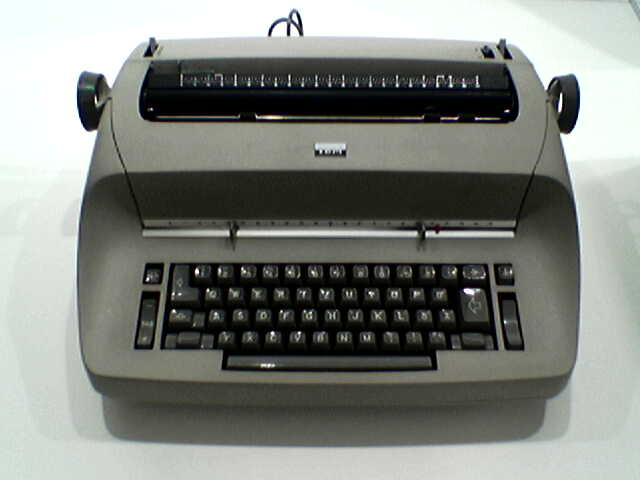
There are many flaws in my earlier works, especially the ones going back to my days of pecking them out on the old IBM Selectric.They are rife with misspellings, poor grammar, clichés, head-hopping, and hokey dialogue. But underneath all the bad fluff I see the bones of the story I was so proud of having written in the first place, and I realize that there was spark there. This is why I say don’t be discouraged by your first initial draft of any work. All it needs is a lot more attention from you and the eye of an editor.
 I was once a singer in a heavy metal band, and the opening lines of one of the songs I wrote went like this:
“It’s a cold and lonely morning, the sky dawns bland and white.
The emptiness inside my heart is as chilling as the night.”
It was cheerful little tune (NOT!) but with my ex-husband’s awesome guitar solos it was quite popular among our friends. We were very hip and very serious about the craft when we played. Of course I was 26 at the time, and quite sure I was the next female Ronnie James Dio. The band as a whole took ourselves far too seriously, and it soon got to the point where it wasn’t fun anymore. It was a long time before I realized exactly why we fell apart the way we did, when we were having such a good time playing small gigs as a local band. We became too caught up with the art of the music, instead of getting on with it and we forgot why we were doing it in the first place.
I admit that I don’t need serious anymore. I don’t need to take my writing so seriously that it’s not fun.
With that said, I do need to turn out the best finished product I am able to do, and that means allowing someone I trust to look at it and say, “This just doesn’t read right. Maybe if you change this a little….” I am not married to my prose, although I am sure it is the finest prose in the world. Oh, look…more dragon poo.
 One of the earliest influences on my sometimes smartassed style of writing was Sir Terry Pratchett, O.B.E.‘s watershed fantasy series, Discworld. Sir Terry takes J. R. R. Tolkien, Robert E. Howard, H. P. Lovecraft and William Shakespeare, as well as mythology, folklore and fairy tales, and mashes them up in this hilarious series of tales. There are 39 books in this trilogy! Talk about prolific!
Discworld is a flat disc balanced on the backs of four elephants which, in turn, stand on the back of a giant turtle, Great A’Tuin. Oh my goodness – what opportunities for mayhem were locked in that kernel of a plot! The series begins with “The Colour of Magic.”
One of my favorite books in the series is “Mort.” It is the 4th book and is the first to give Death the main storyline.
As a teenager, Mort had a personality and temperament that made him rather unsuited to the family farming business. Mort’s father, named Lezek, felt that Mort thought too much, which prevented him from achieving anything practical. Thus, Lezek took him to a local hiring fair, hoping that Mort would land an apprenticeship with some tradesman; not only would this provide a job for his son, but it would also make his son’s propensity towards thinking someone else’s problem.
The conversation between Lezek and his brother Hamish as they discuss Mort’s future in the opening pages is hilarious and quite revealing in its simplicity. In this snippett, Lezek and Hamish are observing Mort as he attempts to frighten some birds away from the crop.
“He’s not stupid, mind” said Hamish. “Not what you’d call stupid.”
“There’s a brain there all right,”Lezek conceded. “Sometimes he starts thinking so hard you has to hit him round the head to get his attention. His granny taught him to read, see? I reckon it overheated his mind.”
At the job fair, Mort at first has no luck attracting the interest of an employer. Then, just before the stroke of midnight, a man concealed in a black cloak arrives on a white horse. He says he is looking for a young man to assist him in his work and selects Mort for the job. The man turns out to be Death, and Mort is given an apprenticeship in ushering souls into the next world (though his father thinks he’s been apprenticed to an undertaker).
I love the snarky way Pratchett takes clichés and runs with them. He grabs the boring, bland, overdone themes of western literature by the tail and swings them. When he sets them down they are SO much more fun to watch!
What I have learned from the Terry Pratchett school of prose is that dialog tells us as much about the speaker himself as it does about the words expressed. In the quoted passage above we see enough of the two men who are speaking to have some idea of who they are. Pratchett gives us the personality and demeanor of the character in those simple lines. We can see them, fully formed in our minds eye as they speak. .
That is the hand of the master, and it is what I someday hope to be able to bring to my own work. The important thing to remember is you must read the works of the masters, because if you have no idea of what good writing really is, you can’t write it. Read the best works in your genre and continue writing your own stories and never let the struggle of getting your work out there take away the joy of writing it. It’s not easy, going indie, but it is so rewarding!
 Social networking has always been important for girls–invite me to your birthday party and I will invite you to mine. We both gain that way. After all, you get a present and I get a cupcake! In childhood the little bits of social networking we did led to tears as often as it did to cupcakes, but now we’re grownups and we have a book or a music cd to market. We can’t afford to shed tears over this.
Whether it is music or books, if you are an indie, you must take responsibility for your own marketing.
1. Decide what you are marketing. This sounds like a no brainer, but many people are blurry on this, and they apply a lot of energy and get nowhere. I know many people who write, paint and ALSO make music. If you are doing multiple things, separate your website into different pages for each aspect of your career, with a good home page that directs your prospective client to the product they are looking for. I really like the website which Blackmore’s Night has put up, and I also like Mercedes Lackey’s website. Both are professionally done, but a free WordPress Blog can be utilized to good advantage by a determined self-promoter. The lovely folks at WordPress give you all the tools you need to learn how to do this!
2. Make regular posts and updates, to keep your blog fresh. After all – we’ve all clicked on links in the google list that take us to abandoned virtual warehouses, with out of long out of date information and links to nowhere!
3. Use Twitter well and sparingly. Twitter can easily become a spam-fest, so be careful how you use it. Be sure to retweet your twitter-friend’s important events, and they will return the favor. Once in a while, post your homepage, your professional Facebook page and links to your books or your music, but be wise and respect your friends.
4. The eternal sunshine of the Facebook page – again, be careful not to spam the world everyday with your links on your personal page, because your highschool chums and distant cousins won’t pay anymore attention to them than they do Aunt Caro’s constant barrage of invitations to play Farmville. In fact, they may unsubscribe from you. This is where having a professional page comes in handy. After you send out ONE invitation to your family and friends to ‘LIKE’ your professional fb page, you are good to go. Maybe in a few months, re-post the link on your personal wall, but don’t beat folks over the head with it. Do tweet the links to it once in a while, and post them on your blog/website. Page Owners need to make sure their content is interesting and in that way they are encouraging Likes, comments and Shares so that their posts continue to show up in their Fans’ News Feeds, but they MUST NOT SPAM.
BTW – My Facebook page is at https://www.facebook.com/cjjasperson and I would be awfully happy if you would stop by and ‘like’ me… I’ll save you a cupcake at my next birthday party! (…hmm…should I use ‘lol’ here or is that too hokey?) (I’m not really joking, so maybe ‘lol’ is appropriate… it’s jaunty and pretends I’m not serious…)
lol.
It’s tough trying to learn the ropes in the world of self-promotion. There really is no handbook, because the social-network scene is always changing.
One thing hasn’t changed though and that is business etiquette. Trying to walk that fine line between getting your name out there and being that annoying acquaintance who deluges his casual acquaintances with constant demands that they buy his wretched cd or book is difficult. I think this is where our manners come into play–what would you like your friends who are self-promoting to do? Behave the way you want them to behave for you and hopefully you will still have friends in a year!
lol. (I mean it this time.)
I do have some acquaintances on Facebook who bury me with spammy demands to push their product, and I have friends who only ask to have a product pushed once in a while. Guess who I am always happy to help? Not Spam-the-Man Jones and their sad book of badly conceived, not-so-erotic, pornographic haikus.
Now that might actually sell. (Note to self–consider writing a collection of seventeen-syllable erotic poems…)
Nah. lol.

Today’s guest post is by Maria V.A. Johnson, poet and editor. Maria was the editor on Carlie M.A. Cullen’s novel of paranormal love and adventure, ‘Heart Search: Lost’. Maria can be found blogging at http://mariavajohnson.com.
Maria is discussing the fine balancing act an author has when it comes to description. For me, description is like hot-sauce. I love it, even when my lips are on fire, but I fear going over-board with it so when I am cooking, I don’t go there as often as I should.
>>><<<
The Descriptive Balancing Act
One of the hardest parts about writing is getting the level of detail correct. If you don’t describe something well enough, how are the readers supposed to connect to it? On the other hand, if you describe too much they will give up reading it completely. 
It has always been a balancing act, between description and plot. One thing you need to remember though is that a story should always be either plot or character driven; it cannot be driven on description. The whole point of description is to paint the scene. Think of a painting of a woman. Is it interesting if she is standing in a white canvas, nothing around her? Not really. But is it interesting if she is standing in the middle of a huge crowd, or a forest, so you can barely see her? No. An author has to try to find the middle ground, just like with that painting.
So how do you use enough description to show the scene without overwhelming it?
Step One. Focus on telling the story. You can always go back and add more detail later if it’s needed.
Step Two. Try to be realistic. Don’t put in fancy words and elaborate phrasing just because it sounds good or you think it will stun the reader with your eloquence. Look at this phrase from the Bulwer-Lytton Fiction Contest. http://www.bulwer-lytton.com/2011win.html
The Los Angeles morning was heavy with smog, the word being a portmanteau of smoke and fog, though in LA the pollutants are typically vehicular emissions as opposed to actual smoke and fog, unlike 19th-century London where the smoke from countless small coal fires often combined with fog off the Thames to produce true smog, though back then they were not clever enough to call it that.
Now a) this sentence is way too long, which makes it difficult to follow from one end to the other, and b) you only need the first 8 words. Who doesn’t know what smog is? Who doesn’t know this author is referring to the car emissions? It is unnecessary detail. And the reference to 19th-century London? This would only be relevant if this were in a Historical Fiction novel or something similar, rather than being a throw-away comment on what real smog should be. The author should just say “The Los Angeles morning was heavy with smog,” and then move on with the story. We all know what it looks like, and those 8 words conjure enough of a picture for us to understand the scene.
Step Three. Think about your characters. How do they act, think, feel? When they do or say something can you see their personality, their motivation, their feeling behind it? You don’t need whole paragraphs to do this unless it is a scene that calls for it, e.g. when someone is crushed by grief and the emotions are overwhelming everything – including the story, sometimes all you need is a word or two. Look at this example from Heart Search: Lost by Carlie M. A. Cullen.
“I don’t know what to say,” he moaned, anguish still apparent in his tone.
The male protagonist has just accidentally hurt his partner. You can see with just a few words how much it has affected him and how he feels about it. This tells you a lot about his character, how caring and gentle he is, and how much he loves her.
Step Four. Before sending it off to an editor, give it a read through and ask yourself “Is this something I would like to read?” If the answer is no, then ask yourself why.
Four easy steps to follow towards a balanced story. Of course, there are exceptions to every rule, but even for the exceptions there is a rule.
The Rule. If you are going to break a rule, make sure you do it well enough that nobody cares!
Let’s look at two classic examples of this – C. S. Lewis and J. R. R. Tolkien. Tolkien is known for his amazing scenes. Pick up The Lord of the Rings and you will find description on top of description. Even when they take up the entire page, it doesn’t feel too heavy. This is partly because of the length of the book, and partly because of the way he makes the scenes come to life. You don’t notice how long the descriptive passages are when you are lost within the world he has created.
On the south-eastern side the ground fell very steeply, as if the slopes of the hill were continued far down under the trees, like island-shores that really are the sides of a mountain rising out of deep waters.
Lewis is the exact opposite. Read The Chronicles of Narnia and you will see how little description he actually uses. The fact that this is a children’s book helps. A person’s imagination is most vivid as a child. He gives just enough detail to release the child to see the rest. He makes the reader the describer, letting them go where they want with only a little nudge. In The Lion, The Witch and the Wardrobe most things and people are described, but not until you are half-way through the final chapter do you learn anything about the four main characters.
And they themselves grew and changed as the years passed over them. And Peter became a tall and deep-chested man and a great warrior, and he was called King Peter the Magnificent. And Susan grew into a tall and gracious woman with black hair that fell almost to her feet … Edmund was a graver and quieter man than Peter, and great in council and judgement. He was called King Edmund the Just. But as for Lucy, she was always gay and golden-haired…
So now you know the steps to follow, you are half-way to having a decent novel which will engage your readers. Don’t forget that you should ALWAYS send it off to a professional editor – NEVER try to do it yourself!
Remember The Rule and happy writing!
Filed under Adventure, Books, Fantasy, Humor, Literature, Uncategorized, vampires, writer, writing
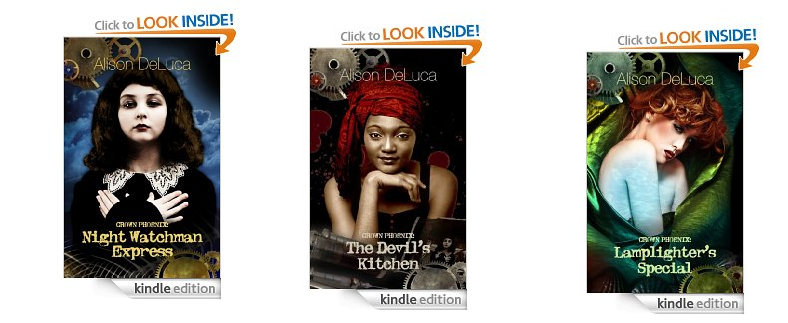
 Alison DeLuca is the well-known author of the Steampunk series, ‘The Crown Phoenix’. This series has captured my imagination since I first read ‘The Night Watchman Express’, and she has just published the third book in the series, ‘Lamplighter’s Special’. My review of the series is posted on my book review blog, Best In Fantasy.
Alison is a master of character development. I love each and every one of her characters, feeling as if they were my dearest friends (or in some cases enemies). The premise of the series is extremely creative, involving all the finest elements of the Steampunk genre – magic, machines and the eternal battle with dark-forces. She manages to do this magnificently and neatly avoids devolving into formulaic kitsch as some rather popular pulp-novels have done.
Because I love her characters and their depth so much, I asked her to discuss the most unlikely and intriguing pair, Riki and Neil. Two people less like to make a romantic connection never lived, and yet their story has been one of my favorite threads in the saga.
>>><<<
A Sharp Left Turn
In my first book, Crown Phoenix: Night Watchman Express, the action changes in the middle of the book. I leave Miriam and Simon on the Night Watchman train, kidnapped and heading to a sinister, unknown destination.
Simon’s friend, Neil, heads off to the mythical island of Lampala. When I wrote the book, I based the geography on the country of Madeira. Beyond that, I wanted to completely avoid any trace of colonialism in my plot. The Lampalans had to be well-off with a thriving industry and their own government.
Neil reaches the island, thanks to the mechanics of the Crown Phoenix, a quantum typewriter. He is rescued by Riki, a girl who is very thin, energetic, and quite a pain in the behind.
Her parents are well-to-do, but they cannot control Riki. She is just one of those kids who was born yelling her head off, and she hasn’t stopped since. She gets bored easily, which probably means she is very intelligent. Furthermore, she is extremely loyal. Once Riki is your friend, she will stick by you through anything.
She can hardly believe, however, that Neil doesn’t immediately fall for her:
“Well, don’t worry. When you and I get married, you’ll be rich.”
Neil shot to his feet and dropped his sandwich onto the beach below, where it was picked up by a triumphant gull. “When we what?” he repeated in a strangled voice.
“When you marry me.” Riki smiled at him and swallowed the last of her sweet roll.
He huffed, catching his breath, and finally managed to say, “Oh, no, I’m not marrying you. No-ho. Mhp-hm.”
She looked up at him in astonishment. “You mean, you don’t want to marry me? Why not?”
“Because,” he responded, “you are, without a doubt, the rudest, most ill-mannered girl I have ever met in my entire life.”
She considered this. Her eyes turned into slits. “Well,” she finally retorted, “I’ve been nice to you today.
“Maybe. However, I’m not going to marry someone whose best claim to decent behavior is that they’ve ‘been nice today’. If I ever get married at all, that is.”
Both Riki and Neil run into Kyoge, one of the King’s Guards. I based Kyoge on a painting called, “The Moorish Chief.” He is tall and strong – a superbly athletic man. His physical prowess is matched by his shrewd wits. He, like Riki, is also very loyal. When he realizes that the true ruler of Lampala is alive and hidden on the island, he risks everything to help.
When I took that Sharp Left Turn, I knew it was a risk. Instead of following the plot and main character of the first section, I followed a new train of thought and a different set of people. Why did I do it? Not to torture my readers, but instead to increase the excitement of what followed. In that, I borrowed a page from one of my favorite children’s authors, Joan Aiken. She would reach the most exciting part of a scene and go to another set of characters. It kept me reading, agog, well past my bedtime, when I was ten years old.
I’m no Joan Aiken, but I do hope that readers enjoy my side trip to Lampala. I love the island, and I adored writing the story that happened there.
>>><<<
Alison DeLuca grew up on an organic farm in Chester County, Pennsylvania. Her parents were British, so in the summers she went to stay with her grandparents near Dublin.
There was no stereo or TV there, so Alison, her sister, and her cousins spent the summer inventing stories and plays for each other. “This gave me the ability to entertain myself with my own imagination in any situation,” she says. “We used to be taken to tea with great-aunts, and we were expected to sit on an uncomfortable couch and not move or say a word. It was possible to endure it because I was watching my own little stories play out in my mind.”
After graduating from West Chester University, Alison became a teacher of English and Spanish, teaching students from kindergarten up to college level. She loved teaching, and it was with reluctance that she left the classroom to be a fulltime mom when her daughter was born.
While she was teaching and raising her daughter, Alison took every free minute she had to write. The Crown Phoenix Series was the result.
She is currently working on the final book in the series, as well as several other projects.
Comments Off on Alison DeLuca – A Sharp Left Turn
Filed under Battles, Books, Fantasy, Humor, Literature, Romance, Uncategorized, writer, writing
Today is day 12 of NaNoWriMo – and I’ve managed to write a total of 39,700 words since day one. It’s been a pure stream-of-consciousness, run-for-the-money, laying down of the basic structure of the story. Nothing of what I’ve written is anything I would be proud to show the dog at this point, but when I’ve finished with the many vignettes which form the basic storyline, I’ll begin the task of actually writing the story. I think it will be about 60,000 words when it is fully plotted.
Then the real work begins, when I have to turn this patchwork quilt of a manuscript into a book!The finishied book will be about 130,000 words.
In the meantime, for your dining pleasure we are serving up a delicious guest-post by UK author and blogger-extraordinaire, J.D. Hughes. J.D.’s new book ‘Northman’ is scheduled to be released on Friday, November 16th . He has kindly allowed me to reuse a post from his blog, J.D.Hughes.
I must confess that having seen the cover, and read the pitch I am lurking, waiting to get my hands on my copy! And now, without further ado I give you a reprise of my favorite post ever by one of my favorite bloggers:
WILLIAM THE CAT
Originally Posted on June 15, 2012 by J.D.Hughes
I am not a fan of cats.
They leave excrement in my orchard and pee on my windfall apples.
But, I have a grudging respect for William the cat. He is white, sleek – turning to a little tubbiness as he ages – but will kill anything smaller than he. That characteristic would be psychotic in a human being, but defines a cat.

I’ve never seen him pee on my apples or crap in my garden, so he is – in that catlike manner – returning my respect. Or so I like to think. If I am realistic he probably regards me as an occasional source of food and gruffly masculine tummy rubs but is indifferent to my opinion of him. He has repeatedly tried to get into my house after one successful raid. We are now engaged in a cat and man game, which he believes he will win. He is seeking to wear me down with persistence, but I have owned many dogs who knew more about persistence than any creature living or dead when it came to precise feeding and walking times, so he will be disappointed.
For some reason he has a liking for my garage and is often locked in for long periods of time. We have a thriving community of field mice to keep him entertained, but I think it may be an attempt to show me how easy my garage is. Logically, that ties in with his belief that my house will one day be his.
He has no remorse, no sense of guilt when some small creature is struggling in his jaws, little understanding or sympathy with anything living and zero interest in anything with which he has played and which has now stopped moving.
So, why do I respect William the cat?
Because he is being a cat.
It’s what cats do. He has no choice.
I respect human beings who tell the truth, help others, attempt to raise mankind from the gutter and try to behave in a kindly manner to their neighbours for a similar, but perhaps not the same, reason.
Not all humans behave like that. Some of William is built into our DNA and we occasionally behave badly towards our fellows.
The difference is that we have a choice. We can think rationally about whether it is a good idea to kill people smaller, weaker, less intelligent than, or different from, ourselves.
There are exceptions, of course. The sociopathic or psychotic personality may have no choice, but we do.
My previous post was about Truth and this is a (sort of) continuation. My belief is that there is nothing to be gained by being unpleasant or violent to strangers and that it is a part of our journey to the status of rational beings for us to be kind to people – do unto others and all that.
Of course, if they attack you with a machete then one should adopt the William attitude and either run away or get a bigger machete.
My own journey through life tells me that most people harbour few truly evil thoughts towards others. Occasionally, hatred will spring up in the fight for sex, resources or survival (perceived or real) but unless there is a continuing need for the above then it often dies away and people (mostly) play nice, or at least become tolerant.
So, as William wanders past with something furry clamped in his jaws I wonder how I would feel trapped in behaviours I cannot control, without choice and destined to repeat the same patterns, again and again.
Got to stop now. It’s 12.30pm, time for my Ploughman’s Lunch, a short walk, the BBC News, a nap at 1.27pm for exactly 21 minutes and a quick chase around the garden looking for small rodents or baby birds to eat.
Unless William has been there before me.
>>><<<
 Below I have posted J.D.’s biography, exactly as he sent it to me. He cracks me up!
A ‘sort of’ Writer, living in the Peak District of Derbyshire, England.
His new supernatural thriller for adults, NORTHMAN, begins in Anglo-Saxon England, 943 AD, moves through World WarTwo, 1943 and into the present. It is an epic story of timeless love and eternal evil but contains no vampires or werewolves.
It has something infinitely more evil. 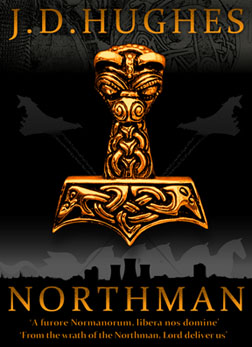
He also has several free, dark tales (links on blog). Or on Amazon if you want in a perverse gesture of altruism to buy them.
JD has worked as a writer, director and producer of commercials, short films, corporate and music promos. Recently, he accidentally gained an MA in Film Studies and Screenwriting, whilst continuing to work as a freelance. He loves film, so enjoyed the experience and almost continued on to a PhD, but decided that it would interfere with real writing and painting the shed.
JD started writing fiction aged 11 and it has taken him until now to be competent – obviously a slow learner. Some might say that point of competency is still some way off. Despite those people, JD is determined to inflict his writing on innocent readers and will be doing so to the exclusion of all other delusions (except painting the shed) for the foreseeable future.
He apologises in advance to those who will be offended, and hopes the rest of the world will enjoy some of it.
Don’t tell me the moon is shining; show me the glint of light on broken glass. ~Anton Chekhov
Filed under Adventure, Books, Fantasy, Humor, Literature, Uncategorized, writer, writing
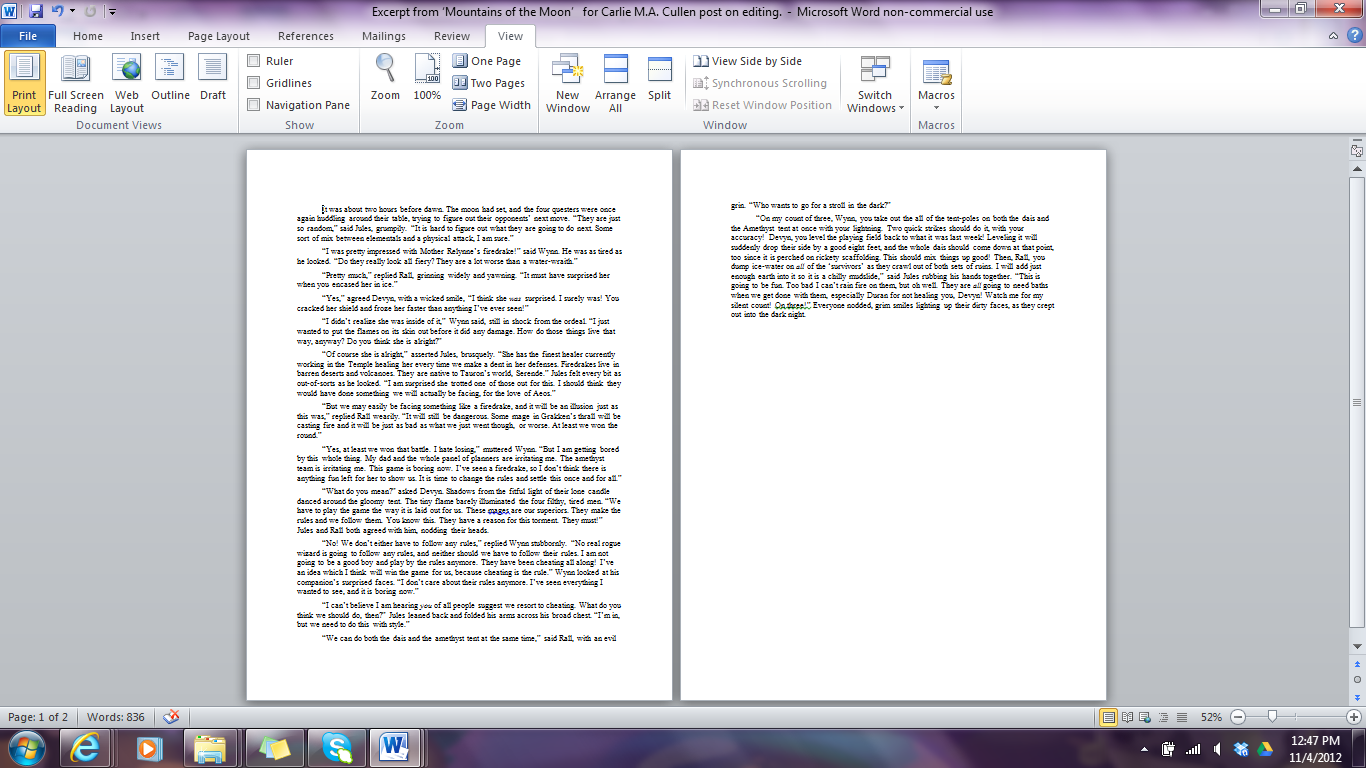 I’ve asked Carlie Cullen, author of Heart Search, and one of my editors on the Tower of Bones series to write a guest post detailing what an editor looks for when they receive a manuscript for the first editing. I also asked her to take a hitherto unedited bit of a current work in progress and to edit it for this post in the way she will when it actually goes to her sometime next year. The following is her post and the commentary. To the left here, I’ve inserted a screen shot of the unedited ms. At the bottom of this post is the screenshot of what the ms looks like now she’s sent it back to me.
What I hope you will all gain from this is (a) the importance of an impartial eye on your work, and (b) the understanding that criticism is a necessary part of growth.
I take each of her comments, and I analyze it with as fair an eye as I can. Then I make the changes, but I do them my own way. I don’t do heavy descriptors, and Carlie’s own work is very descriptive. This is why we work well together. She brings out the places where I’ve skimped on the descriptors too much, and forces me to be more forthcoming with showing the emotions of the scene.
Today I bring you part one of Carlie M.A. Cullen on editing!
>>><<<
Editing a raw manuscript is like dealing with an overgrown garden full of weeds; you need to cut back the long stuff before you can see the weeds choking the plants. This analogy is why editors generally do more than one round of editing, as they need to get some semblance of order to the manuscript before they can look at structure and the development of a story.
An editor has to look for a large number of things as they go through each line. As well as spelling, grammar (including correct use of tenses) and punctuation, which is the first thing I look at, there are the following:
All the above is what I would normally do on a first round of editing – the cutting back of the long stuff to get to the plant-choking weeds. Then on the second round, I double check all the items above once more to ensure nothing has been missed, plus I begin the structural and developmental part of the edit. These are the sorts of things I look at:
At the end of these processes and when the author has made any relevant changes, the editor has to final check the manuscript, to ensure it’s a polished gem, before it goes out for beta reading and subsequent publishing.

Thank you Carlie! On Wednesday we will see what the lovely, colorful commentary on the finished ms above means!
Filed under Battles, Books, Humor, Literature, Uncategorized, writer, writing


 Life in the Realm of Fantasy
