Tag Archives: Fine Art Friday

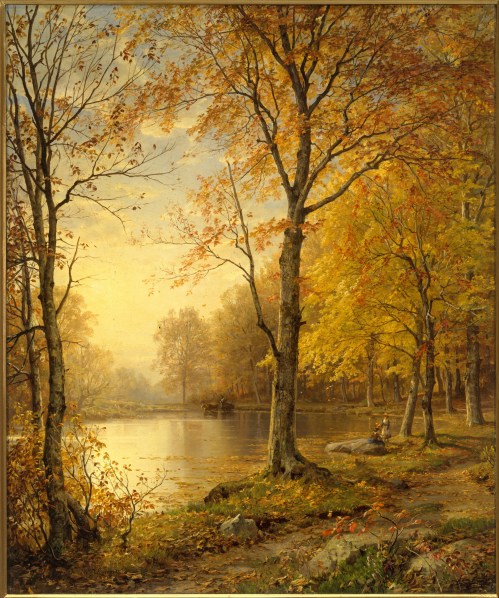
#FineArtFriday: Indian Summer by William Trost Richards 1875

Indian_Summer_MET_DT276257Title: Indian Summer by William Trost Richards

Genre: landscape art

Date: 1875

Medium: oil on canvas

Dimensions: 24 1/8 x 20 in. (61.3 x 50.8 cm)

Collection: Metropolitan Museum of Art

What I love about this painting:

Richards has captured a singular moment of tranquility for us all to enjoy in these troubled times. A light breeze barely ruffles the surface of our pond. At the bottom right, two girls play beside a large boulder at the waters’ edge.

Across the pond, in the center and nearly hidden in the shadows, a teamster and his oxen wade across the shallows.

Autumn’s haze lends a feeling of mystery to the scene, muting the reds, yellows, and oranges of leaves about to fall. This last burst of grandeur can’t hold back winter, though it tries. Soon the forest will sleep, soon snow and ice will decorate barren limbs and ice will stop the waters’ gentle motions.

But beneath the grasp of winter, new life will bide its time, and winter will fade into spring. The seasons will follow their course, but today is autumn’s day to shine, to go down in a blaze of golden glory.

Richards paints a day of peace and serenity, a small pocket of time where one can just sit back and admire the beauty of our world.

 >>><<<

About William Trost Richards:

William Trost Richards (November 14, 1833 – November 8, 1905) was an American landscape artist. He was associated with both the Hudson River School and the American Pre-Raphaelite movement. [1]

1856 he married Anna Matlack Richards (1834–1900), a 19th-century American children’s author, poet and translator best known for her fantasy novel, A New Alice in the Old Wonderland. The couple had eight children, only five of whom lived past infancy. Anna educated the children at home to a pre-college level in the arts and sciences. [2]

One of the couple’s sons, Theodore William Richards, would later win the 1914 Nobel Prize in Chemistry. Anna Richards Brewster, their sixth child, went on to become an important painter in her own right, having received an early arts education from her father as well. [2]

Richards rejected the romanticized and stylized approach of other Hudson River painters and instead insisted on meticulous factual renderings. His views of the White Mountains are almost photographic in their realism. In later years, Richards painted almost exclusively marine watercolors. [1]


Credits and Attributions:

Indian Summer by William Trost Richards, Wikimedia Commons contributors, “File:Indian Summer MET DT276257.jpg,” Wikimedia Commons, the free media repository, https://commons.wikimedia.org/w/index.php?title=File:Indian_Summer_MET_DT276257.jpg&oldid=678817431 (accessed November 3, 2022). Public Domain.

[1] Wikipedia contributors, “William Trost Richards,” Wikipedia, The Free Encyclopedia, https://en.wikipedia.org/w/index.php?title=William_Trost_Richards&oldid=1089835304 (accessed November 3, 2022).

[2] Wikipedia contributors, “Anna Matlack Richards,” Wikipedia, The Free Encyclopedia, https://en.wikipedia.org/w/index.php?title=Anna_Matlack_Richards&oldid=1055684363 (accessed November 3, 2022).
1 Comment

Filed under #FineArtFriday, writing

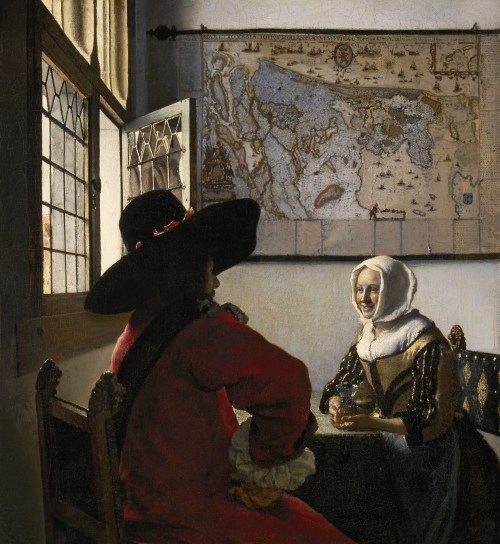
#FineArtFriday: Officer and Laughing Girl by Johannes Vermeer circa 1657 #prompt

Johannes_Vermeer_-_Officer_and_Laughing_Girl_-_Google_Art_Project

Artist: Johannes Vermeer (1632–1675)

Title: Officer and Laughing Girl

Genre: genre art

Date: circa 1657

Medium: oil on canvas

Dimensions: height: 50.5 cm (19.8 in); width: 46 cm (18.1 in)

Collection: The Frick Collection

This is the last prompt of October, as National Novel Writing Month kicks into gear in November. Vermeer paints us a story of courtship within the bounds of society, of two people with middleclass values who are clearly attracted to each other. Will they be married? I like to think so.

What I love about this painting:

As I said above, Vermeer paints a story for us. He shows us a courting couple, a modestly dressed young woman seated opposite a young officer. Is this the home of her parents?

It is clearly not a tavern, as she has a crystal wine glass, which taverns wouldn’t have. Another clue to her social status is the map on the wall behind her, indicating her family may be merchants. Taverns rarely displayed maps as they were expensive.

Our girl is dwarfed by the map and also by the large man, whose face we don’t see, as he is captivated by her. Yet though she is physically smaller than her companion, she is not made small in this painting. Indeed, she has a large presence; her personality and smile have power, speaking to us across the centuries.

The light falls gently though the open window, illuminating the woman, bathing the scene with that quality Vermeer recreated so brilliantly.

Some male art critics suggest that the position of her hand indicates a less savory transaction is occurring here, but I feel they are wrong. Her hair is completely covered. She is not dressed provocatively, nor are they shown in a tavern or brothel. Her hand is shown as if gesturing in conversation, a natural gesture.

I think that nasty kind of interpretation is the result of a Victorian-era male art critic prejudice against women in art, dismissing them as morally corrupt. That sort of attitude poisons art interpretation at all levels. Maybe traditional critics need to look at paintings such as this with a fresh eye and see what is actually there: a young woman talking to a young man, seated in a corner at a table, most likely in full view of her middleclass parents.

The model for the woman in this painting was most likely Vermeer’s wife, and the dress she wears appears in other domestic scenes painted by Vermeer, as does the window and the table.

About Johannes Vermeer, the Master of Light (from Wikipedia)

Johannes Vermeer (October 1632 – December 1675) was a Dutch painter who specialized in domestic interior scenes of middle-class life. He was a moderately successful provincial genre painter in his lifetime but evidently was not wealthy, leaving his wife and children in debt at his death, perhaps because he produced relatively few paintings.

Vermeer worked slowly and with great care, and frequently used very expensive pigments. He is particularly renowned for his masterly treatment and use of light in his work.

Vermeer painted mostly domestic interior scenes. “Almost all his paintings are apparently set in two smallish rooms in his house in Delft; they show the same furniture and decorations in various arrangements and they often portray the same people, mostly women.”

He was recognized during his lifetime in Delft and The Hague, but his modest celebrity gave way to obscurity after his death. He was barely mentioned in Arnold Houbraken‘s major source book on 17th-century Dutch painting (Grand Theatre of Dutch Painters and Women Artists), and was thus omitted from subsequent surveys of Dutch art for nearly two centuries. In the 19th century, Vermeer was rediscovered by Gustav Friedrich Waagen and Théophile Thoré-Bürger, who published an essay attributing 66 pictures to him, although only 34 paintings are universally attributed to him today. Since that time, Vermeer’s reputation has grown, and he is now acknowledged as one of the greatest painters of the Dutch Golden Age. [1]


Credits and Attributions:

Wikimedia Commons contributors, “File:Johannes Vermeer – De Soldaat en het Lachende Meisje – Google Art Project.jpg,” Wikimedia Commons, the free media repository, https://commons.wikimedia.org/w/index.php?title=File:Johannes_Vermeer_-_De_Soldaat_en_het_Lachende_Meisje_-_Google_Art_Project.jpg&oldid=617576363 (accessed April 29, 2022).

[1] Wikipedia contributors, “Johannes Vermeer,” Wikipedia, The Free Encyclopedia, https://en.wikipedia.org/w/index.php?title=Johannes_Vermeer&oldid=1082091616 (accessed April 29, 2022).

4 Comments

Filed under #FineArtFriday

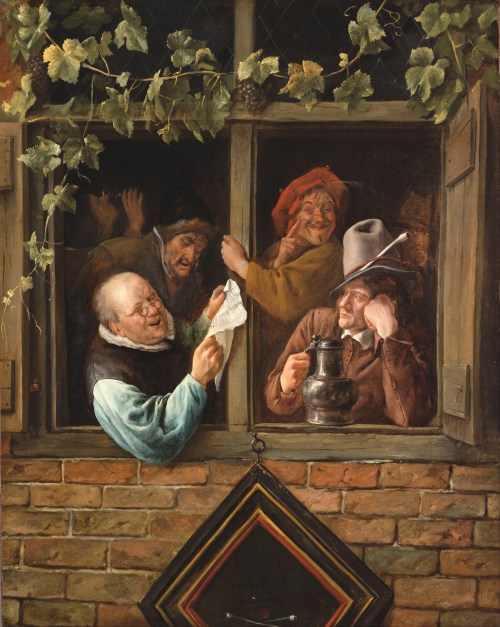
#FineArtFriday: Rhetoricians at a Window by Jan Steen ca. 1666 #prompt

Artist: Jan Steen  (1625/1626–1679)

Title: Rhetoricians at a Window

Genre: genre art

Date: c. 1661-66

Medium: oil on canvas

Dimensions: Height: 759.46 mm (29.90 in); Width: 586.23 mm (23.07 in)

Collection: Philadelphia Museum of Art

Today we’re looking to art for ideas, and our prompt is Rhetoricians at a Window by the Dutch master, Jan Steen.

What I love about this painting:

This is one of my all-time favorite Dutch genre paintings. It has inspired some the characters who pass through my stories, people my protagonists meet along the way. These jolly rogues have such vivid personalities that the viewer immediately feels a kinship to them. Who were they? Did they keep their day jobs?

The reading of a poem or play was clearly the opportunity for the performers to have a good time. From the drinker in the shadows of the background, to the grapevines growing around the window, Steen tells us that wine and rhetoric are clearly entwined.

I love the inclusion of both “the critic” who leans his head on his hand and listens analytically, and the man behind him, who is clearly “a little over the limit,” and supports himself by grasping the window frame and heartily agreeing with some point.

The actor who reads is clearly enjoying himself, as are the others.

About the Artist (Via Wikipedia):

Jan Havickszoon Steen (c. 1626 – buried 3 February 1679) was a Dutch Golden Age painter, one of the leading genre painters of the 17th century. His works are known for their psychological insight, sense of humour and abundance of colour.

Daily life was Jan Steen’s main pictorial theme. Many of the genre scenes he portrayed, as in The Feast of Saint Nicholas, are lively to the point of chaos and lustfulness, even so much that “a Jan Steen household”, meaning a messy scene, became a Dutch proverb (een huishouden van Jan Steen). Subtle hints in his paintings seem to suggest that Steen meant to warn the viewer rather than invite him to copy this behaviour. Many of Steen’s paintings bear references to old Dutch proverbs or literature. He often used members of his family as models, and painted quite a few self-portraits in which he showed no tendency of vanity.

Steen did not shy from other themes: he painted historical, mythological and religious scenes, portraits, still lifes and natural scenes. His portraits of children are famous. He is also well known for his mastery of light and attention to detail, most notably in Persian rugs and other textiles.

Steen was prolific, producing about 800 paintings, of which roughly 350 survive. His work was valued much by contemporaries and as a result he was reasonably well paid for his work. He did not have many students—only Richard Brakenburgh is recorded—but his work proved a source of inspiration for many painters. [2]

About this painting, Via Wikipedia:

Chambers of rhetoric (Dutch: rederijkerskamers) were dramatic societies in the Low Countries. Their members were called Rederijkers (singular Rederijker), from the French word ‘rhétoricien’, and during the 15th and 16th centuries were mainly interested in dramas and lyrics. These societies were closely connected with local civic leaders and their public plays were a form of early public relations for the city. [1]

In 1945, Sturla Gudlaugsson, a specialist in Dutch seventeenth-century painting and iconography and Director of the Netherlands Institute for Art History and the Mauritshuis in The Hague, wrote The Comedians in the work of Jan Steen and his Contemporaries, which revealed that a major influence on Jan Steen’s work was the guild of the Rhetoricians or Rederijkers and their theatrical endeavors.

It is often suggested that Jan Steen’s paintings are a realistic portrayal of Dutch 17th-century life. However, not everything he did was a purely realistic representation of his day-to-day environment. Many of his scenes contain idyllic and bucolic fantasies and a declamatory emphasis redolent of theater.

Jan Steen’s connection to theater is easily verifiable through his connection to the Rederijkers. There are two kinds of evidence for this connection. First, Jan Steen Steen’s uncle belonged to the Rhetoricians in Leiden, where Steen was born and lived a substantial part of his life. Second, Jan Steen portrayed many scenes from the lives of the Rederijkers, an example being the painting Rhetoricians at a Window of 1658–65. The piece is currently held in the Philadelphia Museum of Art which was established in February 1876. The humanity, humor and optimism of the figures suggest that Jan Steen knew these men well and wanted to portray them positively.

With his lavish and moralising style, it is logical that Steen would employ the stratagems from theater for his purposes. There is conclusive evidence that the characters in Steen’s paintings are predominantly theatrical characters and not ones from reality. [2]


Credits and Attributions:

This post first appeared here on Life in the Realm of Fantasy  in September of 2020.

[1] Wikipedia contributors, “Jan Steen,” Wikipedia, The Free Encyclopedia, https://en.wikipedia.org/w/index.php?title=Jan_Steen&oldid=950709901 (accessed September 10, 2020).

[2] Wikipedia contributors, “Chamber of rhetoric,” Wikipedia, The Free Encyclopedia, https://en.wikipedia.org/w/index.php?title=Chamber_of_rhetoric&oldid=975283829 (accessed September 10, 2020).

Wikimedia Commons contributors, “File:Jan Steen, Dutch (active Leiden, Haarlem, and The Hague) – Rhetoricians at a Window – Google Art Project.jpg,” Wikimedia Commons, the free media repository, https://commons.wikimedia.org/w/index.php?title=File:Jan_Steen,_Dutch_(active_Leiden,_Haarlem,_and_The_Hague)_-_Rhetoricians_at_a_Window_-_Google_Art_Project.jpg&oldid=355150081 (accessed September 10, 2020).

4 Comments

Filed under #FineArtFriday, writing

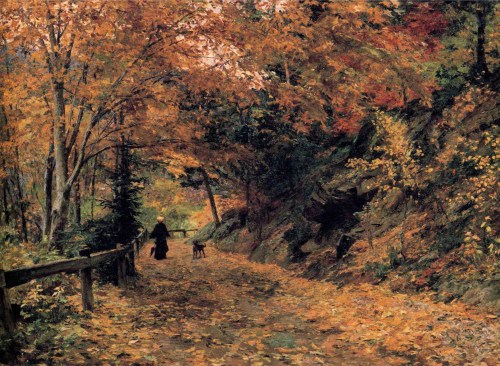
#FineArtFriday: Falling Leaves, by Olga Wisinger-Florian (revisited)

Falling Leaves, by Olga Wisinger-Florian, circa 1899, first appeared here in October of 2018.  It is one of my favorite depictions of autumn. The scene could be happening here in my lovely Pacific Northwestern forests. The colors of the leaves, the dirt road–this is very like where I grew up.

The painting depicts a woman and her dog enjoying a quiet walk in the serenity of an autumn day. Using light and shadow, the artist employs an impressionistic style to convey the forest. Nothing is drawn with precision, yet everything is shown in its entirety. The feeling of this piece is a little dreamlike–she carries an umbrella, so she’s prepared for rain. She is dressed all in black except for her yellow hat. Leaves in all the many shades of green, gold, and red cling to their trees; the damp, aging rails of the wooden fence offers a flimsy barrier to the carriages and motor vehicles that may travel the roadside. Leaves cover the dirt road, and more are falling down, and the dog trots happily along beside her mistress—the story is there for us to see.

About the Artist:

According to Wikipedia, Olga Wisinger-Florian’s early paintings can be assigned to what is known as Austrian Mood Impressionism. In her landscape paintings she adopted Schindler’s sublime approach to nature. The motifs she employed, such as views of tree-lined avenues, gardens and fields, were strongly reminiscent of her teacher’s work. After breaking with Schindler in 1884, however, the artist went her own way. Her conception of landscapes became more realistic. Her late work is notable for a lurid palette, with discernible overtones of Expressionism. With landscape and flower pictures that were already Expressionist in palette by the 1890s, she was years ahead of her time.


Credits and Attributions:

Falling Leaves, by Olga Wisinger-Florian, ca 1899 [Public domain], via Wikimedia Commons

Wikipedia contributors, “Olga Wisinger-Florian,” Wikipedia, The Free Encyclopedia, https://en.wikipedia.org/w/index.php?title=Olga_Wisinger-Florian&oldid=852607929 (accessed October 11, 2018).

Wikimedia Commons contributors, “File:Olga Wisinger-Florian – Falling Leaves.JPG,” Wikimedia Commons, the free media repository, https://commons.wikimedia.org/w/index.php?title=File:Olga_Wisinger-Florian_-_Falling_Leaves.JPG&oldid=273565541 (accessed October 11, 2018).

Comments Off on #FineArtFriday: Falling Leaves, by Olga Wisinger-Florian (revisited)

Filed under #FineArtFriday

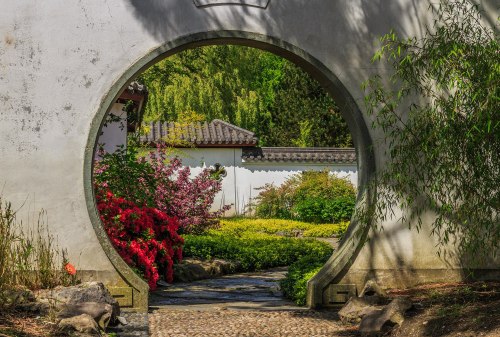
#FineArtFriday: Moon Gate – Chinese Garden in the Hortus Haren by Dominicus Johannes Bergsma

Doorgang_in_muur._Locatie,_Chinese_tuin_Het_Verborgen_Rijk_van_Ming._Locatie._Hortus_Haren_01

Moon Gate, Chinese Garden in the Hortus Haren, The Netherlands

Date: 30 May 2015, 14:31:15

Author: Dominicus Johannes Bergsma

Camera location: 53° 10′ 48.67″ N, 6° 36′ 13.15″ E

About this image, via Wikimedia Commons:

A photograph of the passage in wall known as Moon Gate. Location, Chinese garden, the Hidden Realm of Ming. Location: Hortus Haren, one of the oldest botanical gardens in the Netherlands.

This photograph is a featured picture, which means that members of the community have identified it as one of the finest images on the English Wikipedia, adding significantly to its accompanying article. It was also a finalist in Picture of the Year 2015. [1]

What I love about this photograph:

This is a fairytale image. What magic lies beyond the gate? The composition is perfect. The round gate centered in the ordinary wall, a surprise opening onto a world of color and mystery. I would love to walk in this place.

About Hortus Haren, via Wikipedia:

Hortus Haren is a botanical garden in Haren, Groningen, Netherlands. First created in 1626 by the pharmacist Henricus Munting, it was then situated between Grote Rozenstraat and Grote Kruisstraat in Groningen.  Because of space considerations it relocated to Haren in 1967 and became the largest botanical garden in the country. [2]


Credits and Attributions:

Moon Gate, Chinese Garden in the Hortus Haren, The Netherlands, by Dominicus Johannes Bergsma. Dominicus Johannes Bergsma, CC BY-SA 4.0 https://creativecommons.org/licenses/by-sa/4.0, via Wikimedia Commons.

[1] Wikimedia Commons contributors, “File:Doorgang in muur. Locatie, Chinese tuin Het Verborgen Rijk van Ming. Locatie. Hortus Haren 01.jpg,” Wikimedia Commons, the free media repository, https://commons.wikimedia.org/w/index.php?title=File:Doorgang_in_muur._Locatie,_Chinese_tuin_Het_Verborgen_Rijk_van_Ming._Locatie._Hortus_Haren_01.jpg&oldid=684921659 (accessed September 29, 2022).

[2] Wikipedia contributors, “Hortus Haren,” Wikipedia, The Free Encyclopedia, https://en.wikipedia.org/w/index.php?title=Hortus_Haren&oldid=1111475348 (accessed September 29, 2022).

2 Comments

Filed under #FineArtFriday

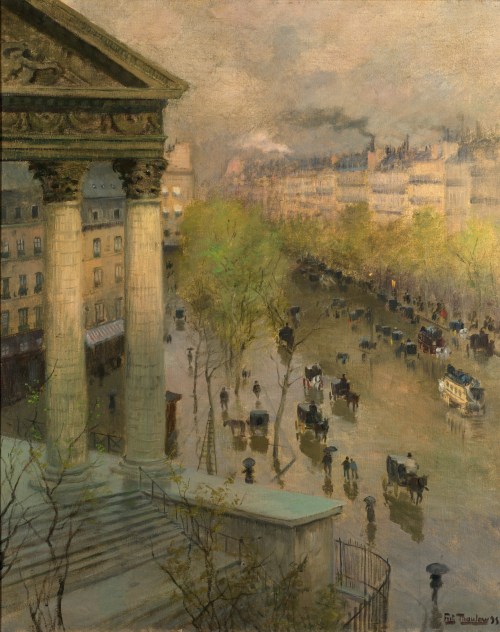
#FineArtFriday: Boulevard de la Madeleine in Paris by Frits Thaulow ca 1897 (revisited)

Frits_Thaulow_-_Boulevard_de_la_Madeleine_à_Paris_(1890s)Title: Boulevard de la Madeleine in Paris by Frits Thaulow

Date: circa 1896-1897

Medium: oil on canvas

Dimensions: Height: 88.2 cm (34.7 in); Width: 66.3 cm (26.1 in)

Collection: Pushkin Museum of Fine Arts

Inscriptions: Signature and date bottom right: Frits Thaulow (date is unclear)

What I like about this painting:

This is a street scene viewed from an angle we rarely see in paintings. The people and vehicles are small, insignificant in comparison with the size and grandeur of the buildings.

While Thaulow didn’t enjoy painting cityscapes, I think Boulevard de la Madeleine in Paris is one of the best of that era.

The soot from the chimneys in the distance, the wet street, the muted, watery colors of a rainy spring day, and the God’s-eye view of the busy street—it all comes together to present a powerful statement.

About the Artist, Via Wikipedia:

Thaulow was one of the earliest artists to paint in Skagen in the north of Jutland, soon to become famous for its Skagen Painters. He arrived there in 1879 with his friend Christian Krohg, who persuaded him to spend the summer and autumn there. They arrived from Norway in Thaulow’s little boat. Thaulow, who had specialized in marine painting, turned to Skagen’s favourite subjects, the fishermen and the boats on the shore.

Thaulow moved to France in 1892, living there until his death in 1906. He soon discovered that the cityscapes of Paris did not suit him. His best paintings were made in small towns such as Montreuil-sur-Mer (1892–94), Dieppe and surrounding villages (1894–98), Quimperle in Brittany (1901) and Beaulieu-sur-Dordogne in the Corrèze département (1903). One of his most famous works once he moved to france was A village street in France. In Dieppe Thaulow and his wife Alexandra made themselves popular: they were friends with artist Charles Conder, and they met Aubrey Beardsley. [1]


Credits and Attributions:

[1] Wikipedia contributors, “Frits Thaulow,” Wikipedia, The Free Encyclopedia, https://en.wikipedia.org/w/index.php?title=Frits_Thaulow&oldid=1026282924 (accessed June 10, 2021).

Boulevard de la Madeleine in Paris, ca 1896-97 by  Frits Thaulow, Public domain, via Wikimedia Commons. Wikimedia Commons contributors, “File:Frits Thaulow – Boulevard de la Madeleine à Paris (1890s).jpg,” Wikimedia Commons, the free media repository, https://commons.wikimedia.org/w/index.php?title=File:Frits_Thaulow_-_Boulevard_de_la_Madeleine_%C3%A0_Paris_(1890s).jpg&oldid=566337323 (accessed June 10, 2021).

7 Comments

Filed under #FineArtFriday

#FineArtFriday: Two Photographs via Wikimedia Commons

Best_Nature_Picture_of_the_dayDescription: Best Nature Picture of the Day, by Guruspsingh
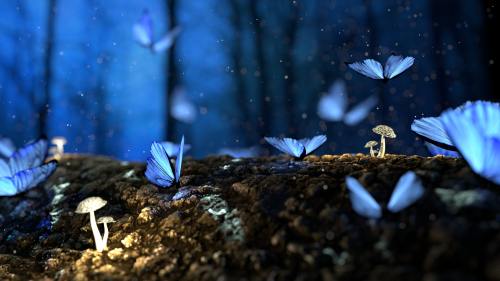
English: This picture for nature and anyone see now and save nature

Date: 1 August 2020

Source: Own work

Author: Guruspsingh

About these images:

I enjoy looking at the various photographs of nature that one can find through Wikimedia Commons. Every day, it’s something new and different. Sometimes I come across an image that should be an award winner, but so far as I know, has gone unnoticed. These are two of those.

The author titled the above photograph “Best Nature Picture of the Day” and I have to agree with her/him, whoever they are. The intensity of color, the serenity of the composition – this image is powerful.

I wish I could find out more about this photographer and their work. The photographer doesn’t have a completed bio on Wikimedia. I could find no information or website for them, so I have no way of directing viewers to their artwork. There are numerous photographers with the last name of Singh. This particular artist has a singular identifiable style of composition and an affinity for intense, saturated colors.

Fortunately, the above photograph can be found on Wikimedia Commons, along with another amazing image by this artist, one of butterflies taken at dusk: Best Butterfly Picture of the Day.

Best_Butterfly_picture_of_the_day 

Description: Best Butterfly Picture of the Day, by Guruspsingh

Date: 1 August 2020

Source: Own work

Author: Guruspsingh

Guruspsingh was kind enough to make their work available for us through Wikimedia Commons, a virtual art gallery where anyone can view the finest art in the world. I hope you enjoy these pictures as much as I do. They express the beauty of nature as seen through the eyes of an extremely talented photographer.


Credits and Attributions:

Best Nature Picture of the Day, by Guruspsingh, CC BY-SA 4.0 <https://creativecommons.org/licenses/by-sa/4.0&gt;, via Wikimedia Commons

Wikimedia Commons contributors, “File:Best Nature Picture of the day.jpg,” Wikimedia Commons, the free media repository, https://commons.wikimedia.org/w/index.php?title=File:Best_Nature_Picture_of_the_day.jpg&oldid=505869626 (accessed August 18, 2022).

Best Butterfly Picture of the Day, by Guruspsingh, CC BY-SA 4.0

<https://creativecommons.org/licenses/by-sa/4.0&gt;, via Wikimedia Commons

Wikimedia Commons contributors, “File:Best Butterfly picture of the day.jpg,” Wikimedia Commons, the free media repository, https://commons.wikimedia.org/w/index.php?title=File:Best_Butterfly_picture_of_the_day.jpg&oldid=627864380 (accessed August

Comments Off on #FineArtFriday: Two Photographs via Wikimedia Commons

Filed under #FineArtFriday

#FineArtFriday: Dawn In The Hills by Julian Onderdonk 1922 (revisited)

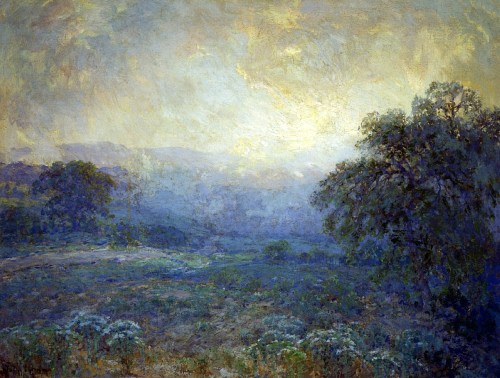
Julian_Onderdonk_(1882-1922)_-_Dawn_In_The_Hills_(1922)

Artist: Julian Onderdonk  (1882–1922)

Title: Dawn In The Hills

Date    1922

Medium: oil on canvas

Dimensions: Height: 76.2 cm (30″); Width: 101.6 cm (40″)

Collection: Private collection

What I love about this painting:

Onderdonk captured the surreal essence of early morning near San Antonio, Texas. The mists are rising in the hills, slowly revealing the riotous splendor of deep blue wildflowers. It is a rolling sea of bluebonnets, with the occasional white of the blackfoot or fleabane daisy mingled in.

The artist perfectly conveyed the mystical quality of that singular moment of the morning when the air is still and golden, and the day ahead is full of possibilities.

I could spend hours in this place.

About this painting:

Art historian Jeffrey Morseburg writes, “In the fall of 1922, as he was just entering his prime, Onderdonk was rushed to the hospital with an intestinal blockage. He failed to recover from the emergency surgery and died on October 27, 1922. His sudden death created an outpouring of emotion for the man who had become “The Dean of Texas Painters.” Just before he died, Onderdonk had finished a beautiful early morning view of a Texas hillside carpeted with Bluebonnets titled ‘Dawn in the Hills’ and another work, a bold fall scene titled ‘Autumn Tapestry.’” [1]

About the Artist, Via Wikipedia:

Julian Onderdonk was born in San Antonio, Texas, to Robert Jenkins Onderdonk, a painter, and Emily Gould Onderdonk. He was raised in South Texas and was an enthusiastic sketcher and painter. As a teenager Onderdonk was influenced and received some training from the prominent Texas artist Verner Moore White who also lived in San Antonio at the time. He attended the West Texas Military Academy, now the Episcopal School of Texas, graduating in 1900. His grandfather Henry Onderdonk was the Headmaster of Saint James School in Maryland, from which Julian’s father Robert graduated.

At 19, with the help of a generous neighbor, Julian left Texas in order to study with the renowned American Impressionist William Merritt Chase. Julian’s father, Robert, had also once studied with Chase. Julian spent the summer of 1901 on Long Island at Chase’s Shinnecock Hills Summer School of Art. He studied with Chase for a couple of years and then moved to New York City to attempt to make a living as an en plein air artist. While in New York he met and married Gertrude Shipman and they soon had a son.

Onderdonk returned to San Antonio in 1909, where he produced his best work. His most popular subjects were bluebonnet landscapes. Onderdonk died on October 27, 1922 in San Antonio.

President George W. Bush decorated the Oval Office with three of Onderdonk’s paintings. The Dallas Museum of Art has several rooms dedicated exclusively to Onderdonk’s work.

His art studio currently resides on the grounds of the Witte Museum.


Credits and Attributions:

[1] Julian Onderdonk, An Illustrated Biography by Jeffrey Morseburg, © 2011 https://julianonderdonk.wordpress.com/tag/julian-onderdonk-biography/  (accessed March 4, 2020).

Wikimedia Commons contributors, “File:Julian Onderdonk (1882-1922) – Dawn In The Hills (1922).jpg,” Wikimedia Commons, the free media repository, https://commons.wikimedia.org/w/index.php?title=File:Julian_Onderdonk_(1882-1922)_-_Dawn_In_The_Hills_(1922).jpg&oldid=278966540 (accessed March 4, 2020).

Wikipedia contributors, “Julian Onderdonk,” Wikipedia, The Free Encyclopedia, https://en.wikipedia.org/w/index.php?title=Julian_Onderdonk&oldid=882101452 (accessed March 4, 2020).

6 Comments

Filed under #FineArtFriday

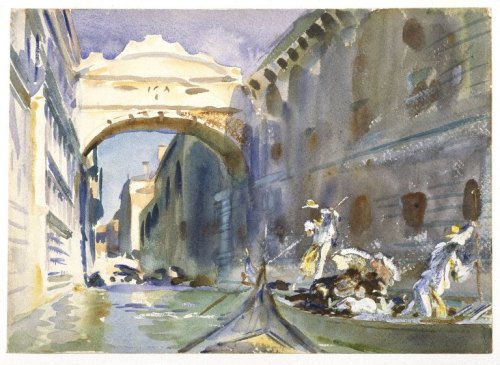
#FineArtFriday: The Bridge of Sighs, John Singer Sargent ca,1905 – 1908

John_Singer_Sargent_-_The_bridge_of_sighsArtist: John Singer Sargent (1856–1925)

Title: The Bridge of Sighs

Date: between 1905 and 1908

Medium: watercolor on paper

Dimensions: height: 25.4 cm (10 in); width: 35.6 cm (14 in)

Collection: Brooklyn Museum

Current location: American Art collection

What I love about this picture:

John Singer Sargent was known for his portraits, but it is his watercolors that fascinate me. This painting of Venice’s Bridge of Sighs is one of his finest. Done in every shade of blue and brown, he conveys the mood of an afternoon. He gives us the bridge as seen from a gondola, and the view of ladies beneath parasols going by, passing us in the opposite direction.

By his choice of colors, Sargent paints the atmosphere of a poignant, tragic place.

About this picture, via Wikipedia:

The Bridge of Sighs (Italian: Ponte dei Sospiri, Venetian: Ponte de i Sospiri) is a bridge in Venice, Italy. The enclosed bridge is made of white limestone, has windows with stone bars, passes over the Rio di Palazzo, and connects the New Prison (Prigioni Nuove) to the interrogation rooms in the Doge’s Palace.

The view from the Bridge of Sighs was the last view of Venice that convicts saw before their imprisonment. The bridge’s English name was bequeathed by Lord Byron in the 19th century as a translation from the Italian “Ponte dei sospiri”, from the suggestion that prisoners would sigh at their final view of beautiful Venice through the window before being taken down to their cells. [1]

About The Artist via Wikipedia:

John Singer Sargent (January 12, 1856 – April 14, 1925) was an American expatriate artist, considered the “leading portrait painter of his generation” for his evocations of Edwardian-era luxury. He created roughly 900 oil paintings and more than 2,000 watercolors, as well as countless sketches and charcoal drawings. His oeuvre documents worldwide travel, from Venice to the TyrolCorfu, the Middle East, Montana, Maine, and Florida.

Born in Florence to American parents, he was trained in Paris before moving to London, living most of his life in Europe. He enjoyed international acclaim as a portrait painter. An early submission to the Paris Salon in the 1880s, his Portrait of Madame X, was intended to consolidate his position as a society painter in Paris, but instead resulted in scandal. During the next year following the scandal, Sargent departed for England where he continued a successful career as a portrait artist.

From the beginning, Sargent’s work is characterized by remarkable technical facility, particularly in his ability to draw with a brush, which in later years inspired admiration as well as criticism for a supposed superficiality. His commissioned works were consistent with the grand manner of portraiture, while his informal studies and landscape paintings displayed a familiarity with Impressionism. In later life Sargent expressed ambivalence about the restrictions of formal portrait work and devoted much of his energy to mural painting and working en plein air. Art historians generally ignored society artists such as Sargent until the late 20th century.

With his watercolors, Sargent was able to indulge his earliest artistic inclinations for nature, architecture, exotic peoples, and noble mountain landscapes. And it is in some of his late works where one senses Sargent painting most purely for himself. His watercolors were executed with a joyful fluidness. He also painted extensively family, friends, gardens, and fountains. In watercolors, he playfully portrayed his friends and family dressed in Orientalist costume, relaxing in brightly lit landscapes that allowed for a more vivid palette and experimental handling than did his commissions (The Chess Game, 1906). His first major solo exhibit of watercolor works was at the Carfax Gallery in London in 1905. In 1909, he exhibited eighty-six watercolors in New York City, eighty-three of which were bought by the Brooklyn MuseumEvan Charteris wrote in 1927:

To live with Sargent’s water-colours is to live with sunshine captured and held, with the luster of a bright and legible world, ‘the refluent shade’ and ‘the Ambient ardours of the noon.’

Although not generally accorded the critical respect given Winslow Homer, perhaps America’s greatest watercolorist, scholarship has revealed that Sargent was fluent in the entire range of opaque and transparent watercolor technique, including the methods used by Homer. [2]


Credits and Attributions:

[1] Wikipedia contributors, “Bridge of Sighs,” Wikipedia, The Free Encyclopedia, https://en.wikipedia.org/w/index.php?title=Bridge_of_Sighs&oldid=1096829521 (accessed August 5, 2022).

[2] Wikipedia contributors, “John Singer Sargent,” Wikipedia, The Free Encyclopedia, https://en.wikipedia.org/w/index.php?title=John_Singer_Sargent&oldid=1099859237 (accessed August 5, 2022).

[Image] Wikimedia Commons contributors, “File:John Singer Sargent – The bridge of sighs.jpg,” Wikimedia Commons, the free media repository, https://commons.wikimedia.org/w/index.php?title=File:John_Singer_Sargent_-_The_bridge_of_sighs.jpg&oldid=660236372 (accessed August 5, 2022).

Comments Off on #FineArtFriday: The Bridge of Sighs, John Singer Sargent ca,1905 – 1908

Filed under #FineArtFriday

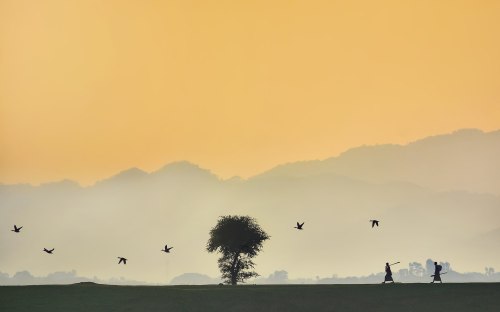
#FineArtFriday: Tanguar Haor by Abdul Momin, 2017

Tanguar_haor,_Bangladesh_01Photograph: Tanguar Haor by Abdul Momin

Date: 2 November 2017 [1]

What I love about this image:

Today I’m detouring briefly from Renaissance art and delving into modern photographic art with a wonderful image by a brilliant young photographer, Abdul Momin. A photograph has to be uniquely special if it is to be selected as a Wikimedia Commons Picture of the Day. This image more than deserved that honor.

As a lover of fantasy art, I feel it was shot at the perfect time of evening.

The artist’s eye comes into play in how the picture was framed. The skill and craft of the photographer comes across in his choice of filters, shutter speed, and how the image was digitally processed to become what we see depicted here.

The scene is simple, only black juxtaposed against shades of gray and orange. Yet there is a surreal quality to this landscape. The silhouettes of the birds and people against the evening sky, with the tree centered and anchoring the scene is magical.

The photographer’s eye and artistic ability gives us a beautiful moment in time, a windless moment of peace and serenity, of humankind coexisting with nature.

About this image, via Wikimedia Commons:

This image was selected as picture of the day on Wikimedia Commons for 4 July 2022. Tanguar Haor is a unique wetland ecosystem of national importance and has come into international focus. The area of Tanguar haor including 46 villages within the haor is about 100 square kilometres. It is the source of livelihood for more than 40,000 people.

Bangladesh declared it an Ecologically Critical Area in 1999 considering its critical condition as a result of overexploitation of its natural resources.

Every winter the haor is home to about 200 types of migratory birds. In 1999–2000, the government earned 7,073,184 takas as revenue just from fisheries of the haor. There are more than 140 species of freshwater fish in the haor. The more predominant among them are: ayirCatfishbaim, tara, gutum, gulsha, tengra, titna, garia, beti, kakia. Gulli, balua, ban tulsinalkhagra and other freshwater wetland trees are in this haor. [2]

About the photographer, via Wikimedia Commons:

Born and raised in Bangladesh, Abdul Momin has earned his name as an emerging photographer with works that are recognized by the global community. He started photography in his college days. Since then, his work has been published in The Guardian, The Times, National Geographic, The Mail, The Mirror, The Telegraph and many more platforms around the world. He has earned various awards from different parts of the globe for his photography works. He says that for him, “Photography changed my life totally. I would have been a typical office going guy, but photography made me see more, to see deeply into the lives of people. It also made me to love nature. The best part of being a photographer is having the ability, the power to show others exactly how you see the world around you.” [1]


Credits and Attributions:

[1] Image: Tanguar Haor by Abdul Momin and licensed under the Creative Commons Attribution-Share Alike 4.0 International license. Wikimedia Commons contributors, “File:Tanguar haor, Bangladesh 01.jpg,” Wikimedia Commons, the free media repository, https://commons.wikimedia.org/w/index.php?title=File:Tanguar_haor,_Bangladesh_01.jpg&oldid=675047221 (accessed July 29, 2022).

[2] Wikipedia contributors, “Tanguar Haor,” Wikipedia, The Free Encyclopedia, https://en.wikipedia.org/w/index.php?title=Tanguar_Haor&oldid=1095980778 (accessed July 29, 2022).

2 Comments

Filed under #FineArtFriday, writing