Tag Archives: Fine Art Friday

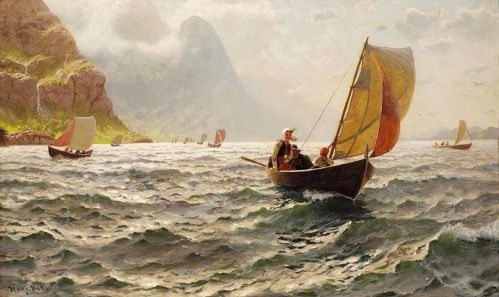
#FineArtFriday: Upon Sunny Waves, by Hans Dahl #prompt #NovemberWriter


Artist: Hans Dahl  (1849–1937)

Title: Upon Sunny Waves

Date: before 1937

Medium: oil painting

Hans Dahl was a Norwegian painter trained in Germany and is associated with the Düsseldorf school of painting, which was characterized by finely detailed imaginary landscapes. In his later years, he endured mean-spirited criticism from other artists and art critics, because he chose to remain true to his idealized fantasy art, resisting the movement from Romanticism to Modernism.

What I love about this painting:

I first featured this painting in 2019 and think it’s a good image for a writing prompt. I love the way Dahl shares with us the bold freedom of sailing on a sunny summer day. He captures the feeling of flying on the water that makes sailing a small boat so much fun.

We aren’t on a leisurely fishing expedition here—this is boating for the sake of adventure. We’re running with wind and enjoying every minute of it. The wind is brisk, and the waters are choppy. There’s a hint of danger, the glee of knowing we’re pushing the boundaries. We’d best be strong swimmers because if we capsize, the waters are cold, and someone might not survive.

Who are these people? What is their relationship to each other? What dramas are they seeking a temporary escape from on this glorious day on the waves?

Hans Dahl has given us a painting with great story potential.

About the Artist, via Wikipedia:

In the 1890s a new school of art arose, and artists like Dahl were not very popular in the leading circles in the capital. He was particularly criticized by the art historian Jens Thiis. He was severely criticized by fellow artists especially by Christian Krohg, who was one of the leading figures in the transition from romanticism to naturalism which characterized Norwegian art in this period. Throughout his life, he increasingly narrowed his range of topics. Dahl often described the scenery of the western part of Norway in brilliant sunshine with smiling people in national costumes. His vibrant colors and charming portrayals of young Norwegian girls in their national costume have always been very popular. [1]


Credits and Attributions:

[1] Wikipedia contributors, “Hans Dahl,” Wikipedia, The Free Encyclopedia, https://en.wikipedia.org/w/index.php?title=Hans_Dahl&oldid=827399492 (accessed November 7, 2024).

IMAGE: Upon Sunny Waves, by Hans Dahl PD|70 [Public domain]

Wikimedia Commons contributors, “File:Hans Dahl – Upon sunny waves.jpg,” Wikimedia Commons, the free media repository, https://commons.wikimedia.org/w/index.php?title=File:Hans_Dahl_-_Upon_sunny_waves.jpg&oldid=140877929 (accessed November 7, 2024).

Comments Off on #FineArtFriday: Upon Sunny Waves, by Hans Dahl #prompt #NovemberWriter

Filed under #FineArtFriday

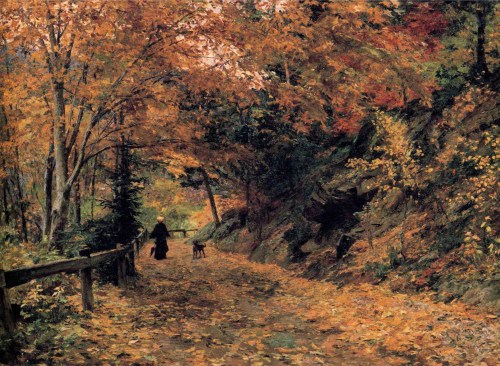
#FineArtFriday: ‘Falling Leaves,’ by Olga Wisinger-Florian, my favorite image of autumn

Falling Leaves, by Olga Wisinger-Florian, circa 1899, first appeared here in October of 2018 and again in autumn of 2022.  When I think of autumn, this painting always springs to mind. It captures the mood and atmosphere of a quiet day when the leaves are falling and the forest is settling in for a winter’s nap.

It is one of my favorite depictions of autumn. The scene could be happening here in my lovely Pacific Northwestern forests. The colors of the leaves, the dirt road–this is very like where I grew up.

The painting depicts a woman and her dog enjoying a quiet walk in the serenity of an autumn day. Using light and shadow, the artist employs an impressionistic style to convey the forest. Nothing is drawn with precision, yet everything is shown in its entirety. The feeling of this piece is a little dreamlike–she carries an umbrella, so she’s prepared for rain. She is dressed all in black except for her yellow hat. Leaves in all the many shades of green, gold, and red cling to their trees; the damp, aging rails of the wooden fence offers a flimsy barrier to the carriages and motor vehicles that may travel the roadside. Leaves cover the dirt road, and more are falling down, and the dog trots happily along beside her mistress—the story is there for us to see.

About the Artist via Wikipedia:

 Olga Wisinger-Florian’s early paintings can be assigned to what is known as Austrian Mood Impressionism. In her landscape paintings she adopted Schindler’s sublime approach to nature. The motifs she employed, such as views of tree-lined avenues, gardens and fields, were strongly reminiscent of her teacher’s work. After breaking with Schindler in 1884, however, the artist went her own way. Her conception of landscapes became more realistic. Her late work is notable for a lurid palette, with discernible overtones of Expressionism. With landscape and flower pictures that were already Expressionist in palette by the 1890s, she was years ahead of her time.


Credits and Attributions:

Falling Leaves, by Olga Wisinger-Florian, ca 1899 [Public domain], via Wikimedia Commons

Wikipedia contributors, “Olga Wisinger-Florian,” Wikipedia, The Free Encyclopedia, https://en.wikipedia.org/w/index.php?title=Olga_Wisinger-Florian&oldid=852607929 (accessed October 11, 2018).

Wikimedia Commons contributors, “File:Olga Wisinger-Florian – Falling Leaves.JPG,” Wikimedia Commons, the free media repository, https://commons.wikimedia.org/w/index.php?title=File:Olga_Wisinger-Florian_-_Falling_Leaves.JPG&oldid=273565541 (accessed October 11, 2018).

Comments Off on #FineArtFriday: ‘Falling Leaves,’ by Olga Wisinger-Florian, my favorite image of autumn

Filed under #FineArtFriday

#FineArtFriday: revisiting Indian Summer by William Trost Richards 1875

Indian_Summer_MET_DT276257Title: Indian Summer by William Trost Richards

Genre: landscape art

Date: 1875

Medium: oil on canvas

Dimensions: 24 1/8 x 20 in. (61.3 x 50.8 cm)

Collection: Metropolitan Museum of Art

What I love about this painting:

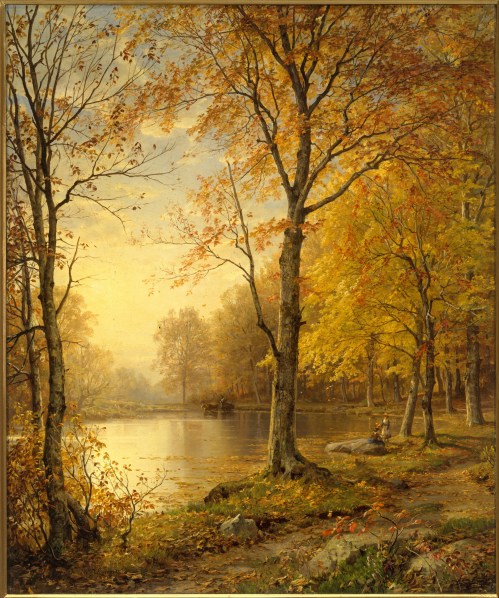
Autumn is upon us once again. I was looking through the vault at Wikimedia Commons, and my eye kept being drawn to this painting by William Trost Richards. I featured this painting two years ago, and still love the feeling of “zen” that Trost Richards managed to instill into this scene.

He captured a singular moment of tranquility. A light breeze barely ruffles the surface of our pond. At the bottom right, two girls play beside a large boulder at the water’s edge.

Across the pond, in the center and nearly hidden in the shadows, a teamster and his oxen wade across the shallows.

Autumn’s haze lends a feeling of mystery to the scene, muting the reds, yellows, and oranges of leaves about to fall. This last burst of grandeur can’t hold back winter, though it tries. Soon, the forest will sleep, snow and ice will decorate barren limbs, and ice will stop the waters’ gentle motions.

But beneath the grasp of winter, new life will bide its time, and winter will fade into spring. The seasons will follow their course, but today is autumn’s day to shine, to go down in a blaze of golden glory.

A century ago, William Trost Richards painted a scene of peace and serenity, perfectly capturing it. He preserved the glory of the scenery, but more than that, he captured the mood and the atmosphere of a perfect autumn day. When we view this scene, we can sit back and admire the beauty of our world.

 >>><<<

About William Trost Richards via Wikipedia:

William Trost Richards (November 14, 1833 – November 8, 1905) was an American landscape artist. He was associated with both the Hudson River School and the American Pre-Raphaelite movement. [1]

In 1856, he married Anna Matlack Richards (1834–1900), a 19th-century American children’s author, poet and translator best known for her fantasy novel, A New Alice in the Old Wonderland. The couple had eight children, only five of whom lived past infancy. Anna educated the children at home to a pre-college level in the arts and sciences. [2]

One of the couple’s sons, Theodore William Richards, would later win the 1914 Nobel Prize in Chemistry. Anna Richards Brewster, their sixth child, went on to become an important painter in her own right, having received an early arts education from her father as well. [2]

Richards rejected the romanticized and stylized approach of other Hudson River painters and instead insisted on meticulous factual renderings. His views of the White Mountains are almost photographic in their realism. In later years, Richards painted almost exclusively marine watercolors. [1]


Credits and Attributions:

Indian Summer by William Trost Richards, Wikimedia Commons contributors, “File:Indian Summer MET DT276257.jpg,” Wikimedia Commons, the free media repository, https://commons.wikimedia.org/w/index.php?title=File:Indian_Summer_MET_DT276257.jpg&oldid=678817431 (accessed November 3, 2022). Public Domain.

[1] Wikipedia contributors, “William Trost Richards,” Wikipedia, The Free Encyclopedia, https://en.wikipedia.org/w/index.php?title=William_Trost_Richards&oldid=1089835304 (accessed November 3, 2022).

[2] Wikipedia contributors, “Anna Matlack Richards,” Wikipedia, The Free Encyclopedia, https://en.wikipedia.org/w/index.php?title=Anna_Matlack_Richards&oldid=1055684363 (accessed November 3, 2022).

4 Comments

Filed under #FineArtFriday, writing

#FineArtFriday: Undergrowth with Two Figures, Vincent van Gogh 1890, a second look

Vincent_van_Gogh_-_Undergrowth_with_Two_Figures_(F773)Artist: Vincent van Gogh (1853–1890)

Title: Undergrowth with Two Figures

Date: late June 1890

Medium: oil on canvas

Dimensions: height: 50 cm (19.6 in); width: 100.5 cm (39.5 in)

Collection: Cincinnati Art Museum

Two years ago, in April of 2022, I was privileged to attend an immersive exhibit of Vincent van Gogh’s life through his work. Viewers roamed freely inside an everchanging exhibit that flowed through many of his most famous works and zoomed in on bits one wouldn’t ordinarily notice.

I managed a few shots with my cell phone that offered some idea of what the exhibition was like, but sadly, the camera on that phone wasn’t the best. Here is the one that nearly shows what we experienced, a glimpse into van Gogh’s Starry Night:

Van Gogh immersive 1 connie j jasperson LIRF04072022

The exhibit was such a moving, emotional experience. It really brought you into touch with the man and his art. I became a Vincent van Gogh fangirl that day.

We were in, above, and surrounded by his work. The powerful soundtrack of classical music paired perfectly with the images, complementing them like fine wine does good food.

The link to what we saw at that exhibit is here: Van Gogh, The Immersive Experience.

What I love about Undergrowth with Two Figures:

This very late work was painted at the end of June 1890, a few weeks before Van Gogh’s death. It was one of several paintings in Auvers-sur-Oise, a commune on the northwestern outskirts of Paris, France. This was also the place where Vincent van Gogh died from injuries suffered in an attempted suicide.

This painting is one of several he made in the last weeks of his life using a double-square format. The double-square paintings were made on uncommonly large canvases, rectangular, twice as wide as they were tall. Vincent’s need to express his art couldn’t be contained on an ordinary canvas—he saw the world with a panoramic view.

One of the things I love about this painting is the use of violet and blue in the trunks of the poplars. They are tall, immense, like bars in a window framing the courting pair. The trees stand out against the black backdrop. They have power and are the soul of the painting, even more so than the flowers and undergrowth through which the couple walks.

I think it’s a wonderful composition, with strong brush strokes and deep, dark colors. He saw the beauty in life and painted it.

[1] About this painting, via Google Arts and Culture:

In a letter to his younger brother, Theo, dated June 30, 1890, van Gogh explained the structure and brilliant colors of “Undergrowth with Two Figures”: “The trunks of the violet poplars cross the landscape perpendicularly like columns,” adding “the depth of Sous Bois is blue, and under the big trunks the grass blooms with flowers in white, rose, yellow, and green.”

“Undergrowth with Two Figures” has a silvery tonality characteristic of van Gogh’s works from Auvers. His brushwork may be swift and visceral, his colors strong and biting, his emotion raw and visible, but the composition reveals no hint of psychological torment.

It is painted on a double square canvas, twice as wide as it is high. Van Gogh explored the artistic possibilities of this panoramic format in several of his last paintings. [1]


Credits and Attributions:

[1] Google Arts and Culture Contributors, Undergrowth with two Figures, Vincent van Gogh 1890, Accessed April 7, 2022.

Wikimedia Commons contributors, “File:Vincent van Gogh – Undergrowth with Two Figures (F773).jpg,” Wikimedia Commons, the free media repository, https://commons.wikimedia.org/w/index.php?title=File:Vincent_van_Gogh_-_Undergrowth_with_Two_Figures_(F773).jpg&oldid=618842665 (accessed April 8, 2022).

View of Vincent’s Starry Night, © 2022 Connie J. Jasperson, own work,

2 Comments

Filed under #FineArtFriday

#FineArtFriday: The Peasant and the Nest Robber by Pieter Bruegel the Elder 1568

The_Peasant_and_the_Birdnester_Pieter_Bruegel_the_Elder_1568Artist: Pieter Brueghel the Elder (1526/1530–1569)

Title:  “The Peasant and the Nest Robber”

Date: 1568

Medium: oil on oak wood

Dimensions: 59.3 × 68.3 cm (23.3 × 26.8 in)

Collection: Kunsthistorisches Museum

What I love about this painting

Pieter Brugel the Elder was a man with a sharp eye for the humorous and the ability to wield allegory and symbolism like a knife. He cuts to the heart of things, pointing out the hubris and vanities of people from all walks of life.

Pieter Brugel the Elder was earthy and honest in his depictions of village life in his time. He painted what he saw and celebrated the ups and downs of the human condition. Today, his art is an important source of evidence about the social mores and values governing 16th-century life.

This painting details his favorite subject of human frailty, but he’s taken a different approach, narrowing his usual cast of thousands to just two.

In this case, he is pointing out that people are opportunists. We either have the knowledge and nerve to take what we need or the knowledge and sly desire to point out the failings of others.

Both men in this scene are taking the opportunity to advance themselves. One gains eggs and a good meal, and the other gains a sense of moral superiority.

Neither man feels guilty.

About this painting, via Wikipedia:

This unusual subject apparently illustrates a Netherlandish proverb:

Dije den nest Weet dijen weeten, dijen Roft dij heeten
He who knows where the nest is, has the knowledge, he who robs, has the nest.

The painting presents a moralising contrast between the active, wicked individual and the passive man who is virtuous in spite of adversity (a similar theme appears in his drawing The Beekeepers)] And lastly it could be suggested that the pointing man is making judgement on the robber whilst not aware that he is nearly stepping into the water in front of him.

It has been suggested that, with his knowledge of Italian art, Bruegel intended the peasant’s gesture as a profane parody of the gesture of Leonardo‘s St John. [1]

About the Artist, via Wikipedia:

Pieter Bruegel (also Brueghel or Breughelthe Elder c. 1525–1530 – 9 September 1569) was the most significant artist of Dutch and Flemish Renaissance painting, a painter and printmaker from Brabant, known for his landscapes and peasant scenes (so-called genre painting); he was a pioneer in making both types of subject the focus in large paintings.

He was a formative influence on Dutch Golden Age painting and later painting in general in his innovative choices of subject matter, as one of the first generation of artists to grow up when religious subjects had ceased to be the natural subject matter of painting. He also painted no portraits, the other mainstay of Netherlandish art. After his training and travels to Italy, he returned in 1555 to settle in Antwerp, where he worked mainly as a prolific designer of prints for the leading publisher of the day. Only towards the end of the decade did he switch to make painting his main medium, and all his famous paintings come from the following period of little more than a decade before his early death, when he was probably in his early forties, and at the height of his powers.

Around 1563, Bruegel moved from Antwerp to Brussels, where he married Mayken Coecke, the daughter of the painter Pieter Coecke van Aelst and Mayken Verhulst. As registered in the archives of the Cathedral of Antwerp, their deposition for marriage was registered 25 July 1563. The marriage itself was concluded in the Chapel Church, Brussels in 1563.

Pieter the Elder had two sons: Pieter Brueghel the Younger and Jan Brueghel the Elder (both kept their name as Brueghel). Their grandmother, Mayken Verhulst, trained the sons because “the Elder” died when both were very small children. The older brother, Pieter Brueghel copied his father’s style and compositions with competence and considerable commercial success. Jan was much more original, and very versatile. He was an important figure in the transition to the Baroque style in Flemish Baroque painting and Dutch Golden Age painting in a number of its genres. He was often a collaborator with other leading artists, including with Peter Paul Rubens on many works including the Allegory of Sight.

Other members of the family include Jan van Kessel the Elder (grandson of Jan Brueghel the Elder) and Jan van Kessel the Younger. Through David Teniers the Younger, son-in-law of Jan Brueghel the Elder, the family is also related to the whole Teniers family of painters and the Quellinus family of painters and sculptors, through the marriage of Jan-Erasmus Quellinus to Cornelia, daughter of David Teniers the Younger. [2]


Credits and Attributions:

[1] IMAGE and Quote about this picture: Wikipedia contributors, “The Peasant and the Nest Robber,” Wikipedia, The Free Encyclopedia, https://en.wikipedia.org/w/index.php?title=The_Peasant_and_the_Nest_Robber&oldid=1160869804 (accessed September 12, 2024).

[2] Wikipedia contributors, “Pieter Bruegel the Elder,” Wikipedia, The Free Encyclopedia, https://en.wikipedia.org/w/index.php?title=Pieter_Bruegel_the_Elder&oldid=1218696694 (accessed September 12, 2024).

2 Comments

Filed under #FineArtFriday

#FineArtFriday: Morning at Grand Manan by Alfred Thompson Bricher 1878

Morning_at_Grand_Manan_by_Alfred_Thompson_BricherArtist: Alfred Thompson Bricher (1837–1908)

Title: Morning at Grand Manan

Date: 1878

Medium: oil on canvas

Dimensions: height: 25 in (63.5 cm); width: 50 in (127 cm).

Collection: Indianapolis Museum of Art

Current location: Paine Early American Painting Gallery

What I Love about this painting:

This is a satisfying scene capturing the best moments of a morning at the shore. The light falls on the water with an almost photographic sheen. Fishing vessels leave the harbor, heading out to sea. The sea is calm, and the waves roll up to embrace the shore. One could wade in the shallows and search the tidal pools for starfish or crabs and other creatures in safety.

The sun is up and the few clouds in the sky are dissipating. This will be a good day, perhaps the best day of the summer.

About this painting via Wikipedia:

Morning at Grand Manan is an 1878 oil painting by Alfred Thompson Bricher. It is part of the permanent collection at the Indianapolis Museum of Art, and is currently on view in the Paine Early American Painting Gallery.

Painted along Grand Manan Island, a favorite vacation spot of the artist in New Brunswick, Canada, Bricher painted the sunrise coming above the Atlantic Ocean in a tiny inlet on the coast. Four sailing ships are clearly visible against the pink sky. On the left of the canvas, a sharp, rocky cliff face is seen, breaking up the composition. Bricher clearly depicts each wave rolling onto the beach in minute detail. The sun is positioned a little left of center of the canvas, but is the major focal point, drawing the eye in. Just like other Hudson River School painters, Bricher hides his brushstrokes as if to make the canvas disappear.

Alfred Thompson Bricher was part of the American Luminist movement, coming out of the Hudson River School. Much like the Impressionists, they were interested in the play of light in landscapes, with Bricher himself being particularly interested in how light played against the ocean. Bricher, in particular, became famous for his seascapes and depicting the North Atlantic seaboard. Bricher is considered the last important luminist painter. Morning at Grand Manan came at the height of his career, and displayed Bricher’s acquisition of European aesthetics into his own paintings.

About the Artist via Wikipedia:

Alfred Thompson Bricher (April 10, 1837 – September 30, 1908) was an American painter associated with White Mountain art and the Hudson River School.

Bricher was born in Portsmouth, New Hampshire. He was educated in an academy at Newburyport, Massachusetts. He began his career as a businessman in Boston, Massachusetts. When not working, he studied at the Lowell Institute. He also studied with Albert BierstadtWilliam Morris Hunt, and others. He attained noteworthy skill in making landscape studies from nature, and after 1858 devoted himself to the art as a profession. He opened a studio in Boston, and met with some success there. In 1868 he moved to New York City, and at the National Academy of Design that year he exhibited “Mill-Stream at Newburyport.” Soon afterward he began to use watercolors in preference to oils, and in 1873 was chosen a member of the American Watercolor Society. In the 1870s, he primarily did maritime themed paintings, with attention to watercolor paintings of landscape, marine, and coastwise scenery. He often spent summers in Grand Manan, where he produced such notable works as Morning at Grand Manan (1878). In 1879, Bricher was elected into the National Academy of Design as an Associate member.


Credits and Attributions

IMAGE: Wikimedia Commons contributors, “File:Morning at Grand Manan by Alfred Thompson Bricher.jpg,” Wikimedia Commons, https://commons.wikimedia.org/w/index.php?title=File:Morning_at_Grand_Manan_by_Alfred_Thompson_Bricher.jpg&oldid=872660352 (accessed September 5, 2024).

[1] ABOUT THE  IMAGE: Wikipedia contributors, “Morning at Grand Manan,” Wikipedia, The Free Encyclopedia, https://en.wikipedia.org/w/index.php?title=Morning_at_Grand_Manan&oldid=1192844232 (accessed September 5, 2024).

[2] BIO: Wikipedia contributors, “Alfred Thompson Bricher,” Wikipedia, The Free Encyclopedia, https://en.wikipedia.org/w/index.php?title=Alfred_Thompson_Bricher&oldid=1229486559 (accessed September 5, 2024).

4 Comments

Filed under #FineArtFriday

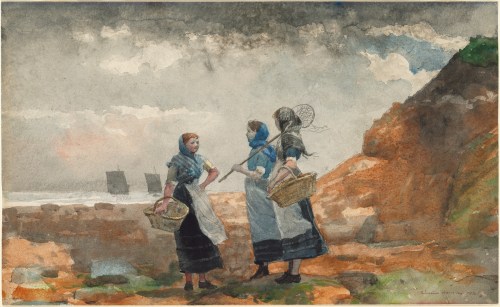
#FineArtFriday: Fisherwomen, Cullercoats by Winslow Homer 1881, a second look

Homer,_Winslow_-_'Fisherwomen,_Cullercoats',_1881,_graphite_&amp;_watercolor_on_paperArtist: Winslow Homer  (1836–1910)

Title: Fisherwomen, Cullercoats

Date:   1881

Medium: watercolor and graphite on paper

Dimensions: height: 34.2 cm (13.4 in); width: 49.2 cm (19.3 in)

Collection: Honolulu Museum of Art

What I love about this painting:

Homer shows us a foggy morning at the beach, capturing the quality of light on the strand at Cullercoats, Tyne and Wear, England. He paints the background with an impressionist’s eye and gives us realistic portraits of the working women whose labors fed the country.

The fish baskets are heavy, but they share the load. Their sleeves are rolled up for work, and skirts are shorter than if they were in town—no one wants wet skirts dragging around their ankles.

I love the way he shows these women as they were that day, treating them with respect. During his lifetime, Winslow Homer depicted men and women of all races, slaves and former slaves, and soldiers. He showed us people who worked hard, not giving us caricatures but painting portraits of real people.

Homer loved the sea and traveled widely, painting everywhere he went. Critics sometimes dismiss his work as “calendar art, appealing to the unschooled masses.” But think about it – calendars and magazines often were the only art poor and working-class people had in their homes. If you don’t have access to art, how can you become “schooled” in it? Some art critics are a little too schooled.

If you are interested in knowing more about the art of Winslow Homer, this documentary is excellent: FAKE OR FORTUNE SE1EO4 WINSLOW HOMER – YouTube

About the Artist, via Wikipedia:

Homer started painting with watercolors on a regular basis in 1873 during a summer stay in Gloucester, Massachusetts. From the beginning, his technique was natural, fluid and confident, demonstrating his innate talent for a difficult medium. His impact would be revolutionary. Here, again, the critics were puzzled at first, “A child with an ink bottle could not have done worse.” Another critic said that Homer “made a sudden and desperate plunge into water color painting”. But his watercolors proved popular and enduring, and sold more readily, improving his financial condition considerably. They varied from highly detailed (Blackboard – 1877) to broadly impressionistic (Schooner at Sunset – 1880). Some watercolors were made as preparatory sketches for oil paintings (as for “Breezing Up”) and some as finished works in themselves. Thereafter, he seldom traveled without paper, brushes and water based paints.

As a result of disappointments with women or from some other emotional turmoil, Homer became reclusive in the late 1870s, no longer enjoying urban social life and living instead in Gloucester. For a while, he even lived in secluded Eastern Point Lighthouse (with the keeper’s family). In re-establishing his love of the sea, Homer found a rich source of themes while closely observing the fishermen, the sea, and the marine weather. After 1880, he rarely featured genteel women at leisure, focusing instead on working women. [1]


Credits and Attributions:

Image: Fisherwomen, Cullercoats by Winslow Homer 1881. Wikimedia Commons contributors, “File:Homer, Winslow – ‘Fisherwomen, Cullercoats’, 1881, graphite & watercolor on paper.jpg,” Wikimedia Commons, https://commons.wikimedia.org/w/index.php?title=File:Homer,_Winslow_-_%27Fisherwomen,_Cullercoats%27,_1881,_graphite_%26_watercolor_on_paper.jpg&oldid=721923030 (accessed August 3, 2023).

[1] Wikipedia contributors, “Winslow Homer,” Wikipedia, The Free Encyclopedia, https://en.wikipedia.org/w/index.php?title=Winslow_Homer&oldid=1168361459 (accessed August 3, 2023).

2 Comments

Filed under #FineArtFriday

#FineArtFriday: Two Watermills and an Open Sluice by Jacob van Ruisdael 1653 revisited

Jacob_Isaacksz._van_Ruisdael_-_Two_Watermills_and_an_Open_Sluice_-_WGA20479Artist: Jacob van Ruisdael  (1628/1629–1682)

Title: Two Watermills and an Open Sluice

Genre: landscape art

Date: 1653

Medium: oil on canvas

Dimensions: height: 664 mm (26.1 in)

Collection: Getty Center

What I Love about this painting:

This painting is the perfect writing prompt. Peaceful and serene, the scene shows us two watermills opposite each other on the stream, sharing the power of the water. These mills were examples of the highest technology of that time, and the families who owned them were prosperous middle-class people. Very likely they were literate, well-respected members of the local community.

Were these mills owned by the same family?

Or were they owned by rivals, competing to grind the grain produced by the local farmers? Is one a grist mill and the other a lumber mill? Or a weaver’s mill housing looms?

Was there a love story behind their being so close to each other, perhaps a Romeo and Juliet-style romance? (Tragedy averted, of course, or it wouldn’t be a romance.)

This is a wonderful painting, a window into the past.

About the artist, via Wikipedia, the free encyclopedia:

Jacob Isaackszoon van Ruisdael (Dutch pronunciation: [ˈjaːkɔp fɑn ˈrœyzˌdaːl] ; c. 1629 – 10 March 1682) was a Dutch painter, draughtsman, and etcher. He is generally considered the pre-eminent landscape painter of the Dutch Golden Age, a period of great wealth and cultural achievement when Dutch painting became highly popular.

Prolific and versatile, Ruisdael depicted a wide variety of landscape subjects. From 1646 he painted Dutch countryside scenes of remarkable quality for a young man. After a trip to Germany in 1650, his landscapes took on a more heroic character. In his late work, conducted when he lived and worked in Amsterdam, he added city panoramas and seascapes to his regular repertoire. In these, the sky often took up two-thirds of the canvas. In total he produced more than 150 Scandinavian views featuring waterfalls.

Ruisdael’s only registered pupil was Meindert Hobbema, one of several artists who painted figures in his landscapes. Hobbema’s work has at times been confused with Ruisdael’s. Ruisdael always spelt his name thus: Ruisdael, not Ruysdael.

Ruisdael’s work was in demand in the Dutch Republic during his lifetime. Today it is spread across private and institutional collections around the world; the National Gallery in London, the Rijksmuseum in Amsterdam, and the Hermitage Museum in St. Petersburg hold the largest collections. Ruisdael shaped landscape painting traditions worldwide, from the English Romantics to the Barbizon school in France, and the Hudson River School in the US, and influenced generations of Dutch landscape artists. [1]

To read more about this artist, go to Jacob van Ruisdael – Wikipedia

About this painting via Wikipedia, the free encyclopedia:

Two Water Mills with an Open Sluice, also known as Two Watermills and an Open SluiceTwo Undershot Water Mills with an Open Sluice is a 1653 painting by the Dutch Golden Age painter Jacob van Ruisdael. It is in the collection of the Getty Museum in Los Angeles.

The painting shows two working undershot water mills, with the major one being half-timbered with a cob-facade construction, tie beams, and vertical plank gable. This is characteristic of the water mills in the Bentheim area in Germany, to where Ruisdael had travelled in the early 1650s. This painting is one of six known variations on this theme and the only one that is dated.

Although other Western artists had depicted water mills before, Ruisdael was the first to make it the focal subject in a painting. Meindert Hobbema, Ruisdael’s pupil, started working on the water mills subject in the 1660s. Today Hobbema is more strongly associated with water mills than his teacher.

The painting is known by various names. The painting is called Two Water Mills with an Open Sluice in Seymour Slive‘s 2001 catalogue raisonné of Ruisdael, catalogue number 119. In his 2011 book on Ruisdael’s mills and water mills Slive calls it Two Undershot Water Mills with an Open Sluice. The Getty Museum calls it Two Watermills and an Open Sluice on their website, object number 82.PA.18. [2]


Credits and Attributions:

Wikipedia contributors, “Two Water Mills with an Open Sluice,” Wikipedia, The Free Encyclopedia, https://en.wikipedia.org/w/index.php?title=Two_Water_Mills_with_an_Open_Sluice&oldid=1160869306 (accessed November 16, 2023).

[2] Wikipedia contributors, “Jacob van Ruisdael,” Wikipedia, The Free Encyclopedia, https://en.wikipedia.org/w/index.php?title=Jacob_van_Ruisdael&oldid=1181677660 (accessed November 16, 2023).

9 Comments

Filed under #FineArtFriday

#FineArtFriday:  The White Horse by John Constable 1819

The_White_Horse_by_John_Constable_-_Google_Art_ProjectArtist: John Constable  (1776–1837)

Title: The White Horse

Date: 1819

Medium: oil on canvas

Dimensions: 51 3/4 × 74 1/8 in. (131.4 × 188.3 cm)

Collection: The Frick Collection 

What I love about this painting:

John Constable gives us the perfect summer day, one not too warm to work, and not so cool one would have to wear a heavy coat. He paints a sky that I would find familiar, very similar to the Pacific Northwest in early June. Clouds drift above, gathering, but drop no rain. The white horse being ferried across the river will be working in comfort today as it tows the barges up and down the river, ensuring the goods and fresh produce reach the people of Sussex and Essex.

What the Artist had to say about the craft of painting landscapes:

“It will be difficult to name a class of landscape in which the sky is not the key note, the standard of scale, and the chief organ of sentiment… The sky is the source of light in nature and governs everything.”

John Constable, writing to his friend and patron, John Fisher, Bishop of Salisbury

About this Painting, via Wikipedia:

The White Horse is an oil-on-canvas landscape painting by the English artist John Constable. It was completed in 1819 and is now in the Frick Collection in New York City.

The painting marked a vital turning point in the artist’s career. It was the first in a series of six so called ‘Six-Footers’, depicting scenes on the River Stour, which includes his celebrated work The Hay Wain. The subject of the painting is a tow-horse being ferried across the river in Flatford, just below the Lock, at a point where the towpath switches banks.

The painting is based on sketches that Constable produced in his native Suffolk, but the full composition was finished between 1818 – 1819 during his time in London. The painting was completed and exhibited at the Royal Exhibition in 1819, where it was well received. Constable was voted an Associate of the Royal Academy on the strength of it. The painting was purchased for 100 guineas by Constable’s friend John Fisher, the Bishop of Salisbury, who would later commission his painting Salisbury Cathedral from the Bishop’s Grounds. This purchase finally provided Constable with financial security and it’s arguable that without it, he may have given up painting altogether.

The White Horse was one of Constable’s favourite paintings. He commented in a letter to Fisher in 1826:

There are generally in the life of an artist perhaps one, two or three pictures, on which hang more than usual interest – this is mine.

In 1830, when Fisher was heavily indebted, he bought the painting back, also for 100 guineas. He would keep it for the rest of his life. After his death in 1837, the painting passed through the hands of various English collectors, before being brought to the United States by financier J. P. Morgan. [1]

About the Artist, via Wikipedia:

John Constable was born in East Bergholt, a village on the River Stour in Suffolk, to Golding and Ann (Watts) Constable. His father was a wealthy corn (grain) merchant, owner of Flatford Mill in East Bergholt and, later, Dedham Mill in Essex. Golding Constable owned a small ship, The Telegraph, which he moored at Mistley on the Stour estuary, and used to transport corn (grain) to London. He was a cousin of the London tea merchant Abram Newman. Although Constable was his parents’ second son, his older brother was intellectually disabled and John was expected to succeed his father in the business. After a brief period at a boarding school in Lavenham, he was enrolled in a day school in Dedham, Essex. Constable worked in the corn (grain) business after leaving school, but his younger brother Abram eventually took over the running of the mills. [2]

Constable’s story is continued at John Constable – Wikipedia.


Credits and Attributions:

IMAGE: The White Horse by John Constable 1819, PD|100. File:The White Horse by John Constable – Google Art Project.jpg – Wikimedia Commons (accessed July 10, 2024).

[1] Wikipedia contributors, “The White Horse (Constable),” Wikipedia, The Free Encyclopedia, https://en.wikipedia.org/w/index.php?title=The_White_Horse_(Constable)&oldid=1222277388 (accessed July 10, 2024).

[2] Wikipedia contributors, “John Constable,” Wikipedia, The Free Encyclopedia, https://en.wikipedia.org/w/index.php?title=John_Constable&oldid=1232567526 (accessed July 10, 2024).

2 Comments

Filed under #FineArtFriday, writing

#FineArtFriday: A second look at “Harvesters” by Anna Ancher, 1905

Anna_Ancher_-_Harvesters_-_Google_Art_ProjectArtist: Anna Ancher  (1859–1935)

Title: Harvesters

Date: 1905

Medium: oil on canvas

Dimensions: w56.2 x h43.4 cm (Without frame)

Collection: Skagens Museum

What I love about this painting:

While she normally painted interiors, Anna Ancher captured a perfect late summer morning beneath blue skies in this painting. One can almost hear the rustling of ripe grain moving with the breeze.

I like the placement of the three figures, two women and a man. Are they husband, wife, and daughter? There is a sense of movement in this painting. They enter the scene from the right, and you feel sure they will exit to the left, where the field that is to be cut that day is.

The man will scythe, the woman who follows third will rake, and the woman in the middle will stack the sheaves.

These are not poor people. These farmers are dressed modestly in clean work clothes that aren’t tattered and patched. They are doing well; the grain is high, and life is good in these years of plenty before the outbreak of WWI.

About the Artist, via Wikipedia:

Anna Ancher (18 August 1859 – 15 April 1935), born Anna Kirstine Brøndum, was born in Skagen, Denmark, was the only one of the Skagen Painters who was born and grew up in Skagen, where her father owned the Brøndums Hotel. The artistic talent of Anna Ancher became obvious at an early age and she became acquainted with pictorial art via the many artists who settled to paint in Skagen, in the north of Jylland.

While she studied drawing for three years at the Vilhelm Kyhn College of Painting in Copenhagen, she developed her own style and was a pioneer in observing the interplay of different colors in natural light. She also studied drawing in Paris at the atelier of Pierre Puvis de Chavannes along with Marie Triepcke, who would marry Peder Severin Krøyer, another Skagen painter.

In 1880 she married fellow painter Michael Ancher, whom she met in Skagen. They had one child, daughter Helga Ancher. Despite pressure from society that married women should devote themselves to household duties, she continued painting after marriage.

Anna Ancher was considered to be one of the great Danish pictorial artists by virtue of her abilities as a character painter and colorist. Her art found its expression in Nordic art’s modern breakthrough toward a more truthful depiction of reality, e.g. in Blue Ane (1882) and The Girl in the Kitchen (1883–1886).

Ancher preferred to paint interiors and simple themes from the everyday lives of the Skagen people, especially fishermen, women, and children. She was intensely preoccupied with exploring light and color, as in Interior with Clematis (1913). She also created more complex compositions such as A Funeral (1891). Anna Ancher’s works often represented Danish art abroad. Ancher has been known for portraying similar civilians from the Skagen art colony in her works, including an old blind woman.


Credits and Attributions:

Harvesters, Anna Ancher, Public domain, via Wikimedia CommonsWikimedia Commons contributors, “File:Anna Ancher – Harvesters – Google Art Project.jpg,” Wikimedia Commons, the free media repository, https://commons.wikimedia.org/w/index.php?title=File:Anna_Ancher_-_Harvesters_-_Google_Art_Project.jpg&oldid=371900766 (accessed October 14, 2021).

Wikipedia contributors, “Harvesters (Ancher),” Wikipedia, The Free Encyclopedia, https://en.wikipedia.org/w/index.php?title=Harvesters_(Ancher)&oldid=1047378795 (accessed October 14, 2021).

5 Comments

Filed under #FineArtFriday