Tag Archives: George Henry Durrie

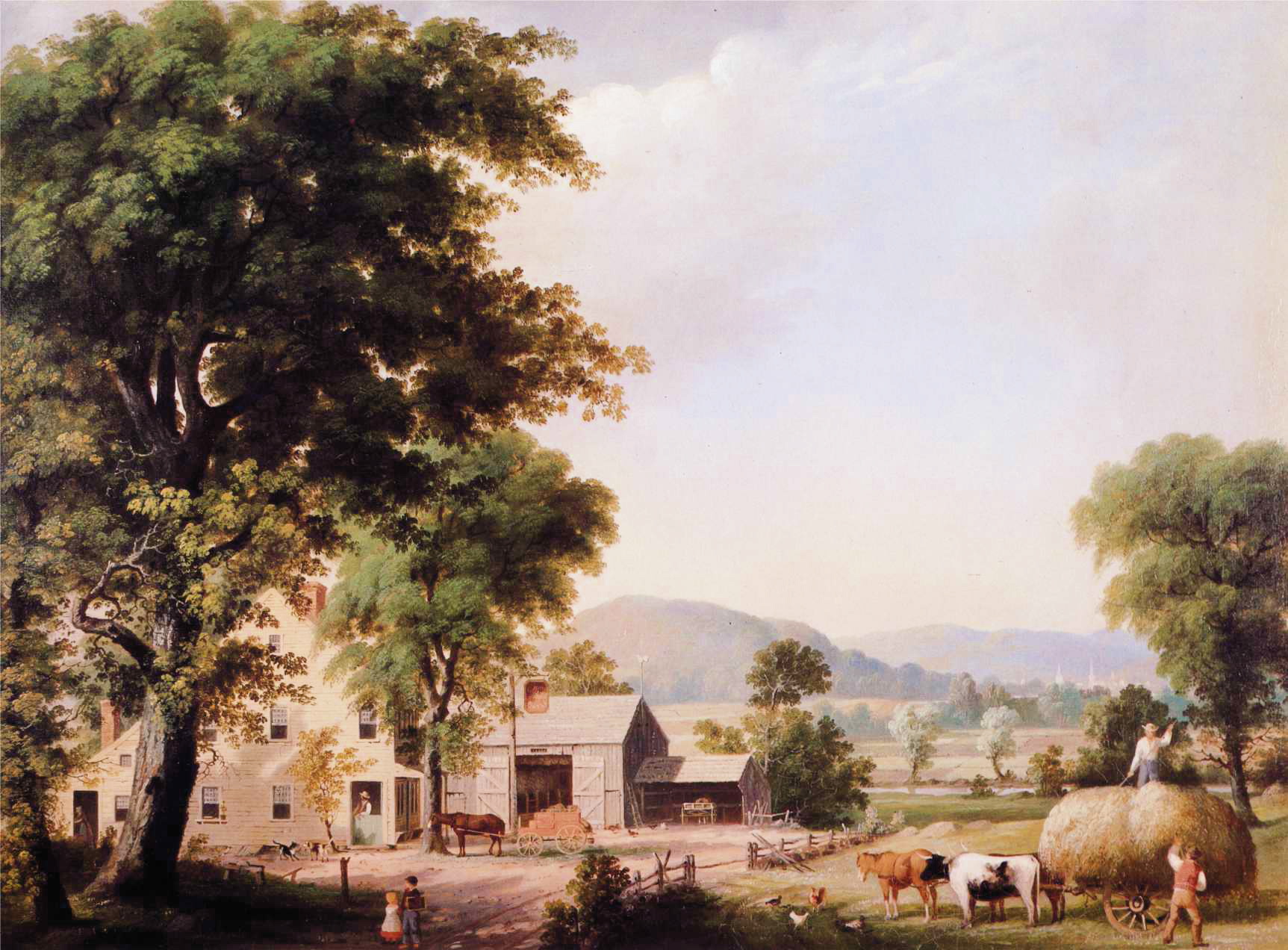
#FineArtFriday: Haying at Jones Inn by George Henry Durrie 1854

Artist: George Henry Durrie (1820–1863)

Title: English: Haying at Jones Inn

Date: 1854

Medium: oil on canvas

Dimensions: 22″×30″

Location: Private collection

What I love about this painting:

George Henry Durrie found beauty in the depictions of ordinary life. He always found a way to fit people into his scenes.

I absolutely love the nostalgia of this scene, and the wealth of information about how a reputable roadside inn worked. It is clear that Durrie was frequent guest at Jones Inn. He traveled widely in the years he worked as a portrait painter, and this particular public house is featured in his work several times from different angles. I like to imagine he painted the inn to provide a little respite from the demands of portraiture.

This scene shows us a day at the end of summer. Laborers are bringing a wagon piled high with hay. Two oxen are hitched behind a horse, the three working together to pull the laden wagon.

Country inns were often working farms. They had to be, as they were feeding staff and laborers as well as guests all year long, and there were no Costco, Sam’s Club, or Wholesale Foods to purchase supplies from.

The stables and the people who cared for the horses were just as important. Providing well for travelers’ horses was as crucial as that of providing the best rooms and food possible for their guests.

The hay piled on this wagon will feed not only the innkeepers’ beasts but will feed the horses ridden by guests as the year progresses. Many more wagons will be required to fill the barn and hayloft.

About the Artist, Via Wikipedia:

George Henry Durrie (June 6, 1820 – October 15, 1863) was an American landscape artist noted especially for his rural winter snow scenes, which became very popular after they were reproduced as lithographic prints by Currier and Ives.

For many years, Durrie made a living primarily as a portrait painter, executing hundreds of commissions. After marriage, he made frequent trips, traveling to New York, Massachusetts, New Jersey, and Virginia, fulfilling commissions and looking for new ones. His diary reveals that he was an enthusiastic railroad traveler, in the early days of the railroads. Durrie also painted what he called “fancy pieces”, whimsical studies of still lives or stage actors, as well as painting scenes on window-shades and fireplace covers. But portrait painting commissions became scarcer when photography came on the scene, offering a cheaper alternative to painted portraits, and, as his account-book shows, Durrie rarely painted a portrait after 1851.

Durrie’s interest shifted to landscape painting, and while on the road, or at home, made frequent sketches of landscape elements that caught his eye. Around 1844 Durrie began painting water and snow scenes, and took a second place medal at the 1845 New Haven State Fair for two winter landscapes. [1]

To learn more about this artist, go to  George Henry Durrie – Wikipedia


Credits and Attributions:

IMAGE: Wikimedia Commons contributors, “File:George Henry Durrie – Haying at Jones Inn.JPG,” Wikimedia Commons, https://commons.wikimedia.org/w/index.php?title=File:George_Henry_Durrie_-_Haying_at_Jones_Inn.JPG&oldid=853995435 (accessed October 22, 2025).

[1] Wikipedia contributors, “George Henry Durrie,” Wikipedia, The Free Encyclopedia, https://en.wikipedia.org/w/index.php?title=George_Henry_Durrie&oldid=1282714933 (accessed October 22, 2025).

Comments Off on #FineArtFriday: Haying at Jones Inn by George Henry Durrie 1854

Filed under #FineArtFriday

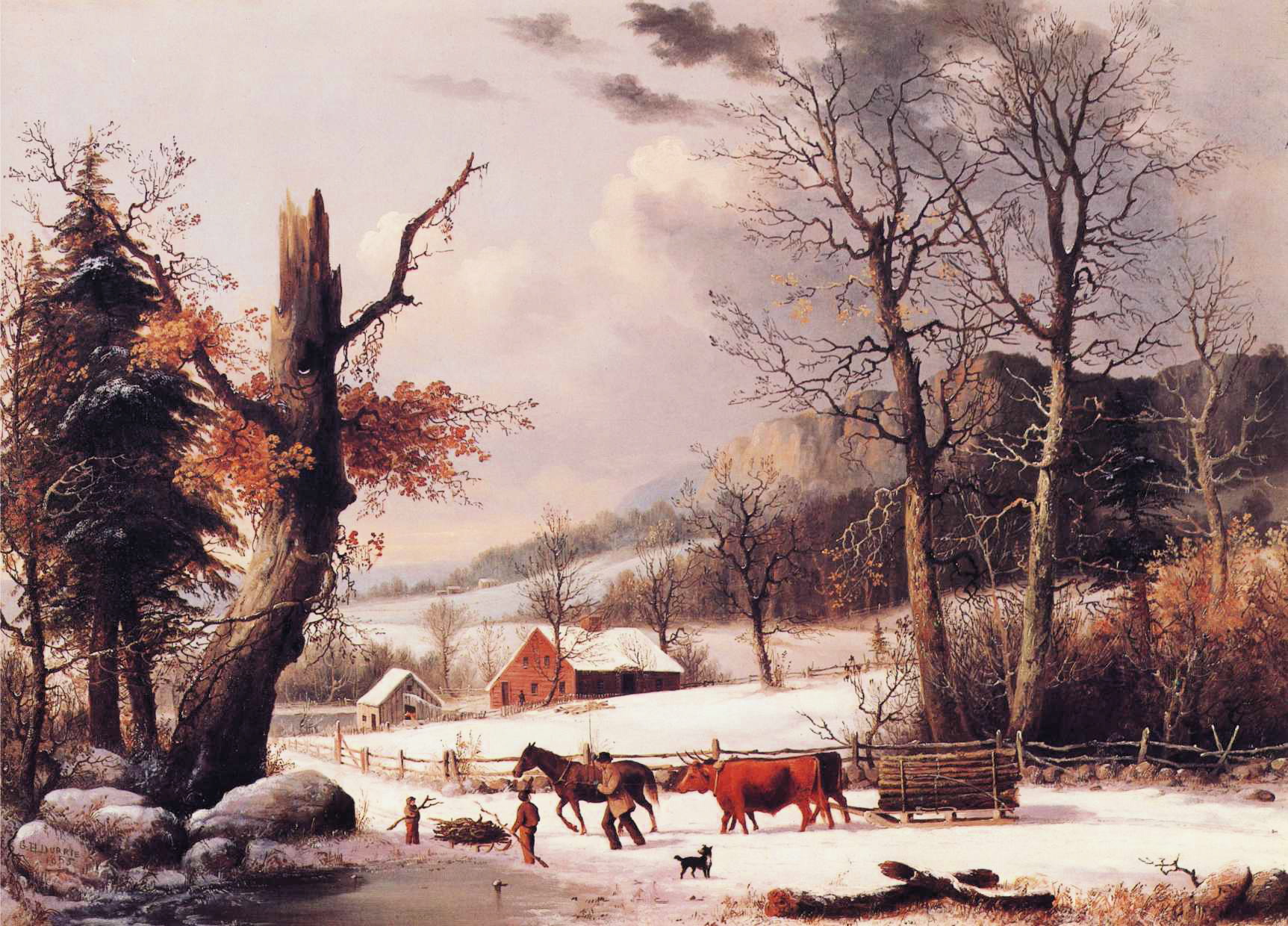
#FineArtFriday: Gathering Wood for Winter by George Henry Durrie 1855

Title: Gathering Wood for Winter

Artist: George Henry Durrie (1820–1863)

Date: 1855

Medium: oil on canvas

Dimensions: height: 26 in (66 cm); width: 36 in (91.4 cm)

Collection: Private collection

Why I love this painting:

Durrie shows us a day in late autumn. His characteristic use of reds and browns juxtaposed against lighter shades of white portrays the stark beauty of late autumn in New England.

The first snow has fallen, and the season is turning to winter. It’s more important than ever to gather as much wood as possible. Fortunately for our wood gatherers, a giant has fallen victim to a storm, snapping off halfway up.

This is not necessarily the end of the tree. Leaves still cling to the branches below the wound and will continue to provide shade and habitat for as long as it can. Someday, it may be cut down, as the fact it broke in half shows that it is nearing the end of its life and may present a hazard to those who walk beneath it.

Regardless of the tree’s future, the farmer and his son are taking advantage of the bounty so close to their home. They will stack it in the woodshed and allow it to dry out or “season” before they must burn it, hopefully not before the end of spring.

The more wood they gather now, the warmer they will be when winter’s grip tightens.

About the author, via Wikipedia:

George Henry Durrie (June 6, 1820 – October 15, 1863) was an American landscape artist noted especially for his rural winter snow scenes, which became very popular after they were reproduced as lithographic prints by Currier and Ives.

For many years, Durrie made a living primarily as a portrait painter, executing hundreds of commissions. After marriage, he made frequent trips, traveling to New York, Massachusetts, New Jersey,  and Virginia, fulfilling commissions and looking for new ones. His diary reveals that he was an enthusiastic railroad traveler, in the early days of the railroads. Durrie also painted what he called “fancy pieces”, whimsical studies of still lives or stage actors, as well as painting scenes on window-shades and fireplace covers. But portrait painting commissions became scarcer when photography came on the scene, offering a cheaper alternative to painted portraits, and, as his account-book shows, Durrie rarely painted a portrait after 1851.

Durrie’s interest shifted to landscape painting, and while on the road, or at home, made frequent sketches of landscape elements that caught his eye. Around 1844 Durrie began painting water and snow scenes, and took a second place medal at the 1845 New Haven State Fair for two winter landscapes. Although he had some training in portrait work, Durrie was self-taught as a landscape artist. He was undoubtedly influenced both by the American Hudson River School, and also by European artists, by studying exhibitions of their work at the New Haven Statehouse, the Trumbull Gallery, and at the Wadsworth Atheneum in Hartford, as well as in New York City. Durrie himself exhibited regularly, both locally, and in New York City at the National Academy of Design and the American Artists’ Union, and his reputation grew. Durrie was especially known for his snow pieces, and would often make copies or near-copies of his most popular pieces, with modifications to order.  The landscapes painted by Durrie offered a more intimate view than the panoramic landscapes painted by the Hudson River School, which was the leading school of American landscape painting. Colin Simkin notes that Durrie’s paintings took in a wide angle, but still “close enough to be within hailing distance” of the people who are always included in his scenes.

Currier and Ives

Durrie’s early landscapes were often of local landmarks, such as East Rock and West Rock, and other local scenes, which were popular with his New Haven clients, and he painted numerous variations of popular subjects. As his portrait commissions declined, Durie concentrated on landscapes. He wanted a wider audience, and he seemed to have a good sense of what would sell. Durrie realized that his paintings would have a wider appeal if he made them as generic New England scenes rather than as identifiable local scenes, retaining, as Sackett said, “a sense of place without specifying where that place was.” The New York City lithographic firm of Currier & Ives knew their audience; the American public wanted nostalgic scenes of rural life, images of the good old days, and Durrie’s New England scenes fit the bill perfectly. Lithographic prints were a very democratic form of art, cheap enough that the humblest home could afford some art to hang on the wall. Durrie had been marketing his paintings in New York City, and Currier and Ives, who had popularized such prints, purchased some of Durrie’s paintings in the late 1850s or early 1860s, and eventually published ten of Durrie’s pictures beginning in 1861. Four prints were published between 1861 and the artist’s death in New Haven in 1863; six additional prints were issued posthumously.

The popularity of Durrie’s snow scenes received an additional boost in the 1930s, when the Traveler’s Insurance Company began issuing calendars featuring Currier and Ives prints. Starting in 1946, the January calendar always featured a Durrie snow scene. Historian Bernard Mergen notes that “84 of the 125 paintings attributed to him are snowscapes, more than enough to make him the most prolific snow scene painter of his time.”

In Durrie’s time, winter landscapes were not popular with most curators and critics, but nevertheless, by the time of his death, Durrie had acquired a national reputation as a snowscape painter. Durrie died in 1863, at age 43, probably from typhoid fever, not long after Currier and Ives began reproducing his paintings as prints.

Durrie was dismissed by critics as a popular artist, an illustrator rather than a fine artist. Although Durrie’s Currier and Ives prints were popular, his name was still relatively unknown. But a revival of interest in Durrie began in the 1920s with the publication in 1929 of Currier and Ives, Printmakers to the American People, by collector Harry T. Peters, Sr., who called Durrie’s prints “among the most valued In the entire gallery [of Currier and Ives prints]”, and says that Durrie was known as the “snowman” of the group. [1]


Credits and Attributions:

IMAGE: Gathering Wood for Winter by George Henry Durrie 1855. Wikimedia Commons contributors, “File:George Henry Durrie – Gathering Wood for Winter.JPG,” Wikimedia Commons, https://commons.wikimedia.org/w/index.php?title=File:George_Henry_Durrie_-_Gathering_Wood_for_Winter.JPG&oldid=853995324 (accessed May 1, 2025).

[1]Wikipedia contributors, “George Henry Durrie,” Wikipedia, The Free Encyclopedia, https://en.wikipedia.org/w/index.php?title=George_Henry_Durrie&oldid=1282714933 (accessed May 1, 2025).
Comments Off on #FineArtFriday: Gathering Wood for Winter by George Henry Durrie 1855

Filed under #FineArtFriday, writing

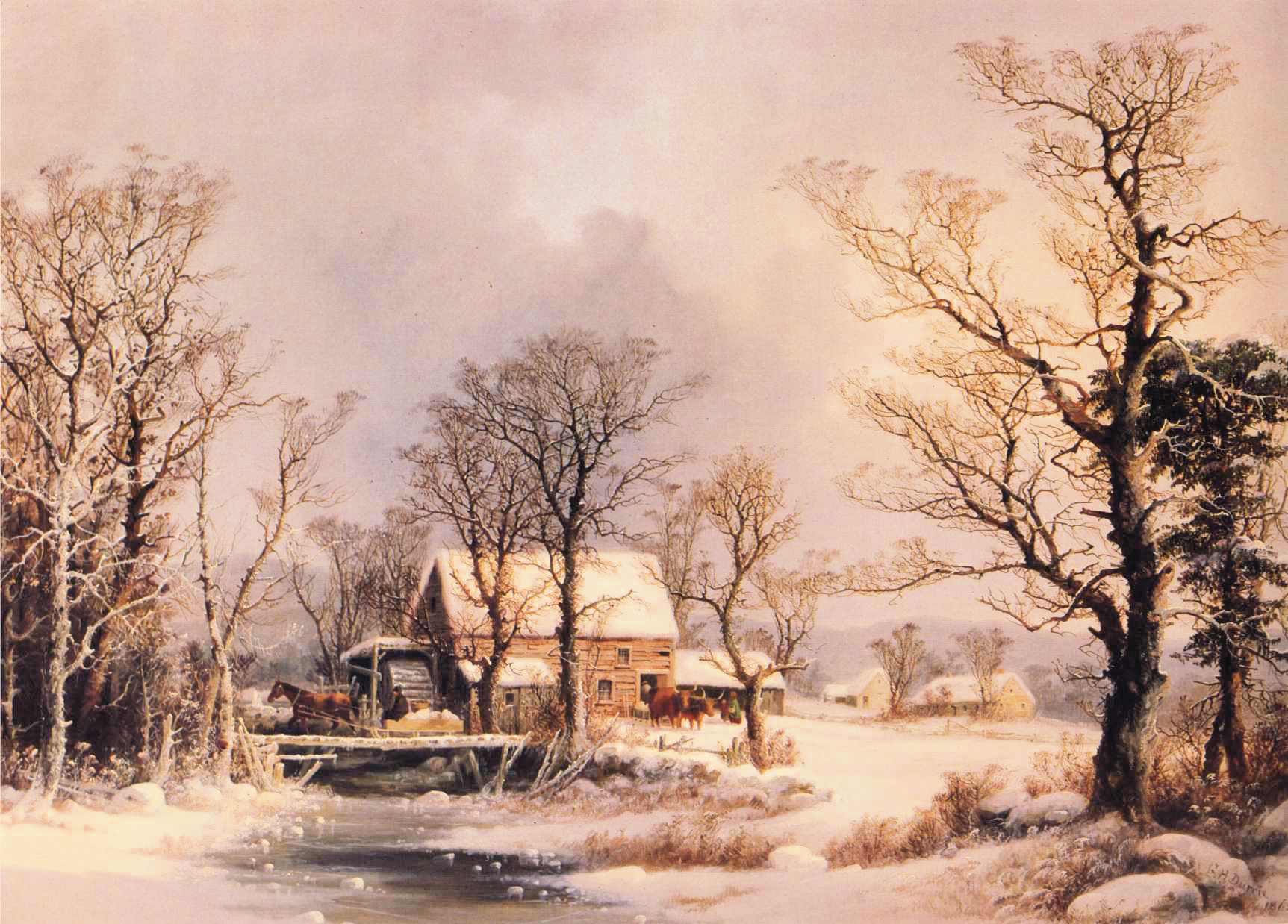
#FineArtFriday: Winter in the Country – The Old Grist Mill by George Henry Durrie

Artist: George Henry Durrie (1820–1863)

Painting: Oil on canvas, 26 x 36 in

Date: 1862

What I love about this painting:

George Henry Durrie is one of my favorite American artists. In this painting, he shows us a winter’s day in New England in 1862. Snow covers the ground, but the sun is shining, lending a rosy glow to the day.

The stream bears a light skim of ice, but though the millwheel is covered in snow, the mill is not idle. This late (or early) in the year there is no wheat to grind, but the grain from the previous autumn’s harvest has been turned to flour and shoveled into bags and barrels and stored for sale as needed.

A horse-drawn sled crosses the log bridge, loaded with white cotton bags of flour. Perhaps the driver intends to take advantage of the good weather and deliver them to the local General Store or Mercantile.

Durrie’s horses and cattle are as true to life as his landscapes are. One can almost see the muscles moving beneath the glossy coat as our horse pull the sleigh.

If you are writing a story set in an era of lower technology, I strongly suggest you go to the art of Durrie and his contemporaries to find inspiration for worldbuilding.

About the artist, via Wikipedia:

George Henry Durrie (June 6, 1820 – October 15, 1863) was an American landscape artist noted especially for his rural winter snow scenes, which became very popular after they were reproduced as lithographic prints by Currier and Ives.

In Durrie’s time, winter landscapes were not popular with most curators and critics, but nevertheless, by the time of his death, Durrie had acquired a national reputation as a snowscape painter. Durrie died in 1863, at age 43, probably from typhoid fever, not long after Currier and Ives began reproducing his paintings as prints.

Durrie’s paintings, depicting idyllic rural life, a world of stability and home comforts, held great appeal for the middle class and the working class, as an visual antidote for the growing industrialization of America, and the uncertainties of a boom-and-bust economy. The American ideal of a land of self-sufficient farmers, captured by Durrie’s paintings, was being replaced with factories belching smoke, along with a rise in urban populations, foreign immigration, and crime brought about by crowded conditions and poverty. The American descendants of the early English settlers felt that their values and way of life were threatened by these new developments and turned to nostalgic images such as Durrie’s for comfort. [1]


Credits and Attributions:

IMAGE: Wikimedia Commons contributors, “File:George Henry Durrie – Winter in the Country, The Old Grist Mill.JPG,” Wikimedia Commons, https://commons.wikimedia.org/w/index.php?title=File:George_Henry_Durrie_-_Winter_in_the_Country,_The_Old_Grist_Mill.JPG&oldid=995260526 (accessed February 10, 2025).

[1] Wikipedia contributors, “George Henry Durrie,” Wikipedia, The Free Encyclopedia, https://en.wikipedia.org/w/index.php?title=George_Henry_Durrie&oldid=1244671369 (accessed February 10, 2025).

5 Comments

Filed under #FineArtFriday, writing

#FineArtFriday: Winter Scene in New Haven, Connecticut, by George Henry Durrie

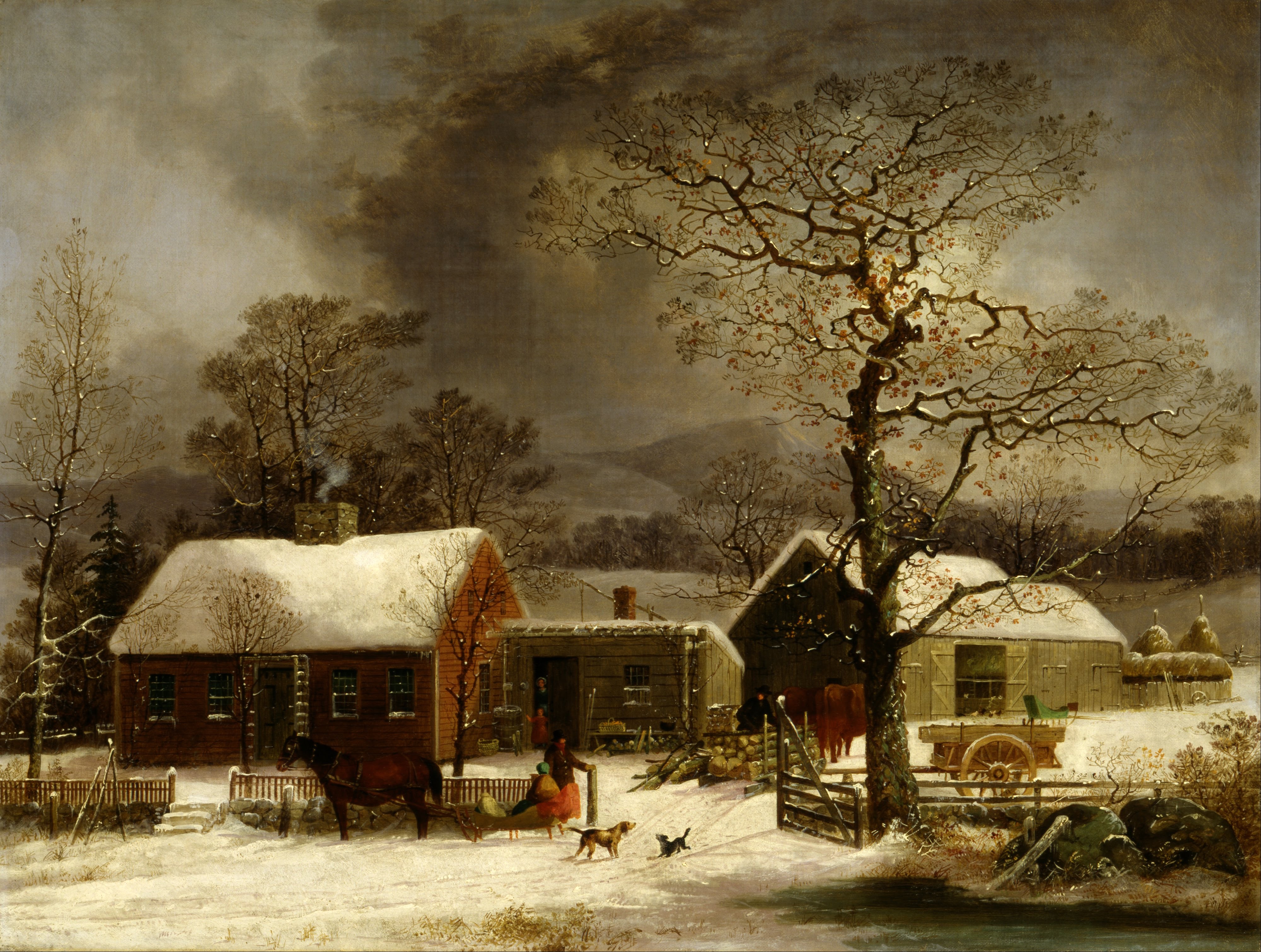
I frequently find myself perusing the vaults at Wikimedia Commons, looking for clues about how people lived in times past. Winter Scene in New Haven, Connecticut, by George Henry Durrie is an intriguing window into the winter of 1858, a surprisingly intimate view of life in America just before the Civil War. I first posted this image in December of 2017, and it remains one of my favorite paintings, for a number of reasons.

Durrie had a modest reputation during his lifetime, an indie struggling unsuccessfully to market his works. After his death, the American printmaking firm, Currier and Ives, ensured his works were kept in the public eye.

The grandeur of the sky is reminiscent of Constable’s work, and the painting, overall, is both bold and comforting. Under a large sky, we find a small farm. It’s a simple pastoral scene, a moment painted during a winter long passed into memory. It’s pleasant, almost boring scene in its common hominess. When you look at the larger picture, you may ask, “How is this intimate? The landscape and the sky provide the drama, while the people are completely overshadowed by the scenery.”

But there is another, deeper story, one that is overshadowed by the majestic landscape and threatening winter skies, and Durrie included these people for a reason.

In Connecticut in 1858 things were not as simple and bucolic as the wide view of this image portrays.

Quote from Matthew Warshauer in his article for Connecticut History:

The state descended into chaos at the start of the war, splitting into warring Republican and Democratic factions that sometimes faced off violently.  Before the Southern states even seceded, the two parties faced off in the 1860 gubernatorial election, a contest that would decide the level of the state’s involvement once the war began.

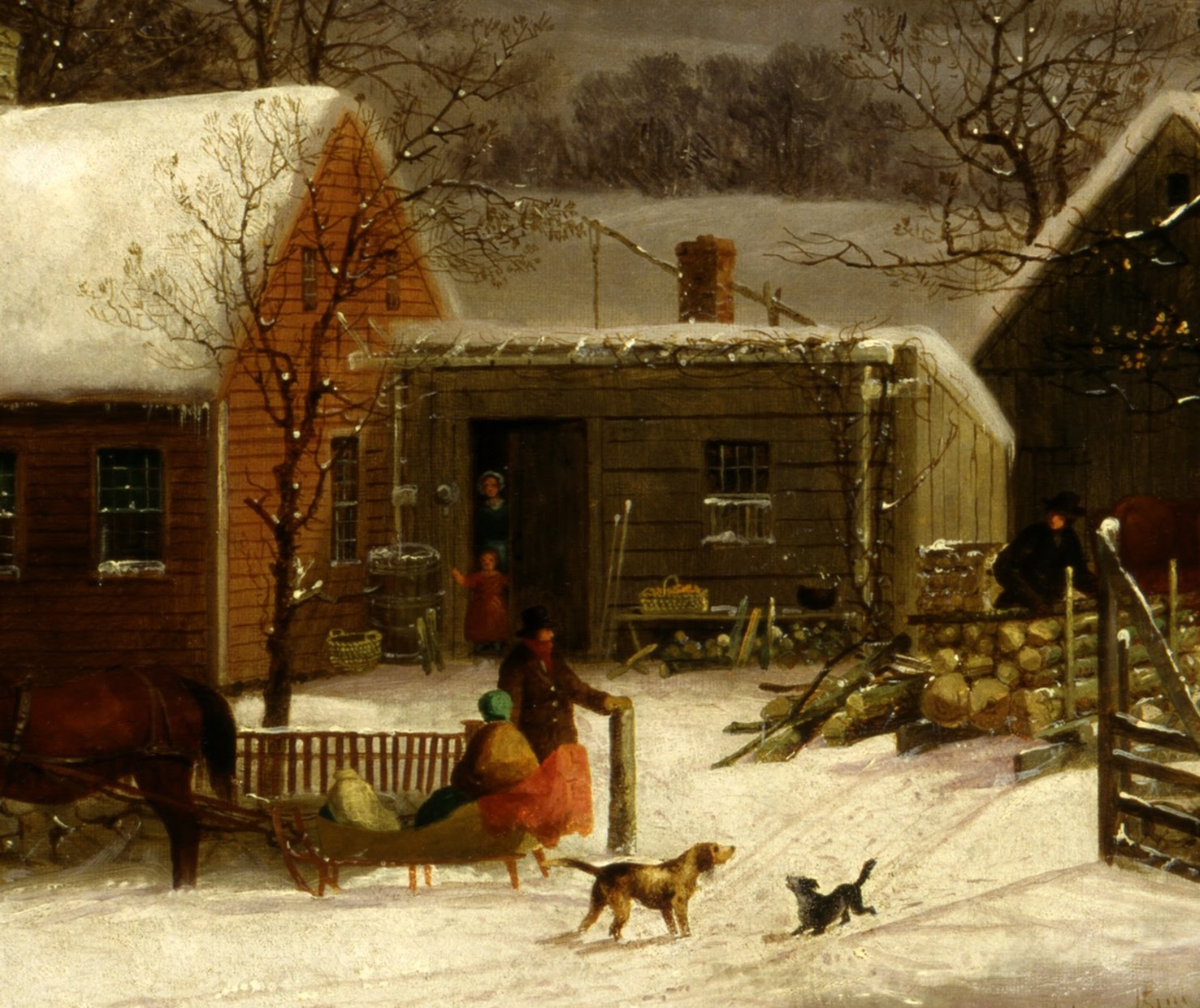
Artists, then and now, frequently deal in allegory and misdirection. Then, as now, they were pressured to portray an acceptable vision of life as it should be. They had to sell their work to live, so they did do that, but they still painted what they saw, inserting the truth into each painting. The story that Durrie hid within this painting can be found by examining the painting in detail. I have enlarged the important section for you.

A sled, drawn by a single horse and driven by a woman, has pulled up beside the gate. A man has emerged and is talking to her. In the doorway of the farmhouse, a woman and girl stand, watching the scene at the gate.

We can imagine that some drama exists in their relationships, beginning with the way the man is standing there, not inviting the woman in. She obviously doesn’t expect to be invited in by him but has come anyway.

The man speaks to the traveler, but his gaze is not focused on the woman who has traveled through the snow, bringing a large sack filled with… what? Presents? Food-gifts? Instead, he looks away, focusing on the fencepost. Is the visitor an unwelcome mother-in-law, or is she, perhaps, a travelling merchant and he is negotiating with her?

Did she purchase something? Perhaps they’re merely chatting and he just happens to be looking away.

The sky can be a clue to the deeper story, too. Dark clouds take up fully half of the scene, dwarfing the homestead. Storms threaten the peace and prosperity of this farm, and barren trees flourish. It’s 1858 and the country is divided politically and ideologically, and the threat of a civil war looms.

The final subliminal clue is in the title: Winter Scene in New Haven, Connecticut. The artist names the picture after the larger community, a town that doesn’t appear at all in the painting, instead of offering the farm’s name. Thus, the scene. the approaching storm threatening the peaceful farm, is an allegory depicting the mood of the larger community.

Does this small detail hidden in the larger picture depict a travelling merchant, a customer, or a disliked mother-in-law bringing gifts despite her son-in-law’s aversion? Or is there something deeper here? Nothing breaks up families or divides communities as surely as strongly held opposing opinions, and we were deeply divided in those turbulent times.

The story is there, and the world in which it is set is all prepared for you. George Henry Durrie painted it, and if you are looking for a deep story that echoes our modern political state of affairs, here it is.

Or, it could simply be a passing stranger, asking for directions on a winter’s day.

When you examine the art of the past closely and look for allegories, you may find a large story hidden within the the image.  It’s up to you to interpret it and then write it.


Credits and Attributions:

Wikimedia Commons contributors, “File:George Henry Durrie – Winter Scene in New Haven, Connecticut – Google Art Project.jpg,” Wikimedia Commons, https://commons.wikimedia.org/w/index.php?title=File:George_Henry_Durrie_-_Winter_Scene_in_New_Haven,_Connecticut_-_Google_Art_Project.jpg&oldid=761233247 (accessed January 23, 2025).

The Complicated Realities of Connecticut and the Civil War, by Matthew Warshauer, Ph.D., Professor of History at Central Connecticut State University. Copyright © Connecticut Humanities. Licensed under a Creative Commons Attribution Non-Commercial Share Alike 3.0 License (accessed January 23, 2025).

3 Comments

Filed under #FineArtFriday, writing

#FineArtFriday: Cider Pressing by George Henry Durrie 1855 (revisited)
George_Henry_Durrie_-_Cider_PressingCider Pressing by George Henry Durrie 1855

Date: 1855

Medium: oil on canvas

Dimensions: Height: 22.2 in (56.5 cm); Width: 30.2 in (76.8 cm)

Collection: Private collection (Mr. & Mrs. Eugene Bugbee)

What I love about this painting:

We’re nearing the end of October, and autumn is fast sliding into the long dark of a northern November. Some trees are shedding their leaves here in the Pacific Northwest, but others are clinging to the last shreds of yellow and gold. Our native fall colors are less brilliant than those depicted in Durie’s work, but many non-native species have been introduced in the suburban landscape, offering bursts of scarlet and orange.

I love the simplicity of George Henry Durrie’s paintings. This one in particular deserves a second look. It first appeared here in September of 2021.

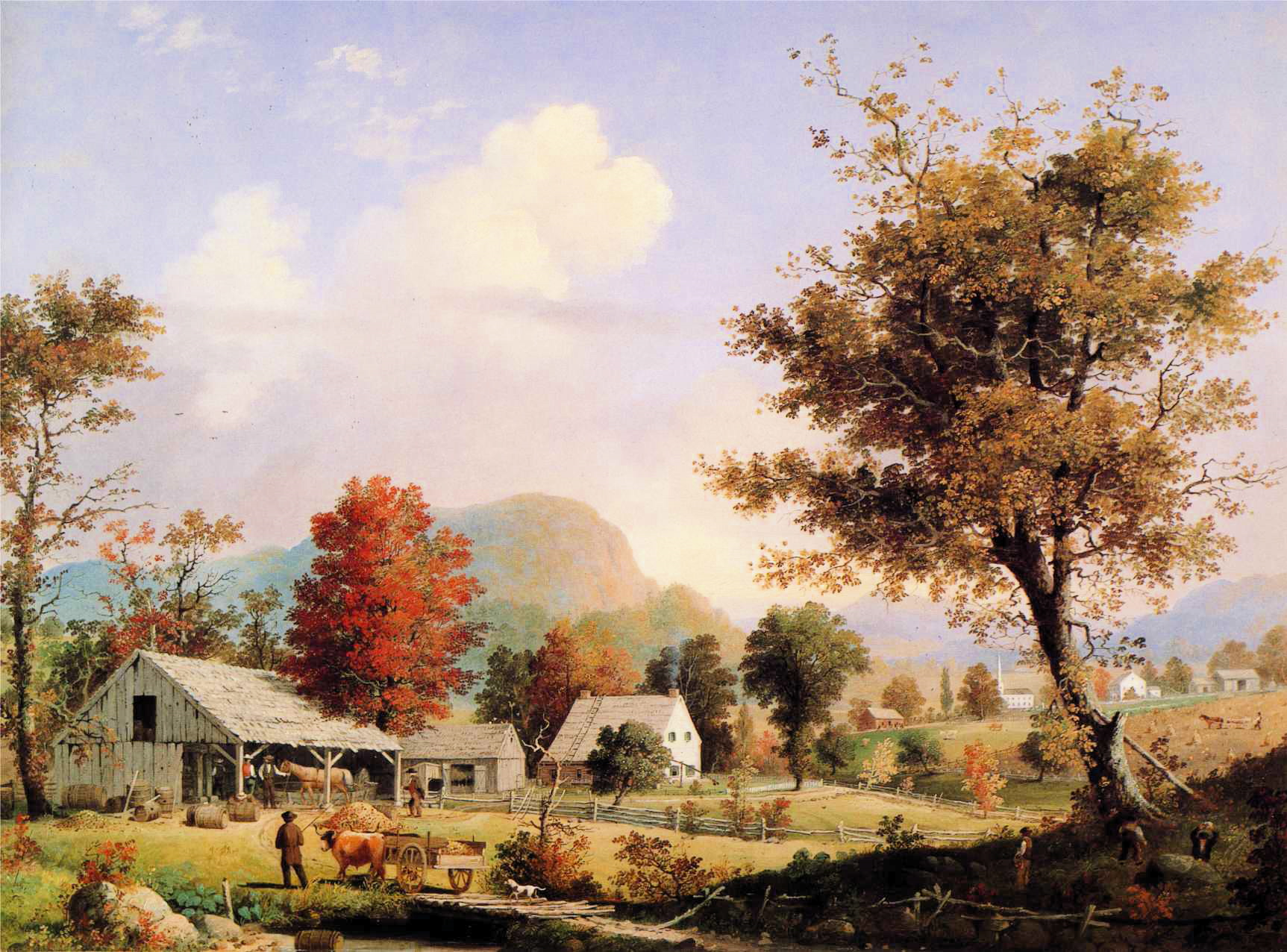
This is a quintessential, slightly romantic, view of history, a window into a New England day in autumn during the 19th century. A farmer leads his ox-drawn cart to the cider press. Is he selling them to the cider-man or just paying to have them juiced? Does he make his own apple jack, or is he a teamster, transporting goods for a fee?

A story can be found here, as in all Durrie’s paintings.

Juicing apples for unfermented ciders juices, jellies, and the highly fermented apple jack was an essential part of bringing in the harvest and preparing for winter, a part of the food chain we who get our food from the supermarket are disconnected from. But this was a scene that played out every fall, in every town and village.

Durrie’s colors are intensely vibrant, deep and rich, and each part of the scene is clear and placed with intent. The air is crisp and cool, but not yet cold. The leaves are turning all shades of red and gold, just as they are doing here today in the Pacific Northwest.

About the Artist, quoted from the National Gallery of Art:

Born in New Haven in 1820, the son of a Connecticut stationer, George Henry Durrie remained in that city virtually his entire life. Married to a choirmaster’s daughter, Sarah Perkins, in 1841, he immersed himself in the quiet pursuits of family and church. While he never achieved the fame of the most renowned nineteenth century American landscape painters, he appears to have had a fulfilling, productive career. His letters show that he never felt the need to move beyond his community, although he once briefly took a studio in New York and exhibited there regularly at the National Academy of Design.

Almost all of his compositions are relatively small in scale, few exceeding 18 x 24 inches, and his views are quiet and intimate. He knew and admired the works of Thomas Cole, and may have tried to emulate certain aspects of Cole’s style, yet he eschewed the Hudson River School’s compositional complexity and expansiveness. Because his paintings combined extensive genre elements with landscape they had a story-telling content that made them pleasant, accessible images to the average viewer.

The lithographic firm of Currier & Ives successfully reproduced ten of Durrie’s scenes and these, in turn, became popular calendar illustrations in the twentieth century. As a result, Durrie’s depictions of rural life in the mid-nineteenth century are now among the most familiar images in all of American art. As Martha Hutson has noted, however, these printed pictures do not convey the keen sensitivity to and understanding of conditions of atmosphere and light that are so pronounced in Durrie’s paintings. [1]

From Wikipedia:

In his teens the self-taught artist painted portraits in the New Haven area. In 1839 he received artistic instruction from Nathaniel Jocelyn, a local engraver and portrait painter. After 1842 he settled in New Haven, but made painting trips to New Jersey, New York, and Virginia. Around 1850, he began painting genre scenes of rural life, as well as the winter landscapes that became popular when Currier and Ives published them as lithographs. Four prints were published between 1860 and the artist’s death in New Haven in 1863; six additional prints were issued posthumously. The painter Jeanette Shepperd Harrison Loop studied with him. [2]


Credits and Attributions:

Wikimedia Commons contributors, “File:George Henry Durrie – Cider Pressing.JPG,” Wikimedia Commons, the free media repository, https://commons.wikimedia.org/w/index.php?title=File:George_Henry_Durrie_-_Cider_Pressing.JPG&oldid=369724230 (accessed September 15, 2021).

[1] National Gallery of Art contributors, “George Henry Durrie,” biography, © 2018 – 2021 National Gallery of Art, https://www.nga.gov/collection/artist-info.6397.html

[2] Wikipedia contributors, “George Henry Durrie,” Wikipedia, The Free Encyclopedia, https://en.wikipedia.org/w/index.php?title=George_Henry_Durrie&oldid=861433469 (accessed September 15, 2021).

2 Comments

Filed under #FineArtFriday, writing

#FineArtFriday: Cider Pressing by George Henry Durrie 1855

George_Henry_Durrie_-_Cider_PressingCider Pressing by George Henry Durrie 1855

Date: 1855

Medium: oil on canvas

Dimensions: Height: 22.2 in (56.5 cm); Width: 30.2 in (76.8 cm)

Collection: Private collection (Mr. & Mrs. Eugene Bugbee)

What I love about this painting:

This is a quintessential, slightly romantic, view of history, a window into a New England day in autumn during the 19th century. A farmer leads his ox-drawn cart to the cider press. Is he selling them to the cider-man or just paying to have them juiced? Does he make his own apple jack, or is he a teamster, transporting goods for a fee?

A story can be found here, as in all Durrie’s paintings.

Juicing apples for unfermented ciders juices, jellies, and the highly fermented apple jack was an essential part of bringing in the harvest and preparing for winter, a part of the food chain we who get our food from the supermarket are disconnected from. But this was a scene that played out every fall, in every town and village.

Durrie’s colors are intensely vibrant, deep and rich, and each part of the scene is clear and placed with intent. The air is crisp and cool, but not yet cold. The leaves are turning all shades of red and gold, just as they are doing here today in the Pacific Northwest.

About the Artist, quoted from the National Gallery of Art:

Born in New Haven in 1820, the son of a Connecticut stationer, George Henry Durrie remained in that city virtually his entire life. Married to a choirmaster’s daughter, Sarah Perkins, in 1841, he immersed himself in the quiet pursuits of family and church. While he never achieved the fame of the most renowned nineteenth century American landscape painters, he appears to have had a fulfilling, productive career. His letters show that he never felt the need to move beyond his community, although he once briefly took a studio in New York and exhibited there regularly at the National Academy of Design.

Almost all of his compositions are relatively small in scale, few exceeding 18 x 24 inches, and his views are quiet and intimate. He knew and admired the works of Thomas Cole, and may have tried to emulate certain aspects of Cole’s style, yet he eschewed the Hudson River School’s compositional complexity and expansiveness. Because his paintings combined extensive genre elements with landscape they had a story-telling content that made them pleasant, accessible images to the average viewer.

The lithographic firm of Currier & Ives successfully reproduced ten of Durrie’s scenes and these, in turn, became popular calendar illustrations in the twentieth century. As a result, Durrie’s depictions of rural life in the mid-nineteenth century are now among the most familiar images in all of American art. As Martha Hutson has noted, however, these printed pictures do not convey the keen sensitivity to and understanding of conditions of atmosphere and light that are so pronounced in Durrie’s paintings. [1]

From Wikipedia:

In his teens the self-taught artist painted portraits in the New Haven area. In 1839 he received artistic instruction from Nathaniel Jocelyn, a local engraver and portrait painter. After 1842 he settled in New Haven, but made painting trips to New Jersey, New York, and Virginia. Around 1850, he began painting genre scenes of rural life, as well as the winter landscapes that became popular when Currier and Ives published them as lithographs. Four prints were published between 1860 and the artist’s death in New Haven in 1863; six additional prints were issued posthumously. The painter Jeanette Shepperd Harrison Loop studied with him. [2]


Credits and Attributions:

Wikimedia Commons contributors, “File:George Henry Durrie – Cider Pressing.JPG,” Wikimedia Commons, the free media repository, https://commons.wikimedia.org/w/index.php?title=File:George_Henry_Durrie_-_Cider_Pressing.JPG&oldid=369724230 (accessed September 15, 2021).

[1] National Gallery of Art contributors, “George Henry Durrie,” biography, © 2018 – 2021 National Gallery of Art, https://www.nga.gov/collection/artist-info.6397.html

[2] Wikipedia contributors, “George Henry Durrie,” Wikipedia, The Free Encyclopedia, https://en.wikipedia.org/w/index.php?title=George_Henry_Durrie&oldid=861433469 (accessed September 15, 2021).

2 Comments

Filed under #FineArtFriday, writing

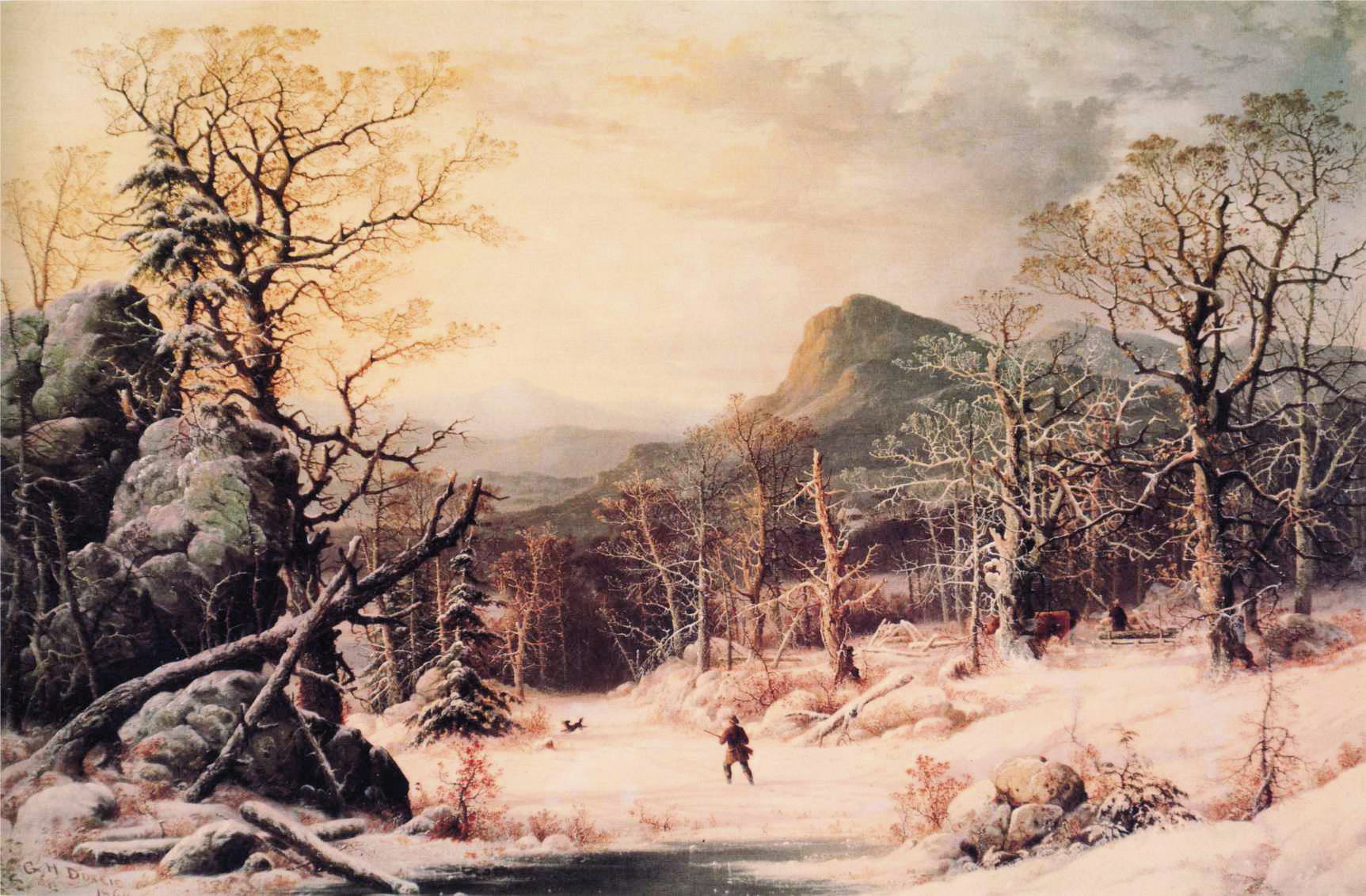
#FineArtFriday: Hunter in Winter Wood, George Henry Durrie

Hunter in Winter Wood, by George Henry Durrie 1860 is one of my favorite images of 19th century Americana. The snow on the bare trees and rocky outcroppings gives the impression of weight, yet it is only a light dusting. The way the light shines golden on the snow—this is how a snowy winter looked in the woods surrounding the rural lake where I grew up. The grandeur of the view shows the 19th century vision of a wide, boundless country. Anything is possible in a country where the land and resources are as limitless as shown in this painting.

Hunter in Winter Wood was painted near the end of Durrie’s life. His most famous works were made into prints by Currier and Ives after his death at the age of 43.

About the Artist, quoted from the National Gallery of Art:

Born in New Haven in 1820, the son of a Connecticut stationer, George Henry Durrie remained in that city virtually his entire life. Married to a choirmaster’s daughter, Sarah Perkins, in 1841, he immersed himself in the quiet pursuits of family and church. While he never achieved the fame of the most renowned nineteenth century American landscape painters, he appears to have had a fulfilling, productive career. His letters show that he never felt the need to move beyond his community, although he once briefly took a studio in New York and exhibited there regularly at the National Academy of Design.

Almost all of his compositions are relatively small in scale, few exceeding 18 x 24 inches, and his views are quiet and intimate. He knew and admired the works of Thomas Cole, and may have tried to emulate certain aspects of Cole’s style, yet he eschewed the Hudson River School’s compositional complexity and expansiveness. Because his paintings combined extensive genre elements with landscape they had a story-telling content that made them pleasant, accessible images to the average viewer.

The lithographic firm of Currier & Ives successfully reproduced ten of Durrie’s scenes and these, in turn, became popular calendar illustrations in the twentieth century. As a result, Durrie’s depictions of rural life in the mid-nineteenth century are now among the most familiar images in all of American art. As Martha Hutson has noted, however, these printed pictures do not convey the keen sensitivity to and understanding of conditions of atmosphere and light that are so pronounced in Durrie’s paintings.

From Wikipedia:

In his teens the self-taught artist painted portraits in the New Haven area. In 1839 he received artistic instruction from Nathaniel Jocelyn, a local engraver and portrait painter. After 1842 he settled in New Haven, but made painting trips to New Jersey, New York, and Virginia. Around 1850, he began painting genre scenes of rural life, as well as the winter landscapes that became popular when Currier and Ives published them as lithographs. Four prints were published between 1860 and the artist’s death in New Haven in 1863; six additional prints were issued posthumously. The painter Jeanette Shepperd Harrison Loop studied with him.


Credits and Attributions:

Hunter in Winter Wood, by George Henry Durrie 1860 [Public Domain] via Wikimedia Commons

Wikipedia contributors, “George Henry Durrie,” Wikipedia, The Free Encyclopedia, https://en.wikipedia.org/w/index.php?title=George_Henry_Durrie&oldid=861433469 (accessed November 23, 2018).

National Gallery of Art contributors, “George Henry Durrie,” biography, © 2018 National Gallery of Art, https://www.nga.gov/collection/artist-info.6397.html

Comments Off on #FineArtFriday: Hunter in Winter Wood, George Henry Durrie

Filed under #FineArtFriday, writing

#FineArtFriday: Winter Scene in New Haven, Connecticut, by George Henry Durrie

I frequently find myself perusing the vaults at Wikimedia Commons, looking for clues about how people lived in times past. Winter Scene in New Haven, Connecticut, by George Henry Durrie is an intriguing window into the winter of 1858, a surprisingly intimate view of life in America just before the Civil War.

Durrie had a modest reputation during his lifetime, an indie struggling unsuccessfully to market his works. After his death, the American printmaking firm, Currier and Ives, ensured his works were kept in the public eye.

The grandeur of the sky is reminiscent of Constable’s work, and the painting, overall, is both bold and comforting. Under a large sky, we find a small farm. It’s a simple pastoral scene, a moment painted during a winter long passed into memory. It’s pleasant, almost boring scene in its common hominess. When you look at the larger picture, you may ask, “How is this intimate? The landscape and the sky provide the drama, while the people are completely overshadowed by the scenery.”

But there is another, deeper story, one that is overshadowed by the majestic landscape and threatening winter skies, and Durrie included these people for a reason.

In Connecticut in 1858 things were not as simple and bucolic as the wide view of this image portrays.

Quote from Matthew Warshauer in his article for Connecticut History:

The state descended into chaos at the start of the war, splitting into warring Republican and Democratic factions that sometimes faced off violently.  Before the Southern states even seceded, the two parties faced off in the 1860 gubernatorial election, a contest that would decide the level of the state’s involvement once the war began.

Artists, then and now, frequently deal in allegory and misdirection. Then, as now, they were pressured to portray an acceptable vision life as it should be. They had to sell their work to live, so they did do that, but they still painted what they saw, inserting the truth into each painting. The story that Durrie hid within this painting can be found by examining the painting in detail. I have enlarged the important section for you.

A sled, drawn by a single horse and driven by a woman, has pulled up beside the gate. A man has emerged and is talking to her. In the doorway of the farmhouse, a woman and girl stand, watching the scene at the gate.

We can imagine that some drama exists in their relationships, beginning with the way the man is standing there, not inviting the woman in. She obviously doesn’t expect to be invited in by him but has come anyway.

The man speaks to the traveler, but his gaze is not focused on the woman who has traveled through the snow, bringing a large sack filled with… what? Presents? Food-gifts? Instead, he looks away, focusing on the fencepost. Is the visitor an unwelcome mother-in-law, or is she, perhaps, a travelling merchant and he is negotiating with her?

Did she purchase something? Perhaps they’re merely chatting and he just happens to be looking away.

The sky can be a clue to the deeper story, too. Dark clouds take up fully half of the scene, dwarfing the homestead. Storms threaten the peace and prosperity of this farm, and barren trees flourish. It’s 1858 and the country is divided politically and ideologically, and the threat of a civil war looms.

The final subliminal clue is in the title: Winter Scene in New Haven, Connecticut. The artist names the picture after the larger community, a town that doesn’t appear at all in the painting, instead of offering the farm’s name. Thus, the scene. the approaching storm threatening the peaceful farm, is an allegory depicting the mood of the larger community.

Does this small detail hidden in the larger picture depict a travelling merchant, a customer, or a disliked mother-in-law bringing gifts despite her son-in-law’s aversion? Or is there something deeper here? Nothing breaks up families or divides communities as surely as strongly held opposing opinions, and we were deeply divided in those turbulent times.

The story is there, and the world in which it is set is all prepared for you. George Henry Durrie painted it, and if you are looking for a deep story that echoes our modern political state of affairs, here it is.

Or, it could simply be a passing stranger, asking for directions on a winter’s day.

When you examine the art of the past closely and look for allegories, you may find a large story hidden within the the image.  It’s up to you to interpret it and then write it.


Credits and Attributions:

Wikimedia Commons contributors, “File:George Henry Durrie – Winter Scene in New Haven, Connecticut – Google Art Project.jpg,” Wikimedia Commons, the free media repository, https://commons.wikimedia.org/w/index.php?title=File:George_Henry_Durrie_-_Winter_Scene_in_New_Haven,_Connecticut_-_Google_Art_Project.jpg&oldid=249454341  (accessed December 14, 2017).

The Complicated Realities of Connecticut and the Civil War, by Matthew Warshauer, Ph.D., Professor of History at Central Connecticut State University. Copyright © Connecticut Humanities. Licensed under a Creative Commons Attribution Non-Commercial Share Alike 3.0 License. (accessed December 14, 2017)

5 Comments

Filed under #FineArtFriday, writing