
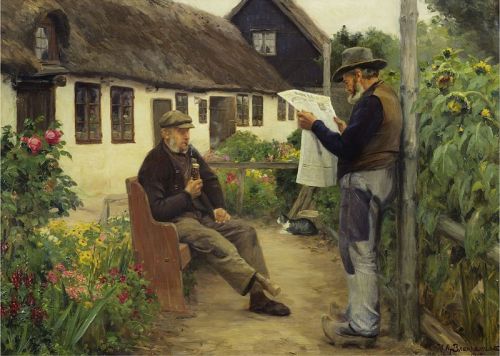
H. A. Brendekilde is one of my favorite artists, which is why I wanted to revisit these two paintings. There is a story in the above painting. I love the details—the patched trousers of the gardener, the mud on his clogs, the other man’s wooden leg—juxtaposed against the lush spring garden and prosperous village life of Denmark in 1912. Their hands and clothes indicate they have stopped work to read the newspaper. Both men seem stunned. Are they perhaps reading of the death of King Frederick VIII, who died on 14 May 1912?
Whatever they are reading, the cat remains undisturbed by the news. Even in 1912, cats were notoriously unconcerned about the life or death of kings.
The next painting also tells a powerful story.
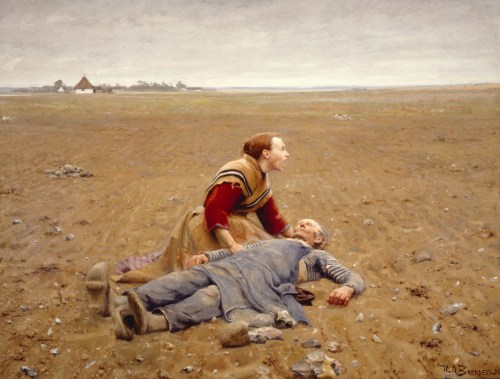
H. A. Brendekilde was a forerunner of the social realist style, embraced by Diego Rivera. His early work often depicted the daily lives of the rural working class. One of his most famous paintings, “Worn Out” (1889) shows an elderly man lying fallen on his back in the plowed field. He has collapsed while picking stones, preparing a field for planting. The stones he had gathered have scattered across the ground, and one of his clogs has fallen off his foot.
Has he worked himself to death? Will he recover? His entire world is this rocky barren field. A story is in this stark painting.
About the Artist via Wikipedia (be patient–this was written by a non-native English-speaker. We should all speak a foreign language so well!)
[1] Hans Andersen Brendekilde (7 April 1857 – 30 March 1942) was a Danish painter.
Brendekilde’s influence was great not only on society, but also on his many friends among painters and potters. Among the painters especially on L.A. Ring. During their young and poor years they were sharing room and studio in Copenhagen for periods. They painted similar themes, both had the family name Andersen and they were therefore often confused with one another. So in 1884 they changed their family names Andersen to the names of their native villages instead, Brendekilde and Ring. Brendekilde was always in a good mood, was deeply committed to paint life in the small villages, and furthermore was an ardent socialist. Ring was of a more depressive disposition and Brendekilde encouraged him to continue painting and join exhibitions. Brendekilde also introduced Ring to Lars Ebbesen, who had a farm “Petersminde” in “Raagelund” close to Odense. In 1883, Ring was living in extreme poverty in Copenhagen, but the introduction to Lars Ebbesen meant that he could live and paint without worrying about the cost of rent and food for long periods. Both Brendekilde and Ring remained lifelong friends with farm owner Ebbesen. Several of Brendekilde’s paintings became very famous and won medals e.g. at the World Expositions in Paris 1889, in Chicago 1893 and at the “Jahresausstellung” im Glaspalast in München 1891. He also inspired painters like his friends Julius Paulsen, Peder Mønsted, Hans Smidth, Paul Fischer, Søren Lund [da] and H. P. Carlsen.
Brendekilde was the first painter bringing the arts and crafts movement to Denmark when from about 1884 he designed and made integrated frames around his paintings, the frames being part of the paintings and their story. Some frames were symbolistic and others more ornamental.
Many of his paintings are obviously related to those by Anna and Michael Ancher, P.S. Krøyer and the Swedish painters Carl Larsson and Anders Zorn. All of these displayed their paintings at the international exhibitions in Copenhagen 1888, Paris 1889, Munich 1891 and Chicago 1893. [1]
Credits and Attributions:
[1] Wikipedia contributors, “H. A. Brendekilde,” Wikipedia, The Free Encyclopedia, https://en.wikipedia.org/w/index.php?title=H._A._Brendekilde&oldid=1019433991 (accessed March 11, 2022). Translated from Dutch.
While reading the newspaper news by H. A. Brendekilde 1912 [Public domain], via Wikimedia Commons
Worn Out by H. A. Brendekilde [Public domain], via Wikimedia Commons


 Life in the Realm of Fantasy
.jpg&oldid=300367623)