Tag Archives: Heroes and Villans

Motivating our Heroes and Villains #writing


WritingCraftSeries_character-arc

In any narrative, the shadow provides opportunities for the plot. Whether it is a person, a creature, or a natural disaster, the antagonist represents darkness (evil), against which light (good) is shown more clearly.

Best of all, the shadow, whether a person, place, or thing, provides the roadblocks, the cause to hang a plot on.

When the antagonist is a person, I ask myself, what drives them to create the roadblocks they do? Why do they feel justified in doing so?

If you are writing a memoir, who or what is the antagonist? Memoirs are written to shed light on the difficulties the author has overcome, so who or what frustrated your efforts? (Hint: for some autobiographies, it is a parent or guardian. Other times it is society, the standards and values we impose on those who don’t fit into the slots designated for them.)

In a character-driven novel, there may be two enemies, one of which is the protagonist’s inhibitions and self-doubt.


Many times, two main characters have a sharply defined good versus evil chemistry—like Sherlock Holmes and Professor Moriarty. (Trust me, the antagonist is a main character, or the hero has nothing to struggle against.)

The characters on both sides of the battle must recognize and confront the darkness within themselves. They must choose their own path—will they fight to uphold the light? Or will they turn toward the shadow?

When the protagonist must face and overcome the shadow on a profoundly personal level, they are placed in true danger. The reader knows that if the hero strays from the light, they will become the enemy’s tool.
The best shadow characters have many layers, and not all of them are bad. They are charismatic because we can relate to their struggle. We might hope events will change them for the better but know in our hearts they won’t.

Antagonists must be fleshed out. Characters portrayed as evil for the sake of drama can be cartoonish. Their actions must be rational, or the reader won’t be able to suspend their disbelief.

The most fearsome villains have deep stories. Yes, they may have begun life as unpleasant children and may even be sociopaths. Something started them down that path, reinforcing their logic and reasoning.

When the plot centers around the pursuit of a desired object, authors will spend enormous amounts of time working on the hero’s reasons for the quest. They know there must be a serious need driving their struggle to acquire the Golden McGuffin.

Where we sometimes fail is in how we depict the enemy. The villain’s actions must also be plausible. There must be a kind of logic, twisted though it may be, for going to the lengths they do to thwart our heroes.

A mere desire for power is NOT a good or logical reason unless it has roots in the enemy’s past. Why does Voldemort desire that power? What fundamental void drives them to demand absolute control over every aspect of their life and to exert control over the lives of their minions?

The characters in our stories don’t go through their events and trials alone. Authors drag the reader along for the ride the moment they begin writing the story. So, readers want to know why they’ve been put in that handbasket, and they want to know where the enemy believes they’re going. Otherwise, the narrative makes no sense and we lose the reader.

Most of us know what motivates our protagonist. But our antagonist is frequently a mystery, and the place where the two characters’ desires converge is a muddle. We know the what, but the why eludes us.

This can make the antagonist less important to the plot than the protagonist. When we lose track of the antagonist, we are on the road to the dreaded “mushy middle,” the place where the characters wander around aimlessly until an event happens out of nowhere.

The reader must grasp the reasoning behind the enemy’s actions, or they won’t be able to suspend their disbelief.

Ask yourself a few questions:

  • What is their void? What made our antagonist turn to the darkness?
  • What events gave our antagonist the strength and courage to rise above the past, twisted though they are?
  • What desire drives our antagonist’s agenda?
  • What does our antagonist hope to achieve?
  • Why does our antagonist believe achieving their goal will resolve the wrongs they’ve suffered?

None of this backstory needs to be dumped into the narrative. It should be written out and saved as a separate document and brought out when it is needed. The past must emerge in tantalizing bits and hints as the plot progresses and conversations happen.

The hero’s ultimate victory must evoke emotion in the reader. We want them to think about the dilemmas and roadblocks that all the characters have faced, and we want them to wish the story hadn’t ended.

The villains we write into our stories represent humanity’s darker side, whether they are a person, a dangerous animal, or a natural disaster. They bring ethical and moral quandaries to the story, offering food for thought long after the story has ended.

Ideas slip away unless I get them on paper first, so I create a separate document that is for my use only, and I label it appropriately:

BookTitle_Plot_CoreConflict.docx
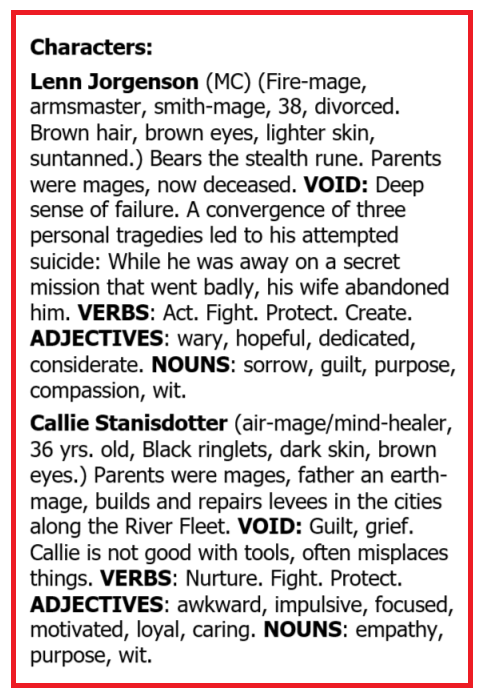
CharacterVoidVerbNoun01052025LIRF

It’s a synopsis of the conflict boiled down to a few paragraphs. Whenever I find myself wondering what the hell we’re supposed to be doing, I refer back to it.

In my current unfinished work-in-progress, Character A, my protagonist, represents teamwork succeeding over great odds. Character B, my villain, represents the quest for supremacy at all costs.

  • Each must see themselves as the hero.
  • Each must risk everything to succeed.
  • Each must believe or hope that they will ultimately win.

When I create a personnel file for my characters, I assign them verbs, nouns, and adjectives that best show the traits they embody. Verbs are action words that show a character’s gut reactions. Nouns describe personalities best when they are combined with strong verbs.

They must also have a void – an emotional emptiness, a wound of some sort. In my current WIP, Character B fell victim to a mage-trap. He knows he has lost something important, something that was central to him. But he refuses to believe he is under a spell of compelling, a pawn in the Gods’ Great Game. He must believe he has agency—this is his void.

This void is vital because characters must overcome fear to face it. As a reader, one characteristic I’ve noticed in my favorite characters is they each have a hint of self-deception. All the characters – the antagonists and the protagonists – deceive themselves in some way about their own motives.

My task is to ensure that the stories of Characters A and B intersect seamlessly. Motivations must be clearly defined so the reader knows what their moral boundaries are. I like to know their limits because even cartoon supervillains draw the line somewhere.

For me, plots tend to evolve once I begin picturing the characters’ growth arcs. How do I see them at the beginning? How do I see them at the end?

As I write the narrative, they will evolve and change the course of what I thought the original plot was. Sometimes it will change radically. But at some point, the plot must settle into its final form.

I love a novel with a plot arc that explores the protagonist’s struggle against a fully developed, believable adversary, one we almost regret having to defeat.

If you are currently working on a manuscript that feels stuck, I hope this discussion helps you in some way. Good luck and happy writing!
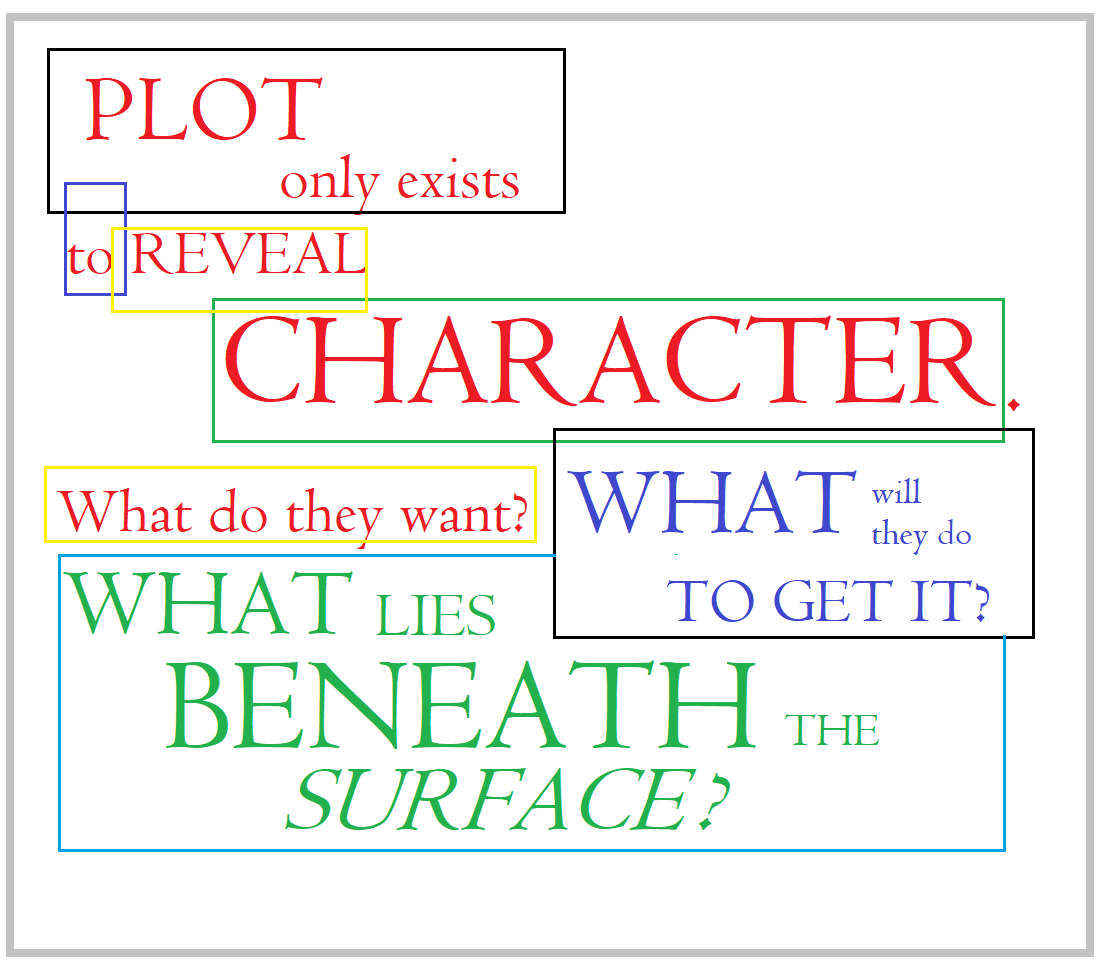
Plot-exists-to-reveal-character

3 Comments

Filed under writing

Heroes and Villains part 3 – Drawing on the Shadow Within #amwriting

Today we’re continuing to explore character creation and the dark energy the villain of a piece brings to a story.

WritingCraft_Dark_EnergyIn his book, The Writer’s Journey, Mythic Structure for Writers, Christopher Vogler discusses how the villain of a piece represents the shadow. The antagonist provides the momentum of the dark side, and their influence on the protagonist and the narrative should be profound.

The shadow character serves several purposes.

  • He/she/it is usually the main antagonist and represents darkness(evil) against which light (good) is shown more clearly.
  • The shadow, whether a person, place, or thing, provides the roadblocks, the reason the protagonist must struggle.

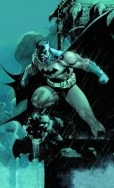
The shadow lives within us all, and our heroes must also struggle with it. The most obvious example of this in pop culture is that of “Batman.”

About the original concept of Batman, via Wikipedia:

Batman_InfoboxBatman is a superhero appearing in American comic books published by DC Comics. The character was created by artist Bob Kane and writer Bill Finger, and debuted in the 27th issue of the comic book Detective Comics on March 30, 1939. In the DC Universe continuity, Batman is the alias of Bruce Wayne, a wealthy American playboy, philanthropist, and industrialist who resides in Gotham CityBatman’s origin story features him swearing vengeance against criminals after witnessing the murder of his parents Thomas and Martha as a child, a vendetta tempered with the ideal of justice. He trains himself physically and intellectually, crafts a bat-inspired persona, and monitors the Gotham streets at night. Kane, Finger, and other creators accompanied Batman with supporting characters, including his sidekicks Robin and Batgirl; allies Alfred PennyworthJames Gordon, and Catwoman; and foes such as the Penguin, the RiddlerTwo-Face, and his archenemy, the Joker. [1]

Bruce Wayne is a flawed character. He is both a generous benefactor of many charities and a vigilante with little or no remorse for his actions. As Batman, he is a hero, a defender of the weak and defenseless. Much of what makes his story compelling is how he justifies indulging his darker side.

The story of Batman is complex, which is why so many movies have emerged exploring his story. We sit in theaters and applaud Batman’s dark side because it’s confined to taking on criminals.

The evil in a narrative is not always represented by a person. Sometimes war is the villain. Hurricanes, tornadoes, earthquakes, wildfires—nature has a pantheon of calamities for us to overcome and no end of stories that emerge from such events.

True heroes don’t necessarily wear capes, and the evils they fight against are often disasters of epic proportions. Ordinary people can become heroes when faced with disasters of any sort.

Consider the true-life events of April 11 through the 17th, 1970. Via Wikipedia:

Apollo_13_liftoff-KSC-70PC-160HRApollo 13 (April 11–17, 1970) was the seventh crewed mission in the Apollo space program and the third meant to land on the Moon. The craft was launched from Kennedy Space Center on April 11, 1970, but the lunar landing was aborted after an oxygen tank in the service module (SM) failed two days into the mission. The crew instead looped around the Moon and returned safely to Earth on April 17. The mission was commanded by Jim Lovell, with Jack Swigert as command module (CM) pilot and Fred Haise as Lunar Module (LM) pilot. Swigert was a late replacement for Ken Mattingly, who was grounded after exposure to rubella. [2]
The villain in that epic space adventure was mechanical failure. The heroic efforts of the ground crew to brainstorm ways to get the astronauts home is one of the most powerful stories of the 20th century. We were glued to the television, watching as remedies for each disaster were devised, celebrating as the crew made their way home safely.

The villains we write into our stories represent humanity’s darker side, whether they are a person, a mechanical failure, a dangerous animal, or a natural disaster. They bring ethical and moral quandaries to the story, raising questions of morality, dilemmas we should examine more closely.

When the protagonist must face and overcome the shadow on a profoundly personal level, they are placed in true danger. Which way will they go? This is where my characters have agency, and they sometimes surprise me. They may unknowingly offer up their souls if they stray from the light.

Every character has a different personality and should respond to each event differently. The freedom you allow the protagonist and antagonist to steer the events is crucial for them to emerge as real to the reader.

Sometimes my characters make their own choices. Other times, they go along as I, their creator, have planned for them. Ultimately, they do things their own way and with their own style.

Our fictional heroes must recognize and confront the darkness within themselves. As they do so, the reader also faces it. The hero must choose their own path—will they fight to uphold the light? Will they walk in that gray area between? Bruce Wayne is a good example of one who walks the gray area.

The reader forms opinions and makes choices too, and these subliminal ideas sometimes challenge their ethics.


Credits and Attributions:

[1] Wikipedia contributors, “Batman,” Wikipedia, The Free Encyclopedia, https://en.wikipedia.org/w/index.php?title=Batman&oldid=1135964072 (accessed January 30, 2023).

[2] Wikipedia contributors, “Apollo 13,” Wikipedia, The Free Encyclopedia, https://en.wikipedia.org/w/index.php?title=Apollo_13&oldid=1133889788 (accessed January 30, 2023).

Image: Batman, drawn by Jim Lee for the cover of Batman: Hush. Created by       Bob Kane and Bill Finger. DC Comics; 15794th edition (December 6, 2011) (Fair Use) Wikipedia, The Free Encyclopedia, https://en.wikipedia.org/w/index.php?title=Batman&oldid=1135964072 (accessed January 30, 2023).

Image: Apollo 13 Lift off, Wikimedia Commons contributors, “File:Apollo 13 liftoff-KSC-70PC-160HR.jpg,” Wikimedia Commons, the free media repository, https://commons.wikimedia.org/w/index.php?title=File:Apollo_13_liftoff-KSC-70PC-160HR.jpg&oldid=560250836 (accessed January 30, 2023). Public Domain.

3 Comments

Filed under writing

Heroes and Villains part 1 – One Coin, Two Sides #amwriting

You have a hero.

You have a villain.

WritingCraftSeries_character-arcYou’ve taken them through two revisions and think these characters are awesome, perfectly drawn as you intend. The overall theme of the narrative supports the plot arc, and the events are timed perfectly, so the pacing is good.
But then you discover that, while the story is engaging, your beta readers aren’t as impressed with the characters as you are.

This has been my problem in the past, and at this stage, I go to my writing group. Someone in that wonderful circle of friends will offer an opinion as to why the characters aren’t as strongly defined as I need them to be.

The problem is, it may take several drafts before my characters translate to paper the way I envision them. When creating their personnel file, I now try to give each character, hero, villain, or sidekick a theme, a sub-thread that is solely theirs.

A personal theme clarifies what drives each character and underscores their motivations. It is both a strength and a weakness.

  • A villain’s personal theme might be hubris – an excess of self-confidence. It is arrogance to a high degree, and terrible decisions can arise from it.
  • A hero’s personal theme might be honor and loyalty. This can undermine their ability to act decisively. The good of the one can exceed the good of the many—and people will die that could have been saved. Who is the villain, then?

Strong personal themes inform how each character reacts and interacts throughout the narrative.

Plot-exists-to-reveal-characterBut in real life, I often find little distinction between heroes and villains. Heroes are often jackasses who need to be taken down a notch. Villains will extort protection money from a store owner and then turn around and open a soup kitchen to feed the unemployed.
Al Capone famously did just that. Mobster Al Capone Ran a Soup Kitchen During the Great Depression – HISTORY.

In reality, heroes are flawed because no one is perfect. I prefer narratives that reflect that. What similarities might blur the boundaries of our heroes and villains and lend some texture to their narratives?

  • Both must see themselves as the hero.
  • Both must take unnecessary risks.
  • Both must believe they will ultimately win.

When I create my two most important characters, my hero and villain, I assign them verbs, nouns, and adjectives, traits they embody. They must also have a void – an emotional emptiness, a wound of some sort.

This void is vital because characters must overcome cowardice to face it. As a reader, one characteristic I’ve noticed in my favorite characters is they each have a hint of self-deception. All the characters – the antagonists and the protagonists – deceive themselves about their own motives.

The heroes come to recognize that fault and are made stronger and more able to do what is necessary. The villains may also acknowledge their fatal flaw but use it to justify and empower their actions.

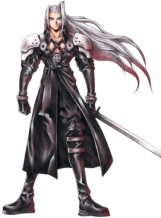
SephirothBoth heroes and villains must have possibilities – the chance that the villain might be redeemed, or the hero might become the villain. As an avid gamer, I think of this as the “Sephiroth factor.”
He is featured in the metaseries Compilation of Final Fantasy VII, which includes other products related to the original game of Final Fantasy VII. It is a series originally begun in 1997 as a game for Sony’s PlayStation 1 and which became wildly popular among RPG players.

This game has become legendary with a huge cult following because of the well-thought-out, intense and layered storyline and the cast of instantly relatable characters.

In Sephiroth’s storyline, he begins as a hero, the most powerful member of SOLDIER, Shinra’s elite military division. He was revered, a heroic, invincible veteran of the Shinra-Wutai war.

Final Fantasy VII Crisis Core (which was made for PlayStation Portable) is a prequel to the original game. We get to know Sephiroth as he once was and meet other members of this elite unit. Over the course of that game, the three most beloved heroes of the Wutai war suddenly abandon their posts and go rogue.

From the outset of Final Fantasy VII Crisis Core, Sephiroth is the kind of hero that makes one wonder just what is going on inside him. He has begun to have doubts and, at one point, indicates that he might leave SOLDIER.

Toward the middle of Crisis Core, Sephiroth, Zack Fair, and Cloud Strife (who is only an infantryman when we first meet him in Crisis Core) are sent on a mission to the village of Nibelheim. There, Sephiroth discovers that he is the product of a biological experiment combining a human fetus with tissue from the extraterrestrial lifeform, Jenova.

This knowledge breaks Sephiroth’s mind, and he goes on a rampage, destroying the village. He is ultimately killed, but his physical death brings about his evolution into the ultimate enemy the true heroes of that RPG game series must battle.

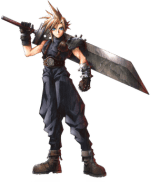
In the end, only one SOLDIER first class remains, Zack Fair. He, too, abandons Shinra and is ultimately hunted down. Zack’s death sows the seeds of the delusion that creates the true hero of the piece, Cloud Strife.

Cloud_StrifeIn Final Fantasy VII, the 1997 game that started it all, we meet Cloud Strife, a mercenary with a mysterious past. Gradually, we discover that, unbeknownst to himself, he is living a lie that he must face and overcome to be the hero we all need him to be.
The fallen angel, the tragic hero who becomes the villain is good fodder for those of us who write fantasy. So is the broken hero, the one who rises from the ruins of their life to save the world.

However, if you strip away the fantasy tropes and the outrageous video game weapons, the hero in any story written in any genre can become the villain, and any villain can change course before it’s too late.

The way my creative mind works, plots and characters evolve together. When I sit down to create a story arc, my characters offer me hints as to how they will develop. This evolution can change the course of the original plot.

In a current work-in-progress, two characters, hero and villain, switched roles, requiring a total rewrite.

Who in your work will be best suited to play the villain? Character B?

Conversely, why is character A the hero?

The next installment of this series will drill down a little further into the nuts and bolts of creating fully realized characters, focusing on the protagonist and the antagonist.

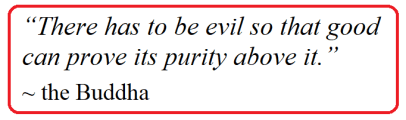
Buddha quote


Credits and Attributions:

Sephiroth, designed by Tetsuya Nomura for Square / Square Enix Final Fantasy VII, © 1997. Fair use.

Cloud Strife, designed by Tetsuya Nomura for Square/Square Enix Final Fantasy VII, © 1997. Fair use.

18 Comments

Filed under writing