Tag Archives: how to write a drabble

Discipline and Micro Fiction #amwriting

I think of writing as a muscle, one that must be exercised the same as other muscles. We’re healthiest when we exercise regularly. Once writing becomes a behavioral habit, we find we can’t go very long without indulging it.
WritingCraft_short-story-drabbleThe more frequently you write, the more confident you become. Spending a small amount of time writing every day is crucial. It develops discipline, and personal discipline is essential if you want to finish a writing project.
WordsThatDrawUsInLIRF01302024Maybe you plan to write a novel “someday” but aren’t there yet. Writing random short scenes and vignettes helps develop that story without committing too much time and energy to the project. This is also a good way to create well-rounded characters.

In writing these scenes, you have the chance to identify the themes and subthemes you hope to explore in your novel. Theme is different from the subject of a work. An example I have used before, and one that most people know of, is the Star Wars franchise.

  • The subject of those movies and books is “the battle for control of the galaxy between the Galactic Empire and the Rebel Alliance.”
  • The major themesexplored in those films are moral ambiguity, coming of age, and the conflict between technology and nature.
  • The subthemes are finding love, abuse of power, and family dynamics.

At some point, you will write something you think worthy of submitting to a contest or publisher. Your manuscript must demonstrate your understanding of what is meant by the word ‘theme,’ as well as your ability to craft clean and compelling prose.

If you do an internet search, you will find contests for drabbles and micro-fiction, some offering cash prizes. Some contests post pictures for prompts, others offer a word or sentence, and still others no prompt at all. I mentioned this site in the previous post: go to 700+ Weekly Writing Prompts if you need an idea.
lasceaux2016However, the Lascaux Prizes in Poetry and Flash Fiction are now open for submission and will close on March 31, 2024. The Lascaux Prize in Creative Nonfiction will reopen on April 1, 2024. The Lascaux Prize in Short Fiction will reopen on July 1, 2024.
lasceax prizeThe Lascaux Review is one of the best contests around. It is exceptionally open to writers who are just beginning their journey. Their fee is reasonable, $15.00 in every category, and submissions are accepted through Submittable. Contest Guidelines | The Lascaux Review

For practice, try picking a theme and thinking creatively. Think a little wide of the obvious tropes (genre-specific, commonly used plot devices and archetypes). Look for an original angle that will play well to a strong theme, then go for it.

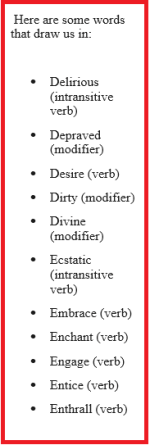
If you are choosing to write a drabble, you must use nouns and verbs with the most visual impact. Your word choices must convey an atmosphere, show a character, and tell a story.
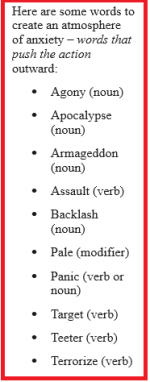
MorePowerWordsLIRF01302024A way to get a grip on these concepts is what I think of as literary mind-wandering. For me, these ramblings hold the seeds of short stories.

I gain a different perspective on my work in progress when I write a short story detailing a side character’s background. These side characters appear in the longer manuscript as having distinct personalities because I am well-acquainted with them.

If you’re experiencing a lull in your ability to advance your novel, why not challenge yourself to write a drabble? It’s a whole story in 100 words or less.

Writing such short fiction forces me to develop an economy of words. Your narrative will be limited to one or two characters. There is no room for anything that does not advance the plot or affect the story’s outcome.

What are the nuts and bolts of writing micro-fiction?

I’ve said this before, but all writing is a time commitment, no matter the intended length of the piece. When writing a drabble, you can expect to spend an hour or more getting it to fit within the 100-word constraint.

Extremely short fiction must showcase the same essential components as a longer story:

  1. A setting
  2. One or more characters
  3. A conflict
  4. A resolution.

First, we need a prompt, a jumping-off point. For a drabble, we have 100 words to write a scene that tells the entire story of a moment in a character’s life. That’s about two paragraphs, which is the length of many scenes in longer works.

In a previous post on writing short stories, I showed how I use a loose outline to break short stories into three acts.
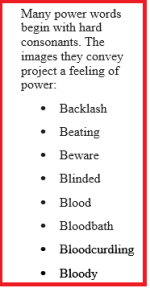
powerWordsLIRF01302024I break down the word count to know how many words to devote to each act in the story arc. I allow around 25 words to open the story and set the scene. Then, I give myself about 50 – 60 for the heart of the story. That leaves me 10 – 25 words to conclude it.

Some contests will ask for work that fits exactly into their word count parameter: if they ask for 50 words, they want exactly 50, no more and no less. Choose your words with care and intention.

That is when writing micro-fiction becomes fun.

Spend an hour to get that idea and emotion down before you forget it. The completed scene is a small gift you give yourself. I suggest you save your short work and proto scenes in a clearly labeled file for later use. Each one has the potential to be a springboard for writing a longer work or for submission to a contest.

Whether you submit a drabble to a contest or hang on to it doesn’t matter. Either way, writing micro-fiction hones your skills, and you will have captured the emotion and ambiance of a brilliant idea.
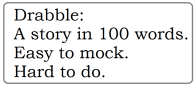
Drabble_LIRF_1_jan_2018_cjjapExtremely short fiction is the distilled essence of a novel. It contains everything the reader needs to know and makes them wonder what happened next.

That desire to know what happened next is why readers keep reading and why they might seek out your other work.
Comments Off on Discipline and Micro Fiction #amwriting

Filed under writing

Micro Fiction: Goals and Rewards #amwriting

The habit of creative writing usually begins small. It’s an idea, something we wish someone would write. At first, it’s a hobby we must fit around our work schedule and family obligations. Somehow, that hobby grows and grows. For some of us, it becomes a second job that pays little and demands a great deal of attention.

WritingCraft_short-story-drabbleWhen a new writer decides to begin their career by embarking on writing a novel, the magnitude of the undertaking soon becomes apparent.
At first, they are fired up about the project. For several pages, the words flow. Unfortunately, the fire of enthusiasm burns low as creativity fails.

They have the idea. They have the characters. But they don’t have the skills to write something as long and involved as a novel.

Many people see that as a sign that they are untalented. They put it away and never write again.

But the truth is, the project was too ambitious for their skill level. They haven’t learned the tools of the trade and received no reward for their efforts.

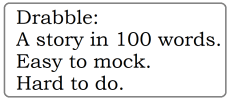
I suggest people begin by writing micro fiction. Drabbles are a form of micro fiction, an entire story in exactly 100 words.

Some forms of poetry, such as haiku, are not micro fiction, as they don’t tell a fully developed story.

My Coffee Cup © cjjasp 2013 iconWriting a drabble takes less time than writing a 3,000-word story or a 70,000-word novel, but all writing is a time commitment. When writing a drabble, you can expect to spend an hour or more getting it to fit within the 100-word constraint.
First, we need a prompt, a jumping-off point. We have 100 words to write a scene that tells the entire story of a moment in a character’s life.

Some contests give whole sentences for prompts. Others offer one word, and still others have no prompt at all.

prompt is a word or visual image that kick-starts the story in your head. If you need an idea, go to Reedsy’s Weekly Writing Prompts.

But prompts are only the beginning. To write a story of any length, we need these essential components:

  • A setting
  • One or more characters
  • A conflict
  • A resolution.

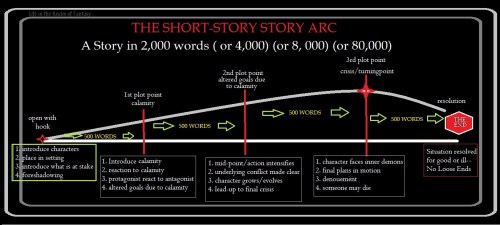
writer_at_work_nanowrimo_signI use a loose outline to break the arc of every story I write into acts, each with a specific word count. (I’ve included a graphic at the bottom of this post.)
A drabble may have only 100 words, but my process works the same as for a novel.

For a novel, I divide my outline this way: 10,000 or so words to open the story, set the scene, introduce the characters and get to the inciting incident. 50,000 or so words for the heart of the story. 10,000 or so words for the conclusion.

A micro fiction is outlined the same way:

  • I have about 25 words to open the story and set the scene.
  • I have about 50 – 60 for the heart of the story.
  • I give myself 10 – 25 words to conclude it.
  • The story must be told in precisely 100 words. (Not more, and not less—exactly 100 words.)

Writing micro fiction teaches you to tell a story without exposition.

However, you should save the clumps of exposition and backstory in a separate file because they do come in usefully as part of your world-building and character development exercises.

  • Every word you write and discard might be useful in a later story.
  • Label the file with a title that says what it is.
  • Save it in a master file that contains ideas for longer stories.

Drabble_LIRF_1_jan_2018_cjjapI mentioned rewards in the title of this post. The completed story is a small gift you give yourself, and the surge of endorphins you experience in that moment of “Yes! I can write after all!” are the reward.
When you write to a strict word count limit, every word is precious and must be used to the greatest effect. By shaving away the unneeded info in the short story, the author has more room to expand on the story’s theme and how it supports the plot.

I suggest you save your drabbles and short scenes in a clearly labeled file for later use. Each one has the potential to be a springboard for writing a longer work. Or you might want to submit it to a drabble contest.

Contests for micro fiction abound on the internet. Whether you choose to submit a drabble to a contest or hang on to it doesn’t matter. Either way, the act of writing micro fiction hones your skills, and you will have captured the heart of your brilliant idea.

Micro fictions are the distilled essence of novels. They contain everything the reader needs to know about that one moment in time. The reader wants to know what happens next.

You will have succeeded in writing your story, and that success is a reward in itself.

short-story-arc

25 Comments

Filed under writing

Writing the short story part 3: extremely short fiction #amwriting

If not having the time to sit down and write a novel is holding you back from writing, you have another option: extremely short fiction.

WritingCraft_short-story-drabbleYou are more likely to sell a drabble than a short story in today’s speculative fiction market. You are also more likely to sell a short story than a novel.
Many online publications are looking for drabbles (100-word stories) and flash fiction under 500 words. These editors are looking for new, unpublished work, so this is an opportunity to use the limited time you have for writing and still get published.

Perhaps you’ve heard other writers use the term drabbles, but you don’t know what one is.

Drabbles are extremely short fiction. In 100 words or less, they offer everything the reader needs to know, so drabbles are the distilled essences of novels. A good drabble tells the story of one scene and makes the reader ponder what might have happened next.

Writing drabbles teaches us how to write a good hook in only one sentence.

In literary terms, what is a “hook“? Wikipedia says: A narrative hook (or just hook) is a literary technique in the opening of a story that “hooks” the reader’s attention so that they will keep on reading. The “opening” may consist of several paragraphs for a short story or several pages for a novel, but ideally it is the opening sentence in the book. [1]

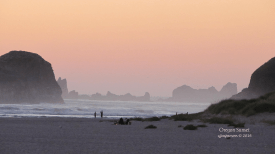
Writing a 100-word story takes far less time than writing a 2,000-word short fiction or a 70,000-word novel. However, itOregon Sunset Taken August 12, 2016 CJJasperson does require plotting and rewriting the prose until the entire story is told in exactly 100 words. You should expect to spend an hour or so writing and then editing it to fit within the 100-word constraint.

A 100-word story has the same essential components as a longer story:

  1. A setting.
  2. 1 or 2 characters.
  3. A conflict.
  4. A resolution.
  5. No subplots are introduced.
  6. Minimal background is introduced.

Every sentence propels the story to the conclusion. Trying to tell a complete story in 100 words or less teaches you several skills.

  • You are forced to develop an economy of words.
  • You begin to see what the core plot elements of a story might be.

When you have a backlog of drabbles and extremely short pieces, you also have a vault full of ready-made characters and premade settings to draw on.

First, you need a prompt, a jumping-off point.

prompt is a word or visual image that kickstarts the story in your head. The prompt for the following drabble was sunset. Some contests and publications give whole sentences for prompts, others offer one word, and some will post an image. The difficult ones are those with no prompt at all.

I break short stories into acts by taking the number of words I plan to fit the story into and dividing it into 3 sections.

A drabble works the same way. We break it down to make the story arc work for us.

For a drabble, we have about 25 words to open the story and set the scene, about 50 – 60 for the heart of the story, and 10 – 25 words to conclude it.

For this drabble, I used:

24 Words (opening): We sat on the beach near the fire, two old people bundled against the cold Oregon sunset. Friends we’d never met fished the surf.

51 words (middle and crisis): Wind whipped my hair, gray and uncut, tore it from its inept braid. The August wind was chill inside my hood, but I remained, pleased to be with you, and pleased to be on that beach.

Mist rose with the tide, closed in and enfolded us, blotting out the falling stars.

25 Words (conclusion): Laughing at our folly, we dragged our weary selves back to our digs, rented, but with everything this old girl needed—love, laughter, and you. [2]

Sunset_Cannon_Beach_05_August_2019The above drabble is a 100-word romance and is an example I have used here before. It has a beginning (hook), a middle (the conflict), and a resolution. The opening shows our protagonist on the beach with someone for whom she cares deeply.
The conflict in this tale is the weather. Wind and blowing mist make it too cold for our protagonist to stay on the beach and forces her indoors.

The resolution is a romantic evening spent indoors.

Drabbles contain the ideas and thoughts that can easily become longer works, such as this drabble did in my poem, Oregon Sunset.

If you are thinking about participating in National Novel Writing Month (NaNoWriMo), write your story ideas in the form of drabbles and flash fiction. That way, you won’t forget them, and you can save them for later use as the seeds of a longer work.

Submitting the drabble/flash fiction to a publication or contest won’t ruin whatever novel you think it might later become. Whatever it grows into will be vastly different than the 100-word premise.

Sometimes, you reach a point where you can’t write any further on the novel you’ve given your soul to. That is when it’s time to take a break from that project and do something completely different.

Drabble_LIRF_1_jan_2018_cjjapThe act of writing random ideas and emotions down in drabble form rejuvenates your creativity, a mini-vacation from your other work. It rests your mind and clears things so you can return to your main project with all your attention.
Whether you choose to submit a drabble to a contest/small press or not is your choice. The important thing is this: that idea is written down and accessible when you need a new project.

I have always considered drabbles as the literary equivalent of dried beans and rice. They are the staples we can set aside for later when we need inspiration.


Credits and Attributions:

[1] Wikipedia contributors, “Narrative hook,” Wikipedia, The Free Encyclopedia, https://en.wikipedia.org/w/index.php?title=Narrative_hook&oldid=1010359448 (accessed April 10, 2021).

[2] Oregon Sunset Drabble, by Connie J. Jasperson, © 2016, All Right Reserved.

Images:

Oregon Sunset, © 2016 Connie J. Jasperson, author’s own work.

Sunset on Cannon Beach, © 2019 Connie J. Jasperson, author’s own work.

5 Comments

Filed under writing

The Drabble #amwriting

Right now, we have a lot of opportunities to sell our extremely short stories. Many online publications are looking for drabbles (100-word stories) and flash fictions under 750 words.

These editors are looking for new, unpublished work, so get out your pens and start writing.

You might ask why you would want to write something that short, and I do see your point. But if not having the time to sit down and write a novel is holding you back from writing, you have another option: extremely short fiction.

When you force yourself to create within strict wordcount limits, you increase your ability to tell a story with minimal exposition. We grow in the craft and gain different perspectives when we write short stories and essays.

This is especially true if you practice writing drabbles. Trying to tell a story in 100 words or less teaches you several skills.

  • You are forced to develop economy of words.
  • You begin to see what the core plot elements of a story might be.

When you have a backlog of short stories, you also have a vault full of ready-made characters and premade settings to draw on.

I hear you saying that any investment of time is difficult if it takes you away from your longer works. It’s hard to not feel jealous of the scant time we have for that.

Look at this as a muscle-building routine. Writing a 100-word story takes far less time than writing a 2,000 word short fiction, or a 70,000-word novel.

Something you should consider: you are more likely to sell a drabble than a short story, and more likely to sell a short story than a novel.

Just saying.

Writing a drabble is like any other form of writing. You should expect to spend an hour or so writing and then editing it to fit within the 100-word constraint.

A 100-word story has the same basic components as a longer story:

  1. A setting.
  2. 1 or 2 characters.
  3. A conflict.
  4. A resolution.
  5. No subplots are introduced.
  6. Minimal background is introduced.
  7. Every sentence propels the story to the conclusion.

First, we need a prompt, a jumping-off point. Some contests give whole sentences for prompts, others offer one word, and still others no prompt at all.

A prompt is a word or visual image that kickstarts the story in your head. The prompt for the following drabble was sunset.

I break short stories into acts by taking the number of words I plan to fit the story into and dividing it into 3 sections.

A drabble works the same way. We break it down to make the story arc work for us.

For a drabble, we have about 25 words to open the story and set the scene, about 50 – 60 for the heart of the story, and 10 – 25 words to conclude it.

For this drabble, I used:

24 Words (opening): We sat on the beach near the fire, two old people bundled against the cold Oregon sunset. Friends we’d never met fished the surf.

51 words (middle and crisis): Wind whipped my hair, gray and uncut, tore it from its inept braid. The August wind was chill inside my hood, but I remained, pleased to be with you, and pleased to be on that beach.

Mist rose with the tide, closed in and enfolded us, blotting out the falling stars.

25 Words (conclusion): Laughing at our folly, we dragged our weary selves back to our digs, rented, but with everything this old girl needed—love, laughter, and you.

The above drabble is a 100-word romance, one I have used here before. It has a beginning, a middle, and an end. The opening shows our protagonist on the beach with someone for whom she cares deeply.

The conflict in this tale is the weather. Wind and blowing mist make it too cold for our protagonist to stay on the beach and forces her indoors.

The resolution is a romantic evening spent in front of the fireplace.

Drabbles contain the ideas and thoughts that can easily become longer works, such as this drabble did in my poem, Oregon Sunset.

I think of drabbles as the distilled essences of novels. In 100 words, they offer everything the reader needs to know. A good drabble makes the reader ponder what might have happened next.

In this way, writing drabbles teaches us how to write a good hook. Knowing how to write a great hook is critical. The first paragraphs of our longer works must intrigue the reader or they will set it aside.

Write your story ideas in the form of drabbles and flash fictions. Save them for later use as they could hold the seeds of a longer work.

Save the drabble/flash fiction for submission to a publication or contest, as it won’t spoil whatever novel you think it might grow into.

When you can’t write on the project you’ve given your soul to, it’s time to take a break. The act of writing random ideas and emotions down is a kind of vacation from your other work. It rests your mind and clears things so you can return to your main project with all your attention.

Whether you choose to submit a drabble or hang on to it doesn’t matter. The idea is written down and accessible for when you need a new project.

In that regard, drabbles are the literary equivalent of dried beans and rice. They are resources we can set aside for a rainy day.

9 Comments

Filed under writing