Tag Archives: Hudson River School

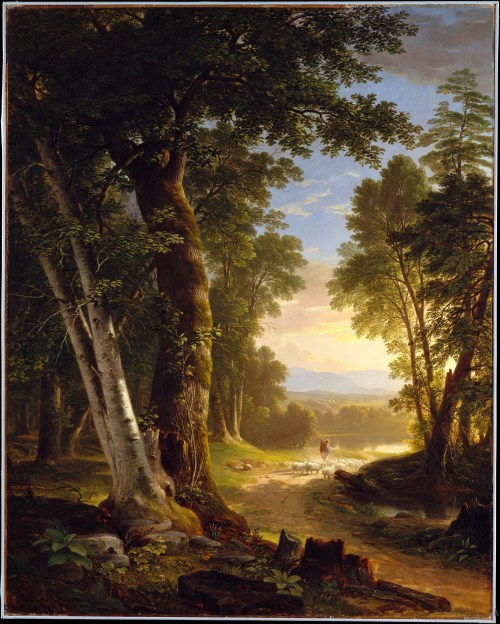
#FineArtFriday: a closer look at “The Beeches” by Asher Brown Durand 1845 #prompt

The_Beeches_MET_DT75Artist: Asher Brown Durand  (1796–1886)

Title: The Beeches

Genre: landscape art

Date: 1845

Medium: oil on canvas

Dimensions: 60 3/8 x 48 1/8 in. (153.4 x 122.2 cm)

Collection: Metropolitan Museum of Art

Current location: American Paintings and Sculpture

What I love about this painting:

It’s been raining cats and dogs here, a regular monsoon. There has been some minor flooding here as the street drains aren’t able to cope with the quantities of rain that has fallen for the last week. It seems like a good time to revisit one of my favorite paintings, one detailing a sunny day painted during a calmer time.

Asher Brown Durand gives us a summer day on the shore of a large pond, in a grove of beech and birch trees. The large beech tree is magnificent, with its rough, moss-covered bark commanding the center stage. In the distance, as if they were accidentally included, a shepherd leads a flock of sheep, a minor part of the scene as compared to the superb majesty of the beech tree.

Yet, nothing in this painting is accidental. The sheep and their shepherd are painted in exquisite detail, with as much attention as he gives to the texture of the bark and the moss. Each leaf, each blade of grass, each stone—every part of this scene is painted with intention. Each component of this landscape painting is as true and perfect as they were in real life.

I love the natural feeling of the plants, the intense colors of nature, the sense of a place that is vibrant and alive.

This painting is not merely a photographic representation of a summer morning in 1845. It has a life, a sense that you are there. We can almost feel the warming sunshine and slight breeze lifting the morning haze, hear the sheep as they walk to the water, perhaps even catch the earthy scent of the woods around us.

What story will you find in this scene? I think there are several. The observer has a story, but so does the shepherd and the sheep. The tree also has a story, but trees rarely tell what they know.

Durand was a master in the Hudson River School, a group of artists who believed that nature in the form of the American landscape was a reflection of God. Durand himself wrote, “The true province of Landscape Art is the representation of the work of God in the visible creation.” [1]

This painting demonstrates that conviction.

About the Artist, via Wikipedia:

Asher Brown Durand (August 21, 1796, – September 17, 1886). (He) was an American painter of the Hudson River School. was born in, and eventually died in, Maplewood, New Jersey (then called Jefferson Village). He was the eighth of eleven children. Durand’s father was a watchmaker and a silversmith.

Durand was apprenticed to an engraver from 1812 to 1817 and later entered into a partnership with the owner of the company, Charles Cushing Wright (1796–1854), who asked him to manage the company’s New York office. He engraved Declaration of Independence for John Trumbull during 1823, which established Durand’s reputation as one of the country’s finest engravers. Durand helped organize the New York Drawing Association in 1825, which would become the National Academy of Design; he would serve the organization as president from 1845 to 1861.

Asher’s engravings on bank notes were used as the portraits for America’s first postage stamps, the 1847 series. Along with his brother Cyrus he also engraved some of the succeeding 1851 issues.

Durand’s main interest changed from engraving to oil painting about 1830 with the encouragement of his patron, Luman Reed. In 1837, he accompanied his friend Thomas Cole on a sketching expedition to Schroon Lake in the Adirondacks Mountains, and soon after he began to concentrate on landscape painting. He spent summers sketching in the Catskills, Adirondacks, and the White Mountains of New Hampshire, making hundreds of drawings and oil sketches that were later incorporated into finished academy pieces which helped to define the Hudson River School.

Durand is remembered particularly for his detailed portrayals of trees, rocks, and foliage. He was an advocate for drawing directly from nature with as much realism as possible. [1]


Credits and Attributions:

Image:  The Beeches by Asher Brown Durand, PD|100. Wikimedia Commons contributors, “File:The Beeches MET DT75.jpg,” Wikimedia Commons, the free media repository, https://commons.wikimedia.org/w/index.php?title=File:The_Beeches_MET_DT75.jpg&oldid=617658539 (accessed November 6, 2025).

[1] Wikipedia contributors, “Asher Brown Durand,” Wikipedia, The Free Encyclopedia, https://en.wikipedia.org/w/index.php?title=Asher_Brown_Durand&oldid=1129313847 (accessed November 6, 2025).
2 Comments

Filed under #FineArtFriday

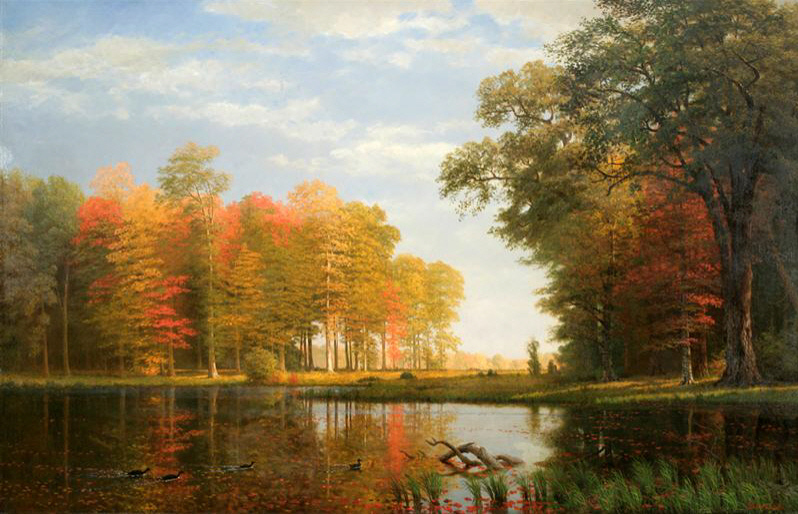
#FineArtFriday: Autumn Woods by Albert Bierstadt 1886

Artist: Albert Bierstadt (1830–1902)

Title: Autumn Woods, Oneida County, State of New York

Date: 1886

Medium: Oil on linen

Dimensions: Overall (linen): 54 x 84 in. (137.2 x 213.4 cm) Framed: 64 3/4 in. × 7 ft. 10 3/4 in. × 3 1/4 in. (164.5 × 240.7 × 8.3 cm)

Collection: New York Historical  (Gift of Mrs. Albert Bierstadt)

What I love about this painting:

Albert Bierstadt gives us a beautiful day in Glorious Autumn (with capitol letters), the kind of day rare here in my part of the Pacific Northwest. In October, rainy weather usually rolls in, accompanied by a blustery wind that strips the trees of leaves and takes the joy out of sightseeing.

Bierstadt’s trees are luminous, red and gold the way they are far away in the mystical lands on the other side of the continent from me. His sky is lovely, but he has kept our focus on the theme, so it doesn’t dominate the scene. The reflections of the trees on the quiet, still waters of the pond ensure they are the stars of this painting.

I especially like the realism of the branches of a downed tree rising out of the water in the foreground. This is a romantic depiction of what Autumn should be, as opposed to the sodden mess that it often is here in my town.

I would love to go walking along the shore of this pond.

About the Artist, via Wikipedia:

Albert Bierstadt (January 7, 1830 – February 18, 1902) was a German American painter best known for his lavish, sweeping landscapes of the American West. He joined several journeys of the westward expansion to paint the scenes. He was not the first artist to record the sites, but he was the foremost painter of them for the remainder of the 19th century.

Bierstadt was born in Prussia, but his family moved to the United States when he was one year old. He returned to study painting for several years in Düsseldorf. He became part of the second generation of the Hudson River School in New York, an informal group of like-minded painters who started painting along the Hudson River. Their style was based on carefully detailed paintings with romantic, almost glowing lighting, sometimes called luminism. Bierstadt was an important interpreter of the western landscape, and he is also grouped with the Rocky Mountain School. [1]

To read more about this artist, go to  Albert Bierstadt – Wikipedia.


Credits and Attributions:

IMAGE: Wikimedia Commons contributors, “File:Autumn Woods, Oneida County, State of New York 1910 11.jpeg,” Wikimedia Commons, https://commons.wikimedia.org/w/index.php?title=File:Autumn_Woods,_Oneida_County,_State_of_New_York_1910_11.jpeg&oldid=1069889157 (accessed October 16, 2025).

[1] Wikipedia contributors, “Albert Bierstadt,” Wikipedia, The Free Encyclopedia, https://en.wikipedia.org/w/index.php?title=Albert_Bierstadt&oldid=1308977510 (accessed October 16, 2025).

5 Comments

Filed under #FineArtFriday

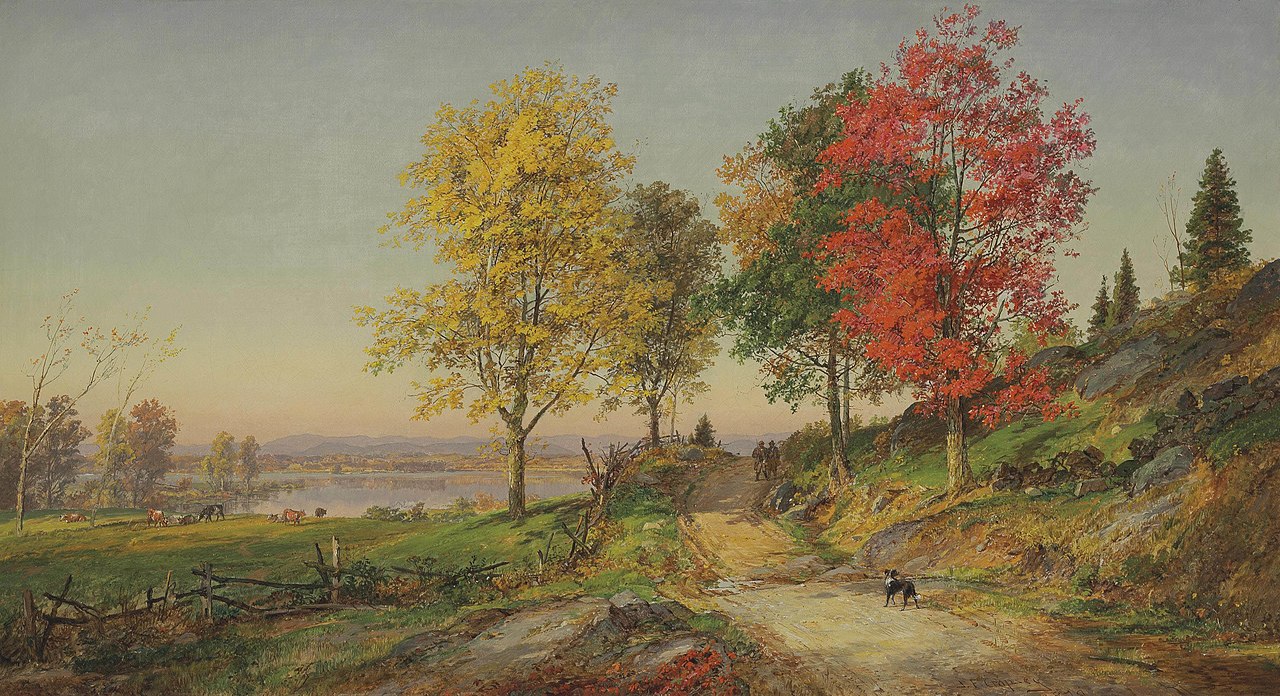
#FineArtFriday: Greenwood Lake by Jasper Francis Cropsey, 1879

Artist: Jasper Francis Cropsey (1823–1900)

Title: Greenwood Lake

Description: English: Greenwood Lake by Jasper Francis Cropsey

Date: 1879

Medium: oil on canvas

Dimensions: height: 60.3 cm (23.7 in); width: 110.5 cm (43.5 in)

Collection: Private collection

What I love about this painting:

Jasper Francis Cropsey loved the wild beauty of Greenwood Lake as it was in his day. I suspect he wouldn’t feel quite the same about it nowadays, since it is definitely a summer destination for modern vacationers. He found his muse in the rural beauty there.

Autumn seems to have been a favorite time of year for him. Each autumn, he made numerous paintings from his favorite spots along the shore and in the area. This painting was made just as warm September drifted toward the cold months of October and November. The deciduous trees are dressed in shades of red and gold.

Two men walk along the dirt lane that runs beside a meadow. Perhaps they are just going from one place to another, or maybe they are hunters. If so, they are returning empty-handed.

Cattle graze and gossip in the distance, as cows often do. A dog (perhaps the farm dog?) has stopped in the middle of the road to bark his greeting to the men.

I understand why Cropsey painted this scene many times from different angles. In my opinion, the end of September is the best part of autumn in the north. Soon, the beautiful colors will fade, falling to the ground and turning soggy and brown, marking the end of the annual cycle. But now, this day, Cropsey’s world is at peace, the air is crisp, and the leaves are at that wonderful stage that pleases the eye and makes one glad to be alive.

About the Artist, via Wikipedia:

Jasper Francis Cropsey (February 18, 1823 – June 22, 1900) was an American architect and artist. He is best known for his Hudson River School landscape paintings.

Cropsey trained as an architect under the tuition of Joseph Trench in the early 1840s, a period in which he was also trained in watercolor painting, instructed by Edward Maury, and took some life drawing courses at the National Academy of Design. He set up his own architecture office in 1843, but began exhibiting his watercolors at the National Academy of Design in 1844. A year later he was elected an associate member and turned exclusively to landscape painting; shortly after he was featured in an exhibition entitled “Italian Compositions”.[1]

To learn more about Jasper Francis Cropsey, go to Jasper Francis Cropsey – Wikipedia.

About the scenery in this painting via Wikipedia:

Greenwood Lake is an interstate lake approximately seven miles (11 km) long, straddling the border of New York and New Jersey. It is located in the Town of Warwick and the Village of Greenwood LakeNew York (in Orange County) and West MilfordNew Jersey (in Passaic County). It is the source of the Wanaque River.

Jasper Francis Cropsey created several paintings of Greenwood Lake beginning in 1843. Cropsey painted many paintings of the area such as American Harvesting (1864), Greenwood Lake (1870), Fisherman’s House, Greenwood Lake (1877), and Cooley Homestead–Greenwood Lake (1886). Cropsey met and married Maria Cooley, daughter of Issac P. Cooley, in 1847 and continued to visit the area for many years.

Some of Cropsey’s painting command high prices at auctions. Greenwood Lake (1879) sold at Christie’s auction in 2012 for $422,500. Sunset, Camel’s Hump, Lake Champlain (1877) sold for $314,500 in 2011. [2]


Credits and Attributions:

IMAGE: Wikimedia Commons contributors, “File:Greenwood Lake by Jasper Francis Cropsey, 1879.jpg,” Wikimedia Commons, https://commons.wikimedia.org/w/index.php?title=File:Greenwood_Lake_by_Jasper_Francis_Cropsey,_1879.jpg&oldid=617153620 (accessed September 4, 2025).

[1] Wikipedia contributors, “Jasper Francis Cropsey,” Wikipedia, The Free Encyclopedia, https://en.wikipedia.org/w/index.php?title=Jasper_Francis_Cropsey&oldid=1309347669 (accessed September 4, 2025).

[2]  Wikipedia contributors, “Greenwood Lake,” Wikipedia, The Free Encyclopedia, https://en.wikipedia.org/w/index.php?title=Greenwood_Lake&oldid=1300748871 (accessed September 4, 2025).

4 Comments

Filed under #FineArtFriday

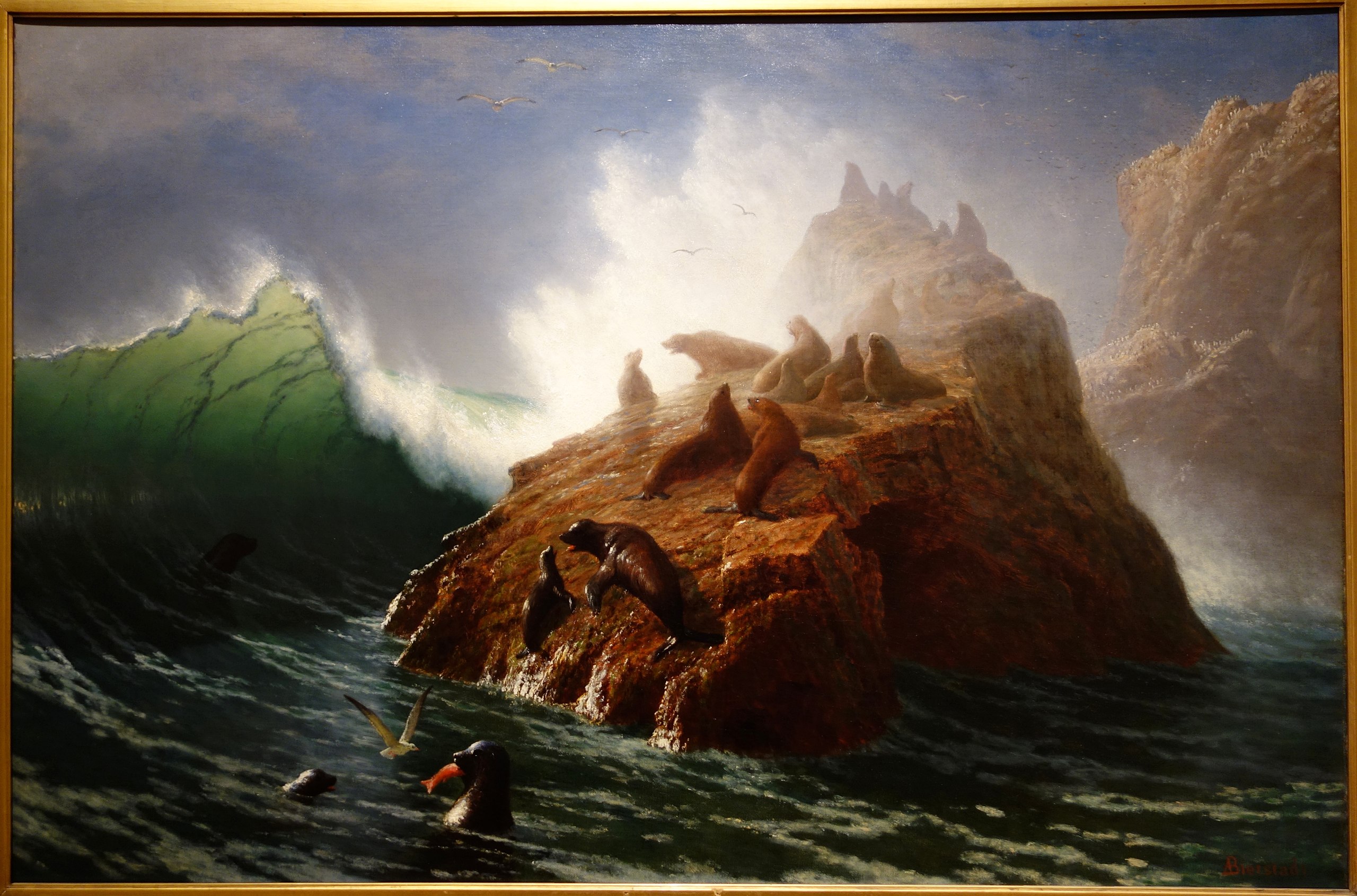
#FineArtFriday: Seal Rock by Albert Bierstadt

Artist: Albert Bierstadt (1830–1902)

Title: Seal Rock

Genre: marine art

Date: 1880s

Medium: oil on canvas

Dimensions:   height: 105 cm (41.3 in)

What I love about this painting:

It is a blustery day on the cold, wild sea. The sun briefly shines through, illuminating the rocks, glowing through a cresting wave. This is a masterful depiction of the scene, painted later in his life. It is dynamic and dramatic, conveying the power of the waves and the emotion of the scene.

Despite the efforts of the sea to wash them away, the rocks stand strong, offering a safe place for the seals.

As an avid watcher of nature shows, I love this painting.  Bierstadt captures these seals doing all the things seals do. They are fishing, lounging, and several pairs are apparently arguing.

Not unlike my family when we go out to lounge on a rock beside the sea.


About the Artist, via Wikipedia:

Albert Bierstadt (January 7, 1830 – February 18, 1902) was a German American painter best known for his lavish, sweeping landscapes of the American West. He joined several journeys of the Westward Expansion to paint the scenes. He was not the first artist to record the sites, but he was the foremost painter of them for the remainder of the 19th century.

Bierstadt was born in Prussia, but his family moved to the United States when he was one year old. He returned to study painting for several years in Düsseldorf. He became part of the second generation of the Hudson River School in New York, an informal group of like-minded painters who started painting along the Hudson River. Their style was based on carefully detailed paintings with romantic, almost glowing lighting, sometimes called luminism. Bierstadt was an important interpreter of the western landscape, and he is also grouped with the Rocky Mountain School. [1]


Credits and Attributions:

IMAGE: Seal Rock by Albert Bierstadt, Wikimedia Commons contributors, “File:Seal Rock by Albert Bierstadt, c. 1872-1887, oil on canvas – New Britain Museum of American Art – DSC09221.JPG,” Wikimedia Commons, https://commons.wikimedia.org/w/index.php?title=File:Seal_Rock_by_Albert_Bierstadt,_c._1872-1887,_oil_on_canvas_-_New_Britain_Museum_of_American_Art_-_DSC09221.JPG&oldid=975772252 (accessed March 27, 2025).

[1] Wikipedia contributors, “Albert Bierstadt,” Wikipedia, The Free Encyclopedia, https://en.wikipedia.org/w/index.php?title=Albert_Bierstadt&oldid=1277160716 (accessed March 27, 2025).

2 Comments

Filed under #FineArtFriday

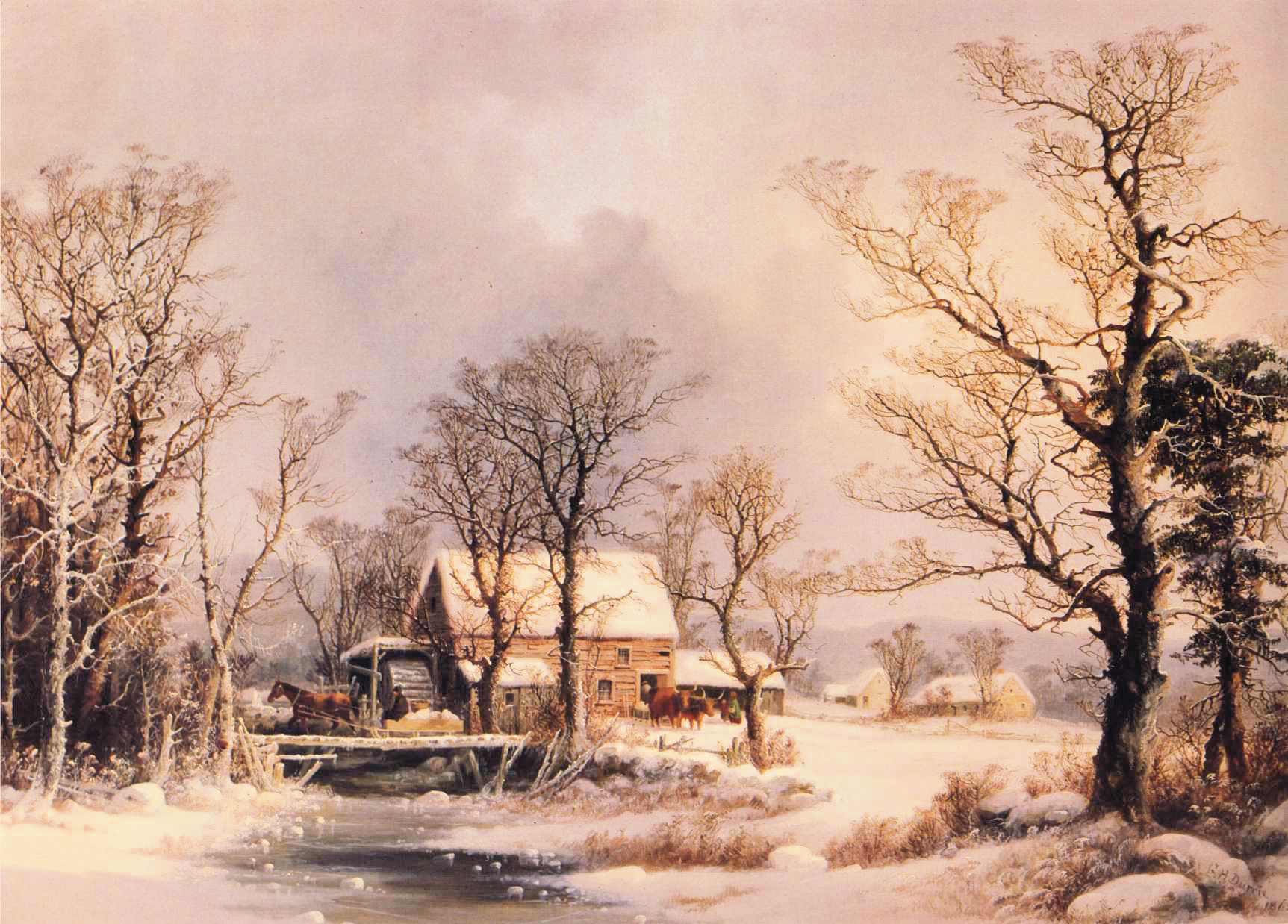
#FineArtFriday: Winter in the Country – The Old Grist Mill by George Henry Durrie

Artist: George Henry Durrie (1820–1863)

Painting: Oil on canvas, 26 x 36 in

Date: 1862

What I love about this painting:

George Henry Durrie is one of my favorite American artists. In this painting, he shows us a winter’s day in New England in 1862. Snow covers the ground, but the sun is shining, lending a rosy glow to the day.

The stream bears a light skim of ice, but though the millwheel is covered in snow, the mill is not idle. This late (or early) in the year there is no wheat to grind, but the grain from the previous autumn’s harvest has been turned to flour and shoveled into bags and barrels and stored for sale as needed.

A horse-drawn sled crosses the log bridge, loaded with white cotton bags of flour. Perhaps the driver intends to take advantage of the good weather and deliver them to the local General Store or Mercantile.

Durrie’s horses and cattle are as true to life as his landscapes are. One can almost see the muscles moving beneath the glossy coat as our horse pull the sleigh.

If you are writing a story set in an era of lower technology, I strongly suggest you go to the art of Durrie and his contemporaries to find inspiration for worldbuilding.

About the artist, via Wikipedia:

George Henry Durrie (June 6, 1820 – October 15, 1863) was an American landscape artist noted especially for his rural winter snow scenes, which became very popular after they were reproduced as lithographic prints by Currier and Ives.

In Durrie’s time, winter landscapes were not popular with most curators and critics, but nevertheless, by the time of his death, Durrie had acquired a national reputation as a snowscape painter. Durrie died in 1863, at age 43, probably from typhoid fever, not long after Currier and Ives began reproducing his paintings as prints.

Durrie’s paintings, depicting idyllic rural life, a world of stability and home comforts, held great appeal for the middle class and the working class, as an visual antidote for the growing industrialization of America, and the uncertainties of a boom-and-bust economy. The American ideal of a land of self-sufficient farmers, captured by Durrie’s paintings, was being replaced with factories belching smoke, along with a rise in urban populations, foreign immigration, and crime brought about by crowded conditions and poverty. The American descendants of the early English settlers felt that their values and way of life were threatened by these new developments and turned to nostalgic images such as Durrie’s for comfort. [1]


Credits and Attributions:

IMAGE: Wikimedia Commons contributors, “File:George Henry Durrie – Winter in the Country, The Old Grist Mill.JPG,” Wikimedia Commons, https://commons.wikimedia.org/w/index.php?title=File:George_Henry_Durrie_-_Winter_in_the_Country,_The_Old_Grist_Mill.JPG&oldid=995260526 (accessed February 10, 2025).

[1] Wikipedia contributors, “George Henry Durrie,” Wikipedia, The Free Encyclopedia, https://en.wikipedia.org/w/index.php?title=George_Henry_Durrie&oldid=1244671369 (accessed February 10, 2025).

5 Comments

Filed under #FineArtFriday, writing

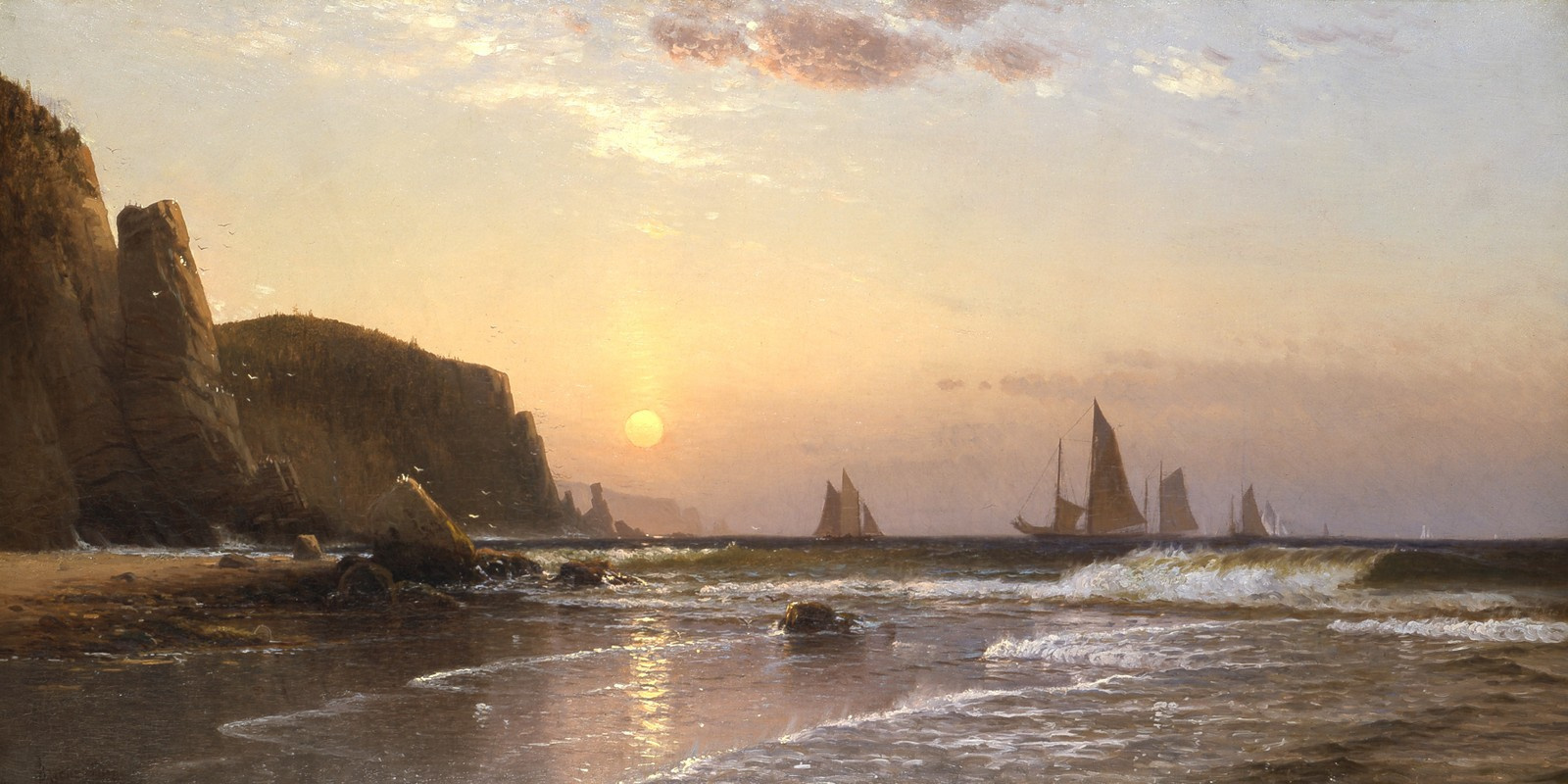
#FineArtFriday: Morning at Grand Manan by Alfred Thompson Bricher 1878

Morning_at_Grand_Manan_by_Alfred_Thompson_BricherArtist: Alfred Thompson Bricher (1837–1908)
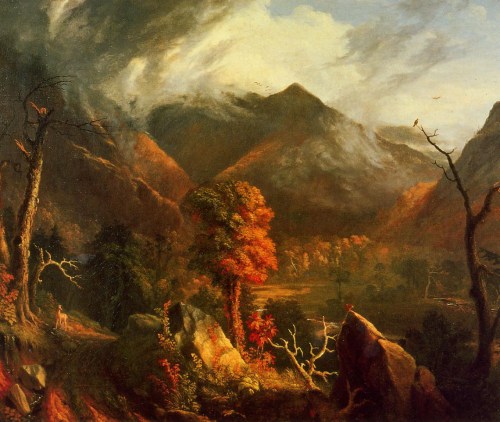
Title: Morning at Grand Manan

Date: 1878

Medium: oil on canvas

Dimensions: height: 25 in (63.5 cm); width: 50 in (127 cm).

Collection: Indianapolis Museum of Art

Current location: Paine Early American Painting Gallery

What I Love about this painting:

This is a satisfying scene capturing the best moments of a morning at the shore. The light falls on the water with an almost photographic sheen. Fishing vessels leave the harbor, heading out to sea. The sea is calm, and the waves roll up to embrace the shore. One could wade in the shallows and search the tidal pools for starfish or crabs and other creatures in safety.

The sun is up and the few clouds in the sky are dissipating. This will be a good day, perhaps the best day of the summer.

About this painting via Wikipedia:

Morning at Grand Manan is an 1878 oil painting by Alfred Thompson Bricher. It is part of the permanent collection at the Indianapolis Museum of Art, and is currently on view in the Paine Early American Painting Gallery.

Painted along Grand Manan Island, a favorite vacation spot of the artist in New Brunswick, Canada, Bricher painted the sunrise coming above the Atlantic Ocean in a tiny inlet on the coast. Four sailing ships are clearly visible against the pink sky. On the left of the canvas, a sharp, rocky cliff face is seen, breaking up the composition. Bricher clearly depicts each wave rolling onto the beach in minute detail. The sun is positioned a little left of center of the canvas, but is the major focal point, drawing the eye in. Just like other Hudson River School painters, Bricher hides his brushstrokes as if to make the canvas disappear.

Alfred Thompson Bricher was part of the American Luminist movement, coming out of the Hudson River School. Much like the Impressionists, they were interested in the play of light in landscapes, with Bricher himself being particularly interested in how light played against the ocean. Bricher, in particular, became famous for his seascapes and depicting the North Atlantic seaboard. Bricher is considered the last important luminist painter. Morning at Grand Manan came at the height of his career, and displayed Bricher’s acquisition of European aesthetics into his own paintings.

About the Artist via Wikipedia:

Alfred Thompson Bricher (April 10, 1837 – September 30, 1908) was an American painter associated with White Mountain art and the Hudson River School.

Bricher was born in Portsmouth, New Hampshire. He was educated in an academy at Newburyport, Massachusetts. He began his career as a businessman in Boston, Massachusetts. When not working, he studied at the Lowell Institute. He also studied with Albert BierstadtWilliam Morris Hunt, and others. He attained noteworthy skill in making landscape studies from nature, and after 1858 devoted himself to the art as a profession. He opened a studio in Boston, and met with some success there. In 1868 he moved to New York City, and at the National Academy of Design that year he exhibited “Mill-Stream at Newburyport.” Soon afterward he began to use watercolors in preference to oils, and in 1873 was chosen a member of the American Watercolor Society. In the 1870s, he primarily did maritime themed paintings, with attention to watercolor paintings of landscape, marine, and coastwise scenery. He often spent summers in Grand Manan, where he produced such notable works as Morning at Grand Manan (1878). In 1879, Bricher was elected into the National Academy of Design as an Associate member.


Credits and Attributions

IMAGE: Wikimedia Commons contributors, “File:Morning at Grand Manan by Alfred Thompson Bricher.jpg,” Wikimedia Commons, https://commons.wikimedia.org/w/index.php?title=File:Morning_at_Grand_Manan_by_Alfred_Thompson_Bricher.jpg&oldid=872660352 (accessed September 5, 2024).

[1] ABOUT THE  IMAGE: Wikipedia contributors, “Morning at Grand Manan,” Wikipedia, The Free Encyclopedia, https://en.wikipedia.org/w/index.php?title=Morning_at_Grand_Manan&oldid=1192844232 (accessed September 5, 2024).

[2] BIO: Wikipedia contributors, “Alfred Thompson Bricher,” Wikipedia, The Free Encyclopedia, https://en.wikipedia.org/w/index.php?title=Alfred_Thompson_Bricher&oldid=1229486559 (accessed September 5, 2024).

4 Comments

Filed under #FineArtFriday

#FineArtFriday: The Beeches by Asher Brown Durand 1845

The_Beeches_MET_DT75Artist: Asher Brown Durand  (1796–1886)

Title: The Beeches

Genre: landscape art

Date: 1845

Medium: oil on canvas

Dimensions: 60 3/8 x 48 1/8 in. (153.4 x 122.2 cm)

Collection: Metropolitan Museum of Art

Current location: American Paintings and Sculpture

What I love about this painting:

It’s been storming here on the west coast of the US, dumping rain. California has been hard hit with so much rain the soil can’t absorb it. Yet, though the snowpack will bring relief (if the state doesn’t wash away) the drought is not over. California Storms Help Relieve Drought, But How Much Is in Question – The New York Times (nytimes.com)

Here in the Puget Sound area, we’re experiencing the usual wind and rain of a Northwest winter, hopefully a respite from the droughts we’ve suffered in the past decade. So, it’s good time to enjoy the image of sunny day painted in a calmer time.

Asher Brown Durand gives us a summer day on the shore of a large pond, in a grove of beech and birch trees. The large beech tree is magnificent, with its rough, moss-covered bark commanding the center stage. In the distance, as if they were accidentally included, a shepherd leads a flock of sheep, a minor part of the scene as compared to the superb majesty of the beech tree.

Yet, nothing in this painting is accidental. The sheep and their shepherd are painted in exquisite detail, with as much attention as he gives to the texture of the bark and the moss. Each leaf, each blade of grass, each stone—every part of this scene is painted with intention. Each component of this landscape painting is as true and perfect as they were in real life.

I love the natural feeling of the plants, the intense colors of nature, the sense of a place that is vibrant and alive.

This painting is not merely a photographic representation of a summer morning in 1845. It has a life, a sense that you are there. We can almost feel the warming sunshine and slight breeze lifting the morning haze, hear the sheep as they walk to the water, perhaps even catch the earthy scent of the woods around us.

Durand was a master in the Hudson River School, a group of artists who believed that nature in the form of the American landscape was a reflection of God. Durand himself wrote, “The true province of Landscape Art is the representation of the work of God in the visible creation.” [1] This painting demonstrates that conviction.

About the Artist, via Wikipedia:

Asher Brown Durand (August 21, 1796, – September 17, 1886). (He) was an American painter of the Hudson River School. was born in, and eventually died in, Maplewood, New Jersey (then called Jefferson Village). He was the eighth of eleven children. Durand’s father was a watchmaker and a silversmith.

Durand was apprenticed to an engraver from 1812 to 1817 and later entered into a partnership with the owner of the company, Charles Cushing Wright (1796–1854), who asked him to manage the company’s New York office. He engraved Declaration of Independence for John Trumbull during 1823, which established Durand’s reputation as one of the country’s finest engravers. Durand helped organize the New York Drawing Association in 1825, which would become the National Academy of Design; he would serve the organization as president from 1845 to 1861.

Asher’s engravings on bank notes were used as the portraits for America’s first postage stamps, the 1847 series. Along with his brother Cyrus he also engraved some of the succeeding 1851 issues.

Durand’s main interest changed from engraving to oil painting about 1830 with the encouragement of his patron, Luman Reed. In 1837, he accompanied his friend Thomas Cole on a sketching expedition to Schroon Lake in the Adirondacks Mountains, and soon after he began to concentrate on landscape painting. He spent summers sketching in the Catskills, Adirondacks, and the White Mountains of New Hampshire, making hundreds of drawings and oil sketches that were later incorporated into finished academy pieces which helped to define the Hudson River School.

Durand is remembered particularly for his detailed portrayals of trees, rocks, and foliage. He was an advocate for drawing directly from nature with as much realism as possible. [1]


Credits and Attributions:

Image:  The Beeches by Asher Brown Durand, PD|100. Wikimedia Commons contributors, “File:The Beeches MET DT75.jpg,” Wikimedia Commons, the free media repository, https://commons.wikimedia.org/w/index.php?title=File:The_Beeches_MET_DT75.jpg&oldid=617658539 (accessed January 12, 2023).

[1] Wikipedia contributors, “Asher Brown Durand,” Wikipedia, The Free Encyclopedia, https://en.wikipedia.org/w/index.php?title=Asher_Brown_Durand&oldid=1129313847 (accessed January 12, 2023).

2 Comments

Filed under #FineArtFriday

#FineArtFriday: Peace at Sunset (Evening in the White Mountains) by Thomas Cole, ca 1827

Peace_at_Sunset_(Evening_in_the_White_Mountains)_Thomas_ColeArtist: Thomas Cole (1801–1848)

Title: Peace at Sunset (Evening in the White Mountains)

Date: circa 1827

Medium: oil on canvas

Dimensions: height: 68.9 cm (27.1 in); width: 81.9 cm (32.2 in)

Collection: Fine Arts Museums of San Francisco

What I love about this painting:

This is one of Cole’s early works. He was able to show us the kind of autumn day we love, with rain trying to sweep in, but held back by the sunshine. It’s good day, despite the chill breeze attempting to scour the leaves from the trees. Clouds brush the hilltops, but the reds and golds seem to glow in the sunlight.

About the Artist, via Wikipedia:

Thomas Cole (February 1, 1801 – February 11, 1848) was an English-American painter known for his landscape and history paintings. He is regarded as the founder of the Hudson River School, an American art movement that flourished in the mid-19th century. Cole’s work is known for its romantic portrayal of the American wilderness.

After 1827 Cole maintained a studio at the farm called Cedar Grove, in the town of Catskill, New York. He painted a significant portion of his work in this studio. In 1836, he married Maria Bartow of Catskill, a niece of the owners, and became a year-round resident. Thomas and Maria had five children. Cole’s daughter Emily was a botanical artist who worked in watercolor and painted porcelain. Cole’s sister, Sarah Cole, was also a landscape painter.

Additionally, Cole held many friendships with important figures in the art world including Daniel Wadsworth, with whom he shared a close friendship. Proof of this friendship can be seen in the letters that were unearthed in the 1980s by the Trinity College Watkinson Library. Cole emotionally wrote Wadsworth in July 1832: “Years have passed away since I saw you & time & the world have undoubtedly wrought many changes in both of us; but the recollection of your friendship… [has] never faded in my mind & I look at those pleasures as ‘flowers that never will in other garden grow-‘”

Thomas Cole died at Catskill on February 11, 1848, of pleurisy. The fourth highest peak in the Catskills is named Thomas Cole Mountain in his honor. Cedar Grove, also known as the Thomas Cole House, was declared a National Historic Site in 1999 and is now open to the public.


Credits and Attributions:

Peace at Sunset (Evening in the White Mountains) by Thomas Cole PD|100 via Wikimedia Commons.

Wikipedia contributors, “Thomas Cole,” Wikipedia, The Free Encyclopedia, https://en.wikipedia.org/w/index.php?title=Thomas_Cole&oldid=1120453843 (accessed November 10, 2022).

Comments Off on #FineArtFriday: Peace at Sunset (Evening in the White Mountains) by Thomas Cole, ca 1827

Filed under #FineArtFriday

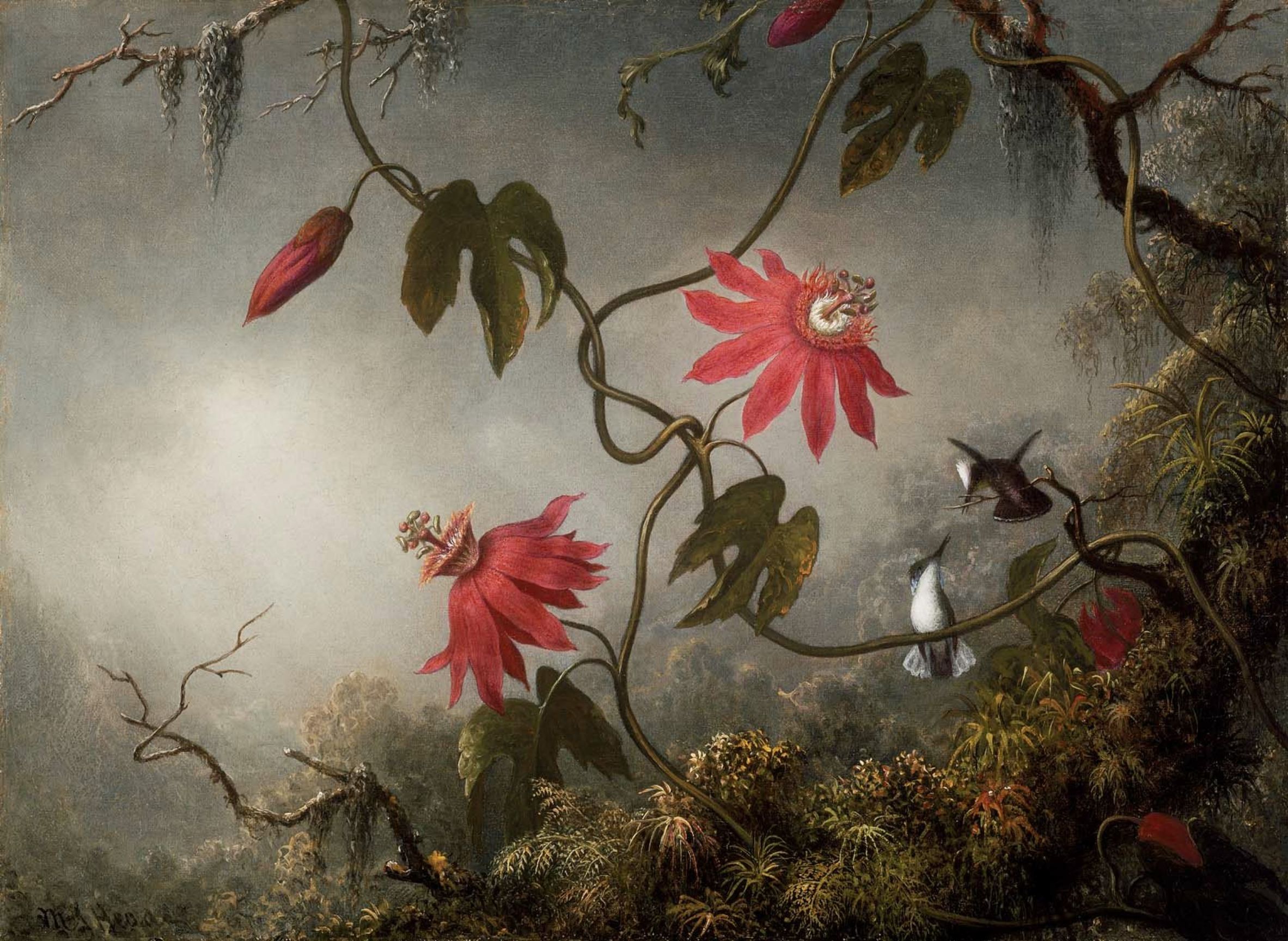
#FineArtFriday: Passion Flowers and Hummingbirds by Martin Johnson Heade

MJ_Heade_Passion_Flowers_and_HummingbirdsArtist: Martin Johnson Heade (1819–1904)

Title: Passion Flowers and Hummingbirds

Genre:  floral painting

Date: circa 1870–83

Medium: oil on canvas

Dimensions: Height: 39.3 cm (15.5 in); Width: 54.9 cm (21.6 in)


About this painting, via Wikimedia Commons:

[1] In Passion Flowers and Hummingbirds, Heade depicted two snowcap hummingbirds, small black-and-white birds found in Panama, and the most brilliantly colored species of passionflower, Passiflora racemosa, in a steamy, lush jungle setting.

The passionflower is so named because missionaries saw correspondences between the parts of the flower and the Passion (or sufferings) of Christ. For example, the ten petals represent the ten apostles present at the crucifixion, the corona filaments resemble the crown of thorns, and the three stigmas relate to the nails.

In this work, Heade successfully combined his scientific interests and his aesthetic sensitivity. He rendered the birds and the passionflowers accurately in a close-up view but also gracefully composed the winding stems across the surface of the picture and contrasted the cool greens and grays with the dazzling red of the flowers.

Although Heade was one of the first to reflect Darwin’s theories in his paintings of flowers in their natural habitats, other artists were subsequently affected by Darwin’s view of the vitality of plants and the interaction of plants with their environment. [1]

About the Artist, via Wikipedia:

[2] Martin Johnson Heade (August 11, 1819 – September 4, 1904) was an American painter known for his salt marsh landscapes, seascapes, and depictions of tropical birds (such as hummingbirds), as well as lotus blossoms and other still lifes. His painting style and subject matter, while derived from the romanticism of the time, are regarded by art historians as a significant departure from those of his peers.

Heade was born in Lumberville, Pennsylvania, the son of a storekeeper. He studied with Edward Hicks, and possibly with Thomas Hicks. His earliest works were produced during the 1840s and were chiefly portraits. He travelled to Europe several times as a young man, became an itinerant artist on American shores, and exhibited in Philadelphia in 1841 and New York in 1843. Friendships with artists of the Hudson River School led to an interest in landscape art. In 1863, he planned to publish a volume of Brazilian hummingbirds and tropical flowers, but the project was eventually abandoned.

He travelled to the tropics several times thereafter, and continued to paint birds and flowers. Heade married in 1883 and moved to St. Augustine, Florida. His chief works from this period were Floridian landscapes and flowers, particularly magnolias laid upon velvet cloth. He died in 1904. His best known works are depictions of light and shadow upon the salt marshes of New England.

Heade was not a widely known artist during his lifetime, but his work attracted the notice of scholars, art historians, and collectors during the 1940s. He quickly became recognized as a major American artist. Although often considered a Hudson River School artist, some critics and scholars take exception to this categorization. Heade’s works are now in major museums and collections. His paintings are occasionally discovered in unlikely places such as garage sales and flea markets. [2]


Credits and Attributions:

[1] Wikimedia Commons contributors, “File:MJ Heade Passion Flowers and Hummingbirds.jpg,” Wikimedia Commons, the free media repository, https://commons.wikimedia.org/w/index.php?title=File:MJ_Heade_Passion_Flowers_and_Hummingbirds.jpg&oldid=577409420 (accessed July 29, 2021).

[2] Wikipedia contributors, “Martin Johnson Heade,” Wikipedia, The Free Encyclopedia, https://en.wikipedia.org/w/index.php?title=Martin_Johnson_Heade&oldid=1013422150 (accessed July 29, 2021).

Comments Off on #FineArtFriday: Passion Flowers and Hummingbirds by Martin Johnson Heade

Filed under #FineArtFriday, writing