Tag Archives: humor

#amwriting: mindwandering and the creative muse

kleenexI’ve been suffering from a heavy cold all weekend, and doing my work from bed. Me and NyQuil are once again best friends. So, imagine my surprise yesterday when I wrote what was supposed to be today’s blogpost and instead of pressing the “save as draft” button, I hit “publish.”

Oops.

So that meant I didn’t have a post for today. Thus, I have gone to the archives, and pulled up an old post, updated a few thing and voila! I have a post for today. Yesterday’s post  still there, so check it out!


When people first discover I write fantasy tales, the first thing they ask (after what the heck are you thinking) is where I get ideas for my tales.  I usually give them some song-and-dance about adapting modern relationships and values to mythological world situations and while it’s true, it’s not the whole truth.

The real truth is, these thing just pop into my head, and I think “Wow – that would be a good story.”  I will be riding in the car listening to music, not thinking about anything in particular and I will have a flash of brilliance – What if the dark ages never happened? or  How would Europe look if the Druids had conquered Europe instead of the Romans?

If I’m smart, I will write the idea down, because I’m 63 years old and the old main-frame ain’t what she used to be, memory-wise.

The flow of random thoughts really is the river of creativity for me. Letting your mind roam free and allowing the possibilities to enter your stream of consciousness (or not, as they will) is good for you.  Fifteen or twenty minutes a day of simply watching the world go by will rejuvenate you.

Some people will say, “I don’t have time to waste daydreaming,” and that’s all right for them. I personally need to throw open the windows of my mind and let the breezes clear away the musty ideas which get in the way of my creativity. For me, the path to writer’s block is paved with “I don’t have time to relax!”

Don’t get me wrong, I get up at 5:30 am and immediately begin blogging. After noon I read for several hours and then I do revisions or work on my current Work In Progress. I read before I go to sleep.  I do two weekly book review blogs besides this blog, and all in all I work 10 to 16 hours a day at this job, but it is interspersed with various household tasks and errands.  I also take the time to let my mind rest, simply watching the town go by from my back porch.

Some people call it meditation, and some people call it a waste of time.

I call it necessary.

I think of my mind as if it were an ‘idea farm.’.Just as a wise farmer allows his fields to occasionally lie fallow it is important to let your mind rest. Letting farmlands lie fallow is one of the best ways of allowing the land to replenish its nutrients, and regain its fertility. Letting your mind roam with no particular direction is essential in lowering your stress levels (!) which immediately improves your health and your thought processes.

So I guess  when  someone asks me where I get ideas for my tales I should tell them the truth:

I don’t really know!


mindwandering and the creative muse was first published on Life in the Realm of Fantasy on July 11, 2012 under the title The Idea Farm.

Comments Off on #amwriting: mindwandering and the creative muse

Filed under writing

#FlashFictionFriday: Edna’s Garden, Part 2

I’m packing up to move. Selling the house was more work than I thought it would be. My agent assured me the large sum of money I spent replacing the old carpets with laminate, and getting new, natural-stone counter-tops would more than pay for itself when I found the right family to sell the place to. Frank Lanier, my real estate agent, has known me for years. He accepts that I believe more is at stake than mere money and was willing to write some unusual clauses into the contract.

My daughter doesn’t know this, but I told Frank that if the right people wanted the house, I would accept any offer they made, even if it was a little low.

The problem is, I’ve buried two husbands, and now I’ve outlived my handyman, Jasper. He seemed so healthy too. But he dropped dead of a heart attack at the young age of only eighty-two. Jasper did everything I couldn’t for the last thirty years, mowing the grass, cleaning the gutters, fixing the wonky electric system, or repairing the roof. I don’t want to have to train some young know-it-all in how things should be done, such as not running the lawnmower over the sprinkler heads. I’ve accepted that I can’t care for the place anymore.

But I do have a responsibility to see to it the right family moves in here. They must be able to see past the expected, must have an imagination, and absolutely must be committed to preserving…nature.

Marjorie, my daughter, is only in her seventies and, unfortunately for her husband, she’s as healthy as a racehorse. The way she carries on about every minor ailment, you’d think she was at death’s door. Arthur, Marjorie’s husband, is the least spirited man I’ve ever met. I suppose forty-eight years of being tied to her has long since beaten anything resembling a backbone out of him. Marjorie has the notion her life will be much easier if they sell everything and move to Florida.

I know what my extraordinarily lazy daughter is up to.  By purchasing a condominium in a resort for well-heeled seniors, Marjorie will have housekeepers to order around and will never have to cook again. They could eat every meal in the community dining room. I’m sure Arthur sees that as a point in her favor since Marjorie can’t even boil water without burning it.

It sounds like a cruise ship but without the Norovirus. However, she needs me to foot the bill, because she always spent her and her husband’s salaries faster than they could earn it, and then she insisted on retiring early. So, they’re out of money now, but she has a new retirement plan–me. She’s been pretending I’m senile and petitioned the court to be given custodial power over me and my assets “for my best interests.”

That will never happen. She now hates my lawyer, because he made it clear that I am in complete possession of my wits, and the judge rather bluntly asked her what she was hoping to gain. She became quite offended, saying it was her duty to care for me in my declining years.

Of course, she came apologizing afterward, trying to convince me to move in with them, but I told her I had plans that involved having a life. Marjorie got that pouty look, the one she wears anytime she’s balked. After we had left the court, I did tell Violet that booking myself into the lowest-rated nursing home in a Bombay slum would be preferable to putting myself and my money in Marjorie’s power. Violet knows Marjorie, and had to agree.

With Jasper’s untimely death, I had to do something about the house, but I have a responsibility to the “guests” in my garden. I didn’t tell Frank why I wanted only a certain kind of family, but the truth is, whoever purchased this place had to be people with an open mind. They had to be able to see my fairies and understand they are an endangered species and that they have a sacred duty to protect them. That’s why I had Frank put the clause in the contract that the new owners must never cut the hedge.

Frank finally found the right people. Kaitlyn and Martha fell in love with it. When they looked at the garden, Kaitlyn spotted the fairies and got all excited, pointing and whispering to Martha that this was the place for them to build their life together, and she had to have it, no matter what.

Martha agreed.

So now, that perfectly sweet couple will live here, and my fairies will be safe.

As the judge advised me to, I’m spending Marjorie’s inheritance. Frank found me the perfect little condo downtown near the senior center, and I can bring my cat, Rufus. It’s only a few blocks from the farmer’s market, and it’s on the bus line so I can sell my car, which will make my insurance agent happy.

Once I get settled there, Violet and I will take a two-week trip to Italy. We have a lot of plans, and making a pilgrimage to Fabio’s birthplace is just the beginning.

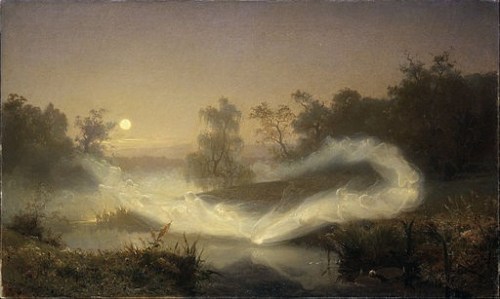
512px-August_Malmström_-_Dancing_Fairies_-_Google_Art_Project


Edna’s Garden, Part 2 © 2016 Connie J. Jasperson, All Rights Reserved

Click here to read part one of Edna’s Garden 

Comments Off on #FlashFictionFriday: Edna’s Garden, Part 2

Filed under #FlashFictionFriday, Fairies, Fantasy, writing

#amwriting: Two punctuation wrongs that don’t make a right

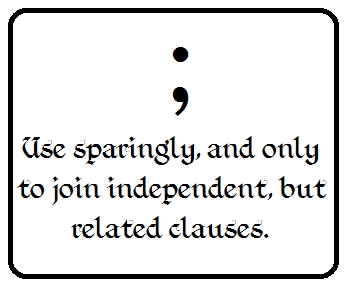
semicolon memeToday, I am revisiting independent clauses and how NOT to join them. This has been discussed at length elsewhere on this blog, so I’ll keep today’s discourse short and to the point.

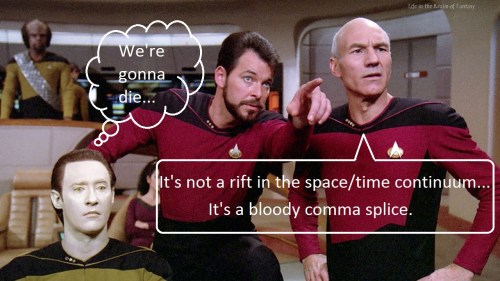
You do not join independent clauses (clauses that can stand alone as separate sentences) with commas as that creates a rift in the space/time continuumthe Dreaded Comma Splice:

Comma Splice: My car is a blue Chevy Malibu and I like it, the dog likes to ride shotgun.

Same thought, written correctly: My car is a blue Chevy Malibu, and I like it. The dog likes to ride shotgun.

Would it be better if we used a semicolon? No. The dog riding shotgun is an independent clause and does not relate at all to the color of the car.

A semicolon in an untrained hand is a needle to the eye of an editor.

Remember: Semicolons join independent clauses, which are clauses that can stand alone, and your best bet is to avoid using them except under extreme duress as they can create some lo-o-o-o-ong, run-on sentences.

But what if you absolutely, positively have to use a semicolon, or your hair will fall out? Trust me, it won’t happen, but there are rules for using this type of punctuation, and the wise author will follow them:

Two clauses that are joined together with a semicolon should be

  1. complete sentences that relate to each other
  2. if they don’t relate to each other, make them separate sentences and reword them so they are not choppy.

Two separate ideas done wrong: We should go to the Dairy Queen; it’s nearly half past five.

The first sentence is one whole idea—they want to go somewhere. The second sentence is a completely different idea—it’s telling you the time.

Two separate ideas done right, assuming the mention of time is important: We should go to the Dairy Queen soon. They close at eight, and it’s nearly half past five.

If time is the issue in both clauses, and you feel like you absolutely MUST use a semicolon or you will explode, say, “The Dairy Queen is about to close; it’s nearly half past five.”

I generally try to find alternatives to semicolons, but I don’t dislike them, as some editors do. I do think they are too easily abused and misused, and should not be used if you are in doubt.

Comma splices—don’t do it. The universe will grind to halt, and everyone will die, and it will be your fault.

Semicolons—use only when two stand-alone sentences or clauses are really short and relate directly to each other.

Comma Splice Meme


7 Comments

Filed under writing

#amwriting: Sturm und Drang

hp-touchsmart-320-1030-full-setMy main, desktop computer died on Saturday. It’s been limping along for a while. We had into the shop about six months ago, and should have known then it was terminal. The thing is, while I love Sturm und Drang in my literature, I prefer my electronic life to be stress-free.

Limping along on my ancient, half-functional laptop, I can get by well enough to write the odd blogpost or work on my own work. But the screen is too small for me to use to edit for a client. Also, I can’t do any work requiring Photoshop, as that program is on my dead dinosaur.

I have my headphones on and the laptop strategically positioned, so it blocks the 50-inch technological disaster that is our TV and which seems to take up an entire wall. It also needs replacing as a series of vertical lines obscures the view on part of the screen but I doubt that will happen this year–TV is not that important. Music is mostly my form of entertainment.

Greg’s laptop is older than this one, although he is keeping it alive. All our technology is older than dirt. So, after I finish writing this blogpost, we are going shopping and two new machines will come to our house.

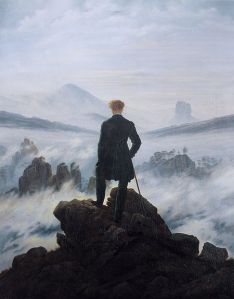
Caspar David Friedrich, Wanderer Above the Sea of Fog, 1818

Caspar David Friedrich, Wanderer Above the Sea of Fog, 1818 PD|100 via Wikimedia Commons

Let’s talk about Sturm und Drang. The English translation is literally, Storm and stress.

Google defines it as: a literary and artistic movement in Germany in the late 18th century, influenced by Jean-Jacques Rousseau and characterized by the expression of emotional unrest and a rejection of neoclassical literary norms.

What does this mean in simpler terms?

Sturm und Drang as a literary form evolved during the time of the American Revolutionary War, which a period of global unrest and great hardship, especially in Europe. The main feature is the expression of high emotions, strong reactions to events, and often, rebellion against rationalism. It is characterized by violent individualism and complex emotions. Literature and music written in this style were aimed at shocking the audience and infusing them with extremes of emotion.

Classical literature in this style began in 1772 with “Prometheus,” a poem by Johann Wolfgang von Goethe, in which the character of the mythic Prometheus addresses God (as Zeus) in misotheistic accusation and defiance. Misotheism is the hatred of God, or the Gods, in literature described as stemming from a moment in a person’s life where one feels the gods have abused and abandoned him. Misotheism requires a firm belief in a God or Gods.

Again, Wikipedia tells us this: Prometheus is the creative and rebellious spirit which, rejected by God, angrily defies him and asserts itself; Ganymede is the boyish self which is adored and seduced by God. One is the lone defiant, the other the yielding acolyte. As the humanist poet, Goethe presents both identities as aspects or forms of the human condition.

Modern genre and indie literature using this style can be found as an underlying trope in Cyberpunk.

Wikipedia defines Cyberpunk as: a subgenre of science fiction in a future setting that tends to focus on the society of the proverbial “high tech low life[1][2] featuring advanced technological and scientific achievements, such as information technology and cybernetics, juxtaposed with a degree of breakdown or radical change in the social order.[3]

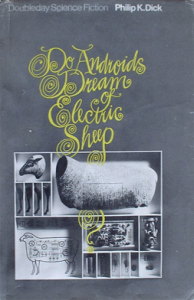
DoAndroidsDreamIt is exemplified by post-industrial dystopias that tend to feature wide divisions in the social order and extreme chaos in society. Protagonists acquire and make use of technology in ways never anticipated by its original inventors (“the street finds its own uses for things”).  Much of the genre’s atmosphere is heavily film noir, and  employs techniques and style reminiscent of detective fiction.

The difference between classical Sturm und Drang and modern Cyberpunk is Technology and Industry are the Gods whose knowledge the mortals desire, and whom they seek to replace. All aspects of Sturm und Drang can be found in Cyberpunk.

Cyberpunk began as a niche rebellion by authors like Phillip K. Dick, and is now mainstreamed and growing in popularity.

Authors writing in the early days of speculative fiction were Indies who were finding success getting short stories published in popular sci-fi magazines, and who were fortunate enough to have some farsighted editors take chances with publishing their longer work. They formed publishing companies and became giants. That opportunity will always be out there.

Indie authors have a great deal of latitude in their choice of what to write, as we can write and publish edgy work that would be deemed too chancy by traditional publishers. Authors always engage in artistic rebellion, and society always appreciates it—years afterward.

And tonight, I will continue my artistic rebellion while getting my new computing thing, whatever it shall be, up and running.

2 Comments

Filed under Fantasy, Literature, Uncategorized, writing

#FlashFictionFriday: Astorica

800px-Ladies_safety_bicycles1889Chance Jensen approached The Duck Walk Inn, aiming for the front door. It was classier than most of Astorica’s cocktail lounges, and was the third place she’d looked that afternoon. She entered, peering around to see if Jack was there.

He was, and ignoring the worried glances from the few men who were present in the otherwise empty bar, she walked toward him.

Stella, the bartender, chatted with Chuck Moore, Astorica’s lone hooker. Chuck’s clientele was comprised mostly of lonely, blue-collar laborers, women who worked in the shipyard. Stella nodded at Chance, as she lit Chuck’s cigarette.

Chuck exhaled a cloud of smoke, and glared at Chance. “You’ve been neglecting him, Chance Jensen. Don’t take your husband for granted. You’re a lucky woman to have a man like Jack. He shouldn’t be sitting in a place like this.”

“I know. I’ll do better, I promise.” She did have to smile, getting advice on her marriage from the local whore. But, she supposed, Chuck had seen plenty of marriages fail.

“Good. I don’t want to have this conversation again.” With a flounce, Chuck turned back to Stella.

The nervous-looking men at the corner table had moved their handbags to hide their cocktails, obviously regretting their decision to be so daring as to go into a cocktail lounge unaccompanied.

Jack looked out of place at the bar, dressed in his usual proper, suburban, house-husband style. He glanced up from his iced-tea. “What do you want? I’m not going back unless you’ve changed your mind.”

“Jack, we had a quarrel. I’m sorry I shouted. But, you can’t file for a divorce, as you don’t have grounds. I don’t beat you or cheat on you. You’re just angry because I can’t afford to buy you a bicycle like Loris did her husband.”

Jack straightened his sweater and crossed his trouser-clad legs. “You’re right, I am unhappy about that. I might not be able to get a divorce, but I don’t need one. I’m not interested in dating, so I have no desire to be single. But no law says I have to share your roof. If I got a job as a waiter or a housekeeper, I could support myself and buy my own bicycle. One with a good-sized basket for carrying things.”

Chance attempted to reason with him. “Jack, if you took a job outside our home what would people think? They’d think I can’t manage on my salary. I’m just starting out with this company. I don’t need that kind of image dogging me, holding me back, or I’ll never be promoted. They’re assigning me better routes now, so things will improve. I promise.”

He burst out, “I have needs too, you know. I want to go places, and do things. I’m tired of being cooped up, with nothing to do but slave away, making sure that when you come home, you find a clean house and a hot meal. Where’s the joy in that?” Jack wiped a tear, a sure sign he was really worked up. His voice, however, was calm. “It’s just, if we had a child, I would feel needed. I don’t have a purpose, Chance.” He met her eyes. “Give me a purpose, and I’ll stay.”

Chance sighed. It always came back to that. “I’d like a child too. I don’t know why we haven’t been blessed. We’re both healthy. There’s no reason we haven’t conceived.”

Jack looked around the room. “See? They’re the same as me. We’re bored stiff. Playing bridge on Tuesdays and going to Tupperware parties just doesn’t fill the void. It’s not just us. Fewer and fewer babies—something’s wrong with this world, and no one will admit it.” He stared down at his handbag. “It’s more than that. It’s everything. I get up at five to cook  breakfast and fix your lunch. The darkest corners in our house are so clean they glow in the dark! I do laundry. I wash windows. Every day, the same things.”

Chance started to agree, but Jack cut her off.

“At ten I get all dressed up and take the bus to the market, then I haul the groceries home and put them away. Once that’s done, I change and go out to work in the flower beds, because God forbid the neighbors should see an untidy yard! Once every bloody just-sprouting weed has been yanked, I prepare your dinner, and fifteen minutes before you get home I get all dolled up, just to look good while I serve you dinner. Then I have to clean the kitchen. The next day it starts all over again. My life revolves around cooking, cleaning, and what the damned neighbors might think of us.”

Hoping to calm him, Chance said,“I know it’s difficult for you, depending on public transportation. But I’m a truck driver. You knew that when you married me. Maybe I’m not as romantic or rich as the wives in your soap operas, but I do try. Don’t I give you a large enough allowance? I never ask how you spend it. I don’t care if you have lunch out with the boys, or have your hair done twice a week. I love you! I married you for keeps, and I respect the vows we took.”

“You could tell me you love me more often.” Jack sat  hunched in on himself.

“I know. I’m not good at saying how I feel.” Chance put her hand on his shoulder. “I’ll try to do better.”

Jack burst out, “I could learn to drive, but men aren’t allowed to. I could vote and help pass laws that would improve society, but no, men aren’t allowed to. We’re too emotional, too high strung to be allowed the same privileges as women.”

Desperate to head off the men’s emancipation argument, Chance said, “I know you’d be great at all those things, better than some women if I’m truthful. But it’s the way things are, and we have to live with it. And guess what—I got a raise, today.”

Jack’s eyes it up. “Really? That’s wonderful.”

Pressing her advantage, Chance said, “You know what that means? We can save up for your bicycle. If we’re careful, next month you can buy it.”

Picking up his handbag, Jack stood up. “Let’s go home. I’ll make a pie to celebrate your raise.”

Relief flooded Chance. Taking his elbow, she opened the door for Jack and guided him across the parking lot, reminding herself that men were the fairer sex, and required gentle handling. Chuck was right–she had been neglecting Jack’s emotional needs. She resolved to be more attentive.

She loved Jack , but he confused her. He had an overabundance of paternal instincts. It occurred to her that a puppy might take Jack’s mind off things. And, it just so happened Chance’s new boss, Carol, was trying to find homes for six dachshund puppies.

That was a brilliant idea. She’d gain favor with the boss and surprise Jack with a puppy, solving both problems in one swoop. Smiling, Chase opened the car door for her husband, helping him into the sedan.


“Astorica” © 2016 Connie J. Jasperson, All Rights Reserved

4 Comments

Filed under #FlashFictionFriday, Fantasy, writing

#amblogging: trying to get the word out.


windows dialogue box 6 dude are you sureIt’s hard to gain readers when you first begin to blog. The reason we write is so people can read our work, and if we have a limited audience, we feel a little defeated in our efforts to gain readers.

Because we want to gain readers, it’s necessary to use every platform available to get the word out and WordPress offers us many opportunities to do just that. On the dropdown menu to the left of your Blog title, under the words “My Sites,” click the dropdown menu.

In that menu, scroll down to “sharing” and click on it. that will take you to the “Sharing Settings” page. Click on the button that says “Publicize Settings.”

That will open a list of what I think of as blog warehouses, places that collect blogs and offer them to their regular readers. You want to activate as many of them as you can.

My blog automatically post to Path, Stumble Upon, Tumblr, Google+, Networked Blogs, Facebook, and Twitter, and each one of those venues has increased my readership.

I don’t normally post on Saturdays, but I am trying a new (to me) thing called Bloglovin, hence the html in the first paragraph of this post–they want you to put their code in a new post. As my blog automatically posts in a variety of different places, I figured it would confuse people if I posted a blog that just had their code in it, so I am bringing you all along on this journey!

Bloglovin is not in the WP publicize menu yet, so you have to go out to their website and try to follow their instructions, which I am doing at this moment. I will keep you all posted on how that goes, and we will see whether my readership increases or not!

.
Edit: Okay–the html at the top of the post didn’t work, because: WordPress. SO what I did was, I downloaded their logo, got the link to my Bloglovin Page, and linked that to the logo image. Now, when a person clicks on that logo, they will go directly to my page there, where the follow button is right at the top.

We will see how this works!

Comments Off on #amblogging: trying to get the word out.

Filed under blogging

#FlashFictionFriday:Happy Hour at the Drunken Sasquatch

796px-Louis_Ducros_(circle)_Pifferari_in_einer_römischen_TaverneI’m always at the Drunken Sasquatch for Happy Hour, as I have nowhere else to be. But Harry Wolfe was a family man with a problem, and he looked distinctly out of place there among the regulars. I had told him I thought the perfect person to resolve it would be in at about four, and sure enough, there she was.

He set his root-beer on the table. “Everyone knows Grandma is no one to mess with! Sure, my stepdad was a big, bad wolf. I won’t argue that he received a kind of back-handed justice. And who is sitting there proudly wearing his hide?” Harry gazed at the elderly woman seated at the bar. “Not my stepdad, that’s for sure.”

The elderly woman in the ratty fur coat turned to see what all the noise was about. We smiled and waved at Grandma.

“See how innocent she looks?  She could be any old barfly. But that’s no ordinary old drunk.” I tried to impress on him how perfect she was for his problem. “That’s Grandma, and she’s the one for the job.”

Harry capitulated. “Um… okay, but no violence. They’re terrible tenants, but they’re college kids, right?”

“So are you going to ask her?”

Harry’s eyes showed the whites, as he mastered his panic. “No! She’s…could you ask her?” The werewolf was actually shaking in his boots.

“Okay,” I said. “I’ll do it.” Very few things intimidate a dragon. I took my orange juice to the bar and found a stool next to the lady in question.

“Mrs. Johnson?” I asked.

“Who wants to know?”

“Dan Dragonsworthy. My friend has a rental property, occupied by some tenants who’re trashing it…he was wondering if you were still in the vigilante business.”

“You mean that nice young man doesn’t want to dirty his paws with such matters.” She met my gaze. “Sure, but it will cost him. I don’t work for free.”

I brought Harry over and introduced him. They got down to the nitty-gritty, and a price was arranged. Grandma fixed Harry with her steely gaze. “Tell me everything you know about these tenants.”

“Well, they’re pigs.”

“We know that. What do they look like?”

“They’re pigs, Yorkshire pigs, to be exact, and seemed so charming and British. They’re foreign exchange students and had good references, but now I’m assuming they were forged.”

“What exactly have they done to your property?” Grandma tried to look comforting. It scared the willies out of me. As I said, very few things scare a dragon, but that look on this old lady was one of them.

Harry said, “Every Saturday night they have these huge parties with hundreds of people and live bands. Loud punk music all night long. My phone is always ringing off the hook, with the other tenants’ complaining.”

“Over on Walnut Street?” Grandma asked, and Harry nodded. “Yeah,” she said. “Those are some great parties.” Grandma thought for moment. “I hate to evict my friends, but business is business, and a girl’s gotta make a living.”

She fished around in her handbag, setting things on the bar: old Kleenexes, mints, a pearl-handled Colt forty-five, her cell phone, a hacksaw, her checkbook, a crescent wrench, a dog-eared address book… and so on… and so on. Finally, she came to a small stack of business cards, with a rubber band wrapping them. Pulling one card from the bundle, she handed it to Harry. “Send the legal paperwork to me at this address here, along with half the fee. I’ll collect the other half when the job is done, Tuesday at the latest. Just make sure a large dumpster is delivered to the curb in front of the place Monday morning.” She turned, tossing everything back into her bag and addressed herself to her gin and tonic. It was a dismissal Harry and I both could recognize.

As we sat down at our table, Harry said, “I don’t like doing things this way, but I can’t have my property destroyed. She’s definitely the one for the job. I hate to have to play the Grandma card, but those pigs have got to go. I just hope she doesn’t harm them.”

Looking at the little old lady seated at the bar, I had to agree. “When you have a tough job, you can always count on Grandma. It may not be pretty, but she gets results.”

Harry shivered.


Happy Hour at the Drunken Sasquatch © 2016 Connie J. Jasperson, All Rights Reserved

6 Comments

Filed under #FlashFictionFriday

#amwriting: mathoms, the Room of Shame, and me

I am cleaning and redecorating my office. This brought to mind an article touching on this very subject, written a year ago for Edgewise Words Inn, which in turn was originally posted in a slightly different form here in Jan 2015. To reduce my carbon footprint, I even recycle my words.


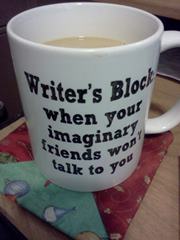
My Coffee Cup © cjjasp 2013I’ve said this before and I’ll say it again—I have parties for the same reason I have editors.

Having a party forces me to

  1. Clean my dusty house and
  2. Get rid of the ‘fluff and nonsense’ that we acquire as part of modern living.

What sort of fluff and nonsense you ask?

Consider the plastic container. Why is the lower cupboard in my house a place where containers come home to die? They have their place but too many is just too many. And where are the lids?  I think the lids to plastic containers go to that pocket in the universe where random socks and spare pairs of reading glasses go.

Plastic containers are the devil. Despite my best efforts they enter the house in insidious ways.

  1. They arrive neatly wrapped around vegan margarine, or hummus.
  2. I pick up a few to use to send leftovers home with loved ones,
  3. But more containers arrive than are used—and the ones in the cupboard are never the size I need.

Then there are the glass jars—I go on binges of saving them because “I don’t like plastic containers.” (Did you note the sarcasm?)

  1. But pickle jars and spaghetti sauce jars are never the right size.
  2. And the lids get lost.
  3. And my favorite jar is always full.

If you think the plastic containers and the jars are out of control, let’s talk about coffee cups.

peacock tea cup - useless but I wish I owned it!

peacock tea cup – useless but I wish I owned it!

How many coffee cups do two old people need? And where do these things keep coming from? It’s a miracle the shelves aren’t bowing under the weight of them.

Some of these go with the two sets of dishes we need for when we have the family over. And remember this set of dishes? I thought we gave them away.  Oooh…this one was a gift…and this one fits perfectly in my minivan’s cup-holder….

At least maybe I can get rid of the chipped ones. But this is the one Mama liked…and this one was my father-in-law Ron’s favorite cup.

Sigh.

But at least I can declutter the spare room. Now that is an editing job worthy of a medal–the room has become my overflow room for stuff that won’t fit in the Room of Shame.

The Room of Shame is not what you might think–it is technically my office, but it is also a warehouse for ‘mathoms.’ (Bear with me—I am a Tolkien freak).

Mathom is a word invented by Tolkien, but every author needs a day job, and Tolkien’s was as a professor of Anglo-Saxon studies.  So his word “mathom”

  1. has a Frisian origin and
  2. was constructed from an obsolete Old English word máðm which means “treasure, precious thing.”

Oh dear. My whole house is a warehouse for mathoms.

Amaryllis Ultraviolet Vase, by Daum Studio (Valued at $5,500.00--NOT in my collection)

Amaryllis Ultraviolet Vase, by Daum Studio (Valued at $5,500.00–NOT in my collection)


I noticed last year that I have twenty vases–who needs twenty vases? And why am I driven to buy vases when I have more than funeral home could ever need? But they’re so pretty, sitting on this closet shelf where no one ever sees them….

Me on a house cleaning binge is a boon to the recycling community—a van full of fluff and nonsense will go to be recycled back into the community. And the house will look so good…until the next party starts. Once that next party starts, all bets are off as to how long it will take to clean up afterward.

Gosh, I hope someone brings me a new vase. There’s a corner in that closet where it would fit perfectly.


Originally published  August 26, 2015 on Edgewise Words Inn

6 Comments

Filed under writing

#FlashFictionFriday: Edna’s Garden

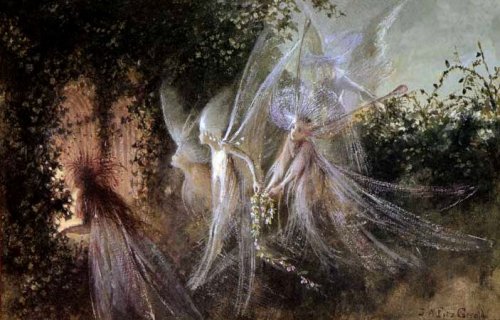
Fairies Looking Through A Gothic Arch John Anster Fitzgerald

Fairies Looking Through A Gothic Arch, John Anster Fitzgerald

This morning I noticed there were fairies in the back garden.

I was a little surprised. At first, I thought they were a side effect of my medication. But hallucinations were not listed on any of the labels, which, by the way, I had to read with the magnifier. I decided they weren’t, and several hours later they were still there.

At first, I couldn’t see them well, and wasn’t sure if they were bugs or birds, but no…when I looked closer with my magnifier, I could see they were definitely fairies.

It seems odd to me, to think that after all these years of wishing for a fairytale ending in my life, I should finally have a garden full of fairies. But life is what it is, and sometimes the things you want elude you until you no longer need them.

When I had lunch, they had progressed to building a rather large bower in the yew hedge. I was glad to see that because it meant they were staying, and they’re a lot more interesting to watch than birds.

They ignored me as they went about their business, rather like the rest of the world, probably just seeing a really old lady, nothing to worry or fret about. I was concerned that Rufus would pester them, but they didn’t interest him. He is the laziest cat, but he does sometimes work up the energy to bother the birds.

I thought about sharing the information with Violet, as they’re something she would enjoy, but she worries about me too much. If I were to call her up and say, “Violet, guess what! Fairies are nesting in the back yard,” she would say, “That’s nice, Edna. Have you a unicorn now too? Perhaps you should stop driving.” She would immediately call my daughter.

That would be bad.

Violet should talk…she’s as bad off as me or worse. But I think we’re doing quite well, for a couple of old crackpots. Funny how ninety-two doesn’t feel as old when you’re wearing that birthday hat as it seemed when we were young and whining about turning sixty-two.

So now I have a garden full of fairies. I wonder if they eat the same sort of things the birds like? Maybe I should get some of that fancy wild-bird food with all the sunflower seeds. And I should probably fill the birdbath.

Then I’ll give Violet a call and invite her over for coffee on the back porch, just to see if she notices anything out of the ordinary. If she does, I’ll pretend like I don’t see them.

She’s always moaning about how nothing exciting ever happens in this town, so this should be good for a laugh.


“Edna’s Garden” © 2016 Connie J. Jasperson, All Rights Reserved

Click here to read part 2

3 Comments

Filed under #FlashFictionFriday, Fantasy, Literature, writing

#amwriting: Commas: Morsels of madness or necessary evils?

commaNothing gets certain people jacked up more than misplaced commas. Why this rabid hysteria? Personally, I have no energy to waste, so I’m selective about my frenzies.

But commacentric grammarians do raise a few salient points. Commas and the rules for their use exist for a reason, and if we want the reading public to understand our work, we need to follow them.

I am a decent structural editor, but I don’t claim to have any special knowledge about commas.

However, I do know a couple of things:

  1. Never insert commas “where you take a breath” because everyone breathes differently.
  2. Do not insert commas where you think it should pause, because every reader sees the narrative differently.

Commas are the rules of the road for writing. They are the universally acknowledged pausing and joining symbol. Readers expect to find their pauses between clauses and commas are sometimes the signifiers of those pauses.

One rule I had to unlearn the first time I sent my work to a professional line editor:

  1. Do not place a comma before ‘because’ unless the information that follows is necessary to the sentence.

What? That’s not what I was taught in school!

The Chicago Manual Online gives this example (and I quote):

He didn’t run, because he was afraid.

He didn’t run because he was afraid.

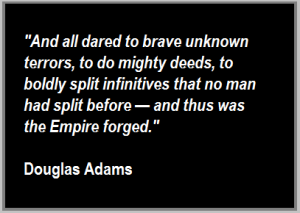
Douglas Adams quote, split infinitivesIn the first sentence, “because he was afraid” isn’t necessary. The main thing is that he didn’t run, and the reason is incidental. The second sentence, which omits the comma, is unclear. It might mean that he ran, but fear was not the reason he did so.

Mignon Fogarty, the Grammar Girl, explains this well. “You don’t automatically put a comma before the word because, but sometimes you need a comma there to make sure your meaning is clear.”

We do use commas to set off introductory clauses:

  1. In the first sentence, “because he was afraid” isn’t necessary.

I italicized the introductory clause in the above sentence to show that it is not a stand-alone sentence. This clause introduces the clause that follows it, and its meaning is dependent on that following clause.

Another thing I had to unlearn:

  1. Do not automatically place a comma before the conjunction ‘and.’

Compound sentences combine two separate ideas (clauses) into one compact package. A comma should be placed before a conjunction only if it is at the beginning of an independent clause. So use the comma before the conjunction (and, but, or) if the clauses are actually standalone sentences. If one of them is not a standalone sentence, it is a dependent clause, and you do not add the comma.

Take these two sentences: She is a great basketball player. She prefers swimming.

  1. If we combine them this way we add a comma: She is a great basketball player, but she prefers swimming.
  2. If we combine them this way, we don’t: She is a great basketball player but prefers swimming.

I hear you saying, “Now wait a minute! Mrs. Downing very clearly taught us to use commas to join clauses, and she was right.”

I’m sorry, but Mrs. Downing probably  explained that. It just didn’t stick in your memory.

Two complete ideas can be joined with ‘and.’ Did I just contradict myself?

Sort of.

Think of it like a list: if there are only two things (or ideas) in a list, they do not need to be separated by a comma. If there are more than two ideas, the comma should be used to separate them, with a comma preceding the word ‘and’ before the final item/idea.

Dogs, cats, rabbits, and birds.

Oh YES, we DO use serial commas to prevent confusion! You’ve all seen the meme:

serial commas meme, martha stewartOn a personal level, I do love cooking, my pets, and my family. (But not in the same pot.) They’re happy that I use serial commas.

One of my favorite personal failings is the notorious comma splice. Apparently it’s bad form to join two independent clauses with a simple comma. This error is called a comma splice.

I have it on good authority that a comma splice will not cause a tear in the space-time continuum. But since this breach of humanity occasionally sends commacentrics into a frothing frenzy, we will use the conjunction and give these poor wretches a break.

From Wikipedia, the fount of all knowledge: “A comma splice is the use of a comma to join two independent clauses. For example: It is nearly half past five, we cannot reach town before dark. Although acceptable in some languages and compulsory in others (e.g., Bulgarian or French), comma splices are usually considered style errors in English.”

chicago manual of styleCommas and their proper use can drive you crazy when you are trying to get your work in order. And quite frankly, the rules are a little confusing.

Consistency is critical. UK usage can vary from US usage in some ways. Find a style guide that you can understand and consult it. Once you have a guide you can work with, use those suggestions consistently in all your work.

I use the Chicago Manual of Style for my work because I am a US citizen, and for creative writing, this is the most comprehensive manual and is what publishers and editors use. If you are strapped for cash, you can often buy secondhand copies of this manual through Amazon.

Commas can easily get out of control for me because I have a tendency to hit the comma key whenever I pause in my thinking when I am in the first draft phase. At that point, I am more concerned with just getting the words down than I am form and style.

However, proper form and style must come into play when we get into the later drafts. Using established protocols for punctuation is important if you want your readers to understand what you meant when you wrote that amazing piece of literature.

14 Comments

Filed under writer, writing