
Today I am featuring two famous paintings, Claude Monet’s Impression Sunrise, the painting that gave a name to an entire movement withing the artistic community. But Monet was not the first of the impressionists, and he freely admitted that he was an admirer of the radical and oft criticized (in his time) J.M.W. Turner. Indeed, during the years Monet resided in England, he visited the National Gallery, viewing the works of Turner, whom he held in high regard. The painting that, in my opinion, belongs in the same room with Impression Sunrise is turner’s masterpiece, the Fighting Temeraire.
Both paintings are best viewed from a distance, and both have power. Both tell a story, and both artists faced the slings and arrows of critics who were unwilling to accept anything that strayed from traditional portraiture and landscape art.
Uncaring of the critics, both Monet and Turner wandered off in their own artistic direction, and we can be grateful for that stubborn desire to paint what they felt as well as what they saw.
Turner’s work influenced Monet, and both artists influenced generations of artists who followed them.
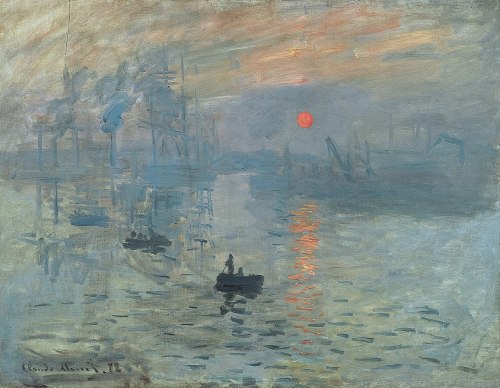
Artist Claude Monet (1840–1926)
Title Impression, Sunrise
Genre marine art
Date 1872
Medium oil on canvas
Dimensions height: 48 cm (18.8 in); width: 63 cm (24.8 in)
Collection Musée Marmottan Monet
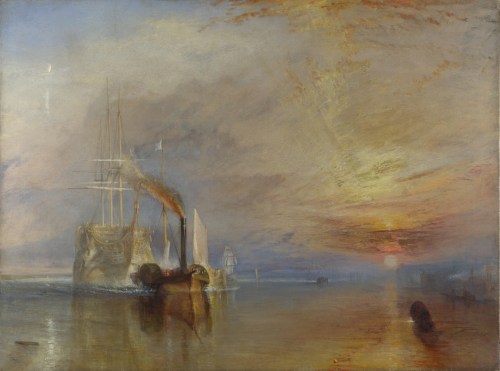
Artist: J. M. W. Turner (1775–1851) (by Joseph Mallord William Turner)
Title: The Fighting Temeraire 1839
Description: The Fighting Temeraire tugged to her last berth to be broken up, 1838
Date: 1839
Medium: oil on canvas
Dimensions: height: 90.7 cm (35.7 in)
Collection: National Gallery
Credits and Attributions:
Impression Sunrise, Claude Monet 1872 [Public domain], via Wikimedia Commons: Impression, Sunrise – Wikipedia accessed September 09, 2023.
The Fighting Temeraire, J. M. W. Turner: 1839 [Public domain], via Wikimedia Commons: The Fighting Temeraire – Wikipedia accessed September 09, 2023.


 Life in the Realm of Fantasy