Tag Archives: Jan Steen

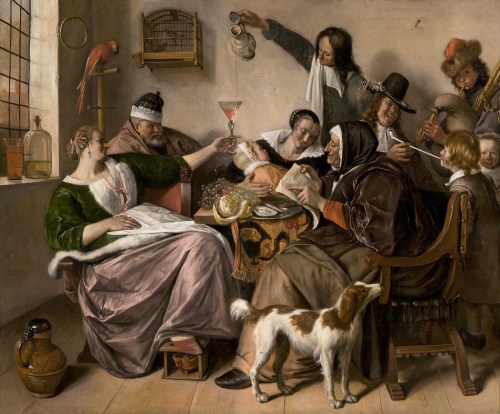
#FineArtFriday: “Feast in the Interior” by artist unknown, 17th century

Title: Feast in the Interior.

Artist: Unknown. Flemish School of the 17th century,

Medium: Oil on canvas.

Size: 57 x 89 cm.

What I love about this painting:

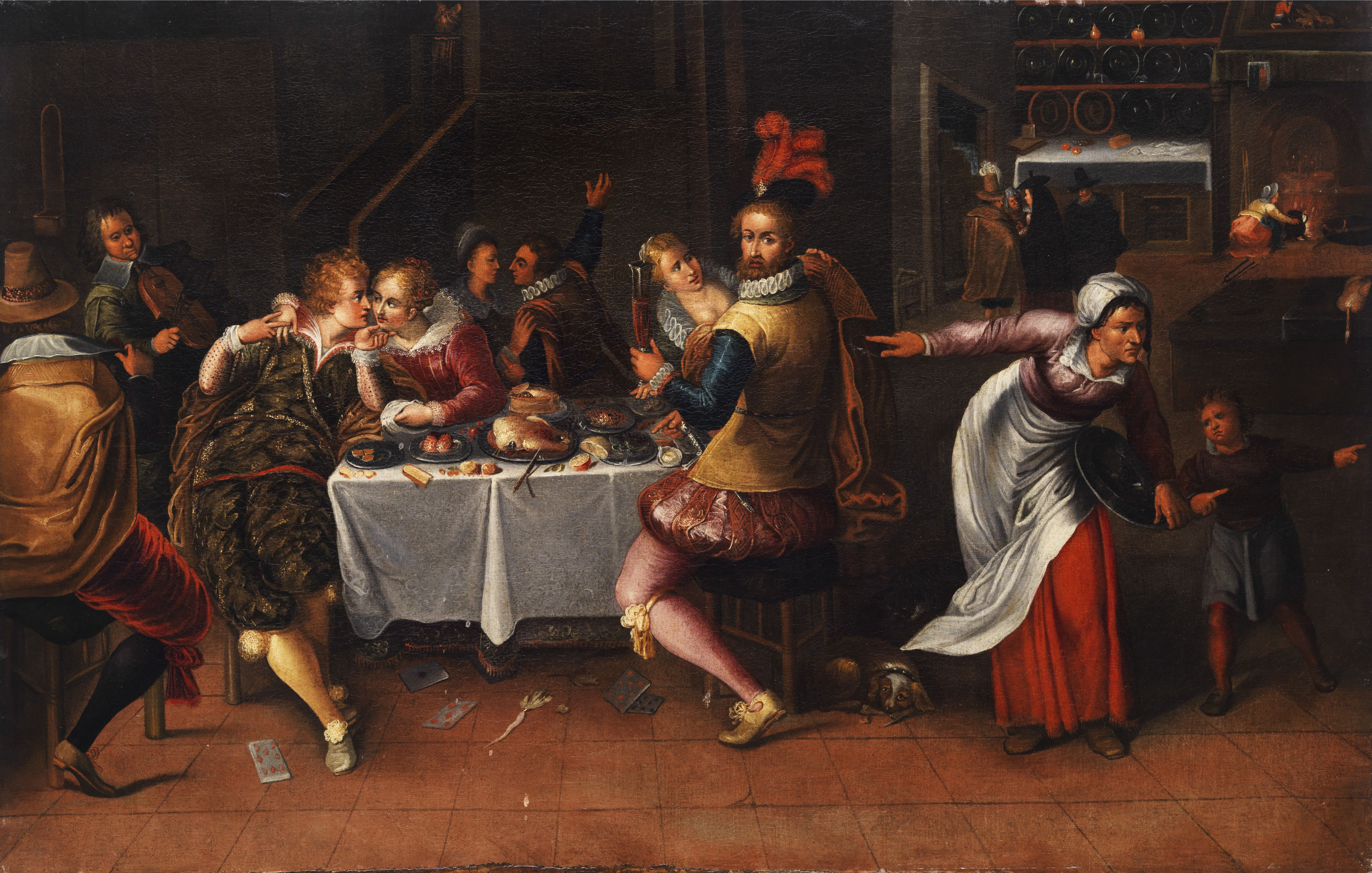
Based on the boy’s interactions with his mother, I would have titled this painting “It’s not my fault!” I assume she is his mother based on the level of frustration she is showing. (Speaking as a mother, frustrations do occasionally boil over.) This painting has been posted to Wikimedia Commons as a 17th-century Flemish painting possibly by the Circle of Frans Francken.

But the more I look at it, the more I wonder why an art historian came to that assessment. To me, this painting looks nothing like any of the paintings I have seen that are attributed to the Francken dynasty of painters. They were definitely active in Flanders during the 17th century, but to me, the composition and style are wrong, and honestly, the subject is a genre scene. The Franckens were more well-known for their excellent cabinet paintings, altar pieces, and religious subjects.

There is one wedding scene attributed to Frans Francken the Elder, which could be why this is attributed to a follower of his. But the people in that painting are quite stiff, a style more reminiscent of Pieter Brueghel the Younger. Frans Francken (I) – The Wedding Dance – Frans Francken the Elder – Wikipedia

These people have a sense of movement and life, the style I think of late 1600s rather than early. This is why I would think it the work of a follower of one of the later artists. An admirer of Jan Steen’s work comes to mind, but it could be a follower of any of the great later genre artist.

The clothing is definitely that of the early 17th century, which is in favor of Frans Francken. However, artists often dressed actors in costumes. Rembrandt most certainly did.

Also, composition of this painting, and certain style features (such as the shape of legs and how the garters are shown) shows us the kind of scene a follower of Dutch Golden Age painter Jan Steen, or a member of his workshop, might have painted.

This painting tells us a story. The tavern is full, the feast is on the table, and the innkeeper’s wife has had enough of Junior’s antics. A well-dressed man turns, ready to jump into the fray, and Junior deflects the blame, pointing to someone just out of the frame.

Beneath the table, several playing cards and a decoration from someone’s garment lie where they have fallen. The wine and ale flow, the ladies of dubious virtue are working the crowd, and the family that owns the tavern is struggling to serve their customers in the midst of the chaos.

This is a story with a moral wrapped in a sense of humor. The composition of this scene is full of symbolism. The positions of various hands, the bounty of oysters, and the clutter beneath the table are deliberately placed to convey subtext that a 17th-century viewer would immediately understand.

The symbolic gestures of the hands could reference tenets of one or the other of the two warring religious faiths, which might have influenced the attribution toward Frans Francken.

You can read about the Francken Dynasty here: Francken family – Wikipedia

And you can read about the brilliant Jan Steen and his merry, chaotic genre scenes here: Jan Steen – Wikipedia

And I wish I could tell you more about the painter who created this wonderful glimpse of tavern life in the 17th century.


Credits and Attributions:

IMAGE: Feast in the Interior, artist unknown. Wikimedia Commons contributors, “File:Flämisch 17 Jh Festmahl im Interieur.jpg,” Wikimedia Commons, https://commons.wikimedia.org/w/index.php?title=File:Fl%C3%A4misch_17_Jh_Festmahl_im_Interieur.jpg&oldid=1113684537 (accessed November 25, 2025).
2 Comments

Filed under #FineArtFriday

#FineArtFriday: Revisiting “The Way you Hear it is the Way you Sing It” by Jan Steen ca. 1665

Artist: Jan Steen  (1625/1626–1679)

Jan Steen: ‘As the Old Sing, So Pipe the Young’

Title: ‘The way you hear it, is the way you sing it’

Genre: genre art

Date: circa 1665

Medium: oil on canvas

Dimensions: Height: 134 cm (52.7 in); Width: 163 cm (64.1 in)

I always post a Jan Steen painting at New Years, because I love how raucous and down to earth his characters are. It’s a New Year and we’re having a party. No Puritans allowed, as we’ll have no feigning a dignified demeanor here–we’re drunk, and we don’t care. The people who posed for this painting are featured in many of Steen’s genre works, sometimes wearing the same costumes as we see here. I suspect we are seeing Steen’s family members or close friends acting out the story Jan wishes to show us.

About this painting:

Jan Steen’s work The Way you Hear it is the Way you Sing It depicts a Dutch Proverb, As the Old Sing, So Twitter the Young. It shows us a family carousing and overindulging in rich foods. Luxurious fabrics, a foot warmer, and rare birds show off this family’s wealth, which they are spending lavishly as fast as they can.

A young piper, who closely resembles a young Jan Steen (possibly one of his sons?), entertains them. He looks directly at us as if to ask what he’s gotten himself into.

Mother and Father, dressed as the King and Queen, are sumptuously attired, being served wine in an overlarge crystal goblet by the family’s servant. Both are indifferent to the chaos, too sated and drunk to care.

To the right of Father (his left, our right), a younger woman, perhaps an unmarried sister or eldest daughter, is holding the baby but has nodded off, having indulged too freely.

The wasting of money on so much luxury that one can’t consume it all is clearly represented here. Mother raises her glass high to have it refilled, as if it is the most important thing–indeed, the wine cascading down into the crystal goblet is the focal point of the picture.

A bottle of clear liquor (distilled?) and a beaker of ale are set on the windowsill behind Father, and a covered pitcher stands on the floor beside Mother. The table is laden with grapes and oysters, expensive luxuries.

Grandmother is singing from sheet music, leading the song that the family sings. This is the direct allegory for the proverb, as the old sing, so twitter the young.

A youngish man, either the eldest son or the Drunk Uncle (every family has one), finds it hilarious to teach the children to smoke.

Neither the dog nor the piper is impressed with the carrying on, and the servant has no comment, merely serving the wine as required.

In essence, Steen tells us that children learn what they live, so if you want sober, morally upstanding children, you must be a sober, morally upright parent.

About the Artist, via Wikipedia:

Jan Havickszoon Steen (c. 1626 – buried 3 February 1679) was a Dutch Golden Age painter, one of the leading genre painters of the 17th century. His works are known for their psychological insight, sense of humour and abundance of colour.

In 1648 Jan Steen and Gabriël Metsu founded the painters’ Guild of Saint Luke at Leiden. Soon after he became an assistant to the renowned landscape painter Jan van Goyen (1596–1656), and moved into his house on the Bierkade in The Hague. On Oct 3, 1649 he married van Goyen’s daughter Margriet, with whom he would have eight children. Steen worked with his father-in-law until 1654, when he moved to Delft, where he ran the brewery De Slang (“The Snake”) for three years without much success. After the explosion in Delft in 1654 the art market was depressed, but Steen painted A Burgomaster of Delft and his daughter. It does not seem to be clear if this painting should be called a portrait or a genre work.

Steen lived in Warmond, just north of Leiden, from 1656 till 1660 and in Haarlem from 1660 till 1670 and in both periods he was especially productive. In 1670, after the death of his wife in 1669 and his father in 1670, Steen moved back to Leiden, where he stayed the rest of his life. When the art market collapsed in 1672, called the Year of Disaster, Steen opened a tavern. In April 1673 he married Maria van Egmont, who gave him another child. In 1674 he became president of the Saint Lucas Guild. Frans van Mieris (1635- 1681) became one of his drinking companions. He died in Leiden in 1679 and was interred in a family grave in the Pieterskerk.

Daily life was Jan Steen’s main pictorial theme. Many of the genre scenes he portrayed, as in The Feast of Saint Nicholas, are lively to the point of chaos and lustfulness, even so much that “a Jan Steen household”, meaning a messy scene, became a Dutch proverb (een huishouden van Jan Steen). Subtle hints in his paintings seem to suggest that Steen meant to warn the viewer rather than invite him to copy this behaviour. Many of Steen’s paintings bear references to old Dutch proverbs or literature. He often used members of his family as models, and painted quite a few self-portraits in which he showed no tendency of vanity.

Steen did not shy from other themes: he painted historical, mythological and religious scenes, portraits, still lifes and natural scenes. His portraits of children are famous. He is also well known for his mastery of light and attention to detail, most notably in Persian rugs and other textiles.

Steen was prolific, producing about 800 paintings, of which roughly 350 survive. His work was valued much by contemporaries and as a result he was reasonably well paid for his work. He did not have many students—only Richard Brakenburgh is recorded—but his work proved a source of inspiration for many painters. [1]


Credits and Attributions:

IMAGE: The Way you Hear it is the Way you Sing It, Jan Steen, Public domain, via Wikimedia Commons

Wikimedia Commons contributors, “File:The way you hear it.jpg,” Wikimedia Commons, https://commons.wikimedia.org/w/index.php?title=File:The_way_you_hear_it.jpg&oldid=428340634 (accessed January 2, 2025).

[1] Wikipedia contributors, “Jan Steen,” Wikipedia, The Free Encyclopedia, https://en.wikipedia.org/w/index.php?title=Jan_Steen&oldid=1249713624 (accessed January 2, 2025).

4 Comments

Filed under #FineArtFriday

#FineArtFriday: Beware of Luxury by Jan Steen ca.1663 #prompt #NovemberWriter

Öèôðîâàÿ ðåïðîäóêöèÿ íàõîäèòñÿ â èíòåðíåò-ìóçåå Gallerix.ru

Artist: Jan Steen (1625/1626–1679)

Title: Beware of Luxury (“In Weelde Siet Toe”)

Date: circa 1663

Medium: oil on canvas

Dimensions: height: 105 cm (41.3 in); width: 145 cm (57 in)

Collection: Kunsthistorisches Museum

What I love about this painting:

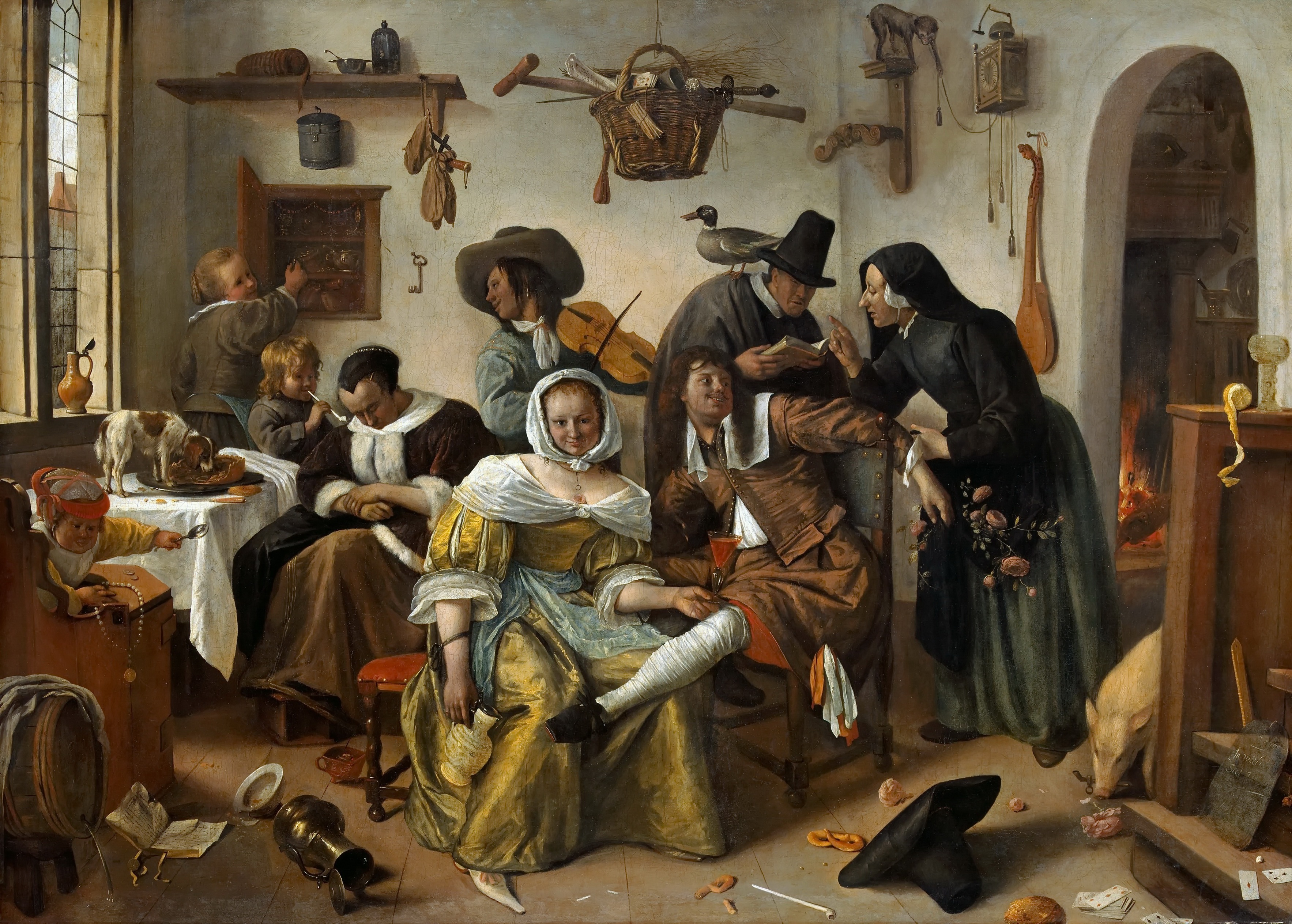
Jan Steen lampoons family life in this riotous scene. Mother is taking a well-deserved nap, and the family is running wild, drinking to excess and partying like it was 1599. Grandma ignores the rumpus and instead, she is lecturing the Reverend on doctrine. The house is trashed, and the dog is on the table eating the pie. The baby is playing with the mother’s pearls. The oldest daughter’s suitor is sitting with his leg over her lap is a visual nod to promiscuity. “Getting his leg over her” was slang for premarital canoodling.

Although each of the many characters and every element of set dressing is realistically depicted, we know this is not a portrayal of a real moment in the artist’s life. We are presented with a theatrical drama here, a situation that is staged and satirized for our entertainment.

The Age of the Puritan had swept across Europe and while it was waning in the mid-seventeenth century, puritanism had a large influence on life in Holland as much as elsewhere.

This painting is a wonderful visual exhortation reminding the good people to live a sober life. Steen himself was not a puritan, as he was born into a family of brewers and ran taverns and breweries off and on throughout his life. But he did need to sell his paintings as he was never a successful businessman, and his allegorical paintings were quite popular.

About the Artist, via Wikipedia:

Jan Havickszoon Steen (c. 1626 – buried 3 February 1679) was a Dutch Golden Age painter, one of the leading genre painters of the 17th century. His works are known for their psychological insight, sense of humour and abundance of colour.

In 1648 Jan Steen and Gabriël Metsu founded the painters’ Guild of Saint Luke at Leiden. Soon after he became an assistant to the renowned landscape painter Jan van Goyen (1596–1656), and moved into his house on the Bierkade in The Hague. On 3 October 1649, he married van Goyen’s daughter Margriet, with whom he would have eight children. Steen worked with his father-in-law until 1654, when he moved to Delft, where he ran the brewery De Slang (“The Snake”) for three years without much success.  After the explosion in Delft in 1654 the art market was depressed, but Steen painted A Burgomaster of Delft and his daughter. It does not seem to be clear if this painting should be called a portrait or a genre work.

Steen lived in Warmond, just north of Leiden, from 1656 until 1660 and in Haarlem from 1660 until 1670 and in both periods he was especially productive. In 1670, after the death of his wife in 1669 and his father in 1670, Steen moved back to Leiden, where he stayed the rest of his life. When the art market collapsed in 1672, called the Year of Disaster, Steen opened a tavern. In April 1673 he married Maria van Egmont, who gave him another child. In 1674 he became president of the Saint Luke’s Guild. Frans van Mieris (1635–1681) became one of his drinking companions. He died in Leiden in 1679 and was interred in a family grave in the Pieterskerk. [1]


Credits and Attributions:

IMAGE: Beware of Luxury by Jan Steen, ca. 1663. Wikimedia Commons contributors, “File:Jan Steen 004b.jpg,” Wikimedia Commons, https://commons.wikimedia.org/w/index.php?title=File:Jan_Steen_004b.jpg&oldid=617576422 (accessed November 15, 2024)

[1] Wikipedia contributors, “Jan Steen,” Wikipedia, The Free Encyclopedia, https://en.wikipedia.org/w/index.php?title=Jan_Steen&oldid=1249713624 (accessed November 15, 2024).

Comments Off on #FineArtFriday: Beware of Luxury by Jan Steen ca.1663 #prompt #NovemberWriter

Filed under #FineArtFriday

#FineArtFriday: Rhetoricians at a Window by Jan Steen ca. 1666 (revisite

Artist: Jan Steen  (1625/1626–1679)

Title: Rhetoricians at a Window

Genre: genre art

Date: c. 1661-66

Medium: oil on canvas

Dimensions: Height: 759.46 mm (29.90 in); Width: 586.23 mm (23.07 in)

Collection: Philadelphia Museum of Art

I regularly look to art for ideas. One of my favorite images is this one, Rhetoricians at a Window by the Dutch master, Jan Steen. It has appeared here several times, but no matter how often I see this painting, I find something new to appreciate about it.

What I love about this painting:

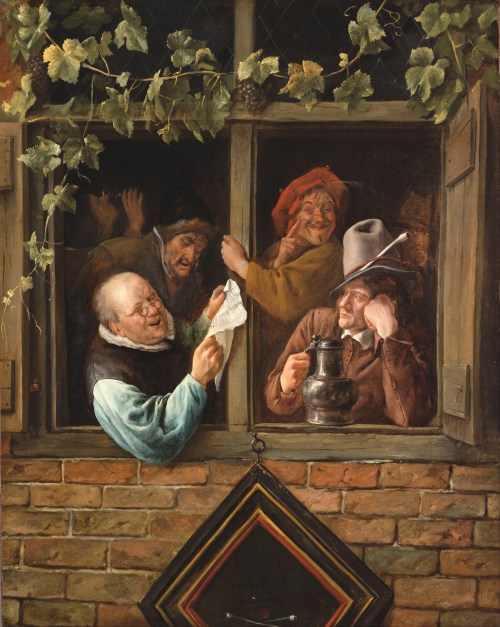
This is one of my all-time favorite Dutch genre paintings. The vivid characters who inhabit the scene inspired some the characters who pass through my Billy’s Revenge stories, people my protagonists meet along the way. These jolly rogues have such vivid personalities that the viewer immediately feels a kinship to them. Who were they? Did they keep their day jobs?

The reading of a poem or play was clearly the opportunity for the performers to have a good time. At left, the group’s orator reads a paper titled Lof Liet (Song of Praise), while the poet who composed the verse looks on over his shoulder. From the drinker in the shadows of the background, to the grapevines growing around the window, Steen tells us that wine and rhetoric are clearly entwined.

I love the inclusion of both “the critic” who leans his head on his hand and listens analytically, and the man behind him, who is clearly “a little over the limit,” and supports himself by grasping the window frame and heartily agreeing with some point.

The actor who reads is clearly enjoying himself, as are the others.

Symbolism: Some have said the characters in this painting represent the different emotions of the human condition:

  • Sanguine, (active, enthusiastic, and social)
  • Choleric, (fast, irritable, and short-tempered)
  • Melancholic, (analytical, quiet, and wise)
  • Phlegmatic, (peaceful and relaxed)

Thanks to Eelko Kappe’s wonderful article on this painting, Rhetoricians at the Window by Jan Steen, I now have four new words to broaden my vocabulary. I may never have a use for them, but now I know what they mean!

About the Artist (Via Wikipedia):

Jan Havickszoon Steen (c. 1626 – buried 3 February 1679) was a Dutch Golden Age painter, one of the leading genre painters of the 17th century. His works are known for their psychological insight, sense of humour and abundance of colour.

Daily life was Jan Steen’s main pictorial theme. Many of the genre scenes he portrayed, as in The Feast of Saint Nicholas, are lively to the point of chaos and lustfulness, even so much that “a Jan Steen household”, meaning a messy scene, became a Dutch proverb (een huishouden van Jan Steen). Subtle hints in his paintings seem to suggest that Steen meant to warn the viewer rather than invite him to copy this behaviour. Many of Steen’s paintings bear references to old Dutch proverbs or literature. He often used members of his family as models, and painted quite a few self-portraits in which he showed no tendency of vanity.

Steen did not shy from other themes: he painted historical, mythological and religious scenes, portraits, still lifes and natural scenes. His portraits of children are famous. He is also well known for his mastery of light and attention to detail, most notably in Persian rugs and other textiles.

Steen was prolific, producing about 800 paintings, of which roughly 350 survive. His work was valued much by contemporaries and as a result he was reasonably well paid for his work. He did not have many students—only Richard Brakenburgh is recorded—but his work proved a source of inspiration for many painters. [2]

About this painting, Via Wikipedia:

Chambers of rhetoric (Dutch: rederijkerskamers) were dramatic societies in the Low Countries. Their members were called Rederijkers (singular Rederijker), from the French word ‘rhétoricien’, and during the 15th and 16th centuries were mainly interested in dramas and lyrics. These societies were closely connected with local civic leaders and their public plays were a form of early public relations for the city. [1]

In 1945, Sturla Gudlaugsson, a specialist in Dutch seventeenth-century painting and iconography and Director of the Netherlands Institute for Art History and the Mauritshuis in The Hague, wrote The Comedians in the work of Jan Steen and his Contemporaries, which revealed that a major influence on Jan Steen’s work was the guild of the Rhetoricians or Rederijkers and their theatrical endeavors.

It is often suggested that Jan Steen’s paintings are a realistic portrayal of Dutch 17th-century life. However, not everything he did was a purely realistic representation of his day-to-day environment. Many of his scenes contain idyllic and bucolic fantasies and a declamatory emphasis redolent of theater.

Jan Steen’s connection to theater is easily verifiable through his connection to the Rederijkers. There are two kinds of evidence for this connection. First, Jan Steen Steen’s uncle belonged to the Rhetoricians in Leiden, where Steen was born and lived a substantial part of his life. Second, Jan Steen portrayed many scenes from the lives of the Rederijkers, an example being the painting Rhetoricians at a Window of 1658–65. The piece is currently held in the Philadelphia Museum of Art which was established in February 1876. The humanity, humor and optimism of the figures suggest that Jan Steen knew these men well and wanted to portray them positively.

With his lavish and moralising style, it is logical that Steen would employ the stratagems from theater for his purposes. There is conclusive evidence that the characters in Steen’s paintings are predominantly theatrical characters and not ones from reality. [2]


Credits and Attributions:

This post first appeared here on Life in the Realm of Fantasy  in September of 2020.

[1] Wikipedia contributors, “Jan Steen,” Wikipedia, The Free Encyclopedia, https://en.wikipedia.org/w/index.php?title=Jan_Steen&oldid=950709901 (accessed September 10, 2020).

[2] Wikipedia contributors, “Chamber of rhetoric,” Wikipedia, The Free Encyclopedia, https://en.wikipedia.org/w/index.php?title=Chamber_of_rhetoric&oldid=975283829 (accessed September 10, 2020).

Wikimedia Commons contributors, “File:Jan Steen, Dutch (active Leiden, Haarlem, and The Hague) – Rhetoricians at a Window – Google Art Project.jpg,” Wikimedia Commons, the free media repository, https://commons.wikimedia.org/w/index.php?title=File:Jan_Steen,_Dutch_(active_Leiden,_Haarlem,_and_The_Hague)_-_Rhetoricians_at_a_Window_-_Google_Art_Project.jpg&oldid=355150081 (accessed September 10, 2020).

2 Comments

Filed under #FineArtFriday, writing

#FineArtFriday: Rhetoricians at a Window by Jan Steen ca. 1666 #prompt

Artist: Jan Steen  (1625/1626–1679)

Title: Rhetoricians at a Window

Genre: genre art

Date: c. 1661-66

Medium: oil on canvas

Dimensions: Height: 759.46 mm (29.90 in); Width: 586.23 mm (23.07 in)

Collection: Philadelphia Museum of Art

Today we’re looking to art for ideas, and our prompt is Rhetoricians at a Window by the Dutch master, Jan Steen.

What I love about this painting:

This is one of my all-time favorite Dutch genre paintings. It has inspired some the characters who pass through my stories, people my protagonists meet along the way. These jolly rogues have such vivid personalities that the viewer immediately feels a kinship to them. Who were they? Did they keep their day jobs?

The reading of a poem or play was clearly the opportunity for the performers to have a good time. From the drinker in the shadows of the background, to the grapevines growing around the window, Steen tells us that wine and rhetoric are clearly entwined.

I love the inclusion of both “the critic” who leans his head on his hand and listens analytically, and the man behind him, who is clearly “a little over the limit,” and supports himself by grasping the window frame and heartily agreeing with some point.

The actor who reads is clearly enjoying himself, as are the others.

About the Artist (Via Wikipedia):

Jan Havickszoon Steen (c. 1626 – buried 3 February 1679) was a Dutch Golden Age painter, one of the leading genre painters of the 17th century. His works are known for their psychological insight, sense of humour and abundance of colour.

Daily life was Jan Steen’s main pictorial theme. Many of the genre scenes he portrayed, as in The Feast of Saint Nicholas, are lively to the point of chaos and lustfulness, even so much that “a Jan Steen household”, meaning a messy scene, became a Dutch proverb (een huishouden van Jan Steen). Subtle hints in his paintings seem to suggest that Steen meant to warn the viewer rather than invite him to copy this behaviour. Many of Steen’s paintings bear references to old Dutch proverbs or literature. He often used members of his family as models, and painted quite a few self-portraits in which he showed no tendency of vanity.

Steen did not shy from other themes: he painted historical, mythological and religious scenes, portraits, still lifes and natural scenes. His portraits of children are famous. He is also well known for his mastery of light and attention to detail, most notably in Persian rugs and other textiles.

Steen was prolific, producing about 800 paintings, of which roughly 350 survive. His work was valued much by contemporaries and as a result he was reasonably well paid for his work. He did not have many students—only Richard Brakenburgh is recorded—but his work proved a source of inspiration for many painters. [2]

About this painting, Via Wikipedia:

Chambers of rhetoric (Dutch: rederijkerskamers) were dramatic societies in the Low Countries. Their members were called Rederijkers (singular Rederijker), from the French word ‘rhétoricien’, and during the 15th and 16th centuries were mainly interested in dramas and lyrics. These societies were closely connected with local civic leaders and their public plays were a form of early public relations for the city. [1]

In 1945, Sturla Gudlaugsson, a specialist in Dutch seventeenth-century painting and iconography and Director of the Netherlands Institute for Art History and the Mauritshuis in The Hague, wrote The Comedians in the work of Jan Steen and his Contemporaries, which revealed that a major influence on Jan Steen’s work was the guild of the Rhetoricians or Rederijkers and their theatrical endeavors.

It is often suggested that Jan Steen’s paintings are a realistic portrayal of Dutch 17th-century life. However, not everything he did was a purely realistic representation of his day-to-day environment. Many of his scenes contain idyllic and bucolic fantasies and a declamatory emphasis redolent of theater.

Jan Steen’s connection to theater is easily verifiable through his connection to the Rederijkers. There are two kinds of evidence for this connection. First, Jan Steen Steen’s uncle belonged to the Rhetoricians in Leiden, where Steen was born and lived a substantial part of his life. Second, Jan Steen portrayed many scenes from the lives of the Rederijkers, an example being the painting Rhetoricians at a Window of 1658–65. The piece is currently held in the Philadelphia Museum of Art which was established in February 1876. The humanity, humor and optimism of the figures suggest that Jan Steen knew these men well and wanted to portray them positively.

With his lavish and moralising style, it is logical that Steen would employ the stratagems from theater for his purposes. There is conclusive evidence that the characters in Steen’s paintings are predominantly theatrical characters and not ones from reality. [2]


Credits and Attributions:

This post first appeared here on Life in the Realm of Fantasy  in September of 2020.

[1] Wikipedia contributors, “Jan Steen,” Wikipedia, The Free Encyclopedia, https://en.wikipedia.org/w/index.php?title=Jan_Steen&oldid=950709901 (accessed September 10, 2020).

[2] Wikipedia contributors, “Chamber of rhetoric,” Wikipedia, The Free Encyclopedia, https://en.wikipedia.org/w/index.php?title=Chamber_of_rhetoric&oldid=975283829 (accessed September 10, 2020).

Wikimedia Commons contributors, “File:Jan Steen, Dutch (active Leiden, Haarlem, and The Hague) – Rhetoricians at a Window – Google Art Project.jpg,” Wikimedia Commons, the free media repository, https://commons.wikimedia.org/w/index.php?title=File:Jan_Steen,_Dutch_(active_Leiden,_Haarlem,_and_The_Hague)_-_Rhetoricians_at_a_Window_-_Google_Art_Project.jpg&oldid=355150081 (accessed September 10, 2020).

4 Comments

Filed under #FineArtFriday, writing

#FineArtFriday: Rhetoricians at a Window by Jan Steen ca. 1666 (reprise)

Artist: Jan Steen  (1625/1626–1679)

Title: Rhetoricians at a Window

Genre: genre art

Date: c. 1661-66

Medium: oil on canvas

English: Oil on canvas

Dimensions: Height: 759.46 mm (29.90 in); Width: 586.23 mm (23.07 in)

Collection: Philadelphia Museum of Art

What I love about this painting:

This is one of my all time favorite paintings. It has inspired some the characters who pass through my stories, people my protagonists meet along the way. These jolly rogues have such vivid personalities that the viewer immediately feels a kinship to them.

The reading of a poem or play was clearly the opportunity for the performers to have a good time. From the drinker in the shadows of the background, to the grapevines growing around the window, Steen tells us that wine and rhetoric are clearly entwined.

I love the inclusion of both “the critic” who leans his head on his hand and listens analytically, and the man behind him, who is clearly “a little over the limit,” and supports himself by grasping the window frame and heartily agreeing with some point.

The reader is clearly enjoying himself, as are the others.

About the Artist (Via Wikipedia):

Jan Havickszoon Steen (c. 1626 – buried 3 February 1679) was a Dutch Golden Age painter, one of the leading genre painters of the 17th century. His works are known for their psychological insight, sense of humour and abundance of colour.

Daily life was Jan Steen’s main pictorial theme. Many of the genre scenes he portrayed, as in The Feast of Saint Nicholas, are lively to the point of chaos and lustfulness, even so much that “a Jan Steen household”, meaning a messy scene, became a Dutch proverb (een huishouden van Jan Steen). Subtle hints in his paintings seem to suggest that Steen meant to warn the viewer rather than invite him to copy this behaviour. Many of Steen’s paintings bear references to old Dutch proverbs or literature. He often used members of his family as models, and painted quite a few self-portraits in which he showed no tendency of vanity.

Steen did not shy from other themes: he painted historical, mythological and religious scenes, portraits, still lifes and natural scenes. His portraits of children are famous. He is also well known for his mastery of light and attention to detail, most notably in Persian rugs and other textiles.

Steen was prolific, producing about 800 paintings, of which roughly 350 survive. His work was valued much by contemporaries and as a result he was reasonably well paid for his work. He did not have many students—only Richard Brakenburgh is recorded—but his work proved a source of inspiration for many painters. [2]

About this painting, Via Wikipedia:

Chambers of rhetoric (Dutch: rederijkerskamers) were dramatic societies in the Low Countries. Their members were called Rederijkers (singular Rederijker), from the French word ‘rhétoricien’, and during the 15th and 16th centuries were mainly interested in dramas and lyrics. These societies were closely connected with local civic leaders and their public plays were a form of early public relations for the city. [1]

In 1945, Sturla Gudlaugsson, a specialist in Dutch seventeenth-century painting and iconography and Director of the Netherlands Institute for Art History and the Mauritshuis in The Hague, wrote The Comedians in the work of Jan Steen and his Contemporaries, which revealed that a major influence on Jan Steen’s work was the guild of the Rhetoricians or Rederijkers and their theatrical endeavors.

It is often suggested that Jan Steen’s paintings are a realistic portrayal of Dutch 17th-century life. However, not everything he did was a purely realistic representation of his day-to-day environment. Many of his scenes contain idyllic and bucolic fantasies and a declamatory emphasis redolent of theater.

Jan Steen’s connection to theater is easily verifiable through his connection to the Rederijkers. There are two kinds of evidence for this connection. First, Jan Steen Steen’s uncle belonged to the Rhetoricians in Leiden, where Steen was born and lived a substantial part of his life. Second, Jan Steen portrayed many scenes from the lives of the Rederijkers, an example being the painting Rhetoricians at a Window of 1658–65. The piece is currently held in the Philadelphia Museum of Art which was established in February 1876. The humanity, humor and optimism of the figures suggest that Jan Steen knew these men well and wanted to portray them positively.

With his lavish and moralising style, it is logical that Steen would employ the stratagems from theater for his purposes. There is conclusive evidence that the characters in Steen’s paintings are predominantly theatrical characters and not ones from reality. [2]


Credits and Attributions:

This post first appeared here on Life in the Realm of Fantasy  in September of 2020.

[1] Wikipedia contributors, “Jan Steen,” Wikipedia, The Free Encyclopedia, https://en.wikipedia.org/w/index.php?title=Jan_Steen&oldid=950709901 (accessed September 10, 2020).

[2] Wikipedia contributors, “Chamber of rhetoric,” Wikipedia, The Free Encyclopedia, https://en.wikipedia.org/w/index.php?title=Chamber_of_rhetoric&oldid=975283829 (accessed September 10, 2020).

Wikimedia Commons contributors, “File:Jan Steen, Dutch (active Leiden, Haarlem, and The Hague) – Rhetoricians at a Window – Google Art Project.jpg,” Wikimedia Commons, the free media repository, https://commons.wikimedia.org/w/index.php?title=File:Jan_Steen,_Dutch_(active_Leiden,_Haarlem,_and_The_Hague)_-_Rhetoricians_at_a_Window_-_Google_Art_Project.jpg&oldid=355150081 (accessed September 10, 2020).

2 Comments

Filed under #FineArtFriday

#FineArtFriday: Winter Scene by Jan Steen 1650

Inv.nr: 10032

Artist: Jan Steen (1625/1626–1679)

Title: Winter Scene

Date: circa 1650

Medium: oil on canvas

Dimensions: Height: 660 mm (25.98 in); Width: 960 mm (37.79 in)

About this painting, Via Wikimedia Commons:

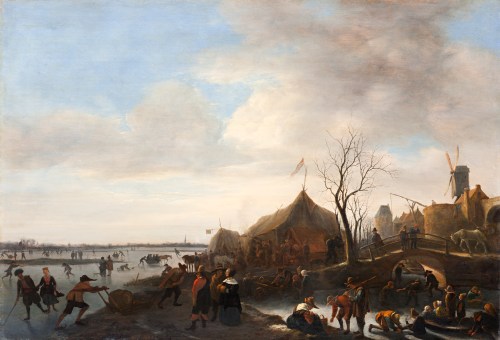
[1] Winter Scene is one of the earliest known paintings by Steen. With its diagonal composition and silhouetted figures on the ice one can clearly see his early inspirations from paintings such as Isaac van Ostade’s Winter from 1645. Here, as often seen in other works by Steen and his contemporaries, the activities are being watched by a well-dressed couple who occupies a central position in the composition. [1]

About the Artist, via Wikipedia:

[2] Jan Havickszoon Steen (c. 1626 – buried 3 February 1679) was a Dutch Golden Age painter, one of the leading genre painters of the 17th century. His works are known for their psychological insight, sense of humour and abundance of colour.

Daily life was Jan Steen’s main pictorial theme. Many of the genre scenes he portrayed, as in The Feast of Saint Nicholas, are lively to the point of chaos and lustfulness, even so much that “a Jan Steen household,” meaning a messy scene, became a Dutch proverb (een huishouden van Jan Steen). Subtle hints in his paintings seem to suggest that Steen meant to warn the viewer rather than invite him to copy this behaviour. Many of Steen’s paintings bear references to old Dutch proverbs or literature. He often used members of his family as models, and painted quite a few self-portraits in which he showed no tendency of vanity.

Steen did not shy from other themes: he painted historical, mythological and religious scenes, portraits, still lifes and natural scenes. His portraits of children are famous. He is also well known for his mastery of light and attention to detail, most notably in Persian rugs and other textiles.

Steen was prolific, producing about 800 paintings, of which roughly 350 survive. His work was valued much by contemporaries and as a result he was reasonably well paid for his work. He did not have many students—only Richard Brakenburgh is recorded—but his work proved a source of inspiration for many painters. [2]


Credits and Attributions:

Wikimedia Commons contributors, “File:Måleri, landskapsbild, vinterlandskap. Jan Steen – Skoklosters slott – 88965.tif,” Wikimedia Commons, the free media repository, https://commons.wikimedia.org/w/index.php?title=File:M%C3%A5leri,_landskapsbild,_vinterlandskap._Jan_Steen_-_Skoklosters_slott_-_88965.tif&oldid=428348165 (accessed July 22, 2021). Photographer:  Jens Mohr.

Wikipedia contributors, “Jan Steen,” Wikipedia, The Free Encyclopedia, https://en.wikipedia.org/w/index.php?title=Jan_Steen&oldid=1022958604 (accessed July 22, 2021).

Comments Off on #FineArtFriday: Winter Scene by Jan Steen 1650

Filed under #FineArtFriday

#FineArtFriday: The Way you Hear it is the Way you Sing It by Jan Steen ca. 1665

Artist: Jan Steen  (1625/1626–1679)

Jan Steen: ‘As the Old Sing, So Pipe the Young’

Title: ‘The way you hear it, is the way you sing it’

Genre: genre art

Date: circa 1665

Medium: oil on canvas

Dimensions: Height: 134 cm (52.7 in); Width: 163 cm (64.1 in)

About this painting:

Jan Steen’s work The Way you Hear it is the Way you Sing It depicts a Dutch Proverb, As the Old Sing, So Twitter the Young. It shows us a family carousing and overindulging in rich foods. Luxurious fabrics, a foot warmer, and rare birds show off this family’s wealth, which they are spending lavishly as fast as they can.

A young piper, who closely resembles a young Jan Steen (possibly one of his sons?), entertains them. He looks directly at us as if to ask what he’s gotten himself into.

Mother and Father, dressed as the King and Queen, are sumptuously attired, being served wine in an overlarge crystal goblet by the family’s servant. Both are indifferent to the chaos, too sated and drunk to care.

To the right of Father (his left, our right), a younger woman, perhaps an unmarried sister or eldest daughter, is holding the baby but has nodded off, having indulged too freely.

The wasting of money on so much luxury that one can’t consume it all is clearly represented here. Mother raises her glass high to have it refilled, as if it is the most important thing–indeed, the wine cascading down into the crystal goblet is the focal point of the picture.

A bottle of clear liquor (distilled?) and a beaker of ale are set on the windowsill behind Father, and a covered pitcher stands on the floor beside Mother. The table is laden with grapes and oysters, expensive luxuries.

Grandmother is singing from sheet music, leading the song that the family sings. This is the direct allegory for the proverb, as the old sing, so twitter the young.

A youngish man, either the eldest son or the Drunk Uncle (every family has one), finds it hilarious to teach the children to smoke.

Neither the dog nor the piper is impressed with the carrying on, and the servant has no comment, merely serving the wine as required.

In essence, Steen tells us that children learn what they live, so if you want sober, morally upstanding children, you must be a sober, morally upright parent.

About the Artist, via Wikipedia:

Jan Havickszoon Steen (c. 1626 – buried 3 February 1679) was a Dutch Golden Age painter, one of the leading genre painters of the 17th century. His works are known for their psychological insight, sense of humour and abundance of colour.

In 1648 Jan Steen and Gabriël Metsu founded the painters’ Guild of Saint Luke at Leiden. Soon after he became an assistant to the renowned landscape painter Jan van Goyen (1596–1656), and moved into his house on the Bierkade in The Hague. On Oct 3, 1649 he married van Goyen’s daughter Margriet, with whom he would have eight children. Steen worked with his father-in-law until 1654, when he moved to Delft, where he ran the brewery De Slang (“The Snake”) for three years without much success. After the explosion in Delft in 1654 the art market was depressed, but Steen painted A Burgomaster of Delft and his daughter. It does not seem to be clear if this painting should be called a portrait or a genre work.

Steen lived in Warmond, just north of Leiden, from 1656 till 1660 and in Haarlem from 1660 till 1670 and in both periods he was especially productive. In 1670, after the death of his wife in 1669 and his father in 1670, Steen moved back to Leiden, where he stayed the rest of his life. When the art market collapsed in 1672, called the Year of Disaster, Steen opened a tavern. In April 1673 he married Maria van Egmont, who gave him another child. In 1674 he became president of the Saint Lucas Guild. Frans van Mieris (1635- 1681) became one of his drinking companions. He died in Leiden in 1679 and was interred in a family grave in the Pieterskerk.

Daily life was Jan Steen’s main pictorial theme. Many of the genre scenes he portrayed, as in The Feast of Saint Nicholas, are lively to the point of chaos and lustfulness, even so much that “a Jan Steen household”, meaning a messy scene, became a Dutch proverb (een huishouden van Jan Steen). Subtle hints in his paintings seem to suggest that Steen meant to warn the viewer rather than invite him to copy this behaviour. Many of Steen’s paintings bear references to old Dutch proverbs or literature. He often used members of his family as models, and painted quite a few self-portraits in which he showed no tendency of vanity.

Steen did not shy from other themes: he painted historical, mythological and religious scenes, portraits, still lifes and natural scenes. His portraits of children are famous. He is also well known for his mastery of light and attention to detail, most notably in Persian rugs and other textiles.

Steen was prolific, producing about 800 paintings, of which roughly 350 survive. His work was valued much by contemporaries and as a result he was reasonably well paid for his work. He did not have many students—only Richard Brakenburgh is recorded—but his work proved a source of inspiration for many painters.


Credits and Attributions:

The Way you Hear it is the Way you Sing It, Jan Steen, Public domain, via Wikimedia Commons

Wikimedia Commons contributors, “File:The way you hear it.jpg,” Wikimedia Commons, the free media repository, https://commons.wikimedia.org/w/index.php?title=File:The_way_you_hear_it.jpg&oldid=428340634 (accessed January 8, 2021).

Wikipedia contributors, “Jan Steen,” Wikipedia, The Free Encyclopedia, https://en.wikipedia.org/w/index.php?title=Jan_Steen&oldid=994869815 (accessed January 8, 2021).

Comments Off on #FineArtFriday: The Way you Hear it is the Way you Sing It by Jan Steen ca. 1665

Filed under #FineArtFriday

#FineArtFriday: Rhetoricians at a Window by Jan Steen ca. 1666

Artist: Jan Steen  (1625/1626–1679)

Title: Rhetoricians at a Window

Genre: genre art

Date: c. 1661-66

Medium: oil on canvas

English: Oil on canvas

Dimensions: Height: 759.46 mm (29.90 in); Width: 586.23 mm (23.07 in)

Collection: Philadelphia Museum of Art

What I love about this painting:

The reading of a poem or play was clearly the opportunity for the performers to have a good time. From the drinker in the shadows of the background to the grapevines growing around the window, Steen tells us that wine and rhetoric are clearly entwined.

I love the inclusion of both “the critic” who leans his head on his hand and listens analytically, and the man behind him, who is clearly “a little over the limit,” and supports himself by grasping the window frame and heartily agreeing with some point.

The reader is clearly enjoying himself, as are the others.

About the Artist (Via Wikipedia):

Jan Havickszoon Steen (c. 1626 – buried 3 February 1679) was a Dutch Golden Age painter, one of the leading genre painters of the 17th century. His works are known for their psychological insight, sense of humour and abundance of colour.

Daily life was Jan Steen’s main pictorial theme. Many of the genre scenes he portrayed, as in The Feast of Saint Nicholas, are lively to the point of chaos and lustfulness, even so much that “a Jan Steen household”, meaning a messy scene, became a Dutch proverb (een huishouden van Jan Steen). Subtle hints in his paintings seem to suggest that Steen meant to warn the viewer rather than invite him to copy this behaviour. Many of Steen’s paintings bear references to old Dutch proverbs or literature. He often used members of his family as models, and painted quite a few self-portraits in which he showed no tendency of vanity.

Steen did not shy from other themes: he painted historical, mythological and religious scenes, portraits, still lifes and natural scenes. His portraits of children are famous. He is also well known for his mastery of light and attention to detail, most notably in Persian rugs and other textiles.

Steen was prolific, producing about 800 paintings, of which roughly 350 survive. His work was valued much by contemporaries and as a result he was reasonably well paid for his work. He did not have many students—only Richard Brakenburgh is recorded—but his work proved a source of inspiration for many painters. [2]

About this painting, Via Wikipedia:

Chambers of rhetoric (Dutch: rederijkerskamers) were dramatic societies in the Low Countries. Their members were called Rederijkers (singular Rederijker), from the French word ‘rhétoricien’, and during the 15th and 16th centuries were mainly interested in dramas and lyrics. These societies were closely connected with local civic leaders and their public plays were a form of early public relations for the city. [1]

In 1945, Sturla Gudlaugsson, a specialist in Dutch seventeenth-century painting and iconography and Director of the Netherlands Institute for Art History and the Mauritshuis in The Hague, wrote The Comedians in the work of Jan Steen and his Contemporaries, which revealed that a major influence on Jan Steen’s work was the guild of the Rhetoricians or Rederijkers and their theatrical endeavors.

It is often suggested that Jan Steen’s paintings are a realistic portrayal of Dutch 17th-century life. However, not everything he did was a purely realistic representation of his day-to-day environment. Many of his scenes contain idyllic and bucolic fantasies and a declamatory emphasis redolent of theater.

Jan Steen’s connection to theater is easily verifiable through his connection to the Rederijkers. There are two kinds of evidence for this connection. First, Jan Steen Steen’s uncle belonged to the Rhetoricians in Leiden, where Steen was born and lived a substantial part of his life. Second, Jan Steen portrayed many scenes from the lives of the Rederijkers, an example being the painting Rhetoricians at a Window of 1658–65. The piece is currently held in the Philadelphia Museum of Art which was established in February 1876. The humanity, humor and optimism of the figures suggest that Jan Steen knew these men well and wanted to portray them positively.

With his lavish and moralising style, it is logical that Steen would employ the stratagems from theater for his purposes. There is conclusive evidence that the characters in Steen’s paintings are predominantly theatrical characters and not ones from reality. [2]


Credits and Attributions:

[1] Wikipedia contributors, “Jan Steen,” Wikipedia, The Free Encyclopedia, https://en.wikipedia.org/w/index.php?title=Jan_Steen&oldid=950709901 (accessed September 10, 2020).

[2] Wikipedia contributors, “Chamber of rhetoric,” Wikipedia, The Free Encyclopedia, https://en.wikipedia.org/w/index.php?title=Chamber_of_rhetoric&oldid=975283829 (accessed September 10, 2020).

Wikimedia Commons contributors, “File:Jan Steen, Dutch (active Leiden, Haarlem, and The Hague) – Rhetoricians at a Window – Google Art Project.jpg,” Wikimedia Commons, the free media repository, https://commons.wikimedia.org/w/index.php?title=File:Jan_Steen,_Dutch_(active_Leiden,_Haarlem,_and_The_Hague)_-_Rhetoricians_at_a_Window_-_Google_Art_Project.jpg&oldid=355150081 (accessed September 10, 2020).

2 Comments

Filed under #FineArtFriday