
Do you have a backlog of short stories? One of the best ways to build a reputation as an author is to submit your work to magazines and anthologies.
 At first, finding places to submit your work can be challenging, but it’s not impossible. Here are links to two Facebook groups where publishers post open calls for short stories. I have posted these before, and they are still relevant.
Open Submission Calls for Short Story Writers (All genres, including poetry)
Open Call: Science Fiction, Fantasy & Pulp Market (speculative fiction only)
- You must answer some questions to prove you are legitimately seeking places to submit your work if you apply to be accepted into these groups.
- Once you are in, you must follow the rules of good conduct for a happy coexistence. Troublemakers and trolls are unceremoniously ejected.
 A word of warning: some open calls will be for charity anthologies and are not paid. Do your due diligence. Some “charity” anthology mills have fancy websites featuring “glowing” reviews designed to trick you into publishing with them. Be wary and carefully research the unpaid ones to ensure that the publisher is reputable and that there is a good reason why you are being asked to donate your work for no compensation.
When an author is new to the mean streets of publishing, a vanity anthology mill can seem like a miracle. After all, your work will definitely be published by these predators, no matter how poorly edited it is. Worse, they sometimes offer that service for a steep fee (a BIG red flag). The only volumes they sell are the ones that the individual authors can pressure their friends and families to purchase.
Legitimate publishers do not charge for editing or any other aspect of the publishing process.
Before you sign a contract, remember this: your author name will be listed on the cover and forever associated with that book.
However, legitimate publishers are out there, and they are worth your time and effort. These publishers will pay industry-standard royalties and will offer reasonable contracts.
And on that note, be sure any contracts you sign limit the use of your story to that volume only, and you retain all other rights.
- You should retain the right to republish that story after a finite amount of time has passed, usually 90 days after the anthology publication date.
 SFWA maintains a list of predatory publishers to avoid doing business with. They also provide useful information on potential red flags in predatory contracts. You don’t need to be a member to access these. https://www.sfwa.org/
There are legitimate calls for extremely short fiction by highly reputable publishers. Flash fiction, works of 1000 words or less, is easier to sell to online magazines. Royalties will be paid by the word and might be small as the work they are contracting for isn’t long, but it is payment.
Reputable publishers often have open calls for charity anthologies, which are worth submitting to. These anthologies typically feature one or two well-known authors donating a short story, with work by up-and-coming writers comprising the rest of the book.
You could be one of those up-and-coming authors. But in order to achieve that goal, you must write something worthy of submission.
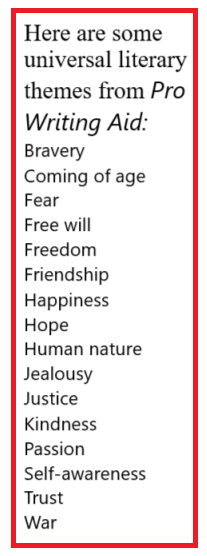 If a publisher is looking for work that explores a particular theme, such as “escape,” you must think creatively. Consider an original angle that will play well to that theme and then write it.
When you submit your work to various places, you should keep a record of it. Most publishers won’t accept simultaneous submissions. To avoid that, you should list:
- what was submitted,
- links or email addresses of where it was sent to,
- when submissions close.
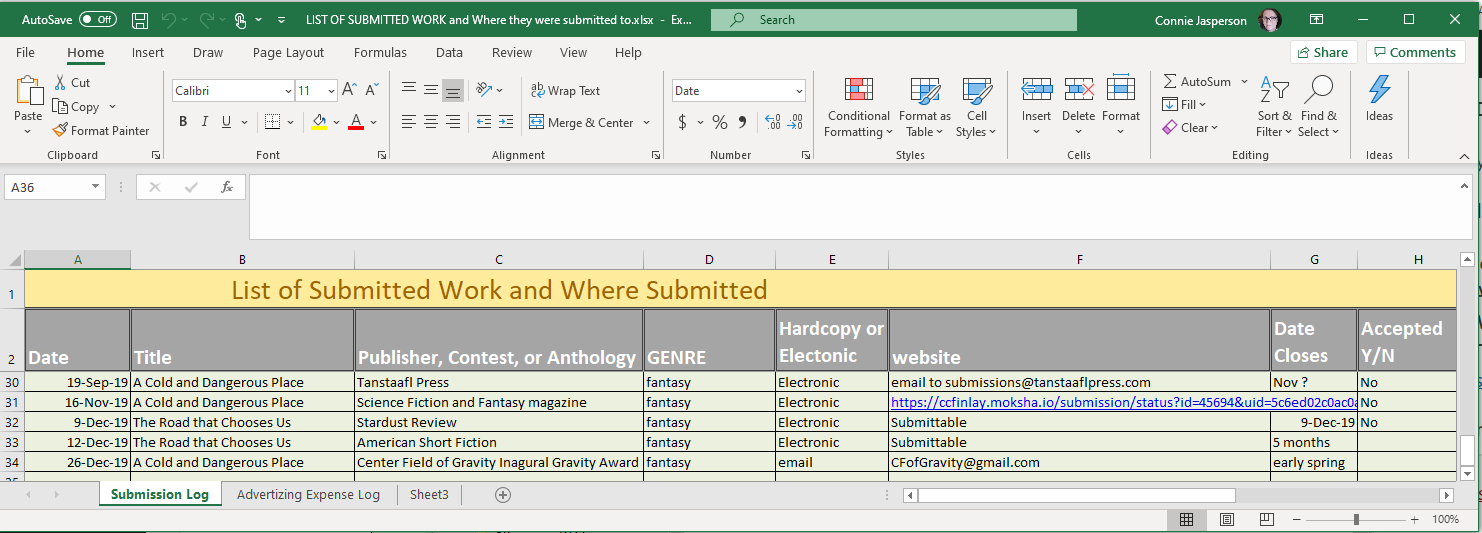
To that end, consider creating a database for your work. I use an Excel spreadsheet that lists the title, word count, completion date, where and when I submitted the work, how much I earned for it, etc.
Below is a screenshot of what my list of submitted work looks like. I started this file in 2015 and continue to use it to track my submissions.
In extremely short fiction such as drabbles and other flash fiction, you must include only the most essential elements of a story. This kind of constraint teaches us to write concisely and still show an engaging story.
As a poet, I find it far easier to tell a story in 100 words than in 1,000. That 100-word story is called a drabble and is an art form in its own right.
You can find publications with open calls at Submittable. Unfortunately, that site is no longer as useful for speculative fiction as it was several years ago. However, I have seen anthology calls for spec fic there. Still, poetry collections, literary anthologies, and contests use Submittable, so that is an option. https://www.submittable.com/
Some social media platforms are useful, as you may hear about open calls that way. I know many people are avoiding social media these days, but you don’t have to go nuts. Use it just for business (and yes, writing is a business). Follow editors on LinkedIn, Facebook, Instagram, and their Twitter feeds, if you are still using that platform. (I no longer use Twitter, but I do use Bluesky.) Consider following the magazines you submit to (or would like to send work to) on each social media platform you use.
 A fellow author keeps a networking notebook. It includes the names of people in the industry she has spoken to, their affiliations (if they work for an agent or editor), their emails and/or business cards, and other relevant details. This information comes in handy when she has to write cover letters to go with submissions to these editors, as she can reintroduce herself as having met them at a specific seminar or conference.
This list of suggestions is meant for authors who intend to write professionally. It’s a business, so these habits help keep me focused and on track.



 Life in the Realm of Fantasy