
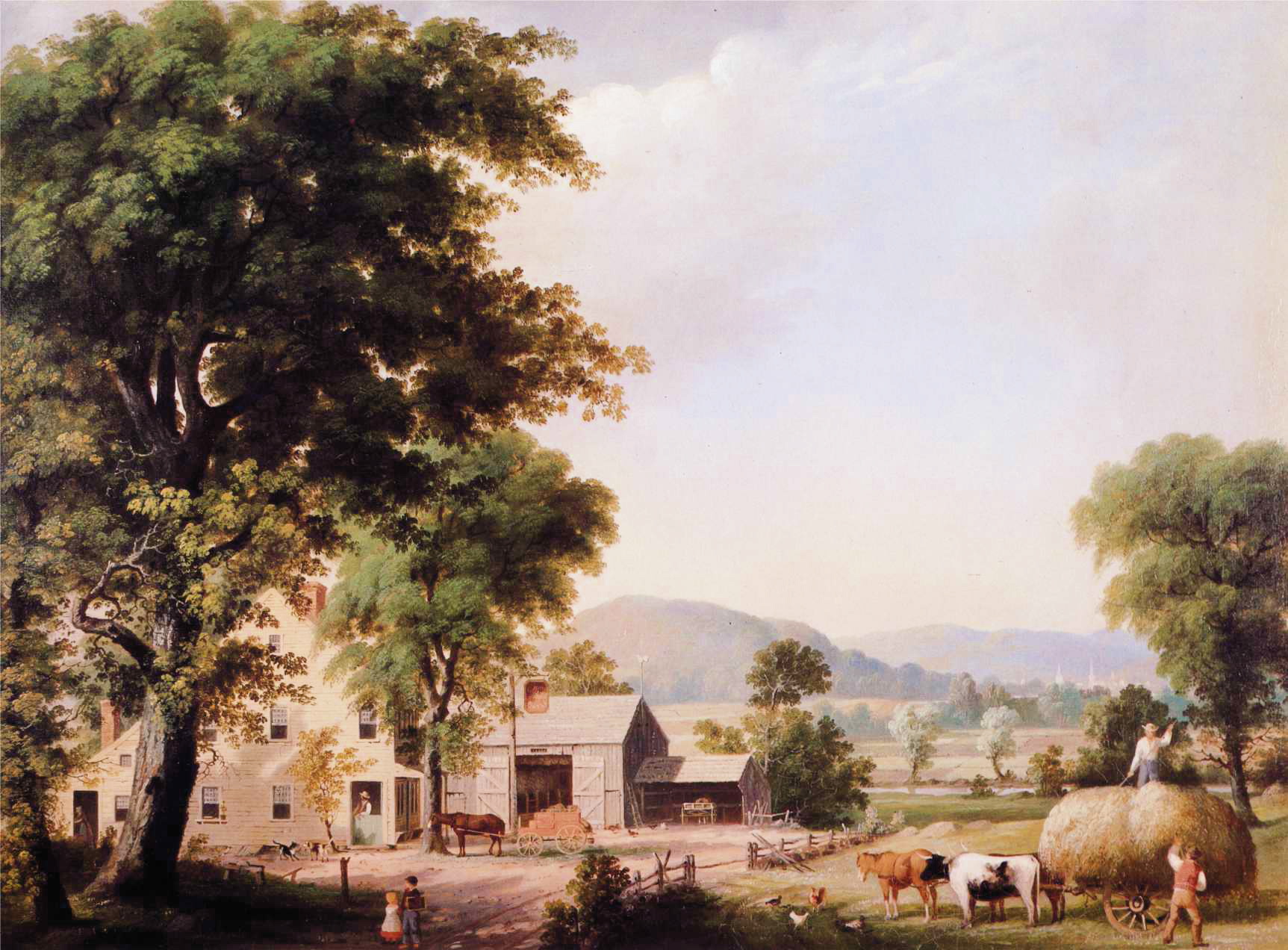
 Artist: George Henry Durrie (1820–1863)
Title: English: Haying at Jones Inn
Date: 1854
Medium: oil on canvas
Dimensions: 22″×30″
Location: Private collection
What I love about this painting:
George Henry Durrie found beauty in the depictions of ordinary life. He always found a way to fit people into his scenes.
I absolutely love the nostalgia of this scene, and the wealth of information about how a reputable roadside inn worked. It is clear that Durrie was frequent guest at Jones Inn. He traveled widely in the years he worked as a portrait painter, and this particular public house is featured in his work several times from different angles. I like to imagine he painted the inn to provide a little respite from the demands of portraiture.
This scene shows us a day at the end of summer. Laborers are bringing a wagon piled high with hay. Two oxen are hitched behind a horse, the three working together to pull the laden wagon.
Country inns were often working farms. They had to be, as they were feeding staff and laborers as well as guests all year long, and there were no Costco, Sam’s Club, or Wholesale Foods to purchase supplies from.
The stables and the people who cared for the horses were just as important. Providing well for travelers’ horses was as crucial as that of providing the best rooms and food possible for their guests.
The hay piled on this wagon will feed not only the innkeepers’ beasts but will feed the horses ridden by guests as the year progresses. Many more wagons will be required to fill the barn and hayloft.
About the Artist, Via Wikipedia:
George Henry Durrie (June 6, 1820 – October 15, 1863) was an American landscape artist noted especially for his rural winter snow scenes, which became very popular after they were reproduced as lithographic prints by Currier and Ives.
For many years, Durrie made a living primarily as a portrait painter, executing hundreds of commissions. After marriage, he made frequent trips, traveling to New York, Massachusetts, New Jersey, and Virginia, fulfilling commissions and looking for new ones. His diary reveals that he was an enthusiastic railroad traveler, in the early days of the railroads. Durrie also painted what he called “fancy pieces”, whimsical studies of still lives or stage actors, as well as painting scenes on window-shades and fireplace covers. But portrait painting commissions became scarcer when photography came on the scene, offering a cheaper alternative to painted portraits, and, as his account-book shows, Durrie rarely painted a portrait after 1851.
Durrie’s interest shifted to landscape painting, and while on the road, or at home, made frequent sketches of landscape elements that caught his eye. Around 1844 Durrie began painting water and snow scenes, and took a second place medal at the 1845 New Haven State Fair for two winter landscapes. [1]
To learn more about this artist, go to George Henry Durrie – Wikipedia
Credits and Attributions:
IMAGE: Wikimedia Commons contributors, “File:George Henry Durrie – Haying at Jones Inn.JPG,” Wikimedia Commons, https://commons.wikimedia.org/w/index.php?title=File:George_Henry_Durrie_-_Haying_at_Jones_Inn.JPG&oldid=853995435 (accessed October 22, 2025).
[1] Wikipedia contributors, “George Henry Durrie,” Wikipedia, The Free Encyclopedia, https://en.wikipedia.org/w/index.php?title=George_Henry_Durrie&oldid=1282714933 (accessed October 22, 2025).
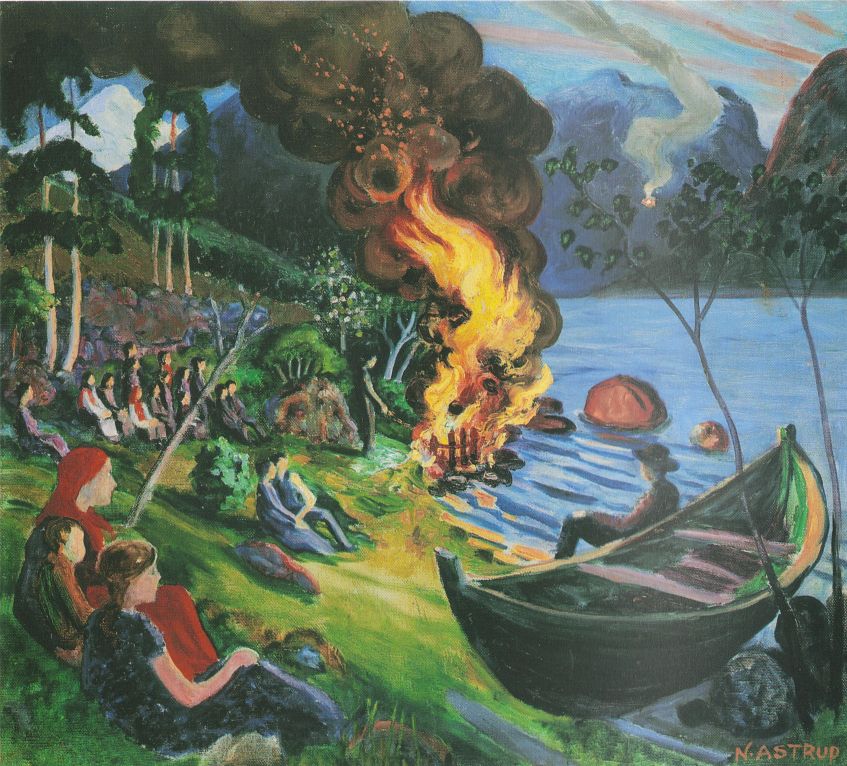 Artist: Nikolai Astrup (1880–1928)
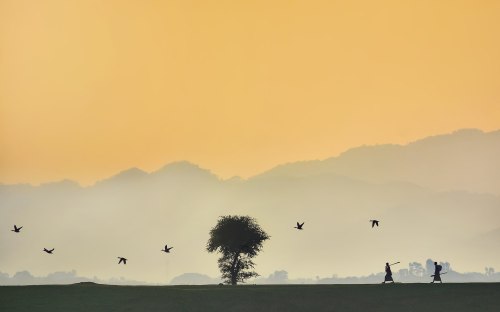 Photograph: Tanguar Haor by Abdul Momin


 Life in the Realm of Fantasy