
There is a quote from the Buddha that I have found especially true for creating a great story. “There has to be evil so that good can prove its purity above it.”
 J.R.R. Tolkien understood this quite clearly. His work was written in a highly literate style that everyone understood a century ago. Reading the Lord of the Rings trilogy requires commitment, and today, fewer readers are willing to undertake it.
Tolkien employs contrasts throughout the length of his stories. He shows the peace and prosperity that Frodo enjoys and then asks him to choose his destiny. Frodo chooses the difficult path. Tolkien takes the hobbit and all the central characters through many personal changes. He forces them to face their fears, gives them reasons to continue, to not give up.
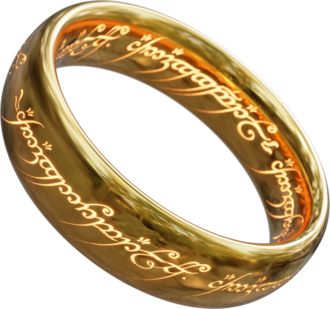 Frodo’s story is about good and evil, war and peace, and the hardships endured in the effort to destroy the One Ring and negate the power of Sauron. So why would ordinary middle-class hobbits living comfortable lives go to so much trouble if Sauron’s evil posed no threat to their peace and prosperity?
They do it because they can see that in the long run, Sauron’s orcs would overrun the Shire and destroy everything good and beautiful.
Lengthwise, the three books aren’t as long as people make them out to be, especially when compared to Robert Jordan and Brandon Sanderson’s long and winding 15-book Wheel of Time series (comprised of 4,410,036 words) or Tad Williams’ epic and highly literate Memory, Sorrow, and Thorn series (comprised of 1,121,720 words).
Tolkien’s trilogy totals only 455,175 words, which is considered an optimal length for a debut series in the epic fantasy genre. Fans of epic fantasy like and expect long books with large stories.
Whenever I talk about what we can learn from Tolkien, someone will respond that Tolkien wrote in a style that 21st-century readers find frustrating. Certainly, he used more words than a modern writer would dare to. A 21st century writer would face the slings and arrows of the modern critique group.
But while his style is more wordy than modern taste, his work is still compelling. He still has plenty to say that can resonate with us. In the process, he takes us on a journey with side quests and an epic, wonderful ending that was somehow left out of the movies – the Scouring of the Shire.
Hint: Yes, reading the books requires persistence, but if you want the real story and don’t have the time or patience, the audiobooks, as narrated by Andy Serkis (who played the role of Gollum in the movies), are a must-listen.
With the Ballantine Books paperback edition in 1965, J.R.R. Tolkien brought epic fantasy to my generation of college students. In the 1970’s, in my college town, the graffiti in downtown Olympia read “Frodo Lives.” Frodo Lives! – Wikipedia
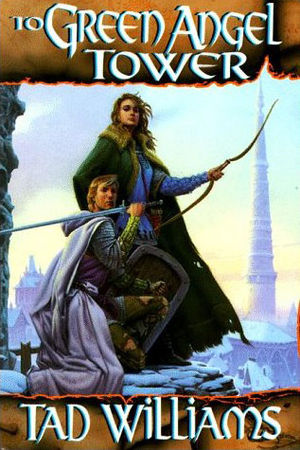
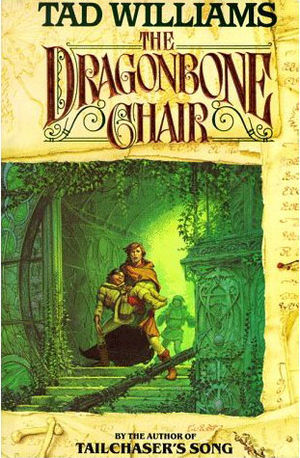 But how did Tolkien’s style of storytelling influence the genre as we know it today? For that, we take a look at Tad Williams’s masterpiece, The Dragonbone Chair. It’s the first book in the fantasy series Memory, Sorrow, and Thorn. It was published in 1988 and hooked me.
Williams takes the fourteen-year-old Simon, a kitchen boy, and Miriamele, a princess, and gives them an epic quest. He brings them together and then forces them down separate paths that eventually rejoin. Along the way, they grow into adulthood, and what they learn about themselves is both bitter and wonderful.
I read The Dragonbone Chair when it first came out in paperback. I loved it so much, I had to re-read it immediately upon finishing.
In both the Lord of the Rings trilogy and Tad Williams’ Memory, Sorrow, and Thorn, we have two of the most enduring works of modern fantasy fiction. Both feature an epic central quest and side quests, all of which must be completed for the protagonists to arrive at the final resolution.
In both series, we have moments of joy and contentment sharply contrasted with events causing terrible deprivation and loss. Each event urges us to keep reading, inspiring the deepest emotions and the desire to find out what happens next.
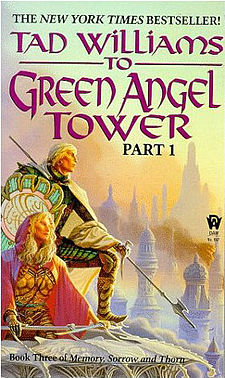 This use of contrast is fundamental to the fables and sagas that humans have been telling since before the discovery of fire. Contrast is why Tolkien’s work is the foundation upon which modern epic fantasy is built. The way Tad Williams wrote his characters, and his trimmed down prose further modernized the genre, but he kept the tropes of an engaging narrative, epic quests, and diverse fantasy cultures and races.
When the author employs the highs and lows of our human experience to tell their story, the reader empathizes with the characters. They live the story as if they were the protagonist.
And what about contrasts in world-building? It can be shown in subtle ways.
Juxtaposing plenty and poverty in your worldbuilding shows the backstory without requiring an info dump. Contrast and good pacing turns a wall of words into something worth reading.
In our real world, war, famine, and floods are followed by times of relative peace and plenty. The emotions and experiences of people living through all those times are the real stories.
This is not just a concept found in fantasy novels; it’s a part of our human history and our future.
We shouldn’t limit our reading to the old favorites that started us on this writing path. You may not love the novels on the NY Times literary fiction bestseller list, but it’s a good idea to read one or two of them every now and then as a means of educating yourself. We learn the architecture of stories by reading and dissecting novels and short stories written by the masters, both famous and infamous.
What you don’t like is as important as what you enjoy. Why would a book that you dislike be so successful? No matter how much money a publisher throws at them, some books are stinkers.
 You don’t need to pay for books you won’t like. Go to the library or to the secondhand bookstore and see what they have from the NYT bestseller list that you would be willing to examine.
Give that book a postmortem.
- Did the book have a distinct plot arc?
- Did it have a strong opening that hooked you?
- Was there originality in the way the characters and situations were presented?
- Did you like the protagonist and other main characters? Why or why not?
- Were you able to suspend your disbelief?
- Did the narrative contain enough contrasts to keep things interesting?
- By the end of the book, did the characters grow and change within their personal arc? How were they changed?
- What sort of transitions did the author employ that made you want to turn the page? How can you use that kind of transition in your own work?
- Did you get a satisfying ending? If not, how could it have been made better?
Reading and dissecting the works of successful authors is a necessary component of any education in the craft of writing.
When you read a book that you like or dislike, think about how you can apply what you learn to your own work.
I say this regularly, but I must repeat it – getting an education about the craft of writing is important. If you have a good library in your town, this sort of education is free, a price that fits my budget perfectly. What I learn from the masters helps me to plan the pacing, helps me balance the emotions and events in my own stories.



 Life in the Realm of Fantasy