Tag Archives: Modern Art

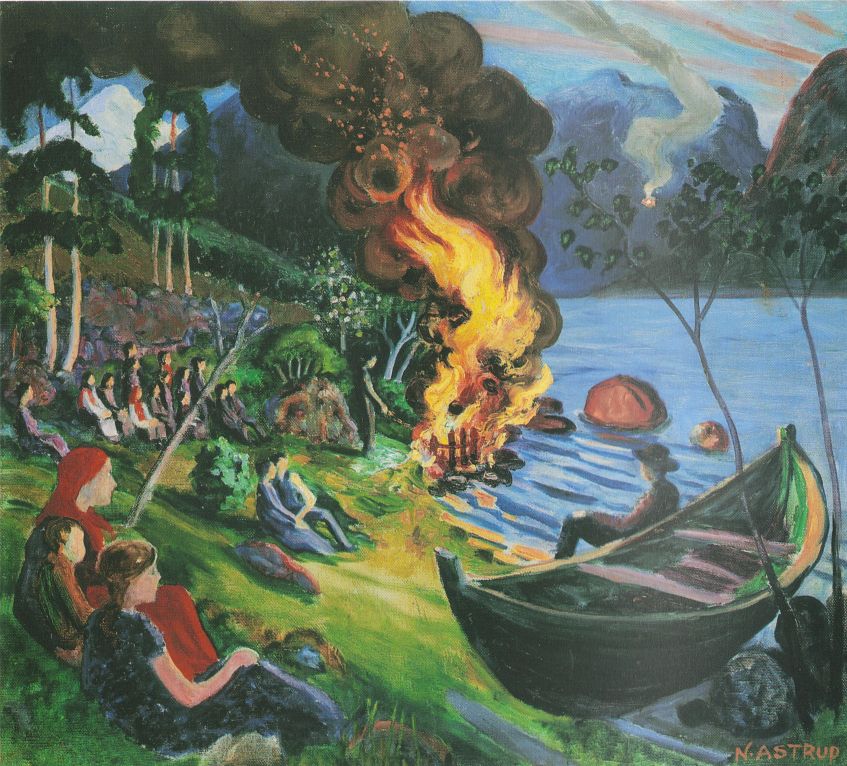
#FineArtFriday: Midsummer Eve Bonfire by Lake Jølstravatnet by Nikolai Astrup 1909

N_Astrup-St._Hansbål_ved_JølstervatnetArtist: Nikolai Astrup  (1880–1928)

Title: Norwegian: St. Hansbål ved Jølstervatnet,

English: Midsummer Eve Bonfire by Lake Jølstravatnet

Date: 1909

Medium: oil on canvas

Inscription: Signature bottom right: NASTRUP

What I love about this painting:

This is a scene that is full of life, family, and tradition. I love the intensity of color, the way people are shown enjoying the company of their loved ones.

Midsummer Eve is the best part of summer. The weather usually cooperates, allowing for an outdoor picnic that goes late into the night. In Norway and in Scandinavian countries, the eve of the Birth of St. John is celebrated with a communal bonfire. The celebration is also known as Jonsok, meaning “the wake of Saint John.”

The summer solstice has just passed and the longest days of the year are upon us. Twilight lasts long into the evening. Nicolai Astrup has shown us a cozy celebration of family and friends gathered at a place he clearly loved. They light bonfires to celebrate the birth of a saint, but more than that, they are there to share the holiday with the people they love.

About the Artist, via Wikipedia:

Nikolai Astrup (Norwegian pronunciation: [nɪkʊˈlɑ̀i̯ ˈɑ̀stɾʉp]) (30 August 1880 – 21 January 1928) was a Norwegian modernist painter. Astrup was a distinctive, innovative artist noted principally for his intense use of color depicting the lush landscapes of Vestlandet featuring the traditional way of life in the region.

Astrup held three significant exhibitions during his lifetime; at Kristiania 1905 and 1911 and at Bergen in 1908. In 1907, he was married to Engel Sunde with whom he had eight children. Astrup struggled with tuberculosis and general poor health as his asthma worsened. In 1913, Astrup settled with his wife and children in Sandalstrand (now Astruptunet) on the south side of Lake Jølstravatn across from the village of Ålhus. He died of pneumonia in 1928 at the age of 47 in the neighboring municipality of Førde. Astrup was buried in Ålhus Cemetery, in Jølster Norway. [1]


Credits and Attributions:

IMAGE: Nikolai Astrup, Public domain, via Wikimedia Commons. Wikimedia Commons contributors. File:N Astrup-St. Hansbål ved Jølstervatnet.jpg [Internet]. Wikimedia Commons; 2024 May 31, 05:34 UTC [cited 2024 Jul 17]. Available from: https://commons.wikimedia.org/w/index.php?title=File:N_Astrup-St._Hansb%C3%A5l_ved_J%C3%B8lstervatnet.jpg&oldid=880323847.

[1] Wikipedia contributors, “Nikolai Astrup,” Wikipedia, The Free Encyclopedia, https://en.wikipedia.org/w/index.php?title=Nikolai_Astrup&oldid=1156381035 (accessed July 17, 2024).
8 Comments

Filed under #FineArtFriday

#FineArtFriday: African Violet Skies by Clark Thomas Carlton

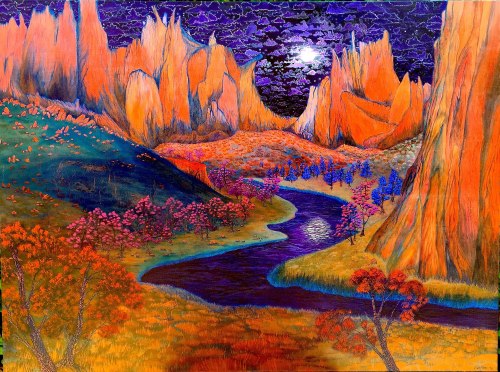
African_Violet_Skies_by_Clark_Thomas_CarltonTITLE: African Violet Skies

BY: Clark Thomas Carlton

MEDIUM: Acrylics on canvas

DATE: ca. 2016

What I love about this painting:

Today we’re dipping into 21st century fantasy landscape art. African Violet Skies by Clark Thomas Carlton is an explosion of color and form. The colors are so intense, I feel as if I could taste them.

I love how delicate the trees and foliage are as compared to the fierce thrust of the landscape. The mountains seem to burst through the earth at high speed, reaching for the incredible night sky, as if they would touch the moon.

This is true mastery of storytelling in an image as well as form and color. He gives us drama, and romance, and violence, and above it all, the moon softly gliding behind the delicate clouds, reflected on the serene stream below.

This painting is exactly what I need after four days of thick fog that refused to lift, followed by eternal rain.

About the Artist, via Wikipedia, the free encyclopedia

Clark Thomas Carlton is a novelist, playwright, and a screen and television writer living in Los Angeles. He has also worked as a producer of reality television. Carlton is best known for his science fiction/fantasy novel Prophets of the Ghost Ants published by HarperCollins Voyager in 2016.

Carlton is the author of Prophets of the Ghost Ants, Book 1 of the Antasy Series published by HarperCollins Voyage on December 13, 2016.  The indie version of the book was named a Best of 2011 by Kirkus Reviews.

In 1997, Carlton was awarded the Drama-Logue Critics Award for his play Self Help or the Tower of Psychobabble along with playwrights Neil Simon and Henry Ong. The play, a satire of the psychotherapy industry, was performed in Santa Monica, Palm Springs, Los Angeles and West Hollywood and directed by Michael Kearns and was also produced in Chicago.

Carlton is a painter who embraces the description of his work as “Grandma Moses on acid”. His work has been displayed through the Palm Springs Art Museum Annex through the Palm Springs Arts Council.

In December 1999, Carlton released an album of songs titled Salt Water through CD baby where he accompanied himself on acoustic guitar.  At present he is at work on Gardens of Babylon, a synth pop opera about the building of the Hanging Gardens of Babylon. The opera was written with his partner, Mike Dobson, an Emmy award winning music supervisor and composer on the daytime drama, the Young and the Restless. [1]


Credits and Attributions:

IMAGE: African Violet Skies by Clark Thomas Carlton. Wikimedia Commons contributors, “File:African Violet Skies by Clark Thomas Carlton.jpg,” Wikimedia Commons, https://commons.wikimedia.org/w/index.php?title=File:African_Violet_Skies_by_Clark_Thomas_Carlton.jpg&oldid=785979611 (accessed November 30, 2023).

[1] Wikipedia contributors, “Clark Thomas Carlton,” Wikipedia, The Free Encyclopedia, https://en.wikipedia.org/w/index.php?title=Clark_Thomas_Carlton&oldid=1171925222 (accessed November 30, 2023).

1 Comment

Filed under #FineArtFriday

#FineArtFriday: the Song of Love by Georgio de Chirico

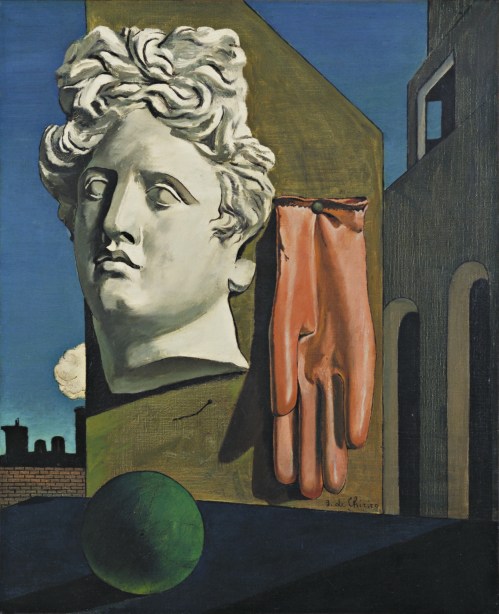
De_Chirico's_Love_SongArtist: Giorgio de Chirico, 1914,

Title: The Song of Love,

Genre: Metaphysical Art

Medium: oil on canvas, 73 x 59.1 cm,

Location: Museum of Modern Art, New York

About this painting, via Wikipedia:

Chirico presents a bust of a classical sculpture, a rubber ball, and a rubber glove on a canvas in between some buildings with a train passing by in a scene that spurs a sense of confusion. The bust could be a representation of Chirico’s love of classical art and a disappearing age. Chirico uses the rubber glove as a mold of a hand that implies the void of human presence. The buildings set up a scene that is reminiscent of the cityscapes of Chirico’s past. [1]

About the Artist,  via Wikipedia:

Giuseppe Maria Alberto Giorgio de Chirico; 10 July 1888 – 20 November 1978) was an Italian artist and writer born in Greece. In the years before World War I, he founded the scuola metafisica art movement, which profoundly influenced the surrealists. His best-known works often feature Roman arcades, long shadows, mannequins, trains, and illogical perspective. His imagery reflects his affinity for the philosophy of Arthur Schopenhauer and of Friedrich Nietzsche, and for the mythology of his birthplace.

After 1919, he became a critic of modern art, studied traditional painting techniques, and worked in a neoclassical or neo-Baroque style, while frequently revisiting the metaphysical themes of his earlier work.

The paintings de Chirico produced between 1909 and 1919, his metaphysical period, are characterized by haunted, brooding moods evoked by their images. At the start of this period, his subjects were motionless cityscapes inspired by the bright daylight of Mediterranean cities, but gradually he turned his attention to studies of cluttered storerooms, sometimes inhabited by mannequin-like hybrid figures. [2]

For more on the life and art of Georgio de Chirico, check out this video: Is This £1 Thrift Shop Painting By 20th Century Italian Master? | Fake Or Fortune | Perspective – YouTube


Credits and Attributions:

Image: Love Song by Georgio de Chirico, PD|100, courtesy Wikipedia Contributors, Wikipedia, The Free Encyclopedia https://en.wikipedia.org/wiki/File:De_Chirico%27s_Love_Song.jpg. (Accessed April 30, 2023.)

[1] Wikipedia contributors, “The Song of Love,” Wikipedia, The Free Encyclopedia, https://en.wikipedia.org/w/index.php?title=The_Song_of_Love&oldid=1146489854 (accessed April 30, 2023).

[2] Wikipedia contributors, “Giorgio de Chirico,” Wikipedia, The Free Encyclopedia, https://en.wikipedia.org/w/index.php?title=Giorgio_de_Chirico&oldid=1152305674 (accessed May 4, 2023).

2 Comments

Filed under #FineArtFriday

#FineArtFriday: Le repos à Pont-Aven (La gardeuse d’Oise) by Émile Bernard

Émile_Bernard_-_Le_repos_à_Pont-Aven

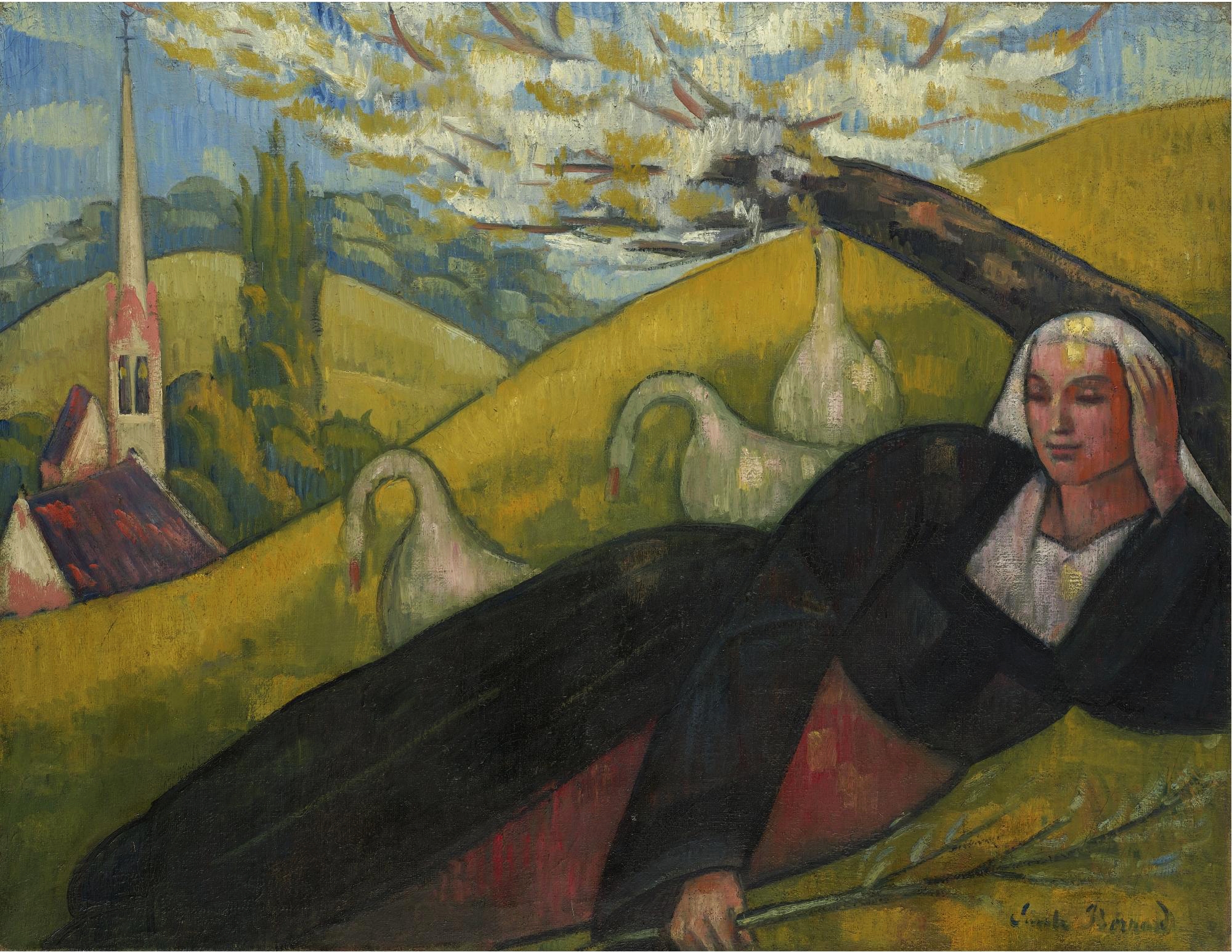
Artist: Émile Bernard  (1868–1941)

Title: Le repos à Pont-Aven (La gardeuse d’Oise) [English: Rest in Pont-Aven (The Keeper of Oise)]

Medium: oil on canvas mounted on cardboard

Dimensions: Height: 85.1 cm (33.5 in); Width: 110 cm (43.3 in)

Inscriptions    Signature bottom right: Emile Bernard

What I love about this painting:

Whoever this woman is, she is determined to enjoy the day. The geese don’t mind, and spring is in full swing. The tree (an apple tree?) leans sharply above as if to shade her. Why shouldn’t a hard-working woman take a well-deserved rest?

The style is intriguing, straight lines of the church against the round lines of the landscape, the woman, and the geese.

About the Artist, Via Wikipedia, the Free Encyclopedia:

Émile Henri Bernard (28 April 1868 – 16 April 1941) was a French Post-Impressionist painter and writer, who had artistic friendships with Vincent van GoghPaul Gauguin and Eugène Boch, and at a later time, Paul Cézanne. Most of his notable work was accomplished at a young age, in the years 1886 through 1897. He is also associated with Cloisonnism and Synthetism, two late 19th-century art movements. Less known is Bernard’s literary work, comprising plays, poetry, and art criticism as well as art historical statements that contain first-hand information on the crucial period of modern art to which Bernard had contributed.


Credits and Attributions:

Wikimedia Commons contributors, “File:Émile Bernard – Le repos à Pont-Aven.jpg,” Wikimedia Commons, the free media repository, https://commons.wikimedia.org/w/index.php?title=File:%C3%89mile_Bernard_-_Le_repos_%C3%A0_Pont-Aven.jpg&oldid=292287019 (accessed April 1, 2021).

Émile Bernard, Public domain, via Wikimedia Commons

Wikipedia contributors, “Émile Bernard,” Wikipedia, The Free Encyclopedia, https://en.wikipedia.org/w/index.php?title=%C3%89mile_Bernard&oldid=1014462432 (accessed April 1, 2021).

Comments Off on #FineArtFriday: Le repos à Pont-Aven (La gardeuse d’Oise) by Émile Bernard

Filed under #FineArtFriday, writing

#FineArtFriday: Utopien 04 by Makis E. Warlamis 2007

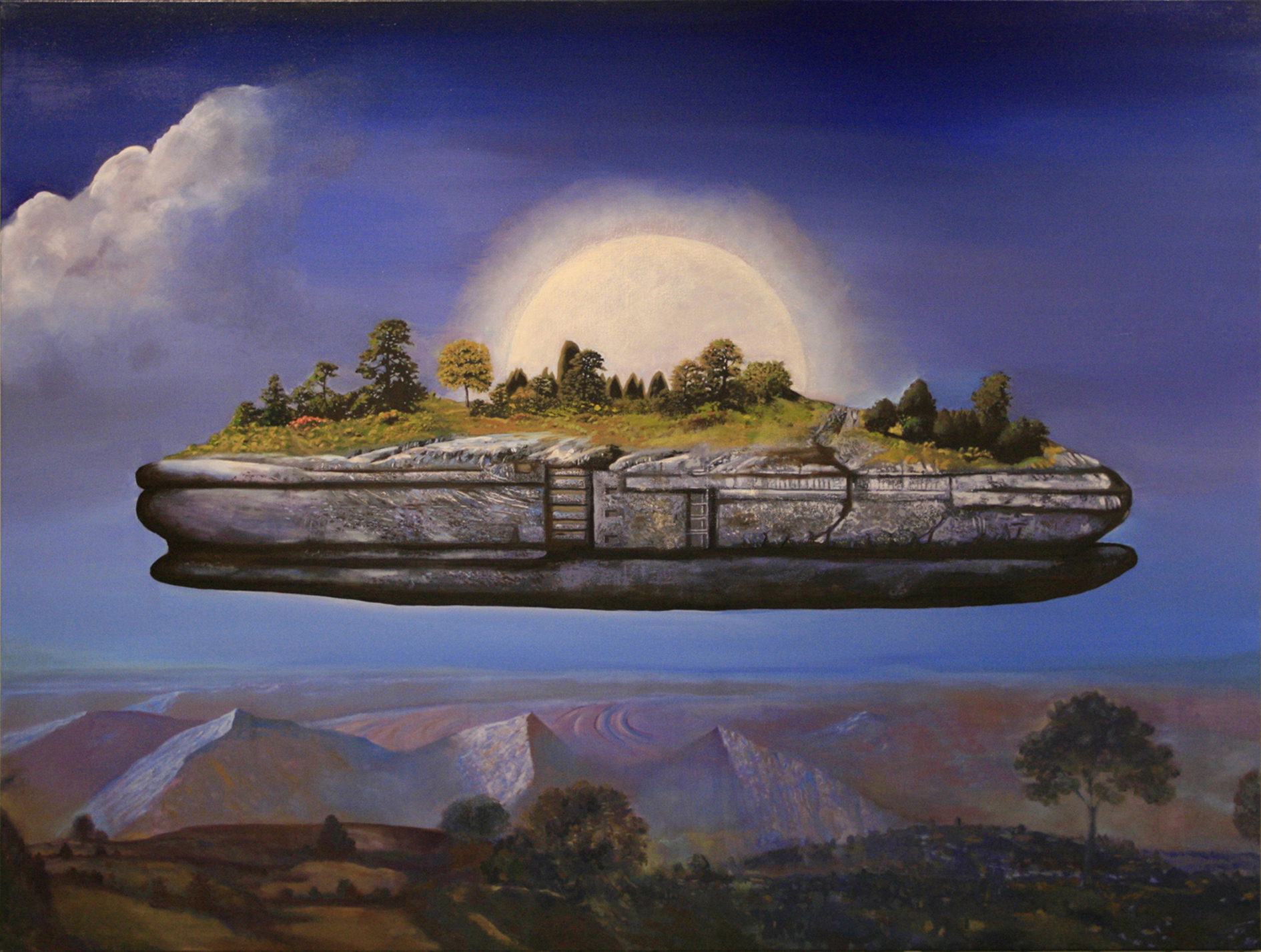
Artist: Makis E. Warlamis

Title: Utopien 04

Medium: painting

Collection: Kunstmuseum Waldviertel

Source/Photographer: Own work, Daskunstmuseum, 2007-01-05

About the word “Utopia,” via Wikipedia:

The word utopia was coined from Ancient Greek by Sir Thomas More in 1516. “Utopia” comes from Greek: οὐ (“not”) and τόπος (“place”) which translates as “no-place” and literally means any non-existent society, when ‘described in considerable detail’. However, in standard usage, the word’s meaning has shifted and now usually describes a non-existent society that is intended to be viewed as considerably better than contemporary society.

In his original work, More carefully pointed out the similarity of utopia to eutopia, which is from Greek: εὖ (“good” or “well”) and τόπος (“place”), hence eutopia means “good place”, which ostensibly would be the more appropriate term for the concept the word “utopia” has in modern English. The pronunciations of eutopia and utopia in English are identical, which may have given rise to the change in meaning.

What I love about this painting:

This Utopia is unreachable, as all true Utopias are. It floats high above the mundane world, visible but just out of reach. The colors are intense, vibrantly moody. The landscape above which this perfect island floats is serene, a beautiful place.

Every idea of perfection is different. Warlamis’ Utopia is not the golden city many storytellers and writers of speculative fiction might imagine, but is instead an island of undisturbed landscape, looking almost like the untrammeled headland one might find beside the sea.

His Utopia is a step back to nature, to a simpler time.

In truth, it isn’t too different from the land over which it flies. And, if that is the case, why strive to reach it?

What story lurks within this painting? What a great visual prompt to jumpstart Nation Novel Writing Month.

About the Author via Wikipedia DE:

Efthymios “Makis” Warlamis (also: Efthymis, Efthymios Varlamis; born 1942 in Veria, in Central Macedonia, Greece; died 27 December 2016) was a Greek-Austrian architect, painter, poet, writer, educator and museum founder.

Warlamis was a versatile artist. In addition to his basic profession as an architect, he worked as a sculptor, painter, designer and writer. He had exhibitions in museums and exhibition centres in Europe, USA, Asia and Egypt. His works are represented in international public and private collections such as the Graphic Collection of the Albertina Vienna, Museum moderner Kunst Wien, DAM Deutsches Architekturmuseum Frankfurt, Collection Alexander Jolas, Collection of the State of Austria, Collection Liaunig.

In 1992, together with his wife Heide, he founded the International Center for Art and Design I.DE. A. in Schrems. He planned and built the Kunstmuseum Waldviertel, which opened in Schrems in 2009.


Credits and Attributions:

Wikimedia Commons contributors, “File:2010 Utopien arche04.jpg,” Wikimedia Commons, the free media repository, https://commons.wikimedia.org/w/index.php?title=File:2010_Utopien_arche04.jpg&oldid=501416249 (accessed October 30, 2020).

Wikipedia contributors, “Utopia,” Wikipedia, The Free Encyclopedia, https://en.wikipedia.org/w/index.php?title=Utopia&oldid=986041921 (accessed October 30, 2020).

Wikipedia DE Contributors, Efthymios Warlamis, Wikipedia the Free Encyclopedia, https://de.wikipedia.org/wiki/Efthymios_Warlamis (accessed October 30, 2020).

2 Comments

Filed under #FineArtFriday

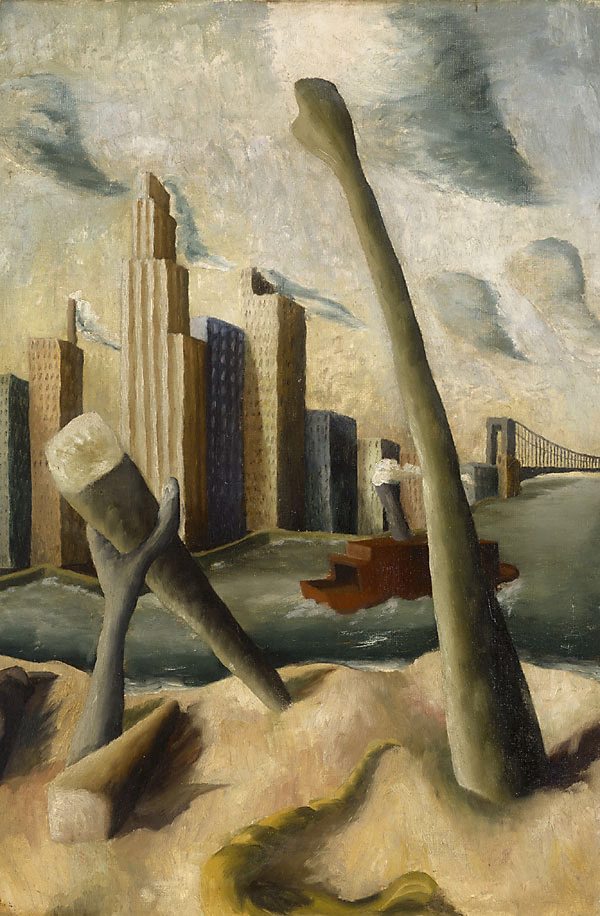
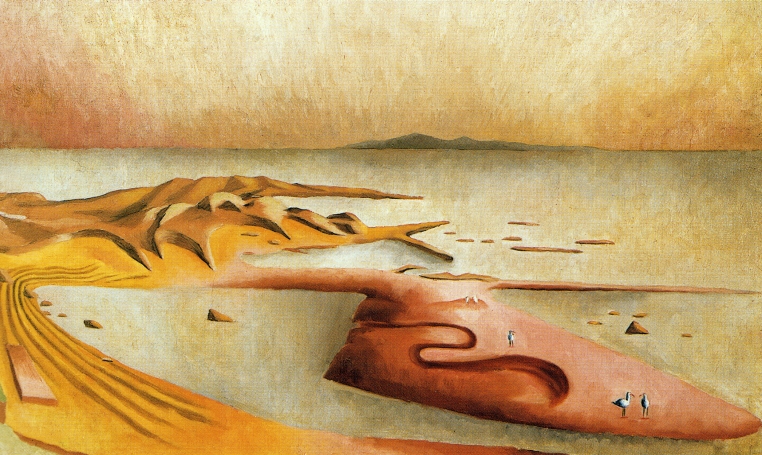
#FineArtFriday: Peter Purves Smith: New York, 1936, and Rickett’s Point, 1937

Usually, in literature, surrealism is shown through the thought processes of the characters rather than in alterations of the environment. On the surface, you believe what they say they think, but their perception of the world is skewed toward a hallucinogenic feel.

In art, the surface, the visual layer is what it is all about. Everything is displayed for you to view and interpret as you will.

Sometimes surrealism asks you to think deeper. Other times, surrealism says “enjoy the moment.” In “New York” Peter Purves Smith asks you to think deeper about our mania for building densely and tall. Skyscrapers grow like weeds, springing from the earth like dandelions in the lawn. What other concepts does he ask us to consider?

Progress and impermanence. Beauty versus utilitarian requirements. He asks us to think deeply.

In Ricketts Point, he asks you to just enjoy a sunny day at the beach.


Credits and Attributions

Wikimedia Commons contributors, “File:Peter Purves Smith – New York, 1936.jpg,” Wikimedia Commons, the free media repository, https://commons.wikimedia.org/w/index.php?title=File:Peter_Purves_Smith_-_New_York,_1936.jpg&oldid=149235926 (accessed July 4, 2019).

Wikimedia Commons contributors, “File:Peter Purves Smith – Ricketts Point, 1937.jpg,” Wikimedia Commons, the free media repository, https://commons.wikimedia.org/w/index.php?title=File:Peter_Purves_Smith_-_Ricketts_Point,_1937.jpg&oldid=296570789 (accessed July 4, 2019).

Comments Off on #FineArtFriday: Peter Purves Smith: New York, 1936, and Rickett’s Point, 1937

Filed under #FineArtFriday

#FineArtFriday: The Kiss, by Bernardien Sternheim

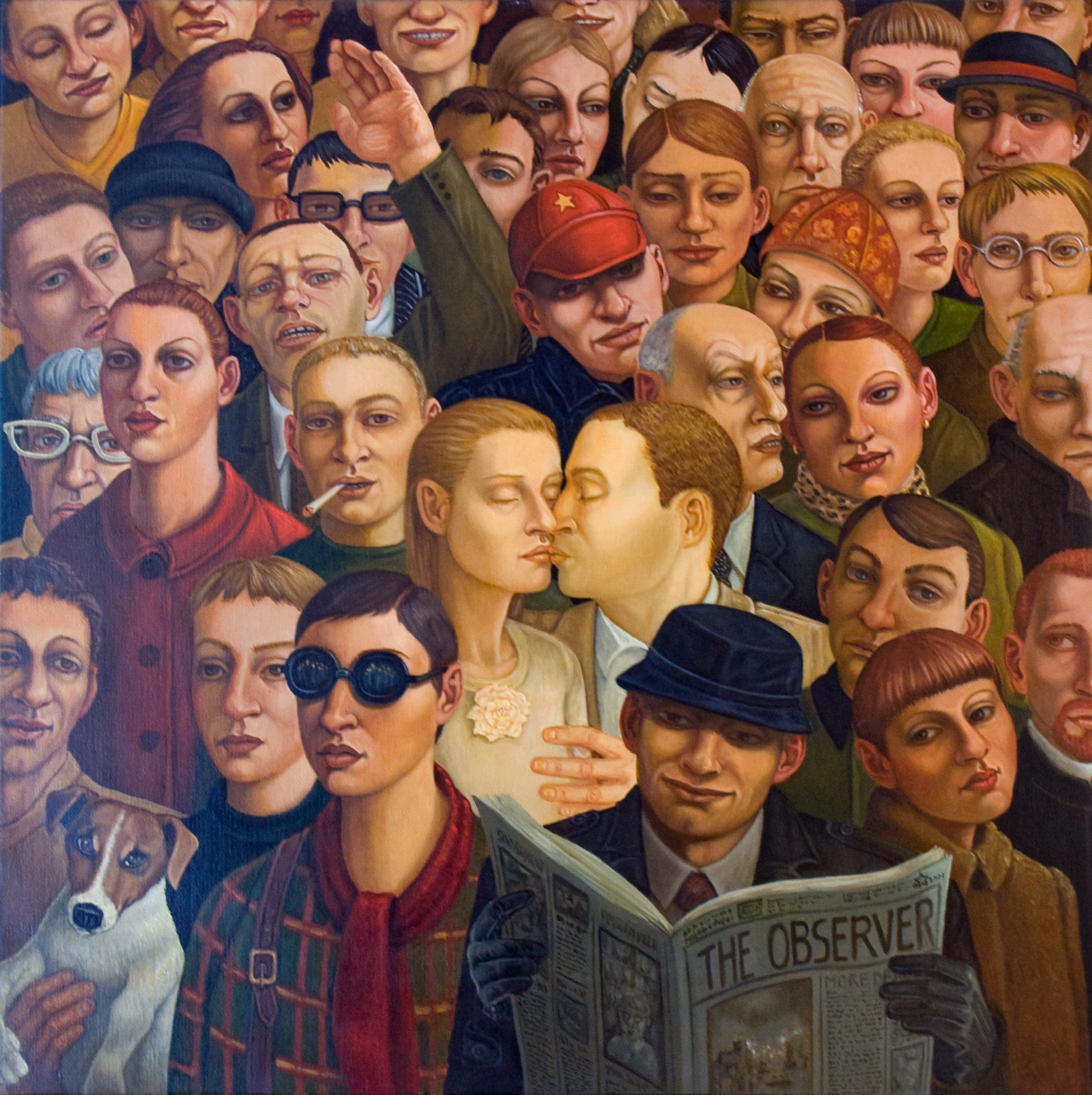
It is a rare treat when we can view modern art as painted by living authors via Wikimedia Commons. Today we are looking at The Kiss, by Bernardien Sternheim. It is dated 2001 and can be found on Wikimedia Commons, in the category Dutch Independent Realism.

What I love about this painting: It is raw, and real, and speaks to the humanity of the throng who are gathered for… what? Are they watching a race? Perhaps they are waiting for a train.

Regardless of what they are waiting for, the crowd faces forward, not watching the man and woman who steal a kiss.

Yet a nod to voyeurism is found here, as one man is reading The Observer, a woman reads over his shoulder, and an elderly man whispers into the ear of a woman.

I love the colors, the detail, and the expressions on each individual in the crowd. This painting is sure and bold, a window showing us a view of… ourselves.

About the artist:

Quote from the artist’s website, Bernardien Sternheim: “Central to the work of Bernardien Sternheim is man, in all his vulnerability and strength.

“Bernardien was born in Amsterdam in 1948. Against the spirit of the age, she opts for realism, figurative art.

“That is how she had to develop herself, with as great examples Pyke Koch, Caravaggio and Rembrandt.”


Credits and Attributions:

The Kiss, by Bernardien Sternheim via Wikimedia Commons contributors, “File:WLANL – Marcel Oosterwijk – De Kus.jpg,” Wikimedia Commons, the free media repository,

https://commons.wikimedia.org/w/index.php?title=File:WLANL_-_Marcel_Oosterwijk_-_De_Kus.jpg&oldid=282201684 (accessed June 22, 2018).

Comments Off on #FineArtFriday: The Kiss, by Bernardien Sternheim

Filed under #FineArtFriday