
November is only a week away. If you are participating in NaNoWriMo and intending to begin writing on November 1st, this post is meant to help you lay the groundwork for the world in which your novel is set. This is definitely pre-writing, but you might want to describe this world in a separate document.
 First, what sort of world is your real life set in? When you look out the window, what do you see? Close your eyes and picture the place where you are at this moment. With your eyes still closed, tell me what it’s like. If you can describe the world around you, you can create a world for your characters.
So, in this fictional world, somebody is in charge of running things. We humans are tribal. We prefer an overarching power structure leading us because someone has to be the leader. We call that power structure a government.
As a society, the habits we develop, the gods we worship, the things we create and find beautiful, and the foods we eat are evidence of our culture.
If your society is set in modern suburbia, that culture and those values will affect your characters’ view of their world. As you write that first draft, the society will emerge onto the paper.
Maybe you are writing a sci-fi or fantasy novel. You will create the world as you write it. But do make a few notes as you go, or you may have trouble showing your world logically and without contradictions later in the narrative.
If that sounds like outlining, relax. You don’t have to call these notes an outline—after all, we don’t want to imply you aren’t a bona fide “pantser.” You can call them “notes.” No one will accuse you of outlining.
 What does the outdoor world look and smell like? Is it damp and earthy, or dry and dusty? Is there the odor of fallen leaves moldering in the gutters? Or have we wandered too near the chicken coop? (Eeew … get it off my shoe!) If an author can inject enough sight, sound, and scent into a fantasy or sci-fi setting, the world will feel solid when I read it.
What about the weather? It can be shown in small, subtle ways, a background giving a sense of place to our characters’ interactions and the events they go through.
Once you have decided on your overall climate, consider your level of technology. Perhaps you are setting your story in a pre-industrial society. Do some research now on how the weather affects agriculture and animal husbandry. Bookmark the websites with the best information.
- Overall, climate limits the variety of food crops that can be grown. Wet and rainy areas will grow vastly different crops from those in arid climates.
Maybe your novel’s setting is a low-tech civilization. If so, the weather will affect your characters differently than one set in a modern society. Also, the level of technology limits what tools and amenities are available to them.
Visualizing the scene and placing yourself there is the best way to make the fantasy world real. Blend what you know about the natural world into it. Consider writing several paragraphs describing all the details that will never make it into your story. Write them on a separate document, a list of things you, as the author, want to have firmly in your mind.
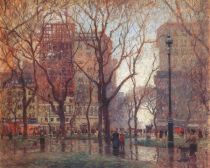
Paul Cornoyer: Rainy day in Madison Square
In any era, the weather affects the speed with which your characters can travel great distances and how they dress. Bad weather always has a detrimental effect on transportation, offering opportunities for conflict.
Society is the way people live in your world. While writing those first lines on November 1st, details about the society your characters inhabit will surface. They will continue to present themselves throughout the first draft and possibly the second.
Keep notes on the places and people you described. When you get to chapter 30 and need to know what you said in chapter 2, you will have the answer and won’t have to waste time searching the manuscript for it.
How is your society divided? Who has the wealth? Where do your characters fall in that spectrum?
How do we treat each other? Do we have a culture of revenge and aggression?
Who has the power, men or women—or is it a society based on mutual respect? Is there a cisgender bias or an acceptance of different gender identities?
As we said above, someone has to run things. If the politics are a part of your narrative, is the government run by tribal elders, or is it a monarchy, or a democracy, or a dictatorship, or a corporate oligarchy?
How does religion impact your story if it plays a role in your society?
 What about transport? How do people and goods go from one place to another?
Many things about the world will emerge from your creative mind as you write those first pages and will continue to arise throughout the story’s arc.
Consider making a glossary as you go. If you are creating names for people or places, list them separately as they come to you. That way, their spelling won’t drift as the story progresses. It happened to me—the town of Mabry became Maury. I put it on the map as Maury, and it was only in the final proofing that I realized that the spelling of the town in chapter 11 was different from that of chapter 30.
 Names and directions might drift and change as you write your first draft. Also, if they’re invented words, consider writing them close to how they are pronounced.
(Sigh.) Some names that looked cool and sword-and-sorcery-like when I first put them on paper in 2007 have lost their charm. It never occurred to me that I would still be writing stories featuring them in 2023.
Oops.
Next up: worldbuilding – creating believable magic and the paranormal.
The #NaNoPrep series to date:
- #NaNoPrep: creating the characters #amwriting | Life in the Realm of Fantasy (conniejjasperson.com)
- #NaNoPrep: The initial setting #amwriting | Life in the Realm of Fantasy (conniejjasperson.com)
- #NaNoPrep: What we think the story might be about #amwriting | Life in the Realm of Fantasy (conniejjasperson.com)
- #NaNoPrep: The Heart of the Story #amwriting. | Life in the Realm of Fantasy (conniejjasperson.com)
- #NaNoPrep: Signing up and getting started 2023 #amwriting | Life in the Realm of Fantasy (conniejjasperson.com)
- #NaNoPrep: How a strong theme will help you write that novel #amwriting | Life in the Realm of Fantasy (conniejjasperson.com)
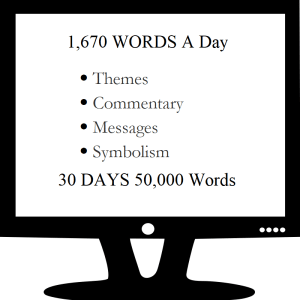
 Many authors are prepping for NaNoWriMo 2022. They are mentally committing to writing 1,667 new words every day beginning on November 1st or a total of 50,000 words by midnight on November 30th.
 Until this past June, I wrote best when I had a long stretch of time to just sit down and immerse myself. Then my husband was diagnosed with Parkinson’s, a degenerative neurological disease, and our life underwent a fundamental change. I am now the only driver in the family, and we live in an area without public transportation.
 A good way to ensure you have that time is to encourage your family members to indulge in their own interests and artistic endeavors. That way, everyone has the chance to be creative in their own way during that hour, and they will understand why you value your writing time so much.
 Perhaps your mind has gone blank. An idea is locked in your head, but you don’t have the words to free it. You can still advance your rough draft and meet your word count goal. Step back and view your story from a distance:
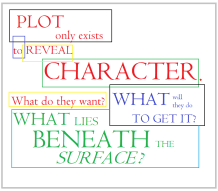
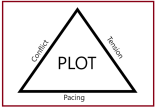
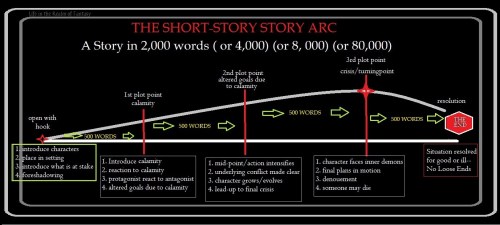
 Now we’re going to design the conflict by creating a skeleton, a series of guideposts to write to. I write fantasy, but every story is the same, no matter the set dressing: Protagonist A needs something desperately, and Antagonist B stands in their way.
 Where does our soldier’s story begin? We open the story by introducing our characters, showing them in their everyday world, and then we kick into gear with the occurrence of the “inciting incident,” which is the first plot point. That might be their arrival at their first camp in the Ardennes region.
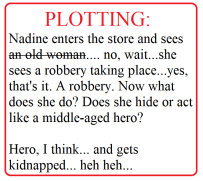 One thing that I do is make notes that help limit my tendency toward heavy-handed foreshadowing. I try to keep it brief, but what will be enough of a hint, and where should it go?
 These exercises will only take a few minutes unless you want to spend more time on them. They’re just a warmup, getting you thinking about your writing project. Each post will tackle a different aspect of preparation and won’t take more than ten or fifteen minutes to complete. By the end of this series, my goal is for you to have a framework that will get your project started.
 I recommend you create a file that contains all the ideas you have in regard to your fictional world, including the personnel files you are creating. I list all my information in an Excel workbook for each book or series, but you can use any kind of document, even handwritten. You just need to write your ideas down. See my post,
  So, who is the protagonist of my intended story? Truthfully, in some aspect or another, they will be the person I wish I were. That is how it always is for me—living a fantasy in the safe environment of the novel. Bilbo was J.R.R. Tolkien’s younger self, an inexperienced man discovering the broader world through his wartime experiences. Luke Skywalker was the hero George Lucas always wanted to be.
 If we know their void, we should write it down now, along with any quirky traits they may have. Next, we decide on verbs that will be the driving force of their personality at the story’s opening. Add some adjectives to describe how they interact with the world and assign nouns to show their characteristics.
 Making lists of names is essential. You want their spellings to remain consistent and being able to return to what you initially planned is a big help later on. When we commence writing the actual narrative, each character will have an arc of growth, and sometimes names will change as the story progresses. Do remember to make notes of those changes.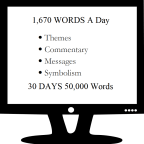
 Short story collection
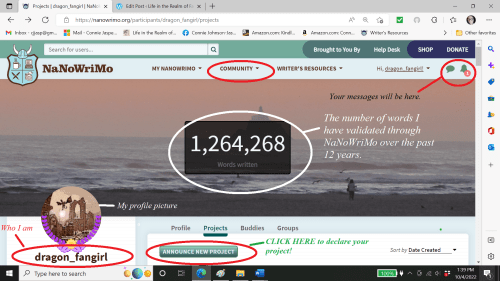
 Next, check out the community tabs. The tabs will be across the top if you are in full screen. If you have the screen minimized, the button for the dropdown menu will be in the upper right corner and will look like the blue/green and black square to the left of this paragraph.
 By the time November arrives, I hope that those who want to “do NaNoWriMo” will have the tools they need and the confidence to get it done.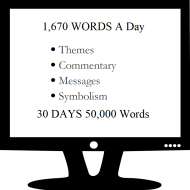
 So, for the two final weeks of November and the first two weeks of December, we will be firing up the Starship Hydrangea (our hydrangea-blue Kia Soul) and driving 30 miles a day to and from the clinic. This will happen four out of five days a week, barring snow.
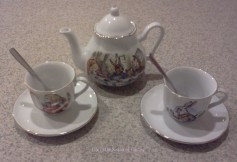 I have no problem getting the first draft done with the aid of a pot of hot, black tea and a simple outline to keep me on track. All that’s required is for me to sit down for an hour or two each morning and write a minimum of 1667 words per day.
 The real work begins after November. After writing most of a first draft, many people will realize they enjoy writing. Like me, they’ll be inspired to learn more about the craft. They discover that writing isn’t about getting a particular number of words written by a specific date, although that goal was a catalyst, the thing that got them moving.
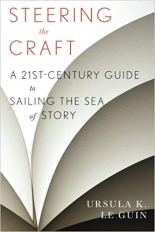 A good way to educate yourself is to attend seminars. By meeting and talking with other authors in various stages of their careers and learning from the pros, we develop the skills needed to write stories a reader will enjoy.
 If you haven’t heard of this before, it’s a worldwide event that happens in November. Each year thousands of people in all parts of the world dedicate themselves to writing a 50,000-word narrative in only thirty days.
 The first roadblock happens when reality sets in and the writers realize that it is work.
 But by November 30th last year, 70 writers out of the 175 in our region had made it to the 50,000-word mark, 3 made it to above 80,000, and 1 exceeded 100,000 words.
 But I got side-tracked. On day 5, I thought about an artifact’s origin that has a role in my still-unfinished novel. 80,000 words later, that bunny trail had become a novel, The Ruins of Abeyon.
 Succeeding in writing even a short story gives many authors the confidence to continue. In their case, NaNoWriMo is about writing and completing a novel they had wanted to write for years, something that had been in the back of their minds for all their lives.
 Over the next few weeks, we will focus on laying the groundwork for our novels so that we will be ready and able to write when November comes. Much of what I will be discussing has emerged from our experience and comes from my co-ML Lee’s prep work as much as from mine.




 Life in the Realm of Fantasy