
Today is the final post in 2022’s NaNoPrep series. The game will be afoot on Tuesday!
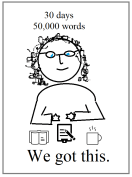 Many authors are prepping for NaNoWriMo 2022. They are mentally committing to writing 1,667 new words every day beginning on November 1st or a total of 50,000 words by midnight on November 30th.
Right now, they are wondering how they will meet this goal. I don’t have a one-size-fits-all answer for that, as you must be able to pay your bills, or no books will ever be written.
When we are just beginning on the path to becoming an author, we feel guilty for taking the time to indulge in such a profoundly personal pleasure. Life tosses up roadblocks, and developing a regular writing habit is difficult.
We have jobs, families, duties to our religious faith, and many demands upon our time. We have all the extra work and activities that come along with living our lives.
In the 1980s, I could only write for half an hour or so at night after my children were asleep, pouring my angst into lyrics for songs. This is why my poetry has a rhythm: I’m a songwriter at heart, and there is always a melody in my head.
The most important thing about developing a writing process is to find one that works for you.
Give yourself permission to try different things until something works.
- Do you work best in short bursts?
- Are you at your best when you have a long session of privacy and quiet time?
- Or is your process something in the middle, a melding of the two?
What if my style changes? What if the way that worked last month no longer works?
Give yourself permission to change, to find a way that does work. Be willing to be flexible.
 Until this past June, I wrote best when I had a long stretch of time to just sit down and immerse myself. Then my husband was diagnosed with Parkinson’s, a degenerative neurological disease, and our life underwent a fundamental change. I am now the only driver in the family, and we live in an area without public transportation.
Varying my projects and writing in bursts broken up by daily activities works best for my schedule nowadays.
The truth is, we must be open to the writing process that makes us feel productive, whether it works for someone else or not. We feel good when we’re productive.
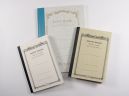
I have my best ideas when I’m about to leave the house—no joke. If that is you too, do as I do and write those thoughts down. I keep a notebook around just for those moments.
You will be productive once you find your best style.
But first—you must give yourself permission to write. Once you do that, your family will too.
I have plenty of downtime between my daily tasks. That is when I work on whatever revisions are needed. You would be amazed at what you can get done in ten-minute bursts.
Balance is the key to a happy life. We want to feel productive and creative, and we need to share our lives and interests with our family and friends.
Therefore, we who wish to write must set aside time to do it. This allows us to be creative and still support our families, who all have activities and interests of their own.
As I have said many times before, being a writer is to be supremely selfish about every aspect of life, including family time.
- It also requires discipline and the ability to set aside an hour or so just for that pursuit, a little time where no one is allowed to disturb you.
 A good way to ensure you have that time is to encourage your family members to indulge in their own interests and artistic endeavors. That way, everyone has the chance to be creative in their own way during that hour, and they will understand why you value your writing time so much.
Many times I wrote while my children did their homework. I was there, able to help, but I was doing my own “homework.”
To be happy, one must have a balanced life. Don’t become so obsessed with writing about fictional lives that you aren’t present in your own.
That need to be present in my real life is why I schedule my writing time. It’s also why I reward myself for achieving my writing goals.
- Some people manage to fit short bursts of writing into their daily schedule, writing at work during breaks or at lunch.
- Others must schedule a dedicated block of time for writing, either rising two hours before they depart for work or skipping some TV in the evening.
If you are a person who needs a dedicated block of time, do it even if you have to get up at 4:00 a.m., and don’t let anything disrupt you. On December 1st, you can reward yourself by sleeping in.
But maybe you can’t sit still for too long.
- Write in small increments—ten minutes here, half an hour there. These short bursts add up.
If you want to meet the goal of 50,000 new words during the 30 days of November, I can’t stress this one thing enough: write every day, whether you have an idea worth noting or not.
 Perhaps your mind has gone blank. An idea is locked in your head, but you don’t have the words to free it. You can still advance your rough draft and meet your word count goal. Step back and view your story from a distance:
- Write several paragraphs detailing what must happen in your story, such as: Fergus dyes Mason’s hair orange here. I don’t know why. Then comes the chase through midtown on bicycles. Fergus gasping, out of shape. Mason catches sight of Leo entering the museum.
Make a note about what blocks you and move on. Once you are past that spot, you will be writing the narrative again. Those notes will be there for you to flesh out when you come back to them. Plus, everything tallies toward your daily word count goal, even those paragraphs that are just thinking out loud.
I am a slow keyboard jockey, and I can do about 1,100 wonky, misspelled words an hour during NaNoWriMo. But every word counts, misspelled or not.
Writers and other artists do have to make sacrifices for their craft. It’s just how things are. But you don’t have to sacrifice your family for it. Sacrifice one hour of sleeping in, and sacrifice something ephemeral and unimportant, like one hour of TV.
By writing in short bursts whenever you have the opportunity, you might finish your first draft and get that certificate that says you completed 50,000 words in 30 days.

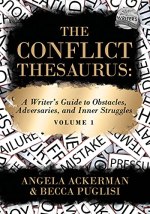
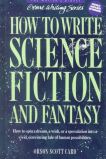 Let’s start with craft. If you are at the beginning stage of your writing life, it’s hard to know where to find help in shaping your work into a coherent story. For many years, I didn’t even know books on the craft of writing existed.
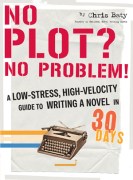 Finishing off the resources from the official NaNoWriMo store is the handbook,
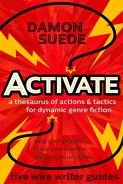
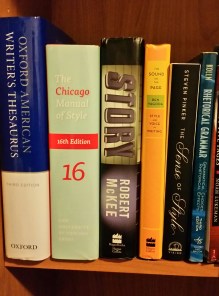
  The following is the list of books that are the pillars of my reference library:
 We usually start our online hunt for information by “googling” a question, no matter what browser you use. Be wary and read several articles to get a broader view of what you are looking for. I also check dates to ensure the information is current and bookmark it if it is relevant to my story. Note: Your browsing history may look a little … unusual … after a while.
 www.Thesaurus.Com
 So, let’s talk about writers’ groups. A good group is the best way to learn about this craft. Your area may have established writers’ groups, and some may be able to accept new members. The best way to find out is to google writer’s groups in your town and make inquiries.
 Today, we will pinpoint the moment in our protagonist(s) life where the story starts. We’re locating the point where this particular memoir, poem, novel, or short story begins.
 Setting: Venice in the year 1430.The weather is unseasonably cold. A bard is concealed amongst the filth and shadows in a dark, narrow alley. Sebastian hides from the soldiers of a prince he has unwisely humiliated in a comic song.
 But the opening moment, the scene showing a lowly bard hiding behind a rubbish heap, is the moment in Sebastian’s life where the story the reader wants to hear starts. That scene is where this story begins regardless of how interesting Sebastian’s story, Venice’s story, or the Warlock Prince’s story was before that day. It is the beginning because this is the point where all the essential characters are in one place and are introduced: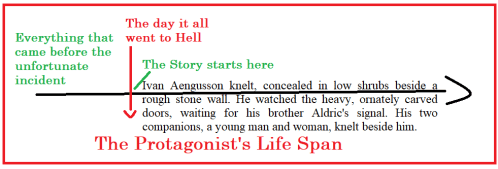
 Post two

 Marco arrives at the inn. The innkeeper mentions Klaus was there, but now he’s gone. Marco sees his barge is still there, and the deckhands don’t know where he is. He goes to the gatehouse where Dinah is supposed to be on duty and immediately knows something is wrong. He fears Klaus has gotten to her, and instinct tells him to go to the Temple.
 In real life, people live happily, but no one really lives deliriously happy ever after. But that’s another story and a different genre.
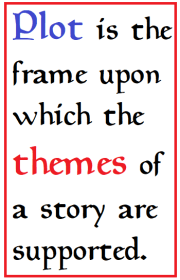 Now we’re going to design the conflict by creating a skeleton, a series of guideposts to write to. I write fantasy, but every story is the same, no matter the set dressing: Protagonist A needs something desperately, and Antagonist B stands in their way.
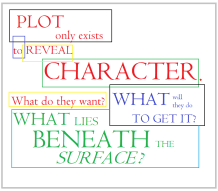 Where does our soldier’s story begin? We open the story by introducing our characters, showing them in their everyday world, and then we kick into gear with the occurrence of the “inciting incident,” which is the first plot point. That might be their arrival at their first camp in the Ardennes region.
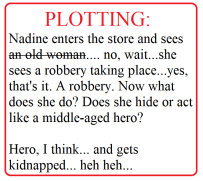 One thing that I do is make notes that help limit my tendency toward heavy-handed foreshadowing. I try to keep it brief, but what will be enough of a hint, and where should it go?
 Every world in which every story is set is imaginary. This is true whether it is a memoir, a cookbook, a math book, a sci-fi novel, a contemporary novel set in London, or an encyclopedia.
 When writing our narrative, we want to avoid contradicting ourselves about our protagonist’s world. Keeping it all in your head is not a good idea, especially if you’re like me—too much data means I regularly have the eternal loading screen when trying to recall something. (I’ll never forget what’s-his-name.)
 Just like we do when creating our characters, we want to begin with a paragraph that might be the encyclopedia explanation of where the action takes place. I write fantasy, so here is the one paragraph I might start with:
 If I were to write a thriller set in the current
  The internet has information about every kind of environment that exists on Earth. All we have to do is use it.
 These exercises will only take a few minutes unless you want to spend more time on them. They’re just a warmup, getting you thinking about your writing project. Each post will tackle a different aspect of preparation and won’t take more than ten or fifteen minutes to complete. By the end of this series, my goal is for you to have a framework that will get your project started.
 I recommend you create a file that contains all the ideas you have in regard to your fictional world, including the personnel files you are creating. I list all my information in an Excel workbook for each book or series, but you can use any kind of document, even handwritten. You just need to write your ideas down. See my post,
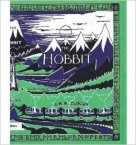
  So, who is the protagonist of my intended story? Truthfully, in some aspect or another, they will be the person I wish I were. That is how it always is for me—living a fantasy in the safe environment of the novel. Bilbo was J.R.R. Tolkien’s younger self, an inexperienced man discovering the broader world through his wartime experiences. Luke Skywalker was the hero George Lucas always wanted to be.
 If we know their void, we should write it down now, along with any quirky traits they may have. Next, we decide on verbs that will be the driving force of their personality at the story’s opening. Add some adjectives to describe how they interact with the world and assign nouns to show their characteristics.
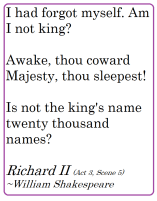 Making lists of names is essential. You want their spellings to remain consistent and being able to return to what you initially planned is a big help later on. When we commence writing the actual narrative, each character will have an arc of growth, and sometimes names will change as the story progresses. Do remember to make notes of those changes.
 Short story collection
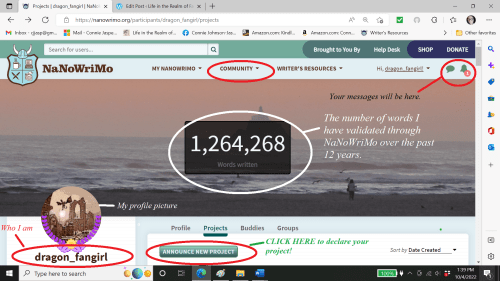
 Next, check out the community tabs. The tabs will be across the top if you are in full screen. If you have the screen minimized, the button for the dropdown menu will be in the upper right corner and will look like the blue/green and black square to the left of this paragraph.
 By the time November arrives, I hope that those who want to “do NaNoWriMo” will have the tools they need and the confidence to get it done.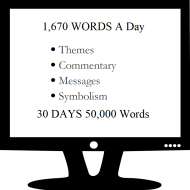
 So, for the two final weeks of November and the first two weeks of December, we will be firing up the Starship Hydrangea (our hydrangea-blue Kia Soul) and driving 30 miles a day to and from the clinic. This will happen four out of five days a week, barring snow.
 I have no problem getting the first draft done with the aid of a pot of hot, black tea and a simple outline to keep me on track. All that’s required is for me to sit down for an hour or two each morning and write a minimum of 1667 words per day.
 The real work begins after November. After writing most of a first draft, many people will realize they enjoy writing. Like me, they’ll be inspired to learn more about the craft. They discover that writing isn’t about getting a particular number of words written by a specific date, although that goal was a catalyst, the thing that got them moving.
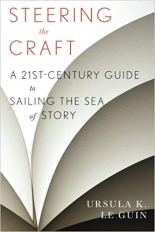 A good way to educate yourself is to attend seminars. By meeting and talking with other authors in various stages of their careers and learning from the pros, we develop the skills needed to write stories a reader will enjoy.
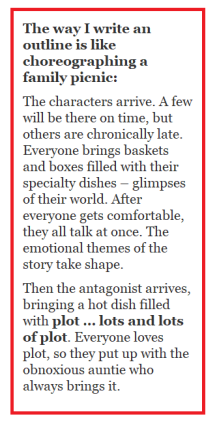 I am a planner, but I’m also a pantser. I’m just writing to a loose outline. All I need is a little free time in advance of November to let my mind wander.
 Next, I ask the creative universe who the protagonist is. I create a brief personnel file, less than 100 words. It’s a paragraph with all the essential background information. Sometimes it takes a while to know what a character’s void is (a deep emotional wound), but it will emerge. I note the verbs, adjectives, and nouns the character embodies, as those give me all the necessary information.
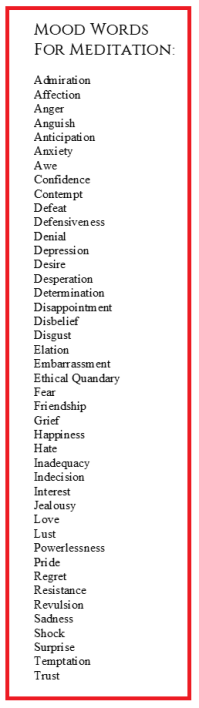 Meditating on mood words often precipitates a flash of brilliance that has nothing to do with anything. What if …


 Life in the Realm of Fantasy