Tag Archives: NaNoWriMo

Motivation, the Character’s Quest #amwriting

The rough draft is called ‘rough’ for a multitude of reasons. This earliest of manuscripts is where we are thinking out loud, finding the true story, so it is bumpy, uneven. We begin with an idea, a ‘what if,’ and as we write, an awesome cast of characters leap onto the page.

Sometimes the side characters are so great, they overshadow the person we originally thought was the protagonist. What do you do if you have chosen a protagonist, but another character suddenly seems to have a more intriguing way about him? You must make a decision–who will be the central character?

If, as you are writing, a different character than the one you originally thought was the protagonist comes to the fore, consider rewriting your beginning to reflect that change. If you are participating in NaNoWriMo and you are 26,000 words into it, don’t scrap it–simply continue forward, but insert a note to go back and change the beginning once November has passed. You wrote those words, and even though they will change in the next draft, they were hard-earned and count toward your official wordcount.

When you have a group of great characters, all with strong storylines, determining who makes the most compelling protagonist can be difficult. Sometimes you must write half a novel before you realize which character has the most opportunity to take full advantage of all the possibilities.

For whatever reason, this never happens in my fantasy work. It is when I am writing contemporary fiction that the story sometimes shifts in a direction I hadn’t planned and identifying just whose journey I am following is easier said than done. As the rough draft progresses, I have to keep in mind that motivation is the key to discovering both who the protagonist is, and who is the villain of the piece. Motivation is the character’s quest to fulfill his/her deepest needs.

  • Who among these people has the most to lose?
  • Which character do you find the most interesting?
  • Whose personal story inspired this tale in the first place?
  • Who will be best suited to take full advantage of all this plot’s possibilities?

The character who best answers those questions must become the protagonist. If necessary, the story will have to be rewritten to reflect that change.

Most of us remember the “five Ws” of journalism. These five words that begin with the letter ‘W’ form the core of every story. Who did what? When and where did it happen?

Why did they do it?

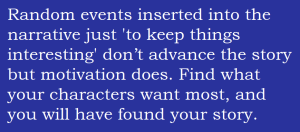
As a reader, I dislike discovering the author is at a loss as to why their protagonist wants to do the task set before them. Random events inserted to keep things interesting don’t advance the story but motivation does.

Suppose we have a protagonist who realizes her marriage is failing. Anna is a well-educated, professional woman, a writer of paranormal fantasy. She is married to another writer, David.

What motivates her? David is strong, charismatic, egocentric, and brilliant. There is nothing he doesn’t feel entitled to, and he will do anything to achieve his goals. Although she is a best-selling author of popular fiction and is the person paying the bills, Anna has made a habit of catering to his needs.

At first, Anna wants to keep her marriage together and presents herself as whatever she thinks David wants her to be. She feels as if she casts no shadow of her own.

Once we know what the characters desire we know who the protagonist is and also we know who will be the best antagonist.

Now, let’s see who the other characters are:

Anna and David rent a secluded house on the wild Washington coast for the summer. They invite 3 companions to join them for the summer, as a working retreat. All five characters have deadlines, and that is their official reason for accepting Anna’s invitation. However, the four other characters each have their own agendas. Other than Anna, they each have strong personalities, are charismatic, and are used to a certain amount of privilege. At first, although it is subtle, each of them uses and manipulates Anna for their own purposes.
Every member of the cast has a secret, including Anna. With the revelation of each secret to the reader, the motivations for subsequent actions become clear.

Unless each character’s desires and needs are clearly defined, the events won’t make any sense. Without clear motivations, all you have are a bunch of drama queens cooped up in a house by the gloomy Washington North Pacific coast.

Once we know who has the most to lose and what motivates each character, we know which of them has the most compelling story. At that point, we have our protagonist. The second draft will be much easier to write.
4 Comments

Filed under writing

Day 8, #NaNoWriMo2017: The Detour

When I was planning my manuscript for NaNoWriMo and the month of November, I had intended to write nothing but short stories.

Unfortunately, the inspiration I had lacked for the rough draft of my current novel-in-progress (set in the Tower of Bones world of Neveyah) struck me at 2:30 a.m. on November 1st, taking us to the mid-point crisis in that story.

As a result, I have written the entire second quarter of that epic fantasy proto-novel, nearly 22,000 words in total over the last six days. But that is how NaNoWriMo sometimes goes for me. I plan to be a rebel, and end up following the rules.

On December 1st, I will copy those new chapters from my NaNo Manuscript and paste them into my original rough draft. Once that is done, the new words will bring the total up to around 60,000 words.

If all goes as planned, I will spend the rest of this month writing short stories, and won’t get back to that story until December 1st.

But as you may have noticed, things don’t always go as planned. When inspiration strikes, you must write, as some stories simply burn to be written. Write when you feel the passion, and you will have done your best work.

The creative process is different, from person to person. I use daydreaming and visual art to fire up the creative muse. With these prompts, I have little trouble getting submerged in my work.

As every writer knows, sometimes finding inspiration for what I am supposed to be working on can be elusive. But some random image or phrase will trigger my imagination. At that point I switch gears and write whatever that story is.

During most of the year, I usually have three manuscripts in various stages: one unfinished first draft, one in the second draft stage, and one near the finish line.  Every day I write new words on my rough draft first thing in the morning, unless I have an editing contract. By ten a.m. I move on to work on the others. Focusing on my rough draft first allows me to come to the more finished stories with a different, less biased eye.

At the end of the day, when my creative mind is tired, I find myself alternating between playing my game and adding a few words here and there to my rough draft.

But during November, my writing time is wholly devoted to writing new words. By the end of the day, my brain is fried, and my creative genius has died an untidy death.

As a result, some of my NaNoWriMo ramblings are brilliant—just ask me and I will tell you so. However, the majority of them not so much.

But every word I write can and will be recycled into something better, something useable, and something worth reading. In writing this stream-of-consciousness prose, I’m getting the ideas down before I forget them.

In 2015 and 2016, the manuscript I patched together for NaNoWriMo was like a quilt made up of short stories. This year’s manuscript will be a patchwork too. It will be made up of scenes and vignettes, parts of stories mingled with complete stories.

This jumble is like a bank, but instead of a place to keep money, it’s a depository of ideas and concepts for short stories, flash fictions, and essays. I will come back to this convoluted mish-mash of genres and prose again and again, whenever I need the core of a new story.

The first 22,000 words of this year have been different from the previous two years, in that my work has been a continuation of an established work-in-progress. However, I have now come to a stopping place.

Now I am experimenting with point of view through short stories. I thought of the perfect plot in which to use the little flâneur that lurks in all of us. Yes, I am leaving the fantasy genre for a brief stint in literary fiction. Besides the flâneur, I have an idea for the story of a woman, navigating the shoals of social ostracization because of her husband’s conviction for embezzlement.

Once those are done,  I will return to fantasy with an installment of Bleakbourne on Heath, and a short story set in Neveyah, the world where Tower of Bones is set.

As my homage to paranormal fantasy, I have the idea for another Dan Dragonsworthy story, set in the Drunken Sasquatch, the neighborhood tavern favored by Seattle’s ‘alternate’ population.

If I have time, Astorica, my gender-bent alternate universe, may see another flash fiction.

I have so many ideas and this month of madness is the time for me to get them all down. In fact, I’ve been talking to you long enough—I have to get back to writing!

Comments Off on Day 8, #NaNoWriMo2017: The Detour

Filed under writing

Developing Discipline #NaNoPrep #NaNoWriMo2017

Every author knows that writing is about so much more than merely laying words down on a page.  Most people with a minimal education can do that, and can even whack out a creditable paragraph or two. However, sustaining the momentum and carrying that vision through an entire novel is quite another thing.

Over the years, I’ve seen disparaging articles where people have expressed their scorn and disdain of authors who participate in Nation Novel Writing Month, mocking the notion of a “competition,” deriding both the authors and work that emerges from this month of madness and frozen pot pies.

They’re missing one important point: to write a novel one must begin a novel and make the time to complete it. It takes discipline to write 50,000 words in 30 days. Most people don’t have what it takes to commit to that kind of regimen. Participating in NaNoWriMo forces the author to sit and write a minimum of 1,667 new words every day. If the participant does only that, they will have completed a 50,000 word novel in 30 days. I generally manage between 2,000 and 4,000 words a day during NaNoWriMo.

So, to the naysayers, I say, “Fine. If it takes a special month of writing and a group frenzy to get some people fired up about an idea they’ve had rolling around in their heads, who am I to complain?” I am a reader as much as I am an author. The more books that are written, the merrier I will be.

Here’s a short list of well-known novels to emerge from NaNoWriMo particpants:

  1. Water for Elephants, by Sara Gruen. On the best-seller lists for over a year, turned into a movie starring Reese Witherspoon and Robert Pattinson, started as a NaNo novel.
  2. The Night Circus, by Erin Morgenstern. What eventually became The Night Circus began life in 2004, seven years before it was finally published, started as a NaNo novel.
  3. Wool, by Hugh Howey. Howey’s dystopian sci-fi novel is one of those credited with putting self-publishing on the map, started as a NaNo novel.

Authors all begin knowing very little about how to write something another person would want to read. But if you maintain the dedication you develop in November, you can learn how to express what your heart feels. Work at learning the craft as hard as you worked to get your wordcount, and you will develop that talent for storytelling.

I think of the many authors to come who will gain both discipline and love of the craft through participating in NaNoWriMo. Many truly talented people are now embarking on learning a craft, committing their time and resources to educating themselves about how to write a novel that others will want to read. Several years down the road, who knows what wonderful works of fiction will have emerged from this year’s madness?

I only know that I am always looking for a good book, and so I will be first in line, hoping to be impressed by a fresh, new work of art. Therefore, I volunteer as a Municipal Liaison for NaNoWriMo. Every year we have new, young writers, with fresh, amazing ideas. But we also have many new older people who are writing their first novel, embarking on a dream they always had but never thought they could do.

The fact is, most people who begin a novel in November do not reach their goal of 50,000 words and never finish those novels. They do not have the discipline to sit down every day and dedicate a portion of their time to this project.

A great number of NaNo authors discover that doing NaNoWriMo is just like doing karaoke. They love to read, and they want to write the next Gone with the Wind, but their work reads as pleasantly as a tone-deaf drunk singing Wind Beneath my Wings. They are not talented writers, and their work isn’t stellar. Just because the rough draft was finished in thirty days and the author got the winner’s certificate of completion, it doesn’t mean that what they wrote was good. It just means they had the discipline to write it.

But despite the high number of would-be authors who fail to finish their novel, a few writers in each age group will continue writing after the month of madness is over. They will embark on the process of educating themselves in the craft.

These authors see the goal and are filled with the desire to finish what they started, knowing they will have to rewrite, edit, revise, and edit again to truly finish their book. When I talk to them and hear how fired up and passionate they are, I am proud to have been a part of their writing life.

Whatever gets a writer fired up and writing is fine by me, and we are all the better for the experience.

7 Comments

Filed under writing

Writing to a Theme #NaNoWriMo2017 #amwriting

November 1st begins the merry month of madness known as NaNoWriMo. Once again, as I have for the last seven years, I will spend the thirty days of November on an intensive writing binge.

Every day I will sit and write at least 1,667 NEW words on my current work in progress. If I do only that, I will have 50,000 words by Nov. 30th, which will bring the rough draft of that book nearly to completion.

But I generally manage between 2,000 and 4,000 words a day, and I work on several different projects. This year, while I WILL work on the rough draft of my current work-in-progress, my official project is another collection of short stories, poems, and flash fictions, all of which will be written to a variety of different themes.

The reason I need to build the backlog with a wide variety of themes is that most anthologies and many publications will call for submissions based around a central idea–such as  redemption, bridges, asylum–a large concept that  unifies the disparate stories.

So, my plan is to write to as many different themes as I can think of. Hopefully, if an opportunity presents itself later, I will have the perfect story ready, one that will only need some revising and editing.

One question I hear often is “how do I identify the theme of my story?” I have discussed this before, but it bears mentioning again. Theme is what the story is about on a deeper level than what is seen on the surface. It’s the big meaning, a thread that is woven through the entire story, and often it’s a moral. Love, honor, family, redemption, and revenge are all common, underlying themes.

Sometimes it’s difficult to write a short story unless you start out with a theme in mind. The same can be said for novels, although the theme can emerge more slowly than in short stories. For me, writing to a theme makes the process easier because half the work is done—I know what I’m writing about.

Several of the stories I will be working on are for themed anthologies with open calls for submission, but whose closing dates are rapidly approaching. When I made my list of proposed stories, I searched Submittable for open calls, so I know the desirable themes in advance. Some publications have submission dates that are quite a ways out, some have short deadlines.

Knowing the trending themes publishers are asking for is crucial to building your backlog with salable stories, so if you don’t have a Submittable account, you should get one.

What I hope to do in each story is to layer character studies, allegory, and imagery to emphasize the central theme and support the story arc. Sometimes I am successful, other times, not so much, but I still keep trying.

Most of my books are based around the hero’s journey, and how the events my protagonists experience shape their reactions and personal growth. The hero’s journey allows me to employ the theme of good vs. evil and the sub-themes of brotherhood, and love of family.

These concepts are important to me on a personal level, and so they find their way into my writing.

What themes are important to you? When you look for a book, what catches your interest? I am not talking genre here, I am speaking of the deeper story. When you look at it from a distance, what do all the stories you love best have in common?

Political thrillers: Set against the backdrop of a political power struggle. Political corruption, terrorism, and warfare are common themes.

Romance Novel: Two people as they develop romantic love for each other and work to build a relationship. Both the conflict and the climax of the novel are directly related to that core theme of developing a romantic relationship, although the novel can also contain subplots that do not specifically relate to the main characters’ romantic love.

Literary fiction focuses on the protagonist of the narrative, creating introspective. These are in-depth character studies featuring interesting, complex and developed characters. Action and setting are not the primary drivers of the story arc here. Instead, action and setting are carefully developed in such a way they frame the character, and provide a visual perspective. Allegory is a featured motif in many literary fiction novels.

Science Fiction: realistic speculation about possible future events, based solidly on adequate knowledge of the real world, past and present, and on a thorough understanding of the nature and significance of the scientific method. Science and technology are a dominant theme but based on current reality. Characters are still subject to sub-themes such as morality and love, but setting and science are the main themes.

Fantasy: Often set in alternate Earths, medieval times, or ancient worlds, the common themes are good vs. evil, hero’s journey, coming of age, morality, romantic love. Can also be set in urban settings with paranormal tropes.

On the surface, these types of books look widely different but all have one thing in common–they have protagonists and side-characters. These imaginary people will all have to deal with and react to the underlying theme of the book.

Morality, love, coming of age–these ideas can be found in nearly every book on my shelves or in my Kindle. These are the themes that were most powerfully depicted in the books that rocked my early reading world and are the sort I still seek out.

4 Comments

Filed under writing

The Stranded Novel #amwriting

Good first lines are critical. They have a singular duty, to involve the reader and kidnap them for the length of the book. For that reason, first lines and the opening chapters frequently become all that is ever written of a would-be author’s novel. Yet the authors of those few chapters have the entire book locked in their head.

Participating in NaNoWriMo teaches authors to write the entire book before they begin editing.

In your first draft, DON’T OBSESS over the small things and the finer details as these will derail your work. You will never get past the first chapter if all you can focus on is writing a brilliant opener. Write the entire story as quickly as you can, let it sit for a month or two while you do something completely different, THEN come back to it and focus on shaping the prose. Once you have the entire structure of the novel laid down on paper, you won’t be left wondering where to go next, writing and rewriting the same first chapter.

So, let’s assume the rough draft has been completed, and you are pleased with the way it ends. But you are looking at your early chapters, and they feel lackluster. Now is the time to shape the words, to write them so they are the words you would want to read if you were looking for a book to purchase.  The second draft is when you should obsess about your first lines.

One of the best first lines ever: George Eliot’s Middlemarch starts, “Miss Brooke had that kind of beauty which seems to be thrown into relief by poor dress.” That line makes one want to know Miss Brooke and the reader wonders who the observer is who chronicles this. It is a novel, but if it had been a short story, it would still have hooked the reader.

Good first lines make the reader beg to know what will happen next.  How about this first line from Ulysses, by the king of great one-liners, James Joyce: “Stately, plump Buck Mulligan came from the stairhead, bearing a bowl of lather on which a mirror and a razor lay crossed.”

Or, take the first line of Jane Austen’s Pride and Prejudice“It is a truth universally acknowledged, that a single man in possession of a good fortune, must be in want of a wife.” 

Should your first lines be required to introduce your main character? I think not.

Dickens introduced an era in the opening lines of A Tale of Two Cities: “It was the best of times, it was the worst of times, it was the age of wisdom, it was the age of foolishness, it was the epoch of belief, it was the epoch of incredulity, it was the season of Light, etc…” 

In his Wheel of Time series, Robert Jordan frequently opened with a glimpse into the side of evil, illuminating the foes whom Rand Al Thor must somehow prevail against, and that always hooked me.

All of the above books were begun as great ideas and the manuscripts were finished, which is why they were published. Admittedly, Robert Jordan did pass away before the final books were completed, but he wrote 12 of the 15 books and left a complete story arc with enough notes that Brandon Sanderson could finish the job. Jordan left behind a complete story, not just a first chapter.

If you are serious about writing, it’s necessary to read, to see how other authors have completed their work. Of course, you must read works published in your chosen genre, but to become an educated reader/author, you should look outside your favorite genre. You don’t have to spend your precious book purchasing funds on books you believe you won’t enjoy. Do a little advance research via the internet and then borrow the books from the library.

Most importantly–published authors, whether Indie or traditionally published, have finished their work. Maybe they didn’t do as great a job as some people think they could have done, but they did finish the job.

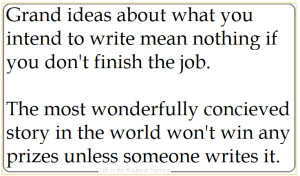
Grand ideas about what you intend to write mean nothing if you don’t finish the job. If you want to lay claim to being an author, write the ENTIRE novel! Get that story arc down on paper before you begin rewriting the first chapter! If all you have ever written is the first chapter, over and over, and over… perhaps you need to set that idea aside and begin one that interests you enough to inspire you to write a complete novel.

6 Comments

Filed under writing

Jumpstart #NaNoWriMo2017 The Storyboard #amwriting

It’s mid-October and time for many writers to think about National Novel Writing Month—thirty days of dedicated writing where you take an idea for a novel, sit down and daily write at least 1,667 words of a rough draft. The goal of this month of concentrated writing time is to get the entire story down while the inspiration and ideas are flowing. At the end of the thirty days, you should have a novel-length story, hopefully with a complete story arc (beginning, middle, end).

Once that is done, the work really begins.

To succeed at completing a project with such an ambitious goal, it helps if you spend some time planning your novel.  To that end, I like to storyboard all my ideas. By making this effort when the idea is first in my head, if I become lost or find myself floundering in the writing process, I can come back to my original files and remind myself of what the original concept of the story actually was.

Many people use Scrivener for this, but I found the learning curve for that program to be too annoying, so I simply use a spreadsheet program, because all the important information is on the same line.

Scrivener costs $40.00which is not bad, but Google Drive has the free program, Google Sheets. This program is similar to Excel (which I use), so the principals I will be discussing are the same.

From Wikipedia:

Google DocsGoogle Sheets, and Google Slides are a word processor, a spreadsheet and a presentation program respectively, all part of a free, web-based software office suite offered by Google within its Google Drive service. The three apps are available as web applications, and as mobile apps for Android and iOS. The apps are compatible with Microsoft Office file formats. The suite also consists of Google Forms (survey software), Google Drawings (diagramming software) and Google Fusion Tables (database manager; experimental[8]).

The suite allows users to create and edit files online while collaborating with other users in real-time. Edits are tracked by user with a revision history presenting changes. An editor’s position is highlighted with an editor-specific color and cursor.

Admittedly, this program doesn’t do what Excel does but it is perfect for this if you don’t have Microsoft Office.

But you can do this any old way that makes you happy, even by drawing columns on a sheet of paper by hand. The point is to have a list of names and places with five pieces of information pertaining to the story all on the same line. I have so many ideas that I created a blank template that I fill in, retitle, and save in a new folder for each prospective story. I may make as many as five storyboards in a week, out of which I may not write any of them, lol. But the ideas are there for me to access when I want them.

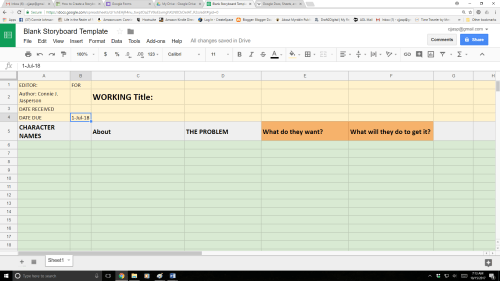
The following is a screenshot of my blank storyboard template. Originally this began as a way to do short stories, but my novels begin with ideas storyboarded out this way too.

The storyboard for my ideas works this way:

At the Top: Working Title

If it’s an idea for a short story, the intended publication and closing date for submissions (not needed it it is for a novel)

Column A: Character Names: list the important characters by name, and also list the important places where the story will be set.

Column B: About: What their role is, a note about that person or place, a brief description of who and what they are.

Column C: The Problem: What is the core conflict?

Column D: What do they want? What does each character desire?

Column E: What will they do to get it? How far will they go to achieve their desire?

As I said, this plays directly to how a linear thinker like me works. It takes advantage of the ideas I have that might make a good story, makes a note of all the pertinent ideas I have at the outset, and offers me a jumping off point.

Feel free to take this idea and run with it. Design the storyboard that works for you!


Credits and Attributions

NaNoWriMo 2017 Municipal Liaison Badge, © 2017 www.nanowrimo.org, (limited use permitted for Municipal Liaisons on blogs and social media).

Wikipedia contributors, “Google Docs, Sheets, and Slides,” Wikipedia, The Free Encyclopedia, https://en.wikipedia.org/w/index.php?title=Google_Docs,_Sheets,_and_Slides&oldid=805075002 (accessed October 15, 2017).

Screenshot of Blank Storyboard Template, © 2017 Connie J. Jasperson, All Rights Reserved.

5 Comments

Filed under writing

#NaNoPrep Season: Learning Your Pre-writing Style #NaNoWriMo

Today I am featuring a post by my good friend, and fellow Municipal Liaison for NaNoWriMo, Lee French. Lee poses the question: Are you a ‘pantser’ or a ‘plotter?’ For me, the answer lies somewhere in the middle. I plot, then I wing it, then I replot, and let it fly. Without further ado, here is Lee’s post.  I heartily suggest you read it all and click on through to finish the post on her page.

Lee French's avatarLee French

There are many writers who claim to pants their stories. That is, fly by the seat of their pants, aka no plan, no outline, no nothing before starting to write. The other option is planning, which consists of drawing up a complete outline, character bios, detailed setting documents, and so on.

Pantser vs. Plotter

I wish to submit two controversial opinions:

  1. Pantsing and plotting are not two options, but rather two ends of a spectrum.
  2. As with many linear scales, most of us fit most comfortably somewhere between the two extremes.

The popularized term for folks who do “both” is Plantser. My argument is that we are all plantsers. Or, at least, the majority of us are.

Planster

The hitch: until you start writing, you have no real idea where you fit on that spectrum. You may think you’re on the Pantser end, then you get stuck on Day 4…

View original post 322 more words

3 Comments

Filed under writing

#amwriting: Dinosaurs Among the Birds

This week has been a challenge–life has conspired against my ability to write. So, being an ecologically minded person, today’s blog post is an essay, recycled from my archives.


I graduated from high school in 1971. My friends and I were so close in those years and we have held onto those connections, despite the rough seas of young adult life. We drifted apart during the ‘blender years,’ but as our children left home and our lives became more our own, we drifted back together.

Forty-six years ago, we were young and wild, determined to carve our path in the world and desperate to get on with living. We were tired of the war, tired of politics, and tired of being told what to think by a media that was controlled by pin-headed men in suits. We were tired of Congress selling us out.

We were going to change the world.

We did change it, but not exactly the way we naively believed we would. Even though we were unable to solve all the problems we wanted to, we did manage to make some positive changes. Unfortunately, we were too few, voices shouting in the wind.

And now we are somewhat jaded. The country is still divided, big money still buys votes. Congress is still selling out, and the media is still owned by pin-headed men in suits. There is always a war somewhere, and it is never done with.

My generation clings to our belief that we will see positive changes, but we don’t believe we’ll live long enough to enjoy them. Nevertheless, change is inevitable and it will happen, even if, like Moses and the promised land, we stand on the opposite shore and see only what yet may be.

My old friends and I are not exactly who we were in those wild days. Now we’re an amalgamation of everything we once believed would happen and the reality we lived. We are people who survived Reaganomics, who survived raising children through the MTV years. We held down three part-time jobs because trickle-down economics didn’t really trickle down the social ladder to our rung, and we had kids to feed.

We survived the Bush years with some of our dignity intact and didn’t fold under the “you’re with us, or you’re against us” propaganda designed to shut us up. We will survive whatever comes our way with the current regime because old wood is tough wood and doesn’t break easily.

We are jaded, but we have hope, we old hippies, we old women and men who are dinosaurs among the birds of the modern, hyper-connected world. We still believe small businesses feed more families and provide more jobs than big corporations do, and are therefore more deserving of the tax breaks that Corporate America extorts from the public coffers. We believe in the American dream of entrepreneurship, that the world can be a better place for everyone. The difference is now we know we can change the world… just not in the way we thought we would.

Now we put our money where our mouth is, donating to charities and spending our retirement years volunteering in schools and hospitals. We do it in small ways, chipping away, and little by little we have a positive effect.

We lost the battle to make the world a simpler, kinder place. Our parents were The Greatest Generation, and they won the second World War with their firm, 20th century belief that only through technology would mankind benefit, and that somewhere a miracle drug was waiting, one able to cure every disease known to man.  It just hadn’t been discovered yet. Now the drug companies have the government’s balls in one hand and a claw-like grip on our pocketbooks with the other. That hoped-for miracle cure is still somewhere out there on the horizon, and likely always will be.

My generation was conquered, despite the struggle to keep it simple. We old hippies now embrace technology and make it ours. We do this because we must either adapt or die, and I am not ready to die. We are a wired society, and we old people have the luxury of a little free time and occasionally, extra money. So, we have become wired.

Writing is my opportunity to live in the world as I would like it to be, and it is my chance to get away from the war, from politics, from the problems of everyday life. Writing is my escape.

I support creativity and free-thinking on a local level. I volunteer as municipal liaison for NaNoWriMo. I encourage people from all walks of life, and from every point of view to write. It doesn’t matter to me if we agree politically or not. Everyone has a story to tell. Some stories are real and incredibly moving, and all the writer needs is the skill to tell that story the way it should be told.

crest-bda7b7a6e1b57bb9fb8ce9772b8faafbThey can gain that skill through participating in NaNoWriMo, National Novel Writing Month. Children and schools benefit year-round from writing programs sponsored by this organization. For me, November is the busiest month of the year. I will be meeting and getting to know many new people, and I will be writing the framework for a new novel.  For one month, thousands of people will be too busy writing to spend their evening in front of the electronic altar, being fed mindless pap in the form of ‘entertainment.’ Instead, they will entertain themselves and find they are so much more than they ever thought they could be.
With every new book that is written, each new magazine article or essay, the world opens its eyes a bit more, seeing more possibilities. Readers discover they are not islands disconnected from society, cocooned in dark living-rooms, unable to look away from the poorly crafted mind-porn we are force-fed by the big networks.

I am an old hippy, I admit it. But I am water, wearing away at ignorance, helping the world learn how to tell its story one person at a time.


Dinosaurs Among the Birds, by Connie J. Jasperson was first published 17 May 2017 on the  myrddinpublishing.com blog, http://www.myrddinpublishing.com/dinosaurs-among-birds/.

American Flag By Michael Dorausch (Flickr: American flag) [CC BY-SA 2.0 (http://creativecommons.org/licenses/by-sa/2.0)%5D, via Wikimedia Commons

2 Comments

Filed under writing

#amwriting: Thoughts on #NaNoWriMo2016

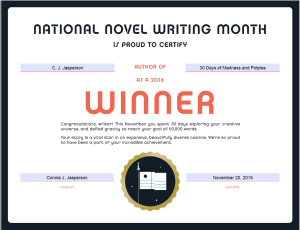
winners-certificateIt is the final day of NaNoWriMo for 2016. I wrote 96,603 words: ten short stories and fifteen chapters on my next novel set in the world of Neveyah. I had my winners certificate by the 23rd, but I write everyday and update my wordcount. More than sixty of the 265 participants in my region will also get their winner’s certificates, which is a very good year. Some years only thirty participants in our region make it to the finish line. On average, 7 out of ten entrants will fall by the way in any given year, because 50,000 words is a difficult goal to achieve in only 30 days, if you are not completely fired up by your novel.

Those who fall by the way are authors who discover that having an idea that would be a good book and writing that book are two radically different things. They are daunted by the amount of work that is involved.

NaNoWriMo (National Novel Writing Month) is a contest in the sense that if you write 50,000 words and have them validated through the national website you ‘win.’ But it is not a contest in any other way as there are no huge prizes or great amounts of acclaim for those winners, only a PDF winners certificate that you can fill out and print to hang on your wall.

It is simply a month that is solely dedicated to the act of writing a novel.

Now lets face it–a novel that is only 50,000 words long is not a very long novel. That falls more into the line of a long novella and is only half a novel, in my opinion. But a dedicated author can get the basic structure and story-line of a novel down in those thirty days simply by sitting down for an hour or two each day and writing a minimum of 1667 words per day.

That is not too hard. In this age of word processors, most authors can double or triple that.

As always, there is a downside to this free-for-all style of writing. Just because you can sit in front of a computer and spew words does not mean you have the ability to write a novel that others want to read.

Over the next few months many cheap or free eBooks will emerge testifying to this fundamental truth.

The good thing is, over the next few months many people will realize they enjoy the act of writing. They will find that for them this month of madness was not about getting a certain number of words written by a certain date, although that goal was important. For a very few, participating in NaNoWriMo has fired them with the knowledge that they are authors. For them it was about writing and completing a novel they had wanted to write for years, something that had been in the back of their minds for all their lives.

These are the people who will join writing groups and begin the long journey of learning the craft of writing. They may go back to school and get their MFA.

These authors will take the time and make the effort to learn writing conventions (practices). They will attend seminars, they will develop the skills needed to take a story and make it a novel with a proper beginning, a great middle and an incredible end.

They will properly polish and edit their work and run it past critique groups before they publish it.

These are books I will want to read.

It’s not easy. Sometimes what we hear back from our readers and editors is not what we wanted to hear. The smart authors haul themselves to a corner, lick their wounds, and rewrite it so it’s more readable. They will be successful, for a variety of reasons, all of them revolving around dedication and perseverance.

But when we write something that a reader loves–that is a feeling that can’t be described.

Authors must keep their day jobs, because success as an author these days can’t be measured in cash. It can only be measured in what satisfaction you as an author get out of your work. Traditionally published authors see a smaller percentage of their royalties than indies, but if they are among the lucky few, they can sell more books.

2016-placeholder-book-cover-smallThe fact your book has been picked up by a traditional publisher does not guarantee they will put a lot of effort into pushing a first novel by an unknown author. You will have to do all the social media footwork yourself. You may even have to arrange your own book signing events, just as if you were an indie.

Going indie or aiming for a traditional contract—it’s a conundrum many new authors will be considering in the new year.

However, if you don’t write that book, you aren’t an author, and you won’t have to worry about it. The concept of NaNoWriMo will jump-start many discussions about this very issue.

Today marks the end of NaNoWriMo 2016.  For many, it will be a mad scramble between now and midnight to get their 50,000 words and earn that certificate.

Some of us have completed our first draft, and some of us still have a ways to go. But we are all walking a path that is more rewarding than any high-paying job I’ve ever had.

nanowrimo_2016_webbanner_winner_congrats

7 Comments

Filed under writing

#amwriting: #nanowrimo momentum

2016-placeholder-book-cover-smallWe’re on Day 2 of NaNo 2016. I’ve written two short stories totaling 11,605 words, 80% of them misspelled, but I won’t worry about that until January. I admit I was hoping to have written four, but I’m still on track to make 50 short stories and flash fictions by the end of November.

Some people are already behind, but all is not lost.  Get caught up now and go forward by adding a few extra words every day.

Habitual behavior, or ‘daily routine’ goes unnoticed because we don’t engage in self-analysis when undertaking routine tasks. Thus, writing daily is easier once it becomes a behavioral habit.

Consider smoking.

Smoking is a behavioral habit as much as it is a physical addiction. Smokers trying to quit always tell me they don’t know what to do with their hands. When they first started smoking they trained themselves to do “the cigarette ritual,” shaking the cigarette out of the pack, lighting it, holding it, and exhaling the smoke with their own style each time they went outside.  They did this ritual every time they lit up their cigarette, and now their hands have “nothing to do.”

If breaking certain habits is difficult, creating new, more positive habits is also tough. Behavioral patterns we repeat become imprinted in our neuro-pathways, so repetition of positive behaviors is necessary to make the behavior automatic. Wikipedia, the Fount of all Knowledge, says this:

“As the habit is forming, it can be analysed in three parts: the cue, the behavior, and the reward. The cue is the thing that causes the habit to come about, the trigger of the habitual behavior. This could be anything that one’s mind associates with that habit and one will automatically let a habit come to the surface. The behavior is the actual habit that one exhibits, and the reward, a positive feeling, therefore continues the “habit loop”.[13] A habit may initially be triggered by a goal, but over time that goal becomes less necessary and the habit becomes more automatic.”

In his November 3rd, 2013 blog post for Creative Writing Guild, Rob Blair says:

“Studies on habit formation have found that extra willpower is almost never sufficient for getting a new habit to stick. What does seem to work is an intervention that looks like this:

  • Write out the details of what you want the new habit to be. (In your case, it’s going to be writing 1,667 words per day.)

  • Plan the details of how and where you will be engaging in the new habit. Be as concrete as you can be.

  • Plan a “trigger” for when you will start doing the new habit. How will you know it’s time to start writing? This can be a specific time, but I’ve found it’s better to choose a point in your normal daily routine where you can insert the new habit. (e.g., “After pouring coffee but before changing out of my PJs.)

  • Write a list of the pitfalls, detailing what’s most likely to go wrong. What’s prevented you from writing in the past? Did you get busy? Did you sleep in? Did you “feel uncreative”? Be honest with yourself, and get your normal traps and tribulations on the page.

  • Write a response plan for each pitfall. This can be something complex, but research has found that even simple response plans (e.g., “I’ll remind myself this is writing time and I can sleep in come December”) are astoundingly effective. (end quoted material.)

I like what Rob has to say about doing a small intervention to short-circuit self-defeating habits, but remember such effort only works if you are honestly committed to the project. He also offers a great deal of other useful advice in that article, so I highly recommend you read his post in its entirety.

But what I really believe is that you will succeed in developing the habit when you write something you are really fired up about. When you are passionate about a story, the words will flow. Find that moment in your daily routine when you can insert a new habit, put pen to paper and begin writing!

The best thing about stream-of-consciousness writing is you don’t take the time to over-think things. You write it as you think it, and the word count grows as if by magic.

I’m using this time to write short stories, but just as if I were writing a nano-novel, I will be done writing at the end of November. I will take a break from this project until January and then, over the course of the next year I will be pulling these rough drafts out of the 2016 NaNoWriMo file and polishing them up.  That is when I will worry about what is wrong with these little stories, and implement plot adjustments. Right now, I am just writing it as I think it, warts and all.


Reference Sources:

6 Steps for Nailing the First Week of NaNoWriMo, published November 3, 2013, on http://www.creativewritingguild.com · by Rob Blair

Wikipedia contributors, “Habit,” Wikipedia, The Free Encyclopedia, https://en.wikipedia.org/w/index.php?title=Habit&oldid=747213739 (accessed November 1, 2016).

2 Comments

Filed under NaNoWriMo, writing