Tag Archives: Netherlandish Proverbs

#FineArtFriday: Revisiting “The Way you Hear it is the Way you Sing It” by Jan Steen ca. 1665

Artist: Jan Steen  (1625/1626–1679)

Jan Steen: ‘As the Old Sing, So Pipe the Young’

Title: ‘The way you hear it, is the way you sing it’

Genre: genre art

Date: circa 1665

Medium: oil on canvas

Dimensions: Height: 134 cm (52.7 in); Width: 163 cm (64.1 in)

I always post a Jan Steen painting at New Years, because I love how raucous and down to earth his characters are. It’s a New Year and we’re having a party. No Puritans allowed, as we’ll have no feigning a dignified demeanor here–we’re drunk, and we don’t care. The people who posed for this painting are featured in many of Steen’s genre works, sometimes wearing the same costumes as we see here. I suspect we are seeing Steen’s family members or close friends acting out the story Jan wishes to show us.

About this painting:

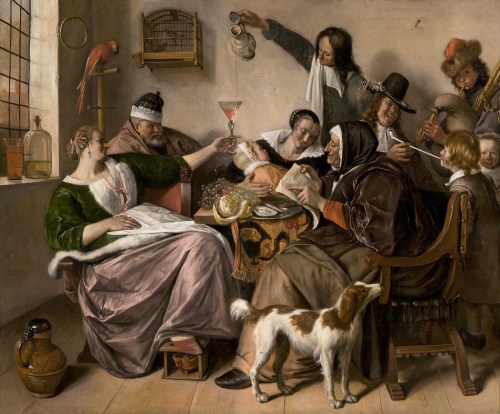
Jan Steen’s work The Way you Hear it is the Way you Sing It depicts a Dutch Proverb, As the Old Sing, So Twitter the Young. It shows us a family carousing and overindulging in rich foods. Luxurious fabrics, a foot warmer, and rare birds show off this family’s wealth, which they are spending lavishly as fast as they can.

A young piper, who closely resembles a young Jan Steen (possibly one of his sons?), entertains them. He looks directly at us as if to ask what he’s gotten himself into.

Mother and Father, dressed as the King and Queen, are sumptuously attired, being served wine in an overlarge crystal goblet by the family’s servant. Both are indifferent to the chaos, too sated and drunk to care.

To the right of Father (his left, our right), a younger woman, perhaps an unmarried sister or eldest daughter, is holding the baby but has nodded off, having indulged too freely.

The wasting of money on so much luxury that one can’t consume it all is clearly represented here. Mother raises her glass high to have it refilled, as if it is the most important thing–indeed, the wine cascading down into the crystal goblet is the focal point of the picture.

A bottle of clear liquor (distilled?) and a beaker of ale are set on the windowsill behind Father, and a covered pitcher stands on the floor beside Mother. The table is laden with grapes and oysters, expensive luxuries.

Grandmother is singing from sheet music, leading the song that the family sings. This is the direct allegory for the proverb, as the old sing, so twitter the young.

A youngish man, either the eldest son or the Drunk Uncle (every family has one), finds it hilarious to teach the children to smoke.

Neither the dog nor the piper is impressed with the carrying on, and the servant has no comment, merely serving the wine as required.

In essence, Steen tells us that children learn what they live, so if you want sober, morally upstanding children, you must be a sober, morally upright parent.

About the Artist, via Wikipedia:

Jan Havickszoon Steen (c. 1626 – buried 3 February 1679) was a Dutch Golden Age painter, one of the leading genre painters of the 17th century. His works are known for their psychological insight, sense of humour and abundance of colour.

In 1648 Jan Steen and Gabriël Metsu founded the painters’ Guild of Saint Luke at Leiden. Soon after he became an assistant to the renowned landscape painter Jan van Goyen (1596–1656), and moved into his house on the Bierkade in The Hague. On Oct 3, 1649 he married van Goyen’s daughter Margriet, with whom he would have eight children. Steen worked with his father-in-law until 1654, when he moved to Delft, where he ran the brewery De Slang (“The Snake”) for three years without much success. After the explosion in Delft in 1654 the art market was depressed, but Steen painted A Burgomaster of Delft and his daughter. It does not seem to be clear if this painting should be called a portrait or a genre work.

Steen lived in Warmond, just north of Leiden, from 1656 till 1660 and in Haarlem from 1660 till 1670 and in both periods he was especially productive. In 1670, after the death of his wife in 1669 and his father in 1670, Steen moved back to Leiden, where he stayed the rest of his life. When the art market collapsed in 1672, called the Year of Disaster, Steen opened a tavern. In April 1673 he married Maria van Egmont, who gave him another child. In 1674 he became president of the Saint Lucas Guild. Frans van Mieris (1635- 1681) became one of his drinking companions. He died in Leiden in 1679 and was interred in a family grave in the Pieterskerk.

Daily life was Jan Steen’s main pictorial theme. Many of the genre scenes he portrayed, as in The Feast of Saint Nicholas, are lively to the point of chaos and lustfulness, even so much that “a Jan Steen household”, meaning a messy scene, became a Dutch proverb (een huishouden van Jan Steen). Subtle hints in his paintings seem to suggest that Steen meant to warn the viewer rather than invite him to copy this behaviour. Many of Steen’s paintings bear references to old Dutch proverbs or literature. He often used members of his family as models, and painted quite a few self-portraits in which he showed no tendency of vanity.

Steen did not shy from other themes: he painted historical, mythological and religious scenes, portraits, still lifes and natural scenes. His portraits of children are famous. He is also well known for his mastery of light and attention to detail, most notably in Persian rugs and other textiles.

Steen was prolific, producing about 800 paintings, of which roughly 350 survive. His work was valued much by contemporaries and as a result he was reasonably well paid for his work. He did not have many students—only Richard Brakenburgh is recorded—but his work proved a source of inspiration for many painters. [1]


Credits and Attributions:

IMAGE: The Way you Hear it is the Way you Sing It, Jan Steen, Public domain, via Wikimedia Commons

Wikimedia Commons contributors, “File:The way you hear it.jpg,” Wikimedia Commons, https://commons.wikimedia.org/w/index.php?title=File:The_way_you_hear_it.jpg&oldid=428340634 (accessed January 2, 2025).

[1] Wikipedia contributors, “Jan Steen,” Wikipedia, The Free Encyclopedia, https://en.wikipedia.org/w/index.php?title=Jan_Steen&oldid=1249713624 (accessed January 2, 2025).

4 Comments

Filed under #FineArtFriday

#FineArtFriday: The Peasant and the Nest Robber by Pieter Bruegel the Elder 1568

The_Peasant_and_the_Birdnester_Pieter_Bruegel_the_Elder_1568Artist: Pieter Brueghel the Elder (1526/1530–1569)

Title:  “The Peasant and the Nest Robber”

Date: 1568

Medium: oil on oak wood

Dimensions: 59.3 × 68.3 cm (23.3 × 26.8 in)

Collection: Kunsthistorisches Museum

What I love about this painting

Pieter Brugel the Elder was a man with a sharp eye for the humorous and the ability to wield allegory and symbolism like a knife. He cuts to the heart of things, pointing out the hubris and vanities of people from all walks of life.

Pieter Brugel the Elder was earthy and honest in his depictions of village life in his time. He painted what he saw and celebrated the ups and downs of the human condition. Today, his art is an important source of evidence about the social mores and values governing 16th-century life.

This painting details his favorite subject of human frailty, but he’s taken a different approach, narrowing his usual cast of thousands to just two.

In this case, he is pointing out that people are opportunists. We either have the knowledge and nerve to take what we need or the knowledge and sly desire to point out the failings of others.

Both men in this scene are taking the opportunity to advance themselves. One gains eggs and a good meal, and the other gains a sense of moral superiority.

Neither man feels guilty.

About this painting, via Wikipedia:

This unusual subject apparently illustrates a Netherlandish proverb:

Dije den nest Weet dijen weeten, dijen Roft dij heeten
He who knows where the nest is, has the knowledge, he who robs, has the nest.

The painting presents a moralising contrast between the active, wicked individual and the passive man who is virtuous in spite of adversity (a similar theme appears in his drawing The Beekeepers)] And lastly it could be suggested that the pointing man is making judgement on the robber whilst not aware that he is nearly stepping into the water in front of him.

It has been suggested that, with his knowledge of Italian art, Bruegel intended the peasant’s gesture as a profane parody of the gesture of Leonardo‘s St John. [1]

About the Artist, via Wikipedia:

Pieter Bruegel (also Brueghel or Breughelthe Elder c. 1525–1530 – 9 September 1569) was the most significant artist of Dutch and Flemish Renaissance painting, a painter and printmaker from Brabant, known for his landscapes and peasant scenes (so-called genre painting); he was a pioneer in making both types of subject the focus in large paintings.

He was a formative influence on Dutch Golden Age painting and later painting in general in his innovative choices of subject matter, as one of the first generation of artists to grow up when religious subjects had ceased to be the natural subject matter of painting. He also painted no portraits, the other mainstay of Netherlandish art. After his training and travels to Italy, he returned in 1555 to settle in Antwerp, where he worked mainly as a prolific designer of prints for the leading publisher of the day. Only towards the end of the decade did he switch to make painting his main medium, and all his famous paintings come from the following period of little more than a decade before his early death, when he was probably in his early forties, and at the height of his powers.

Around 1563, Bruegel moved from Antwerp to Brussels, where he married Mayken Coecke, the daughter of the painter Pieter Coecke van Aelst and Mayken Verhulst. As registered in the archives of the Cathedral of Antwerp, their deposition for marriage was registered 25 July 1563. The marriage itself was concluded in the Chapel Church, Brussels in 1563.

Pieter the Elder had two sons: Pieter Brueghel the Younger and Jan Brueghel the Elder (both kept their name as Brueghel). Their grandmother, Mayken Verhulst, trained the sons because “the Elder” died when both were very small children. The older brother, Pieter Brueghel copied his father’s style and compositions with competence and considerable commercial success. Jan was much more original, and very versatile. He was an important figure in the transition to the Baroque style in Flemish Baroque painting and Dutch Golden Age painting in a number of its genres. He was often a collaborator with other leading artists, including with Peter Paul Rubens on many works including the Allegory of Sight.

Other members of the family include Jan van Kessel the Elder (grandson of Jan Brueghel the Elder) and Jan van Kessel the Younger. Through David Teniers the Younger, son-in-law of Jan Brueghel the Elder, the family is also related to the whole Teniers family of painters and the Quellinus family of painters and sculptors, through the marriage of Jan-Erasmus Quellinus to Cornelia, daughter of David Teniers the Younger. [2]


Credits and Attributions:

[1] IMAGE and Quote about this picture: Wikipedia contributors, “The Peasant and the Nest Robber,” Wikipedia, The Free Encyclopedia, https://en.wikipedia.org/w/index.php?title=The_Peasant_and_the_Nest_Robber&oldid=1160869804 (accessed September 12, 2024).

[2] Wikipedia contributors, “Pieter Bruegel the Elder,” Wikipedia, The Free Encyclopedia, https://en.wikipedia.org/w/index.php?title=Pieter_Bruegel_the_Elder&oldid=1218696694 (accessed September 12, 2024).

2 Comments

Filed under #FineArtFriday

#FineArtFriday: The Way you Hear it is the Way you Sing It by Jan Steen ca. 1665

Artist: Jan Steen  (1625/1626–1679)

Jan Steen: ‘As the Old Sing, So Pipe the Young’

Title: ‘The way you hear it, is the way you sing it’

Genre: genre art

Date: circa 1665

Medium: oil on canvas

Dimensions: Height: 134 cm (52.7 in); Width: 163 cm (64.1 in)

About this painting:

Jan Steen’s work The Way you Hear it is the Way you Sing It depicts a Dutch Proverb, As the Old Sing, So Twitter the Young. It shows us a family carousing and overindulging in rich foods. Luxurious fabrics, a foot warmer, and rare birds show off this family’s wealth, which they are spending lavishly as fast as they can.

A young piper, who closely resembles a young Jan Steen (possibly one of his sons?), entertains them. He looks directly at us as if to ask what he’s gotten himself into.

Mother and Father, dressed as the King and Queen, are sumptuously attired, being served wine in an overlarge crystal goblet by the family’s servant. Both are indifferent to the chaos, too sated and drunk to care.

To the right of Father (his left, our right), a younger woman, perhaps an unmarried sister or eldest daughter, is holding the baby but has nodded off, having indulged too freely.

The wasting of money on so much luxury that one can’t consume it all is clearly represented here. Mother raises her glass high to have it refilled, as if it is the most important thing–indeed, the wine cascading down into the crystal goblet is the focal point of the picture.

A bottle of clear liquor (distilled?) and a beaker of ale are set on the windowsill behind Father, and a covered pitcher stands on the floor beside Mother. The table is laden with grapes and oysters, expensive luxuries.

Grandmother is singing from sheet music, leading the song that the family sings. This is the direct allegory for the proverb, as the old sing, so twitter the young.

A youngish man, either the eldest son or the Drunk Uncle (every family has one), finds it hilarious to teach the children to smoke.

Neither the dog nor the piper is impressed with the carrying on, and the servant has no comment, merely serving the wine as required.

In essence, Steen tells us that children learn what they live, so if you want sober, morally upstanding children, you must be a sober, morally upright parent.

About the Artist, via Wikipedia:

Jan Havickszoon Steen (c. 1626 – buried 3 February 1679) was a Dutch Golden Age painter, one of the leading genre painters of the 17th century. His works are known for their psychological insight, sense of humour and abundance of colour.

In 1648 Jan Steen and Gabriël Metsu founded the painters’ Guild of Saint Luke at Leiden. Soon after he became an assistant to the renowned landscape painter Jan van Goyen (1596–1656), and moved into his house on the Bierkade in The Hague. On Oct 3, 1649 he married van Goyen’s daughter Margriet, with whom he would have eight children. Steen worked with his father-in-law until 1654, when he moved to Delft, where he ran the brewery De Slang (“The Snake”) for three years without much success. After the explosion in Delft in 1654 the art market was depressed, but Steen painted A Burgomaster of Delft and his daughter. It does not seem to be clear if this painting should be called a portrait or a genre work.

Steen lived in Warmond, just north of Leiden, from 1656 till 1660 and in Haarlem from 1660 till 1670 and in both periods he was especially productive. In 1670, after the death of his wife in 1669 and his father in 1670, Steen moved back to Leiden, where he stayed the rest of his life. When the art market collapsed in 1672, called the Year of Disaster, Steen opened a tavern. In April 1673 he married Maria van Egmont, who gave him another child. In 1674 he became president of the Saint Lucas Guild. Frans van Mieris (1635- 1681) became one of his drinking companions. He died in Leiden in 1679 and was interred in a family grave in the Pieterskerk.

Daily life was Jan Steen’s main pictorial theme. Many of the genre scenes he portrayed, as in The Feast of Saint Nicholas, are lively to the point of chaos and lustfulness, even so much that “a Jan Steen household”, meaning a messy scene, became a Dutch proverb (een huishouden van Jan Steen). Subtle hints in his paintings seem to suggest that Steen meant to warn the viewer rather than invite him to copy this behaviour. Many of Steen’s paintings bear references to old Dutch proverbs or literature. He often used members of his family as models, and painted quite a few self-portraits in which he showed no tendency of vanity.

Steen did not shy from other themes: he painted historical, mythological and religious scenes, portraits, still lifes and natural scenes. His portraits of children are famous. He is also well known for his mastery of light and attention to detail, most notably in Persian rugs and other textiles.

Steen was prolific, producing about 800 paintings, of which roughly 350 survive. His work was valued much by contemporaries and as a result he was reasonably well paid for his work. He did not have many students—only Richard Brakenburgh is recorded—but his work proved a source of inspiration for many painters.


Credits and Attributions:

The Way you Hear it is the Way you Sing It, Jan Steen, Public domain, via Wikimedia Commons

Wikimedia Commons contributors, “File:The way you hear it.jpg,” Wikimedia Commons, the free media repository, https://commons.wikimedia.org/w/index.php?title=File:The_way_you_hear_it.jpg&oldid=428340634 (accessed January 8, 2021).

Wikipedia contributors, “Jan Steen,” Wikipedia, The Free Encyclopedia, https://en.wikipedia.org/w/index.php?title=Jan_Steen&oldid=994869815 (accessed January 8, 2021).

Comments Off on #FineArtFriday: The Way you Hear it is the Way you Sing It by Jan Steen ca. 1665

Filed under #FineArtFriday