
Most writers are hobbyists. This is because if one intends to be a full-time writer, one must have an income, and frankly, very few authors support themselves by writing alone.
 Technically, I am a full-time writer. For about ten years after I retired from corporate America, I had regular office hours for writing. Nothing lasts forever, and now I am drawing on the habits I developed during my years as a hobbyist. I write when I can and devote the rest of my time to caring for my family.
It is easy to fit short bursts of writing into my daily schedule. When I was younger, I wrote at work while on break or at lunch. Sometimes, I was able to dedicate a block of time for writing by rising two hours before I had to depart for work. But usually, I wrote after the dishes were done and the house was clean. If I skipped TV, I could get a whole scene on paper.
A happy life is all about balance. I arrange my writing time around whatever the calendar says is scheduled.
 So, let’s talk a little more about what we write. Most of us don’t intentionally write to preach to people, but the philosophies we hold dear do come out.
Some people see good and evil as black and white. A person is either good or evil, with no middle ground. Cartoons are wonderful because often they’re a simple story of good and evil. Many times, a cartoon is precisely what I want at that moment.
Many of my favorite authors are vividly aware of the gray area between good and evil. They write engaging novels exploring that concept. Sometimes, I’m looking for that sort of story.
Whether we are aware of it or not, our life experiences and our societal and religious beliefs emerge in what we write. This is why authoritarian governments ban books they don’t (or can’t) read. Exposure to a broader world of ideas and values undermines ignorance. An educated population is difficult to manipulate.
Subconscious fears of climate change, anxiety about a society on the edge of collapse—these subliminal uncertainties fuel post-apocalyptic storytelling. Our hopes for a better society come out in our plot arcs and world-building.
In many ways, writing is undertaking a pilgrimage.
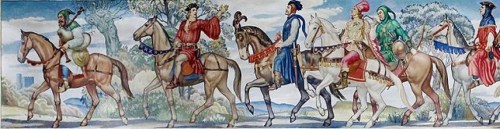
Detail of mural by Ezra Winter illustrating the characters in the Canterbury Tales by Geoffrey Chaucer
People go on pilgrimages for many reasons. Often, they’re in search of moral or spiritual wisdom. Sometimes, pilgrims go to a location that has significance to their beliefs and faith.
Other times, the pilgrimage is an inner, symbolic journey. I find creating a world and writing a society involves a good, in-depth examination of my principles and values.
People are often changed by a journey to a different place and seeing how other people live. We evolve as human beings through our experiences and interactions.
Writing has the same effect on us as if we had journeyed to a far land and experienced a new culture. In the process of writing, we explore events that affect our emotions and challenge our values. We brainstorm our principles and philosophies.
 We each grow and develop in a way that is unique to us. Sometimes, we are hardened by our life experiences, and our protagonists have that jaded sensibility. Other times, we accept our own human frailties, and our protagonists are more forgiving.
J.R.R. Tolkien wrote fantasy showing the evil the world was capable of in the first part of the 20th century. He also laid bare his hope for a better future and understood how the masses are swayed by charismatic leaders. Tolkien recognized the tenuous difference between that which is right and moral and what is expedient and easily glossed over.
He understood how societies lie to themselves and justify their actions.
In The Hobbit, J.R.R. Tolkien put a face on the Engine of War. In our real world, the Engine of War is an evil that seems unstoppable, an endlessly hungry entity made up of faceless soldiers acting on commands given by faceless leaders, committing unspeakable violence against faceless people.
Wars can be fought on another front—my spouse has Parkinson’s. I see that battle not from the side of the military forces but from the side of the people upon whose lands those battles are fought.
 The battles we fight on the home front don’t have to be serious all the time. Sometimes, they can be hilarious. When your spouse has Parkinson’s, life is like a blended margarita, as seen from the ice cube’s perspective.
One minute, you’re sitting in the ice cube bin with the other cubes, everyone acting cool.
The next thing you know, someone drops you and a few of your friends into the blender and then throws Lime Juice in.
Lime looks a little startled, but nothing gets her down for long. She’s a master at keeping things zippy with her tart sense of humor. You’re relaxing with the other cubes, chatting with Lime.
Then, Tequila drops in, and it’s all good—your fellow cubes love Tequila and Lime. Here comes Triple Sec, and now it’s a party. You’re all just sitting around, chilling and flirting with Lime, Tequila, and Triple Sec.
 Suddenly, some joker turns the blender on, and everything goes to hell. They turn it off, and you think, “Okay, disaster averted. It’s gonna be okay.”
But no.
It’s on – off – on – off – on – off – so chaotic you can’t keep up with it. At the end of it all, you and your fellow ice cubes, along with Tequila, Triple Sec, and Lime, are like Fukushima after the tidal wave – a slurry of confusion and terror.
Then, to top it off, the joker who ruined the party pours you into a glass and adds salt to your wounds.
You know you’re gonna die, but you’re still cool. In fact, you’re Stevie Wonder cool.
 Life is like a blended margarita. It’s all in how you look at it, so stay cool and enjoy the party for as long as it lasts.
And let those life experiences fuel your writing.
Credits and Attributions:
IMAGE: Ice Cubes, Wikimedia Commons contributors, “File:Ice cubes openphoto.jpg,” Wikimedia Commons, https://commons.wikimedia.org/w/index.php?title=File:Ice_cubes_openphoto.jpg&oldid=796010605 (accessed February 4, 2024).
IMAGE: Detail of mural by Ezra Winter illustrating the characters in the Canterbury Tales by Geoffrey Chaucer. Library of Congress John Adams Building, Washington, D.C.Wikimedia Commons contributors, “File:North Reading Room, west wall. Detail of mural by Ezra Winter illustrating the characters in the Canterbury Tales by Geoffrey Chaucer. Library of Congress John Adams Building, Washington, D.C. LCCN2007687083.tif,” Wikimedia Commons, https://commons.wikimedia.org/w/index.php?title=File:North_Reading_Room,_west_wall._Detail_of_mural_by_Ezra_Winter_illustrating_the_characters_in_the_Canterbury_Tales_by_Geoffrey_Chaucer._Library_of_Congress_John_Adams_Building,_Washington,_D.C._LCCN2007687083.tif&oldid=727674759 (accessed February 4, 2024).


 Life in the Realm of Fantasy