Tag Archives: making time to write

#NovelNovember: Should I do this?

October has ended, and here in the Northern Hemisphere, the dark days of November are upon us. This is a great time of year for writers to hunker down and get writing.
While NaNoWriMo no longer exists, many of us still see November as the big writing month. ProWriting Aid has a free event going on, and it has all the best aspects of the original NaNoWriMo without the drama.

Last month I mentioned that I participated in ProWritingAid’s Novel November in 2025 and had a great time. I posted about my experience here: #NovelNovember has ended, my book isn’t done, and once again, I’m clueless #writing | Life in the Realm of Fantasy

I am participating again this year. The website is simple enough for an old luddite like me to navigate, and you can get badges for each milestone.

A virtual badge? To some, that may not sound like much, but when the first days of creating a new story pass and excitement fades, writing becomes work. Each badge is a visible goal, an incentive to keep pushing ahead.

If ProWriting Aid’s free, no-strings-attached writing event doesn’t appeal to you, many other online writing challenges and groups try to keep the original spirit of NaNoWriMo alive. I have listed the links to four of them at the end of this post.

Whether you join an online challenge or not, November is a good time to get serious about the story you have always believed you could write.

Perhaps committing to a personal challenge works better for you.

Maybe you will challenge yourself to write for one hour every day for thirty days.

Or, perhaps you are aiming for a specific word count, hoping to get the basics of your novel written.

Some of us plan to write a chapter a day on our current work in progress.

Or maybe, as I did one year, you decide to write a short story every day. In 2015, I took a different path from the usual novel-in-thirty-days approach. I named my project November Tales. I suffered from a bout of pneumonia and worked from my bed for most of the month. Even so, I managed 42 short stories, all fueled by Nyquil and desperation, totaling 107,000 words.

This mess included ten terrible poems, along with chapters 7 through 11 of Bleakbourne on Heath.

The following year, November began with a severe case of bronchitis. I named my project November Tales 2016 – 30 Days of Madness and Pot Pies. I started by writing short stories, flash fiction, drabbles, and poems. Within five days, I was writing the first draft of a novel and managed to pound out 90,000 wonky, misspelled words.

Others will write poetry and other short forms, and still others will focus on journalism and write op-eds and personal essays.

Perhaps you choose to write a blog post every day for 30 days. (Now that is difficult. I manage two a week and sometimes only one.)

Over the next few months, authors embarking on the journey of writing their first novel will hear many rules about the craft of writing. Don’t worry about grammar and mechanics at this stage of the game. Please write the story as it falls out of your head. Don’t worry too much about the rules until you get to the revision stage.

Getting those ideas out of your head now matters most. You can iron out pacing, structure flaws, and grammar hiccups in revisions.
courtesy Office360 graphics

When we are just beginning on the path to becoming an author, we feel guilty for taking the time to indulge in such a profoundly personal pleasure. Life tosses up roadblocks, and developing a regular writing habit is difficult.

We have jobs, families, duties to our community, and many other demands upon our time. We have all the extra work and activities that come along with living our lives.

As a single mother raising children in the 1980s, I could only write for half an hour or so at night. I wrote after my children were asleep, pouring my angst into song lyrics. Many times I wrote while my children did their homework. I was there, able to help, but I was doing my own “homework.” That original grounding in music is why my poetry rhymes and has a rhythm: I’m a songwriter at heart, and a melody is always floating around in my head.

The most important part of developing a writing process is finding one that works for you.

Give yourself permission to try different things until you find something that works.

  • Do you work best in short bursts?
  • Are you at your best when you have a long session of privacy and quiet time?
  • Or is your process something in the middle, a melding of the two?

What if my style changes? What if the way that worked last month no longer works?

Give yourself permission to change, to find a way that does work. Be willing to be flexible.

Balance is the key to a happy life. We want to feel productive and creative, and we need to share our lives and interests with our family and friends.

Therefore, authors must set aside time to write. This lets us be creative while still supporting our families, who all have activities and interests of their own.

Being a writer means being supremely selfish about every aspect of life, including family time.

  1. It also requires discipline and the ability to set aside an hour or so just for that pursuit, a little time where no one is allowed to disturb you.

A good way to ensure you have that time is to encourage your family members to indulge in their own interests and artistic endeavors. That way, everyone has the chance to be creative in their own way during that hour, and they will understand why you value your writing time so much.

To be happy, you need a balanced life. Don’t become so obsessed with writing about fictional lives that you aren’t present in your own.

Maybe you need a challenge to spur you into action:

Novel November™ by ProWritingAid: The Free Writing Challenge

Reedsy Studio Writing Challenges

Pathfinders Writing Collective

AutoCrit Novel 90 Writing Challenge

There are many, many more challenges out there. Just Google “writing challenges” and see if one suits your mood.

And whether you choose to participate in an online challenge or not, write when you can and enjoy the process of getting that idea out of your head and onto paper.
4 Comments

Filed under writing

Parkinson’s, Tequila, and Tolkien #amwriting

Most writers are hobbyists. This is because if one intends to be a full-time writer, one must have an income, and frankly, very few authors support themselves by writing alone.

My Writing LifeTechnically, I am a full-time writer. For about ten years after I retired from corporate America, I had regular office hours for writing. Nothing lasts forever, and now I am drawing on the habits I developed during my years as a hobbyist. I write when I can and devote the rest of my time to caring for my family.
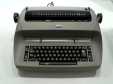
It is easy to fit short bursts of writing into my daily schedule. When I was younger, I wrote at work while on break or at lunch. Sometimes, I was able to dedicate a block of time for writing by rising two hours before I had to depart for work. But usually, I wrote after the dishes were done and the house was clean. If I skipped TV, I could get a whole scene on paper.

A happy life is all about balance. I arrange my writing time around whatever the calendar says is scheduled.

IBM_Selectric (1)So, let’s talk a little more about what we write. Most of us don’t intentionally write to preach to people, but the philosophies we hold dear do come out.
Some people see good and evil as black and white. A person is either good or evil, with no middle ground. Cartoons are wonderful because often they’re a simple story of good and evil. Many times, a cartoon is precisely what I want at that moment.

Many of my favorite authors are vividly aware of the gray area between good and evil. They write engaging novels exploring that concept. Sometimes, I’m looking for that sort of story.

Whether we are aware of it or not, our life experiences and our societal and religious beliefs emerge in what we write. This is why authoritarian governments ban books they don’t (or can’t) read. Exposure to a broader world of ideas and values undermines ignorance. An educated population is difficult to manipulate.

Subconscious fears of climate change, anxiety about a society on the edge of collapse—these subliminal uncertainties fuel post-apocalyptic storytelling. Our hopes for a better society come out in our plot arcs and world-building.

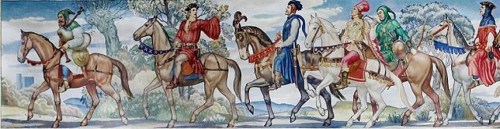
In many ways, writing is undertaking a pilgrimage.

cropped-1380px-canterbury-west-winter-highsmith.jpg

Detail of mural by Ezra Winter illustrating the characters in the Canterbury Tales by Geoffrey Chaucer

People go on pilgrimages for many reasons. Often, they’re in search of moral or spiritual wisdom. Sometimes, pilgrims go to a location that has significance to their beliefs and faith.

Other times, the pilgrimage is an inner, symbolic journey. I find creating a world and writing a society involves a good, in-depth examination of my principles and values.

People are often changed by a journey to a different place and seeing how other people live. We evolve as human beings through our experiences and interactions.

Writing has the same effect on us as if we had journeyed to a far land and experienced a new culture. In the process of writing, we explore events that affect our emotions and challenge our values. We brainstorm our principles and philosophies.

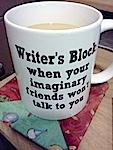
My Coffee Cup © cjjasp 2013We each grow and develop in a way that is unique to us. Sometimes, we are hardened by our life experiences, and our protagonists have that jaded sensibility. Other times, we accept our own human frailties, and our protagonists are more forgiving.

J.R.R. Tolkien wrote fantasy showing the evil the world was capable of in the first part of the 20th century. He also laid bare his hope for a better future and understood how the masses are swayed by charismatic leaders. Tolkien recognized the tenuous difference between that which is right and moral and what is expedient and easily glossed over.

He understood how societies lie to themselves and justify their actions.

In The Hobbit, J.R.R. Tolkien put a face on the Engine of War. In our real world, the Engine of War is an evil that seems unstoppable, an endlessly hungry entity made up of faceless soldiers acting on commands given by faceless leaders, committing unspeakable violence against faceless people.

Wars can be fought on another front—my spouse has Parkinson’s. I see that battle not from the side of the military forces but from the side of the people upon whose lands those battles are fought.

Ice_cubes_openphoto_croppedThe battles we fight on the home front don’t have to be serious all the time. Sometimes, they can be hilarious. When your spouse has Parkinson’s, life is like a blended margarita, as seen from the ice cube’s perspective.

One minute, you’re sitting in the ice cube bin with the other cubes, everyone acting cool.

The next thing you know, someone drops you and a few of your friends into the blender and then throws Lime Juice in.

Lime looks a little startled, but nothing gets her down for long. She’s a master at keeping things zippy with her tart sense of humor. You’re relaxing with the other cubes, chatting with Lime.

Then, Tequila drops in, and it’s all good—your fellow cubes love Tequila and Lime. Here comes Triple Sec, and now it’s a party. You’re all just sitting around, chilling and flirting with Lime, Tequila, and Triple Sec.

caloricclassic  red blenderSuddenly, some joker turns the blender on, and everything goes to hell. They turn it off, and you think, “Okay, disaster averted. It’s gonna be okay.”

But no.

It’s on – off – on – off – on – off – so chaotic you can’t keep up with it. At the end of it all, you and your fellow ice cubes, along with Tequila, Triple Sec, and Lime, are like Fukushima after the tidal wave – a slurry of confusion and terror.

Then, to top it off, the joker who ruined the party pours you into a glass and adds salt to your wounds.

You know you’re gonna die, but you’re still cool. In fact, you’re Stevie Wonder cool.

Blended_MargaritaLife is like a blended margarita. It’s all in how you look at it, so stay cool and enjoy the party for as long as it lasts.

And let those life experiences fuel your writing.


Credits and Attributions:

IMAGE: Ice Cubes, Wikimedia Commons contributors, “File:Ice cubes openphoto.jpg,” Wikimedia Commons, https://commons.wikimedia.org/w/index.php?title=File:Ice_cubes_openphoto.jpg&oldid=796010605 (accessed February 4, 2024).

IMAGE: Detail of mural by Ezra Winter illustrating the characters in the Canterbury Tales by Geoffrey Chaucer. Library of Congress John Adams Building, Washington, D.C.Wikimedia Commons contributors, “File:North Reading Room, west wall. Detail of mural by Ezra Winter illustrating the characters in the Canterbury Tales by Geoffrey Chaucer. Library of Congress John Adams Building, Washington, D.C. LCCN2007687083.tif,” Wikimedia Commons, https://commons.wikimedia.org/w/index.php?title=File:North_Reading_Room,_west_wall._Detail_of_mural_by_Ezra_Winter_illustrating_the_characters_in_the_Canterbury_Tales_by_Geoffrey_Chaucer._Library_of_Congress_John_Adams_Building,_Washington,_D.C._LCCN2007687083.tif&oldid=727674759 (accessed February 4, 2024).

6 Comments

Filed under writing

Writing Around the Distractions #amwriting #writerlife

Life has hit one of those inevitable snags, where writing has become more of a refuge than ever. My amateur nursing skills have been called into battle once again, as hubby has undergone a total hip replacement.

Four hours after the surgery, he was in the car, and we were going home. The minute the anesthesia wears off, they check the patient to make sure they’re alive and able to urinate, then send them home.

To be cared for by enthusiastic, panicking amateurs.

Two days in the hospital would have been better for him, but this is life in the USA. Even before COVID19, they sent patients home before they were able to care for themselves.

Thanks to having two children with seizure disorders and other family members with debilitating illnesses, I have acquired some of the skills necessary to handle this. My only problem is that he is 6’ 3” tall, and suffers from severe arthritis, so he has limited strength. I am just glad my brother is here to help when I need it.

We are 3 days into it, and hopefully, things will become easier as this next week progresses.

Everyone has family, jobs, external demands that limit the amount of time you can devote to writing. For me, the most important thing is to care for my family first. That means I do whatever housework is on for that day, make sure everyone is clean and fed, and if one of them is ill, I make sure they are comfortable and can rest.

I’m not a superwoman, so I do what I can around the house and don’t worry about what I didn’t get done. Some days that means just keeping a path cleared to the front door. Other days, the place is “fit for company,” as my grandma would say.

After surgery, blood clots can be a problem, so modern technology has devised an $80.00 solution, the PlasmaFlow Sequential Compression System. They are prescribed by a physician for use in the home to help prevent the onset of DVT (deep vein thrombosis) in post-surgical patients by stimulating blood flow in the extremities. They do this by stimulating muscle contractions. These are battery-operated, rechargeable cuffs that go around the patient’s calves.

The surgery was on Friday, so of course, they failed at about noon Saturday. This didn’t seem to surprise the on-call physician at the other end of the telephone. They quit charging, and we can’t get replacements until Monday. So, I am making sure he does some extra exercises and helping him do the ones he can’t yet do independently. Regular massage and exercise should do the trick.

Sleep the first night was like the first night you bring the newborn baby home. Sleep for an hour, get up to resolve something, sleep for an hour, get up to resolve something—not a lot of rest. But the second night, he was able to sleep straight through, so that was good.

I have plenty of downtime between things, though. That is when I write or work on whatever revisions are needed. You would be amazed at what you can get done in ten-minute bursts.

The fact is, I rarely watch television. While I do play a little Stardew Valley (see my game review here), my real interests are reading and attempting to write the stories I wish I could read.

This week I have been trying to think up decent titles for two of my works in progress. So far, nothing has risen to the top. “Accidental Novel” is a fair enough working title but probably won’t sell the book.

Before hubby went in for surgery, I sent my Accidental Novel to my structural editor for a beta read. I have a gut feeling that the ending is weak, so I asked her to give me any thoughts on reworking it. All the rough spots will be resolved once I get Irene’s revision notes back. The external eye is crucial at this stage. Having a trusted reader who is also an excellent editor is a gift from heaven.

So, all in all, life is good. Once we get through this week, my husband should be on the road to better health, and we will be able to settle into a routine.

Life can be a bumpy road. The key is to focus on the good things and laugh at the annoyances. Make a little time to do what you love, and always make time for the people you love.


Credits and Attributions:

We Can Do It, by J. Howard Miller, Restored by Adam Cuerden, Public domain, via Wikimedia Commons

4 Comments

Filed under writing