Tag Archives: short literary essay

Writing the Short Story part 2: The Narrative Essay #amwriting

This is part two of a series on writing short fiction. One of my favorite forms of short fiction to read is the narrative essay. For indie authors who wish to earn actual money from their writing, the narrative essay is often more salable and appeals to a broader audience.

narrative essayNarrative essays are drawn directly from real life, but they are fictionalized accounts. They detail an incident or event and talk about how the experience affected the author on a personal level.

One of my favorite narrative essays is 1994’s Ticket to the Fair (now titled “Getting Away from Already Being Pretty Much Away from It All“) by David Foster Wallace, published in Harpers. I’ve talked about this particular piece before. It’s a humorous, eye-opening story of a naïve, slightly arrogant young journalist’s assignment to cover the 1993 Iowa State Fair, told in the first person.

Wikipedia summarizes Ticket to the Fair this way: Wallace’s experiences and opinions on the 1993 Illinois State Fair, ranging from a report on competitive baton twirling to speculation on how the Illinois State Fair is representative of Midwestern culture and its subsets. Rather than take the easy, dismissive route, Wallace focuses on the joy this seminal midwestern experience brings those involved.
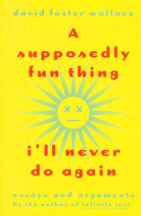
A-supposedly-fun-thing-first-edition-coverWallace went to the fair thinking it would be a boring event featuring farm animals, which might be beneath him. But it was his first official assignment for Harpers, and he didn’t want to screw it up. What he found there, the people he met, their various crafts, and how they loved their lives profoundly affected him, altering his view of himself and his values.

As we find in Wallace’s piece, the primary purpose of an essay is thought-provoking content. The narrative essay conveys our ideas in a palatable form, so writing this kind of piece requires authors to think.

Just like any other form of short fiction, a narrative essay has content and structure. It has

  • an introduction,
  • a plot,
  • characters,
  • a setting,
  • a climax.

Choose your words for impact because writing with intentional prose is critical. A good narrative essay has been put into an entertaining form that expresses far more than mere opinion. They sometimes offer up deep, uncomfortable views. The trick is to offer them in a way that the reader feels connected to the story. Once they have that connection, they will see the merit of the opinions and viewpoints.

So, narrative essays are a way of sharing our personal view of the world, the places we go, and the people we meet along the way.

  • Names should be changed, of course.

Harpers_Magazine_1905Literary magazines want well-written essays on a wide range of topics and life experiences presented with a fresh point of view. Some publications will pay well for first rights.

Authors make their names by being published in a reputable magazine. You must pay strict attention to grammar and editing to have any chance of acceptance. Never send out anything that is not your best work.

After you have finished the piece, set it aside for a week or two. Then, return to it with a yellow highlighter and a fresh eye. Print it out and read it aloud, checking for dropped and missing words. In this case, I do NOT recommend the narrator function of your word processing program.

In the process of reading aloud, you will find:

  • Spelling—misspelled words, autocorrect errors, and homophones (words that sound the same but are spelled differently). These words are insidious because they are actual words and don’t immediately appear out of place.
  • Repeated words and cut-and-paste errors. These are sneaky and dreadfully difficult to spot. Spell-checker won’t always find them. They make sense to you, the author, because you see what you intended to see. For the reader, they appear as unusually garbled sentences, and you will stumble over them as you read aloud.
  • Missing punctuation and closed quotes. These things happen to the best of us.
  • Digits/Numbers: Miskeyed numbers are difficult to spot when they are wrong unless they are spelled out.

oxford_synonym_antonymDon’t be afraid to write with a wide vocabulary, as people who read these publications have a broad command of language.

  • However, we never use jargon or technical terms that only people in certain professions would know unless it is a piece for a publication catering to that segment of readers.

Above all, be a little bold. I enjoy reading David Foster Wallace and George Saunders because they are adventurous in their work.

And finally, we must be realistic. Not everything you write will resonate with everyone you submit it to. Put two people in a room, hand them the most exciting thing you’ve ever read, and you’ll get two different opinions. They probably won’t agree with you.

Don’t be discouraged by rejection. I follow several well-known authors via social media because what they have to say about the industry is intriguing. They’re journalists who submit at least one piece weekly, hoping they will sell one or two a year. One says she aims for one hundred rejections a year because two or three stories or essays are bound to strike a chord with the right editor during that time.

Rejection happens far more frequently than acceptance, so don’t let fear of rejection keep you from writing pieces you’re emotionally invested in.

This is where you have the opportunity to cross the invisible line between amateur and professional. Always take the high ground—if an editor has sent you a detailed rejection, respond with a simple “thank you for your time.” If it’s a form letter rejection, don’t reply.

What should you do if your work is accepted but the editor wants a few revisions?

367px-Saturday_evening_post_1903_11_28_aIf the editor wants changes, they will make clear what they want you to do. Editors know what their intended audience wants. Trust that the editor knows their business.

Make whatever changes they request.

Never be less than gracious to any of the people at a publication when you communicate with them, whether they are the senior editor or the newest intern. Be a team player and work with them.

And when you receive that email of acceptance—celebrate! There is no better feeling than knowing someone you respect liked your work enough to publish it.


Credits and Attributions:

Wikipedia contributors. A Supposedly Fun Thing I’ll Never Do Again [Internet]. Wikipedia, The Free Encyclopedia; 2023 Sep 4, 00:32 UTC [cited 2023 Nov 20]. Available from: https://en.wikipedia.org/w/index.php?title=A_Supposedly_Fun_Thing_I%27ll_Never_Do_Again&oldid=1173714712.
Comments Off on Writing the Short Story part 2: The Narrative Essay #amwriting

Filed under writing

#flashfictionfriday: Going Home

October had arrived in the Pacific Northwest, chill and damp as always. Our friends, Jonna and Jake, lived on Black Lake, on the north end of the lake where my sister and I had spent our childhood. A true Northwesterner, Jonna had planned a day on the lake despite the weather. A women’s day out with my sister, Sherrie, our old school friend, Evonne, and our dear friend from Texas, Irene. We planned to cruise the lake and show Jonna and Irene where we had lived from 1963 through the 1990s.

Jake was worried we would wreck the boat, calling instructions as we pulled away from the dock. “Don’t worry,” we called back to him. “Jonna knows how to drive.” Nevertheless, he stood in the rain, fretting at sending his beloved boat out under his wife’s control, loaded with sparkling cider and a group of women he knew all too well. This despite the fact Jonna would drink no wine until after we returned.

Despite Jake’s misgivings, Jonna neatly negotiated the deeper channel between the half-sunk, rotting posts of the old Black Lake Mill, which had burned in 1918, and was never rebuilt. Like many parts of my childhood, the old posts had simply been left where they were, rotting corpses of a time when Timber was King, and money grew in the forest surrounding Black Lake.

Our boatload of women and laughter slowly passed the new summer homes and palaces of the nouveau riche jammed onto narrow lots, professionally landscaped and manicured. Crammed between the mansions were the familiar, now-ancient mobile homes and the older, rundown shanties. Our childhood friends, “Black-Lakers” all, had lived year-round in these flimsy, drafty homes. Oil was expensive, so feeding the fireplace or woodstove was how we stayed warm back then.

In the 1930s, when my father grew up in the hills above the other side of the lake, the area had been exceedingly rural, a poor place teetering on the edge of poverty. In the 1960s, when I was growing up, it was working-class but still small and insular. Many of the people around the lake had gone to school with my father, and he knew them well.

Jonna slowly followed the shore past those homes, old and new. It was surprising which tattered old cabins stubbornly held on, clinging to their places despite being elbowed aside by the beautiful new homes of the well-heeled few.

Hugging the shoreline, we went south, passing down the eastern side of the lake toward the house that had been my family home for thirty-five years. I was curious, wondering what it looked like. As we idled along, I thought about those years that we had spent there, the good and bad.

How many evenings had I sat beside my grandmother at the picnic table, gazing out across the water to the Black Hills rising above the lake and dominating the view? How many campfires in the fire-pit on the beach, and barbecues? How many summers were spent swimming from morning to evening? I couldn’t wait to see it again.

When we approached the place our home had been, we only recognized it because the contours of the shoreline hadn’t changed. Having fished those waters for so many years, Sherrie and I knew which half-sunken log meant we were nearing the neighbor’s house. Ours had been beyond the woods next door.

The neighbor’s house had seemed large and modern when I was young and had been referred to as “the airplane hangar” by the locals when Ken Nolan built it. I was surprised to see how small it really was. It was greatly changed, but I recognized the mid-century wall of glass facing the lake. The new owners had abandoned the small lawn and gone to simply having a large deck, surrounded by tall salal and Oregon grape. They had sacrificed much of the view from inside in the interests of privacy, I suspect.

Even though the neighboring house was so changed, I was filled with anticipation for the first sight of our childhood home, with me going on and on, telling our friends how beautiful the property was.

We never saw that house, despite my eager searching.

Just beyond the now-ancient grove of alders that had separated our property from the neighbors was a rundown building. It did resemble my parents’ house but was definitely not the home I had grown up in.

It had been made into a duplex and was clearly a rental unit for the large house that now sat behind in what had once been the swamp. The acre of lawn and gardens that had been my parents’ pride and joy was lost to the wilderness, with a dilapidated fence cutting the yard in two. On either side of the fence, narrow paths snaked through the weeds, muddy trails to the beach. Grass and weeds stood waist-high, obscuring the once-beautiful home.

The beach and swimming area were gone. A marina dominated the waterfront, with five dilapidated power boats moored at several docks. Thinking back on that sight, I suspect that summers there see few children playing in the shallows, as the formerly sandy beach is now a swampy morass.

I confess I was devastated to see the old family home in such disrepair.

The last time I had approached the house from the lake had been in 1995 after my grandmother passed away, while my mother still lived there. That day, as we returned to the shore, I had viewed the modest home in its park-like setting, with a broad lawn that took an hour to mow even with the riding mower. Cherry trees, alders, and maples had shaded the yard, with roses, camellias, rhododendrons, and other heirloom shrubs framing the house. Blueberries, cascade blackberries, and loganberries had pride of place in the immense vegetable garden that was to the right of the house when viewed from the lake.

When we were growing up there, the inside of our home was cold and damp and frequently in disrepair. There were no carpets because Mama said they would be ruined, and certainly the linoleum hadn’t stood the test of time. Our furniture had been worn out, and Mama wasn’t really into interior decorating.

Besides, as she was always reminding us, there was no money to fix things up. Dad had a good job, but money was tight. Nevertheless, however shabby it had been compared to the homes of our wealthier classmates who lived in town, it was immaculately clean inside and out. Nothing was ever out of place, because what would people think? Mama had strong opinions about people with poor housekeeping habits and was rather vocal about it.

As I said, the house itself had been nothing special, but the yard… 350 feet of waterfront and five acres going back toward the road. The yard and the view were what my parents had made themselves house-poor for.

When I was a child, the yard had been a magical place of refuge from disapproving adults, with many places to hide and read and to be important to someone, even if it was only the cat.

I didn’t know what to think when we saw the rundown hovel with a flock of boats parked in front. I was glad to be in the company of my friends and my sister, as I fought the sting and burn of tears. I think because I’m four years older than Sherrie, her memories were of happier times than mine, when Mama rebelled against Dad’s wishes and got a job outside the home so she could have some extra money.

Our friends in the boat, Irene, Evonne, and Jonna – they knew. These women could tell what had occurred, how it had set me back. They were united, a wall of strength, silently commiserating and allowing us to just take it all in, yet there for us if we needed to talk about it.

I didn’t. I couldn’t.

At last, Jonna turned the boat, and we idled along the shore, cruising south around the swampy end where the Black River begins its journey to the Chehalis River, and then to the “new” development of Evergreen Shores, built in the 1970s. Then we went north along the west shore, passing the strange dichotomy of shanties mingled between high-end vacation manors. Having circled the lake, we finally negotiated our way back through the rotting pilings at the north end and approached Jonna’s dock.

Jake had been standing there the whole time, likely expecting we would sink his boat. But we hadn’t, and bless him, he was happy to help Jonna park it.

I’m an author now, middle-aged. I’ve lived a long and interesting life, and still I find I have lessons to learn. A place is a place, and a building is only a home when someone lives there. I think that what I really discovered by going back to the lake house is that you don’t go home by returning to the scene of your childhood.

My childhood home still shines in my memories, but nowadays home means comfort and cozy evenings on the back porch with my husband. Home is a wall with photographs of our children and grandchildren.

I carry home within my heart and memories, and wherever I am, that is home.


Credits and Attributions

Going Home, A Memoir by Connie J. Jasperson © 2018, All Rights Reserved, was first published on Myrddin Publishing Blog, on January 17, 2018

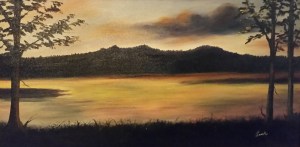
Black Lake Sunset, by Florence Lemke, 1973. Painted by the author’s aunt, image reproduced from the private collection of Connie J. Jasperson. © 2018 All Rights Reserved. Printed by permission.

2 Comments

Filed under #FlashFictionFriday