Tag Archives: memoir

Journaling – a personal odyssey in #writing

I’ve been asked many times what I see as the differences between keeping a journal and writing a memoir.

First, journaling is similar to keeping a diary, but different. You start writing in a stream-of-consciousness style, detailing your observations of where you are in life at that moment.

I find myself journaling when I am unable to write creatively. That is not to say that keeping a journal is not creative, because it is. It is simply a different kind of creative writing.

For example, I’m offering you an excerpt from my journal entry for April 25, 2026. For the second time that month, my husband had been admitted to the hospital, this time with aspiration pneumonia. That morning, I had arrived at eight, expecting to be allowed to visit. Usually, spouses and support people are allowed to be with the patient whenever possible, so I spend the entire day there.

But not that day. Visiting hours began at 10 o’clock, and that was when I would be admitted, and not a moment before. He was in a different unit from the usual one, a short-stay unit with different rules.
So, I sat in the cafeteria, confused and feeling angry at myself for feeling angry. I had a cup of watery tea, which didn’t help my mood, which I knew was unreasonable. So I decided it was a good time to clean out my purse. which was full of unnecessary receipts and other debris of modern life.

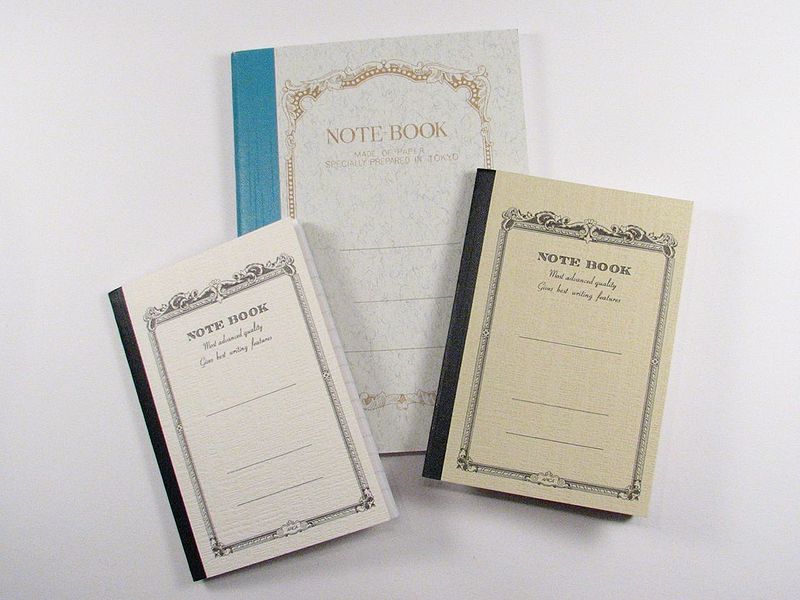
Have you ever noticed that sometimes life hits you with a hard dose of your own mortality? In doing that bit of minor housekeeping, I got one that morning. Fifteen minutes later, I pulled out my notebook and began journaling, detailing the lousy event.

April 25, 2026

Today, I threw away a five-dollar bill.

Greg is in the hospital again, and I’m stuck waiting in the cafeteria, so I cleaned out my purse and separated the cash from the trash.

Then I tossed the unwanted papers into the cafeteria’s trash bin.

As I did so, I saw something green go in, something that should have still been in my hand but wasn’t.

The cash wasn’t unwanted, but I don’t usually carry any, so maybe that’s why it happened.

Forty years ago, that would have been a disaster, and I would have ignored the glares of judgmental strangers and fished for it. Today, I was too embarrassed by the blunder to dumpster dive in the cafeteria.

Hopefully, I’ll be able to get into G’s room soon. The way things are going, I’ll probably toss a twenty in the bin along with my paper cup just so the fiver won’t be lonely, and because I can’t pay attention to anything right now.

Later, I was able to note what the doctor said and our best options. My hubby is currently back in the Adult Family Home, in Hospice care. He is happy and doing as well as can be under the circumstances.

Personally, I can write anywhere. I often find I can sort out a plot hole at the coffee shop on the corner near my apartment. It’s a great place for journaling too, especially when I can’t calm my mind enough to work on my other projects.

Perhaps you have chosen to write in a coffee shop or a public park. You are sitting there with paper and pencil, but where do you start? What do you write?

You could write about your impressions of the people around you. You might include impressions of your environment and how you fit into it.

Some journals are intensely personal. Others are daily diaries, recounting daily activities, lightly touching on conversations. Some journals delve deeply into the writer’s philosophical thoughts.

If you are a novelist, mind-wandering with a pen and paper about your problems can help jump-start your imagination. This can lead to insights that reinvigorate your other work-in-progress.

Although the current state of news journalism in America tends to ignore this fact, fiction is different from truth.

Fiction is spinning yarns, keeping them straight, and making the world believe the tale until the last page. (FYI: American news media isn’t doing too well at that.)

Keeping a personal journal is writing the truth as you see it. Those are the five key words: the truth as you see it.

Sometimes, new authors say their project is a memoir. If a hopeful writer tells me this, I always ask if they have read any memoirs. If they haven’t, there may be a problem. Reading the memoirs written by successful authors is the best way to learn how the plots of outstanding memoirs are constructed.

Memoirists should ask two questions of their work. Will you detail actual memories or write a fictionalized account? Do you dare to name names or not?

  • Naming names could be opening a can of worms, so think long and hard before you do that.

Some who write journals have no intention of publishing their work. Many just want to keep a family history, a fun project. Some may go so far as to explore their family tree through organizations such as Ancestry.com.

Here are some considerations if you are creating a record for your children, grandchildren, nieces, nephews, and other young and future family members.

  1. Are you just curious, or are you searching for an identity, trying to discover who you are and where your family comes from? Research from a site such as Ancestry.com or gleaned from family bibles, letters, and other collected papers will greatly help you.
  2. Will you include photographs or interviews with older family members who may remember something about your family’s history?

This is a project I’ve considered taking on, but I know I would never finish it. I don’t need another unfinished project lying around.
Whether you are journaling for fun or posterity, or writing a memoir, the important thing is to write something every day. It’s good exercise and strengthens your ‘writing’ muscles. If I dedicate 3 hours a day to just writing stream-of-consciousness, I will chunk out 2500 to 3000 words. Of course, half those words will be mis-keyed and misspelled.

But hey, no one is perfect. Some words I accidentally invented: first-draft examples of “I meant to do that.”

But imperfections in the first draft are part of writing. The element of “what did I intend when I wrote this word” is an opportunity to explore and expand on an idea.

Or to eliminate it.

It’s your journal and your choice.
Leave a comment

Filed under writing

#flashfictionfriday: Going Home

October had arrived in the Pacific Northwest, chill and damp as always. Our friends, Jonna and Jake, lived on Black Lake, on the north end of the lake where my sister and I had spent our childhood. A true Northwesterner, Jonna had planned a day on the lake despite the weather. A women’s day out with my sister, Sherrie, our old school friend, Evonne, and our dear friend from Texas, Irene. We planned to cruise the lake and show Jonna and Irene where we had lived from 1963 through the 1990s.

Jake was worried we would wreck the boat, calling instructions as we pulled away from the dock. “Don’t worry,” we called back to him. “Jonna knows how to drive.” Nevertheless, he stood in the rain, fretting at sending his beloved boat out under his wife’s control, loaded with sparkling cider and a group of women he knew all too well. This despite the fact Jonna would drink no wine until after we returned.

Despite Jake’s misgivings, Jonna neatly negotiated the deeper channel between the half-sunk, rotting posts of the old Black Lake Mill, which had burned in 1918, and was never rebuilt. Like many parts of my childhood, the old posts had simply been left where they were, rotting corpses of a time when Timber was King, and money grew in the forest surrounding Black Lake.

Our boatload of women and laughter slowly passed the new summer homes and palaces of the nouveau riche jammed onto narrow lots, professionally landscaped and manicured. Crammed between the mansions were the familiar, now-ancient mobile homes and the older, rundown shanties. Our childhood friends, “Black-Lakers” all, had lived year-round in these flimsy, drafty homes. Oil was expensive, so feeding the fireplace or woodstove was how we stayed warm back then.

In the 1930s, when my father grew up in the hills above the other side of the lake, the area had been exceedingly rural, a poor place teetering on the edge of poverty. In the 1960s, when I was growing up, it was working-class but still small and insular. Many of the people around the lake had gone to school with my father, and he knew them well.

Jonna slowly followed the shore past those homes, old and new. It was surprising which tattered old cabins stubbornly held on, clinging to their places despite being elbowed aside by the beautiful new homes of the well-heeled few.

Hugging the shoreline, we went south, passing down the eastern side of the lake toward the house that had been my family home for thirty-five years. I was curious, wondering what it looked like. As we idled along, I thought about those years that we had spent there, the good and bad.

How many evenings had I sat beside my grandmother at the picnic table, gazing out across the water to the Black Hills rising above the lake and dominating the view? How many campfires in the fire-pit on the beach, and barbecues? How many summers were spent swimming from morning to evening? I couldn’t wait to see it again.

When we approached the place our home had been, we only recognized it because the contours of the shoreline hadn’t changed. Having fished those waters for so many years, Sherrie and I knew which half-sunken log meant we were nearing the neighbor’s house. Ours had been beyond the woods next door.

The neighbor’s house had seemed large and modern when I was young and had been referred to as “the airplane hangar” by the locals when Ken Nolan built it. I was surprised to see how small it really was. It was greatly changed, but I recognized the mid-century wall of glass facing the lake. The new owners had abandoned the small lawn and gone to simply having a large deck, surrounded by tall salal and Oregon grape. They had sacrificed much of the view from inside in the interests of privacy, I suspect.

Even though the neighboring house was so changed, I was filled with anticipation for the first sight of our childhood home, with me going on and on, telling our friends how beautiful the property was.

We never saw that house, despite my eager searching.

Just beyond the now-ancient grove of alders that had separated our property from the neighbors was a rundown building. It did resemble my parents’ house but was definitely not the home I had grown up in.

It had been made into a duplex and was clearly a rental unit for the large house that now sat behind in what had once been the swamp. The acre of lawn and gardens that had been my parents’ pride and joy was lost to the wilderness, with a dilapidated fence cutting the yard in two. On either side of the fence, narrow paths snaked through the weeds, muddy trails to the beach. Grass and weeds stood waist-high, obscuring the once-beautiful home.

The beach and swimming area were gone. A marina dominated the waterfront, with five dilapidated power boats moored at several docks. Thinking back on that sight, I suspect that summers there see few children playing in the shallows, as the formerly sandy beach is now a swampy morass.

I confess I was devastated to see the old family home in such disrepair.

The last time I had approached the house from the lake had been in 1995 after my grandmother passed away, while my mother still lived there. That day, as we returned to the shore, I had viewed the modest home in its park-like setting, with a broad lawn that took an hour to mow even with the riding mower. Cherry trees, alders, and maples had shaded the yard, with roses, camellias, rhododendrons, and other heirloom shrubs framing the house. Blueberries, cascade blackberries, and loganberries had pride of place in the immense vegetable garden that was to the right of the house when viewed from the lake.

When we were growing up there, the inside of our home was cold and damp and frequently in disrepair. There were no carpets because Mama said they would be ruined, and certainly the linoleum hadn’t stood the test of time. Our furniture had been worn out, and Mama wasn’t really into interior decorating.

Besides, as she was always reminding us, there was no money to fix things up. Dad had a good job, but money was tight. Nevertheless, however shabby it had been compared to the homes of our wealthier classmates who lived in town, it was immaculately clean inside and out. Nothing was ever out of place, because what would people think? Mama had strong opinions about people with poor housekeeping habits and was rather vocal about it.

As I said, the house itself had been nothing special, but the yard… 350 feet of waterfront and five acres going back toward the road. The yard and the view were what my parents had made themselves house-poor for.

When I was a child, the yard had been a magical place of refuge from disapproving adults, with many places to hide and read and to be important to someone, even if it was only the cat.

I didn’t know what to think when we saw the rundown hovel with a flock of boats parked in front. I was glad to be in the company of my friends and my sister, as I fought the sting and burn of tears. I think because I’m four years older than Sherrie, her memories were of happier times than mine, when Mama rebelled against Dad’s wishes and got a job outside the home so she could have some extra money.

Our friends in the boat, Irene, Evonne, and Jonna – they knew. These women could tell what had occurred, how it had set me back. They were united, a wall of strength, silently commiserating and allowing us to just take it all in, yet there for us if we needed to talk about it.

I didn’t. I couldn’t.

At last, Jonna turned the boat, and we idled along the shore, cruising south around the swampy end where the Black River begins its journey to the Chehalis River, and then to the “new” development of Evergreen Shores, built in the 1970s. Then we went north along the west shore, passing the strange dichotomy of shanties mingled between high-end vacation manors. Having circled the lake, we finally negotiated our way back through the rotting pilings at the north end and approached Jonna’s dock.

Jake had been standing there the whole time, likely expecting we would sink his boat. But we hadn’t, and bless him, he was happy to help Jonna park it.

I’m an author now, middle-aged. I’ve lived a long and interesting life, and still I find I have lessons to learn. A place is a place, and a building is only a home when someone lives there. I think that what I really discovered by going back to the lake house is that you don’t go home by returning to the scene of your childhood.

My childhood home still shines in my memories, but nowadays home means comfort and cozy evenings on the back porch with my husband. Home is a wall with photographs of our children and grandchildren.

I carry home within my heart and memories, and wherever I am, that is home.


Credits and Attributions

Going Home, A Memoir by Connie J. Jasperson © 2018, All Rights Reserved, was first published on Myrddin Publishing Blog, on January 17, 2018

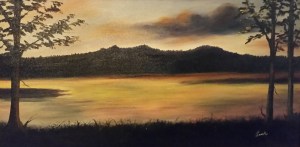
Black Lake Sunset, by Florence Lemke, 1973. Painted by the author’s aunt, image reproduced from the private collection of Connie J. Jasperson. © 2018 All Rights Reserved. Printed by permission.

2 Comments

Filed under #FlashFictionFriday