Tag Archives: The Dusseldorf School of Painting

#FineArtFriday: A closer look at “The Sycamores” by Alexandre Calame 1854

1175px-'The_Sycamores'_by_Alexandre_Calame,_Cincinnati_Art_MuseumTitle: The Sycamores by Alexandre Calame

Genre: landscape art

Date: 1854

Medium: oil on canvas

Dimensions: height: 54.3 cm (21.3 in)

Collection: Cincinnati Art Museum

What I love about this painting:

I live in the Pacific Northwest, a part of the world where sycamore trees do not grow in the wild. They are native to the eastern United States and are often featured as part of the landscape in 18th and 19th-century American literature.

The trees featured in this painting are European Sycamores. When I first came across this painting in 2022, I was impressed by both their size and the rough, boulder-strewn landscape that is their home.

These are trees with a presence. They grow on a sunlit hillside and seem as tough as the boulders surrounding them. Storms may come and go, but these trees remain.

Like people, these trees have seen some stuff. No delicate hothouse specimens here; these are sturdy peasant trees, able to make do with whatever nature throws at them.

About the Artist, via Wikipedia:

Alexandre Calame (28 May 1810 – 19 March 1864) was a Swiss landscape painter, associated with the Düsseldorf School.

He was born in Arabie at the time belonging to Corsier-sur-Vevey, today a part of Vevey. He was the son of a skillful marble worker in Vevey, but because his father lost the family fortune, Calame could not concentrate on art, but rather he was forced to work in a bank from the age of 15. When his father fell from a building and then died, it was up to the young Calame to provide for his mother.

In his spare time he began to practice drawing small views of Switzerland. In 1829 he met his patron, the banker Diodati, who made it possible for him to study under landscape painter François Diday. After a few months he decided to devote himself fully to art.

In 1835 he began exhibiting his Swiss-Alps and forest paintings in Paris and Berlin. He became quite well known, especially in Germany, although Calame was more a drawer than an illustrator. He is associated with the Düsseldorf school of painting. In 1842 he went to Paris and displayed his works Mont Blanc, the Jungfrau, the Brienzersee, the Monte Rosa and Mont Cervin.


Credits and Attributions:

Wikimedia Commons contributors, “File:’The Sycamores’ by Alexandre Calame, Cincinnati Art Museum.JPG,” Wikimedia Commons, the free media repository, https://commons.wikimedia.org/w/index.php?title=File:%27The_Sycamores%27_by_Alexandre_Calame,_Cincinnati_Art_Museum.JPG&oldid=618822225 (accessed December 4, 2025).

Wikipedia contributors, “Alexandre Calame,” Wikipedia, The Free Encyclopedia, https://en.wikipedia.org/w/index.php?title=Alexandre_Calame&oldid=1088977147 (accessed December 4, 2025).
5 Comments

Filed under #FineArtFriday

#FineArtFriday: Upon Sunny Waves, by Hans Dahl #prompt #NovemberWriter


Artist: Hans Dahl  (1849–1937)

Title: Upon Sunny Waves

Date: before 1937

Medium: oil painting

Hans Dahl was a Norwegian painter trained in Germany and is associated with the Düsseldorf school of painting, which was characterized by finely detailed imaginary landscapes. In his later years, he endured mean-spirited criticism from other artists and art critics, because he chose to remain true to his idealized fantasy art, resisting the movement from Romanticism to Modernism.

What I love about this painting:

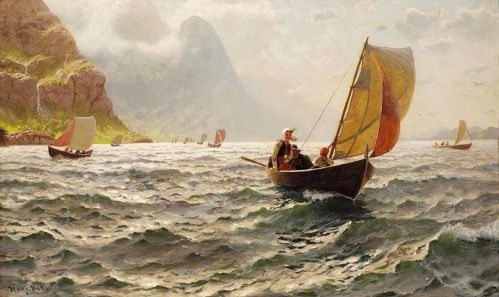
I first featured this painting in 2019 and think it’s a good image for a writing prompt. I love the way Dahl shares with us the bold freedom of sailing on a sunny summer day. He captures the feeling of flying on the water that makes sailing a small boat so much fun.

We aren’t on a leisurely fishing expedition here—this is boating for the sake of adventure. We’re running with wind and enjoying every minute of it. The wind is brisk, and the waters are choppy. There’s a hint of danger, the glee of knowing we’re pushing the boundaries. We’d best be strong swimmers because if we capsize, the waters are cold, and someone might not survive.

Who are these people? What is their relationship to each other? What dramas are they seeking a temporary escape from on this glorious day on the waves?

Hans Dahl has given us a painting with great story potential.

About the Artist, via Wikipedia:

In the 1890s a new school of art arose, and artists like Dahl were not very popular in the leading circles in the capital. He was particularly criticized by the art historian Jens Thiis. He was severely criticized by fellow artists especially by Christian Krohg, who was one of the leading figures in the transition from romanticism to naturalism which characterized Norwegian art in this period. Throughout his life, he increasingly narrowed his range of topics. Dahl often described the scenery of the western part of Norway in brilliant sunshine with smiling people in national costumes. His vibrant colors and charming portrayals of young Norwegian girls in their national costume have always been very popular. [1]


Credits and Attributions:

[1] Wikipedia contributors, “Hans Dahl,” Wikipedia, The Free Encyclopedia, https://en.wikipedia.org/w/index.php?title=Hans_Dahl&oldid=827399492 (accessed November 7, 2024).

IMAGE: Upon Sunny Waves, by Hans Dahl PD|70 [Public domain]

Wikimedia Commons contributors, “File:Hans Dahl – Upon sunny waves.jpg,” Wikimedia Commons, the free media repository, https://commons.wikimedia.org/w/index.php?title=File:Hans_Dahl_-_Upon_sunny_waves.jpg&oldid=140877929 (accessed November 7, 2024).

Comments Off on #FineArtFriday: Upon Sunny Waves, by Hans Dahl #prompt #NovemberWriter

Filed under #FineArtFriday

#FineArtFriday: The Sycamores by Alexandre Calame 1854

1175px-'The_Sycamores'_by_Alexandre_Calame,_Cincinnati_Art_MuseumTitle: The Sycamores by Alexandre Calame

Genre: landscape art

Date: 1854

Medium: oil on canvas

Dimensions: height: 54.3 cm (21.3 in)

Collection: Cincinnati Art Museum

What I love about this painting:

These are trees with a presence. They grow on a rocky, sunlit hillside and seem as tough as the boulders surrounding them. Like people, these trees have seen some stuff. No delicate hothouse specimens here – these are hardy peasant trees, able to make do with whatever nature throws at them.

About the Artist, via Wikipedia:

Alexandre Calame (28 May 1810 – 19 March 1864) was a Swiss landscape painter, associated with the Düsseldorf School.

He was born in Arabie at the time belonging to Corsier-sur-Vevey, today a part of Vevey. He was the son of a skillful marble worker in Vevey, but because his father lost the family fortune, Calame could not concentrate on art, but rather he was forced to work in a bank from the age of 15. When his father fell from a building and then died, it was up to the young Calame to provide for his mother.

In his spare time he began to practice drawing small views of Switzerland. In 1829 he met his patron, the banker Diodati, who made it possible for him to study under landscape painter François Diday. After a few months he decided to devote himself fully to art.

In 1835 he began exhibiting his Swiss-Alps and forest paintings in Paris and Berlin. He became quite well known, especially in Germany, although Calame was more a drawer than an illustrator. He is associated with the Düsseldorf school of painting. In 1842 he went to Paris and displayed his works Mont Blanc, the Jungfrau, the Brienzersee, the Monte Rosa and Mont Cervin.


Credits and Attributions:

Wikimedia Commons contributors, “File:’The Sycamores’ by Alexandre Calame, Cincinnati Art Museum.JPG,” Wikimedia Commons, the free media repository, https://commons.wikimedia.org/w/index.php?title=File:%27The_Sycamores%27_by_Alexandre_Calame,_Cincinnati_Art_Museum.JPG&oldid=618822225 (accessed July 15, 2022).

Wikipedia contributors, “Alexandre Calame,” Wikipedia, The Free Encyclopedia, https://en.wikipedia.org/w/index.php?title=Alexandre_Calame&oldid=1088977147 (accessed July 15, 2022).

4 Comments

Filed under #FineArtFriday

#FineArtFriday: Upon Sunny Waves, by Hans Dahl

Hans Dahl (19 February 1849 – 27 July 1937) was a Norwegian painter.

Trained in Germany, Hans Dahl is associated with the Düsseldorf school of painting, which was characterized by finely detailed imaginary landscapes. Despite later mean-spirited criticisms by other artists and art critics, Dahl remained true to his idealized fantasy art, resisting the movement from Romanticism to Modernism.

What I love about this painting:

Dahl captures the bold freedom of sailing on a sunny summer day. He captures the sense of flying on the water that makes sailing a small boat so much fun.

We aren’t on a leisurely fishing expedition here—this is boating for the sake of adventure. We’re running with wind and enjoying every minute of it.

About the Artist, via Wikipedia:

In the 1890s a new school of art arose, and artists like Dahl were not very popular in the leading circles in the capital. He was particularly criticized by the art historian Jens Thiis. He was severely criticized by fellow artists especially by Christian Krohg, who was one of the leading figures in the transition from romanticism to naturalism which characterized Norwegian art in this period. Throughout his life, he increasingly narrowed his range of topics. Dahl often described the scenery of the western part of Norway in brilliant sunshine with smiling people in national costumes. His vibrant colors and charming portrayals of young Norwegian girls in their national costume have always been very popular.


Credits and Attributions:

Wikipedia contributors, “Hans Dahl,” Wikipedia, The Free Encyclopedia, https://en.wikipedia.org/w/index.php?title=Hans_Dahl&oldid=827399492 (accessed June 13, 2019).

Upon Sunny Waves, by Hans Dahl PD|70 [Public domain]

Wikimedia Commons contributors, “File:Hans Dahl – Upon sunny waves.jpg,” Wikimedia Commons, the free media repository, https://commons.wikimedia.org/w/index.php?title=File:Hans_Dahl_-_Upon_sunny_waves.jpg&oldid=140877929 (accessed June 13, 2019).

2 Comments

Filed under #FineArtFriday