
One of our favorite places to walk before my husband’s Parkinson’s limited his mobility was McLane Creek Nature Trail. The central feature of the reserve is the large beaver pond. While the trails that wind around the pond and through the woods are easy to walk for most, they aren’t really suited for people who must rely on a walker or wheelchair.
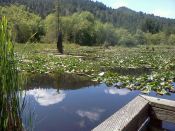 However, there is an accessible viewpoint just at the entrance, and we can go there and just absorb the peace. Several years ago, I shot this photo from that platform.
I grew up in a home that faced the shore of a lake, with a range of forested hills just beyond. Nature was my friend, my sanctuary. That’s why I feel such kinship for McLane Pond and bodies of water in general. They are creatures of many moods.
When you watch the water, you can see the effects of the world around it reflected on its surface. When a storm blows in, things change. The surface moves, and ripples and small waves stir things up down below. The waters turn dark, reflecting the turbulent sky.
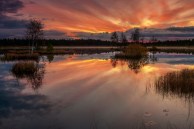
Sunrise at Lake Laanemaa at Orkjärve Nature Reserve, Estonia
And on a windless day, the pool will be calm and quiet. The sky and any overhanging trees will be reflected on its surface.
Just like the surface of a pond, the surface of a story is the literal layer. It is the what-you-see-is-what-you-get layer. It conceals what lurks in the depths but offers clues as to what lies below.
This layer is comprised of four aspects.
- Genre
- Setting
- Action and interaction
- All visual/physical experiences of the characters as they go about their lives.
Genre is an all-encompassing aspect of a story. It determines the shelf in the bookstore, such as General Fiction, fantasy, romance, etc. Those labels tell the reader what sort of story to expect.
Setting – I see the surface of a story as if it were the background in a painting. At first glance, we see something recognizable. The setting is the backdrop against which the story is shown. The setting is comprised of things such as:
- Objects the characters see in their immediate environment.
- Ambient sounds.
- Odors and scents.
- Objects the characters interact with, such as clothing, weapons, transportation, etc.
- Era (the story’s place in time).
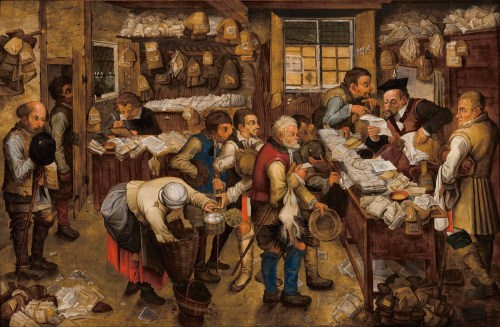 Action and interaction – we know how the surface of a pond is affected by the breeze that stirs it. In the case of our novel, the breeze that stirs things up is made of motion and emotion. These two elements shape and affect the structural events that form the plot arc.
- In the opening, the characters are going about their daily lives. Nothing too exciting, not worth writing about … however, two or three pages in, something happens.
- The inciting incident occurs, and daily life is thrown into disarray.
- To make things worse, the winds of change blow, driving rising waves of action and events in an uncomfortable direction.
- New characters are introduced, people who have parts to play for good or ill.
- Action and interaction occur between the protagonist and antagonist as they battle for position.
- Everyone and everything converge at the final showdown, and changed by our experiences, we return to the serene pond that was our life before.
So, the surface of the story, the world in which it exists, is shown at first by the visual/physical experiences of the characters as they go about their lives in the opening paragraphs. These can appear to be the story, but once a reader wades into the first few pages, they should discover unsuspected depths.
We shape this layer through worldbuilding. We can add sci-fi or fantasy elements, or we can stick to as natural an environment as possible.
 So, how can we use the surface elements to convey a message or to poke fun at a social norm? In other words, how can we get our books banned in some parts of this fractured world?
In Alice’s Adventures in Wonderland, Lewis Carroll played with the setting by incorporating an unusual juxtaposition of objects and animals. His characters behave and interact with their environment as if the bizarre elements are everyday happenings. The setting has a slightly hallucinogenic feel, making the reader wonder if the characters are dreaming.
Yet, in the Alice stories, the placement of the unusual objects is deliberate, meant to convey a message or to poke fun at a social norm. We just don’t realize it because we’re having so much fun.
Most sci-fi and fantasy novels are set in recognizable worlds that are very similar to where we live. The settings are familiar, so close to what we know that we could be in that world. That is where good worldbuilding creates a literal layer that is immediately accepted by the reader.
Setting, action, and interaction—these components are the surface, and they support the deeper aspects of the story.
The depths of the story are shown in how our characters interact and react to stresses within the overall framework of the environment and plot.
- Depth is found in the lessons the characters learn as they live through the events.
- Depth manifests in the changes of viewpoint and evolving differences in how our characters see themselves and the world.
 Creating depth in our story requires thought and rewriting. The first draft of our novel gives us the surface, the world that is the backdrop.
In the first draft, all we are concerned with is getting the structure of the story down and the characters in place with their personalities. Our subconscious mind will insert clues, little breadcrumbs hinting at what lies in the depths below the surface of our story. We might think they are clearly shown, but a beta reader might tell you they need a little more clarification.
The first draft is only the framework of the story, even if you have written “the end.” The true depths of the narrative and the emotions experienced by our characters are yet to be discovered.
The mysterious things that lurk in the depths of the story will begin to reveal themselves in the second draft.
Once you have written “the end” on the first draft, set the narrative aside for a few weeks and then go back to it. That is when the real writing begins.
Credits and Attributions:
IMAGE: Photograph, McLain Pond in July, © 2018 – 2024 by Connie J. Jasperson, from the author’s private photos.
IMAGE Wikimedia Commons contributors, “File:Pieter BRUEGHEL Ii – The tax-collector’s office – Google Art Project.jpg,” Wikimedia Commons, the free media repository, https://commons.wikimedia.org/w/index.php?title=File:Pieter_BRUEGHEL_Ii_-_The_tax-collector%27s_office_-_Google_Art_Project.jpg&oldid=708678946 (accessed December 9, 2022).
IMAGE: Sunrise at Lake Laanemaa at Orkjärve Nature Reserve, Estonia. Wikimedia Commons contributors, “File:Laanemaa järv Orkjärve looduskaitsealal.jpg,” Wikimedia Commons, https://commons.wikimedia.org/w/index.php?title=File:Laanemaa_j%C3%A4rv_Orkj%C3%A4rve_looduskaitsealal.jpg&oldid=801967887 (accessed September 17, 2023).
IMAGE: Wikimedia Commons contributors, “File:Elizabeth Jane Gardner – La Confidence (1880).jpg,” Wikimedia Commons, the free media repository, https://commons.wikimedia.org/w/index.php?title=File:Elizabeth_Jane_Gardner_-_La_Confidence_(1880).jpg&oldid=540767709 (accessed April 22, 2021).


 Life in the Realm of Fantasy