Tag Archives: The Romantic Movement

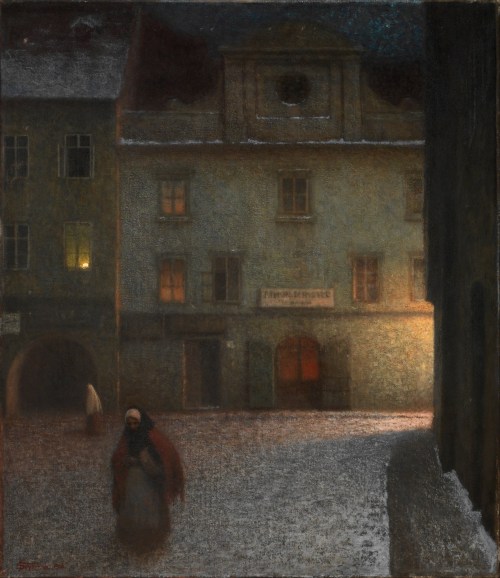
#FineArtFriday: Evening Street by Jakub Schikaneder, 1906

Jakub_Schikaneder_-_Evening_Street_-_Google_Art_ProjectArtist: Jakub Schikaneder (1855–1924)

Title: Evening Street

Date: 1906

Medium: oil on canvas

Inscriptions: signed and dated

Collection: National Gallery Prague

About this Painting, via Copilot GPT (sources listed in the footnotes below):

Evening Street by Jakub Schikaneder is done in the Romanticism style, characterized by its blend of realism and melancholy. In this enchanting cityscape, Schikaneder masterfully captures the quietude of an evening street in Prague. The scene exudes a sense of solitude and nostalgia, as if time has slowed down. The play of light and shadow adds depth to the composition, emphasizing the architectural details and the cobblestone pavement.

The painting invites us to wander through the narrow streets, perhaps imagining the footsteps of passersby and the whispers of history. The subdued palette, with hints of warm tones, evokes the fading light of day. It’s a moment frozen in time—a glimpse into the soul of the city.

Schikaneder often depicted lower-class people in his works, and Evening Street is no exception. The figures, though not prominent, contribute to the overall atmosphere. Their silhouettes blend seamlessly with the surroundings, emphasizing the quiet beauty of everyday life. [1]

About the Artist, via Wikipedia:

Jakub (or Jakob) Schikaneder (February 27, 1855 in Prague – November 15, 1924 in Prague) was a painter from Bohemia.

Jakub (or Jakob) Schikaneder was born to a family of a German customs office clerk in Prague. The family’s love of art enabled him to pursue his studies, despite bad economic circumstances. The aspiring painter was a descendant of Urban Schikaneder, the elder brother of librettist Emanuel Schikaneder.

Following his work in the National Theatre, Schikaneder traveled through Europe, visiting Germany, England, Scotland, The Netherlands, Switzerland, Italy and France. From 1891 until 1923 he taught in Prague’s Art College. Schikaneder counted amongst those who admired the Munich School of the end of the 19th century.

Schikaneder is known for his soft paintings of the outdoors, often lonely in mood. His paintings often feature poor and outcast figures and “combined neoromantic and naturalist impulses.” Other motifs favored by Schikaneder were autumn and winter, corners and alleyways in the city of Prague and the banks of the Vltava – often in the early evening light or cloaked in mist. His first well-known work was the monumental painting Repentance of the Lollards (2.5m × 4m, lost). The National Gallery in Prague held an exhibition of his paintings from May 1998 until January 1999. [2]


Credits and Attributions:

IMAGE: Wikimedia Commons contributors, “File:Jakub Schikaneder – Evening Street – Google Art Project.jpg,” Wikimedia Commons, https://commons.wikimedia.org/w/index.php?title=File:Jakub_Schikaneder_-_Evening_Street_-_Google_Art_Project.jpg&oldid=844404638 (accessed February 22, 2024).

[1] Copilot GPT drew information and quotes from these sources (accessed February 22, 2024):

  1. https://www.wikiart.org/en/jakub-schikaneder/evening-street |
  2. https://www.artrenewal.org/artworks/street-in-the-evening-prague/jakub-schikaneder/100011 |
  3. https://fineartamerica.com/featured/5-evening-street-jakub-schikaneder.html |
  4. https://www.wikiart.org/en/jakub-schikaneder

[2] Wikipedia contributors, “Jakub Schikaneder,” Wikipedia, The Free Encyclopedia, https://en.wikipedia.org/w/index.php?title=Jakub_Schikaneder&oldid=1188016975 (accessed February 22, 2024).

Comments Off on #FineArtFriday: Evening Street by Jakub Schikaneder, 1906

Filed under #FineArtFriday

#amwriting: Physician to The Vampire

John William Polidori (7 September 1795 – 24 August 1821) was an English writer and physician. He was best known for his involvement in the Romantic movement, an artistic, literary, musical and intellectual movement that originated in Europe toward the end of the 18th century. He is considered by many as the originator of the vampire genre of fantasy fiction. His most successful work was the short story The Vampyre (1819), which was the first published, modern vampire story.

Perhaps because John Polidori was a physician, he was able to bring all the disparate elements of 19th-century vampirism mythology into a coherent, compelling short story.  With just that one short story, he spawned an entire literary genre.

How did this come about? The story had its genesis in the summer of 1816, the Year Without a Summer when Europe and parts of North America underwent a severe climate abnormality.

Lord Byron and his young, twenty-year-old physician, John Polidori were staying at the Villa Diodati by Lake Geneva.

On the run from creditors and Shelley’s ailing, understandably jealous wife, Percy Bysshe Shelley, Mary Wollstonecraft Godwin (who later became Mary Shelley) and Claire Clairmont, Mary’s stepsister, visited them.

The group was kept indoors by the incessant rain of that cold, wet, unpleasant summer during a three-day stretch in June. Bored at being cooped up, the five turned to telling fantastic tales, and which inspired them to write their own.

Reportedly, they were fueled by ghost stories such as the Fantasmagoriana, William Beckford’s Vathek, and laudanum, to which Byron was addicted. Mary Shelley, in collaboration with Percy Bysshe Shelley, produced what would become Frankenstein, or The Modern Prometheus.

Polidori was the outsider, the man who was only included as he was in the employ of Byron. Lord Byron made him the butt of many jokes at dinner parties, taking great pleasure in humiliating him. This cruel treatment of anyone in his power was well documented by his contemporaries.

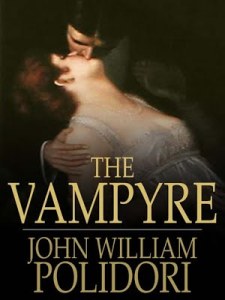
the-vampyrePolidori was inspired by a fragmentary story of Byron’s, Fragment of a Novel (1816), which is also known as “A Fragment” and “The Burial: A Fragment.” Over the course of several mornings, he wrote “The Vampyre.” The manuscript was overlooked for three years when it was discovered by a disreputable publisher, Henry Colburn. He published it in his New Monthly Magazine under the title “The Vampyre: A Tale by Lord Byron.” It was received with acclaim, much to Polidori’s surprise and chagrin.

Polidori struggled to assert his rights to the work, and Lord Byron did have the grace to declare promptly the work was Polidori’s and not his. Despite that assertion, proper credit for authorship of the story was muddy for many years.

Still, Byron was firm that he was not the author. Apparently, Byron felt that the destruction of a man’s soul was no great thing, but theft of his intellectual property was a crime.

Polidori’s work had an immense impact on his contemporary readers. Numerous editions and translations of the tale were published. The influence of The Vampyre as described by Polidori has continued into the twenty-first century, as until recently, his work was frequently considered the primary source of what is accepted as “canon” when writing about vampirism.

What are the traditional tropes of vampire fantasy? First of all, we must think Lord Byron. He was an arrogant, self-centered, charismatic, sociopath with a gift for writing brilliant poetry. From birth, Byron suffered from a deformity of his right foot and by the time he hired Polidori, he was addicted to laudanum which had been prescribed for the pain. He treated the young Polidori atrociously, engendering deep antipathy for his patient in the young doctor.

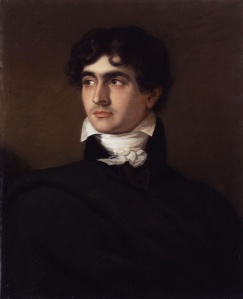
John_William_Polidori_by_F.G._GainsfordWithin the pages of Polidori’s diary, I see “The Vampyre” as an allegory of Byron’s abuse of John Polidori himself. It is easy to visualize Byron as a man possessed of the power to drain one of their soul when seen through the eyes of the man he had in his power, and whom he treated abominably as an employer.

Byron was described as the devourer of souls in the book, Glenarvon, by Lady Caroline Lamb, one of Byron’s former lovers.  “Ruthven” is the name Lady Caroline Lamb referred to Byron as in her novel. Polidori had read Glenarvon that summer, and blatantly used Lamb’s protagonist’s name for his vampire, and Byron proudly admitted he was the role model.

The Public Domain Review article, The Poet, the Physician and the Birth of the Modern Vampire, says this about the rocky relationship between Polidori and Byron:

“It was no great leap for Polidori to believe that Byron was sucking the life from him, just as others had accused Byron of possessing a charismatic power that eclipsed their own identities. Amelia Opie, one of the many women Byron had charmed, described him as having “such a voice as the devil tempted Eve with; you feared its fascination the moment you heard it,” a mesmeric quality that critics also found in his verse, which had, according to the critic Thomas Jones de Powis, “the facility of…bringing the minds of his readers into a state of vassalage or subjection.”

So we know vampires are charismatic and seductive. Their bite would enslave their victims. Folktales from hundreds of years ago tell us they can take the form of bats and fly through the windows of even the tallest buildings. Historically, vampires are powerful, but unable to withstand the light of day, which would burn them, and destroy them forever.

A patch of Dry Skin, Stephen SwartzHowever, that which was once canon regarding vampires is no longer set in stone.

Modern vampires are often able to stay outside during the day, and some even sparkle.  Many are model citizens who get their blood from robbing blood banks.

I love Stephen Swartz’s medical take on vampirism in his book, A Dry Patch of Skin.

But underneath it all, I still have a fondness for the mad, bad, dangerous to know Lord Byron style of vampire.

7 Comments

Filed under History, Literature, vampires, writing