Tag Archives: theme and sub-theme

Exploring theme and morality: contrasts #writing

A few years ago, I wrote a short story for an anthology on the theme of Escape, published by the Northwest Independent Writers Association (NIWA). My story was titled “View from the Bottom of a Lake.” The genre of that story is not fantasy, although it is a dream, a memory of a time gone by.
One of the requirements for that anthology was that all stories must be set in the Pacific Northwest. I set mine in an environment I knew well, the shore of the lake that dominated my early years. With my setting established, I went online and looked up every synonym for the second requirement, which was the theme: “escape.”

Then, after I had all the synonyms, I looked for the antonyms, the opposites.

Capture. Imprisonment. Confront.
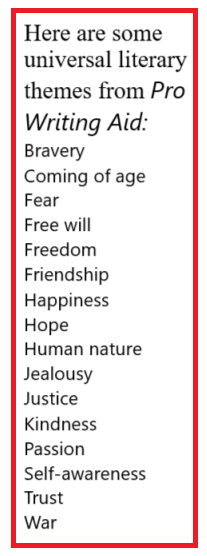
Universal Literary Themes such as braverym coming of age, etc.Once I had a full understanding of all the many nuances of the theme, I asked myself how I could write a story set in an environment I knew and loved. My solution was to set it in the late 1950s. Anything that is history may as well be fantasy because the victors write the history books.

Then, I began plotting.

The main theme of escape had to form the backbone of the plot, that was a given. I asked what my character needed most in her effort to escape. My gut answer was courage.

The first subtheme, the one that formed my main character, was courage. She is underage, fearful of her narcissistic mother, and armed with the knowledge of what she must do to escape.

Every day, she escapes her mother’s disdain by swimming in the lake and staying underwater as long as she can. In those brief moments of freedom, she plans for her long-term escape, determined that once she goes away to college, she won’t return. Her grandmother, who is also a prisoner in that household, is determined to help her escape by paying for her education.

Plot is the frame upon which the themes of a story are supported.The story loops around my protagonist’s fractured family and their twisted relationship with the nearest neighbors.

The second subtheme is hypocrisy. This is a theme of morality, of “do as I say, not as I do.” The parents live out their failed dreams through their children. The girl is forced to take ballet lessons that she despises, and the boy must play football. The girl’s mother is a former ballerina who got pregnant and had to get married, ending her career before it got started. The boy’s father’s glory days were his years as a small-town jock, before WWII changed everything.

In their social world, appearances are everything. And everything is colored by her mother and his father and what everyone knows but cannot speak of.

The final subthemes of that story are hope and perseverance, and in many ways, those themes are the most important.

For the girl, romance with the boy next door is still only a possibility, but the seeds are there through their lifelong friendship. Their plans will come to fruition if only they can survive their senior year and graduate with high grades. All they have to do is endure the pressure cookers of their homes for one more year, and they will achieve their post-high school dreams.

Thus, contrasts drive that short story, and strong themes enabled me to write that tale in three days. The brilliant Lee French was the editor for Escape, and her input was invaluable. View from the Bottom of a Lake is (in my opinion) my best work. Ever.

So, what can I take from that experience to breathe life into my current work-in-progress?

First, I need to identify the overall theme for this half of the story. A comprehensive list of literary themes can be found here: A Huge List of Common Themes – Literary Devices.

The main theme, as I see it now, is two-fold. The theme of religion is explored in the war of the gods, and how a lust for power corrupts one of them.
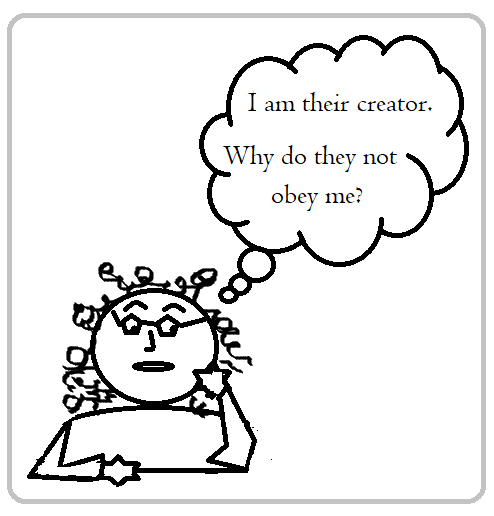
Cartoon: I am their creator. Why do they not obey me?The mortals are the playing pieces in their great game. For the people who must live their lives in the shadow of this war, the more immediate theme of change in the face of tradition underpins the plot. It is explored through the protagonist’s quest to save his people despite their stubborn clinging to xenophobic traditions.

  • My protagonists do have some allies, but they must unite the tribes and convince them of the danger presented by the antagonist.
  • My antagonist knows how the more traditional tribes fear change and ruthlessly stokes that fire.

The enemy presents himself as the man who will keep to the old ways, even though it means abandoning the Goddess Aeos and switching their loyalty to the Bull God. He lies to them about that minor detail, but justifies it as a good lie, a necessary lie.
The 3 S(s) of worldbuilding: Sight, Sound, Smell.So, a third subtheme that runs through the second half of this story is morality. The antagonist can manipulate things and people to achieve his goals. He doesn’t see this as immoral. While the villain is spreading disinformation, the protagonist must try to convey the truth to people who don’t want to hear it. He must convey the facts in such a way that even the staunch traditionalists will see how the antagonist manipulates them.

In real life, everyone is a mass of contradictions we aren’t really aware of. Sometimes, it helps if I use polarities (opposites, contrasts) to flesh out a character. They help me flesh out the protagonist and also the antagonist.

  • courage – cowardice
  • manipulative – honorable
  • truth – misinformation

Now, while I fill in the plot, I am also noting ideas that will support the themes as they come to me. Good use of contrasts will (hopefully) illuminate my characters’ motives and intentions as they work toward the final goal.

Over the next year, I will expand on all these themes and bring this epic to the desired conclusion.

I talk a lot about craft, and yes, it is important. But I believe the most important aspect of the writing process is to have passion for the characters and their story. Writing always flows well when I am emotionally involved.

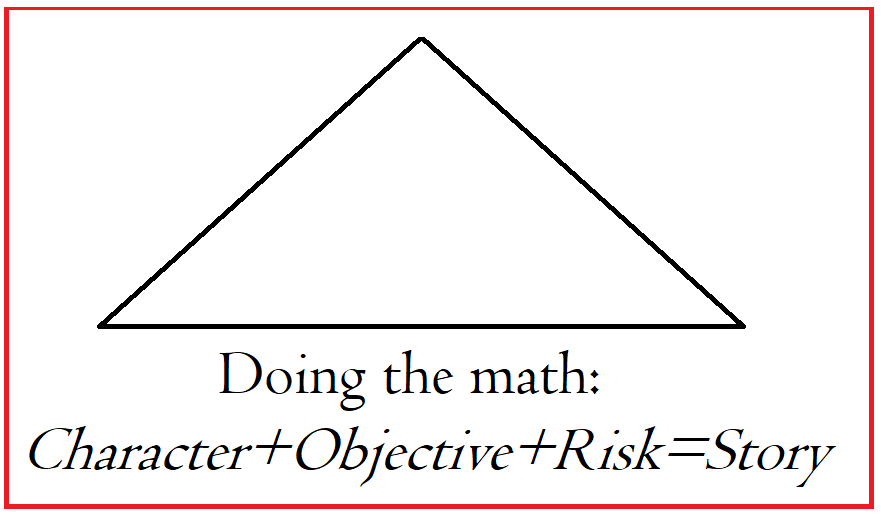
How is your writing going? Are you able to stay emotionally involved with the characters and their lives?Doing the math: Character + Objective + Risk = Story
Leave a comment

Filed under writing

Idea to story part 12 – theme, plot, and the character arc #writing

Two months ago, we began our series, Idea to Story. The previous eleven installments are listed below. We have created a sample story, a romantasy. We have met our protagonists and the ultimate antagonist. We know what their world is like and have given them a worthy quest, and we discovered what genre we are writing by paying attention to the tropes that arose as we were laying down the plot.

Now, we’re going to examine the themes that have emerged. We will strengthen the story arc and make the characters more vivid by ensuring a strong central theme is woven through the story.

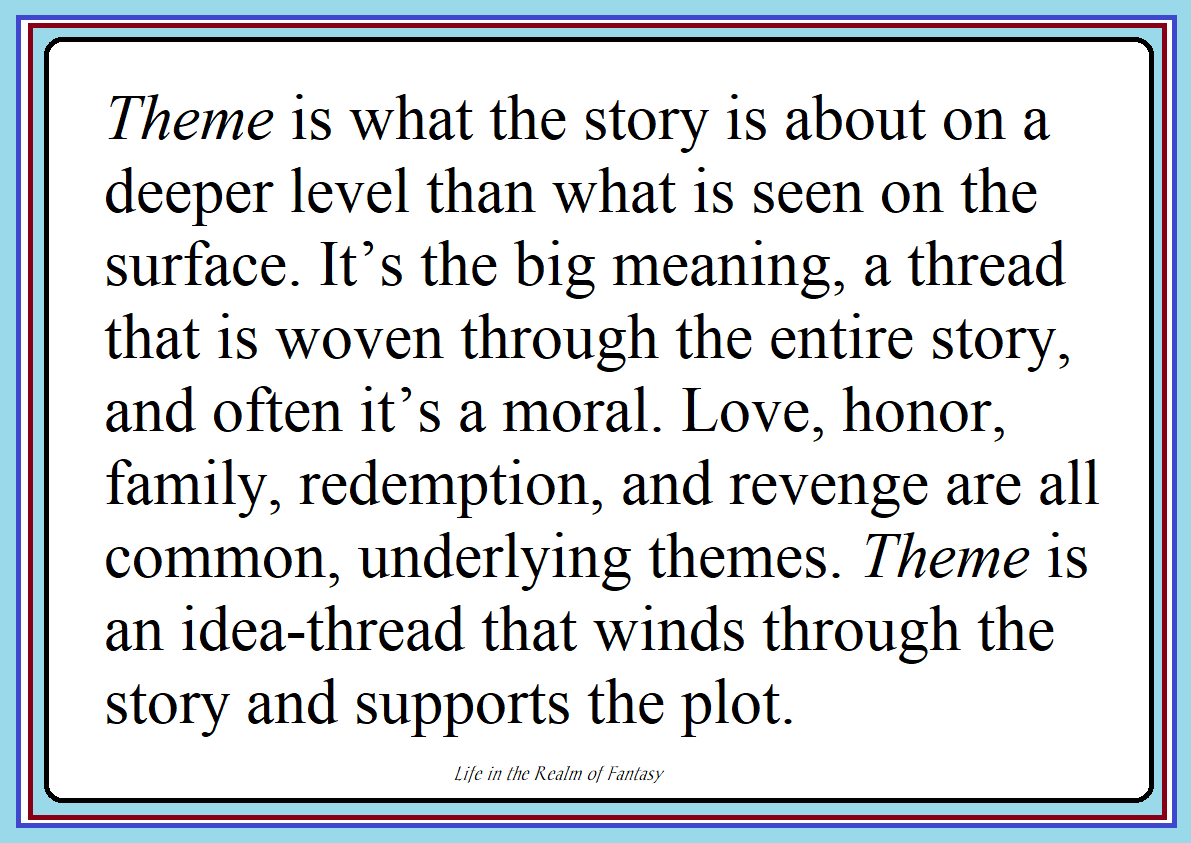
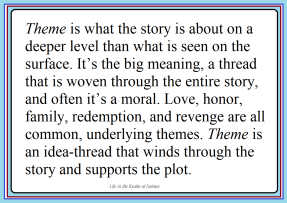
But first, what is a theme? It is an idea, an unspoken message that winds through the arc of the story and generates action. Themes are subtle but move the characters to action and define why the action happens. For an incredible list of themes, go to A Huge List of Common Themes – Literary Devices.

Before we talk about the themes we want to incorporate in our story, let’s look at how the master of themes, Henry James, wove them into his work.

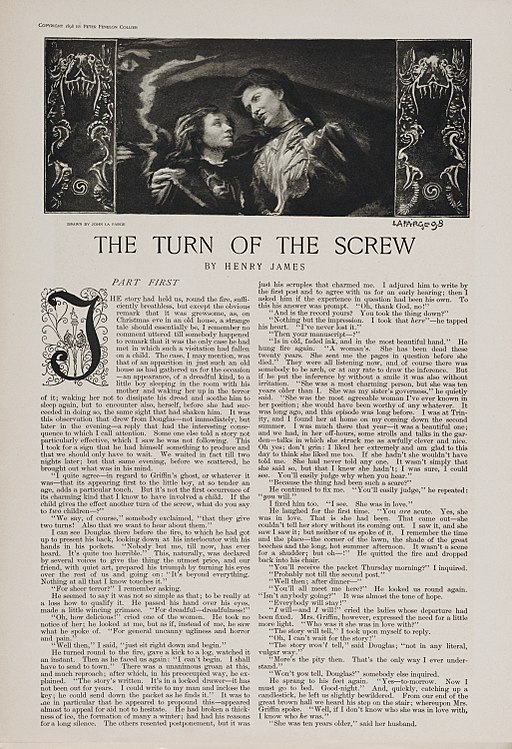
Henry James is a 19th-century writer you might have heard of but never read. However, he can teach us so much about using a story’s themes to create memorable characters. You may be familiar with the titles of some of his works, such as The Turn of the Screw and The Golden Bowl. Filmmakers and playwrights are still turning his work into movies and plays.

Henry James was a master at writing one common theme into a story—lust. Lust for sex. Lust for money. Lust for control.

Lust for power.

Henry James wrote one of the most famous novellas ever published, the Turn of the Screw.

On the surface, the Turn of the Screw is a gothic horror story. The four main themes are the corruption of the innocent, the destructiveness of heroism, the struggle between good and evil, and the difference between reality and fantasy. A fifth theme is the perception of ghosts. Are the ghosts real or the projection of the governess’s madness?

However, there are several subthemes interwoven into the fabric of the narrative:

  • Secrecy.
  • Deception.
  • The lust for control.
  • Obsession.

What I take home from the longevity of Henry James’s work is this: find a strong theme and use it to underscore and support our characters’ motives.

So, now we know that literary themes are a pattern, a “melody” that recurs in varying forms throughout a story. They emphasize mood and shape the plot.

The main theme of our story is the struggle between good and evil. In Donovan’s well-planned manipulation of Kai under the guise of brotherly mentoring, we have the subthemes of deception and the corruption of the innocent. In Val and Kai, we have the dangers of ignorance and the subthemes of arrogance and class prejudice.

Our three main characters are people. In real life, people are a mix of good and bad at the same time. Some lean more toward good, others toward bad. Either way, their intentions are logical, and they desperately want what they think they deserve.

Most importantly, our characters lie to themselves about their own motives and obscure the truth behind other, more palatable truths. These unspoken truths are the themes we must weave into the fabric of our story by subtly showing a pattern.

Two themes we want to emphasize in Donovan are the desire for power and the use of fear as a means of control. However, at first, we want the tug-of-war for control of the child king, Edward, to be focused on the regents, Kai Voss and Valentine.

The story opens from Val’s point of view, so we lean a bit toward her. But not entirely, as Kai’s chapter shows he has good intentions.

By hinting at the pattern of Donvan’s actions in the first quarter of the book, his lust for power becomes clear. We hope to create in the reader a sense of helplessness to stop what we see coming. This is emphasized as clues appear, indicating that Val and Kai are acting on misinformation that is deliberately fed to them.

Once Val and Kai find themselves in the dungeon, new themes will join the story. Both are in their mid-thirties and are established and respected in their respective peer groups. However, both must have a coming-of-age arc. Despite their apparent adulthood, they each have a lot to learn about real life.

But what about young King Edward? For Val and Kai, the theme of parental love is shown in their actions of caring for him from the beginning. While he is not their child, he is in their care and both love him as if he were their son and are secretly jealous of each other. They have differing goals for him, which causes friction, but the reader doesn’t doubt their sincere love for the boy.

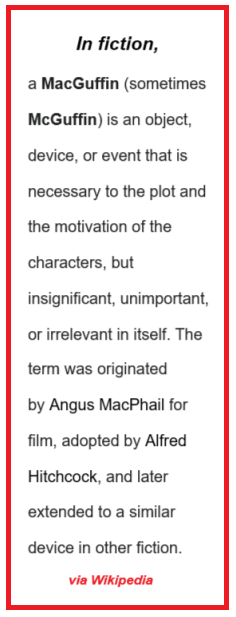
Edward is sickly, cursed with a wasting disease. All through this tale, he has been a McGuffin, the object of the quest and a pawn in Donovan’s game of power. His character arc is limited because he is bedridden and unaware of the war for control centered on him.

When she wakes up in the dungeon, Val realizes who truly set the curse on Edward and who murdered the boy’s parents in the first place. She realizes that if she can’t rescue Edward, Donovan’s curse will kill him, and Donovan will become king. She is miserably aware that she will need a wizard to counter Donovan’s sorcery. Unfortunately, the only sorcerer she has access to is Kai, which means she must rescue him first, something she despises having to do.

Conversely, Kai is glad to be free but not pleased that it is Valentine who has rescued him. He doubts her motives and refuses to believe his brother betrayed him, until they overhear the guards talking.

Val and Kai must learn to work together. As they do, the theme of romantic love will emerge.

What other themes might emerge as we write our story? How will we recognize and underscore the patterns, the melodies that appear in the narrative?

This is where writing becomes a craft, and to excel at any craft, we must work at it.

Thank you for sticking with me as we worked our way through this long and involved process of taking an idea for a story and building the characters, the world, and the plot.

While the story of Val and Kai is just a sample plot for demonstration, I have used these weeks to reexamine the different aspects of my current work in progress. Talking my way through a plot with my friends really helps, so thank you!


Previous in this series:

Idea to story, part 1: novel, poetry, memoir, or short story? #writing | Life in the Realm of Fantasy

Idea to story part 2: thinking out loud #writing | Life in the Realm of Fantasy

Idea to story part 3: plotting out loud #writing | Life in the Realm of Fantasy

Idea to story part 4 – the roles of side characters #writing | Life in the Realm of Fantasy

Idea to story part 5 – plotting treason #writing | Life in the Realm of Fantasy

Idea to story part 6 – Plotting the End #writing | Life in the Realm of Fantasy

Idea to story part 7 – Building the world #writing | Life in the Realm of Fantasy

Idea to story part 8 – world-building and society #writing | Life in the Realm of Fantasy

Idea to story part 9 – technology and world-building #writing | Life in the Realm of Fantasy

Idea to Story part 10 – science and magic as world-building #writing | Life in the Realm of Fantasy

Idea to story part 11: Genre and expected tropes #writing | Life in the Realm of Fantasy

5 Comments

Filed under writing

Theme –Escape from Spiderhead analysis #writing

Last week, we talked about emotions and how they drive each scene. On Monday, we talked about points of no return.

how the universe works themeSo, let’s take a look at theme, the thread that binds emotions and points of no return together. It’s time to take another look at how George Saunders employed themes in his sci-fi masterpiece, Escape from Spiderhead.

In 2015, I took George Saunders’ book, Tenth of December, to Cannon Beach as my summer beach read. For me, the most compelling tale in that collection of short stories was “Escape from Spiderhead.” 

Escape from Spiderhead was first published in the December 12, 2010 edition of the New Yorker. It is a science fiction story set in a prison. It is built around several themes. The central theme is crime and punishment, and Saunders grabs hold of this theme and runs with it.

He asks us to consider where punishment ends, and inhumanity begins.

Tenth of December, George SaundersSaunders gives us the character of Ray Abnesti, a scientist developing pharmaceuticals and using convicted felons as guinea pigs as part of the justice system. The wider world has forgotten about those whose crimes deserve punishment, whose fate goes unknown and unlamented.
Saunders poses questions that challenge us to re-examine our own virtue. Do we have the right to treat a person inhumanely just because they have committed a crime?

He takes a deep dive into the theme of redemption in this tale. He didn’t take the expected path with his plot arc and didn’t opt for revenge by giving Abnesti the drug, which was the obvious choice.

Instead, he takes us on a journey through Jeff’s personal redemption, which is why this story impacted me.

Of course, the scenario is exaggerated, as it is set in a future world. It exposes the callous view modern society has regarding criminals and what punishment they might deserve.

That raises the theme of morality vs. immorality. Who is the real criminal here, Jeff, Abnesti, or a society that would even consider operating such a prison?

plot is the frame upon which the themes of a story are supportedThen there is the theme of compassion. Abnesti explores love vs. lust for his own amusement. The different drugs Jeff is given prove that both are illusionary and fleeting. Yet Saunders implies that the truth of love is compassion. Jeff’s final action shows us that he is a man of compassion.
What does it mean to be human? This theme is a foundational trope of Science Fiction. Saunders shows us that to be human is to be aware and compassionate.

The character of Dr. Abnesti demonstrates that one may be genetically and technically of the human species, yet not human in spirit. He is not aware of others as people; without that awareness, he has no compassion and no humanity.

Theme_1_A common theme in science fiction is the use of drugs to alter people’s behavior and control them emotionally. That theme is explored in detail here, ostensibly as a means to do away with prisons and reform prisoners. But really, these experiments are for Abnesti, a psychopath, to exercise his passion for the perverse and inhumane and for him to have power over the helpless.
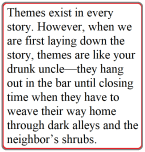
Jeff is aware of the crimes he and his fellow prisoners have committed. Still, he sees Heather struggling with her dose of Darkenfloxx and states his belief that every person is worthy of love.

Spiderhead (the movie) premiered in Sydney on June 11, 2022, and was released on Netflix on June 17, 2022. The film received mixed reviews from critics, and to be honest, I wasn’t impressed.

I will say now – the story and the movie are two different things. The film bears some resemblance to the story it is based on, but – it goes in a different direction and is not that story.

  • All writers should be aware of this important fact: you give up control of your story when you sell the movie rights.

In the short story, Escape from Spiderhead, Saunders’ voice, style, and worldbuilding are impeccable. It is a stark journey into the depths to which some humans are capable of sinking in the pursuit of knowledge for the sake of knowledge.

theme_meme_lirf06302020This short story was as powerful as any novel I’ve ever read, proving that a good story stays with the reader long after the final words have been read, no matter the length. His questions resonate, asking us to think about our true motives.
Where do we draw the line between crime and punishment? When is a legal act really a form of criminal behavior? What does it mean to be human?

For me, that is what good science fiction does—it raises questions and requires us to think.

To learn more about this story, go to Escape from Spiderhead Summary – Litbug.


The majority of this post first appeared here on Life in the Realm of Fantasy on June 29, 2022, https://conniejjasperson.com/2022/06/29/how-the-written-universe-works-exploring-theme-part-3-escape-from-spiderhead-by-george-saunders/.

Comments Off on Theme –Escape from Spiderhead analysis #writing

Filed under writing

The Character Arc part 1 – Theme and Sub-theme #amwriting

I am drawn to books where the protagonist faces their personal demons and finds a hero within themselves. I love the story of someone who meets the unknown and finds the courage to do what they believe is morally right.

2WritingCraft_themeThis is a literary theme and is known as the hero’s journey. But it is only the overarching theme. For that hero’s main character arc to work, they need subthemes.
Subthemes are personal. In a movie score, a particular musical motif plays whenever a specific character enters the scene, and we feel their emotional state. When you discover a character’s void, the thing they lack, you have found the subtheme you need to expand on.

Here are three of the many themes that can help you shape a character’s arc of change:

  • Learning to live with grief.
  • Overcoming a lack of self-worth.
  • Moving beyond an unrequited romantic love.

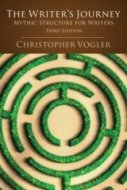
WritersjourneysmallWhat is the “hero’s journey” and why am I so fond of it?  Christopher Vogler broke it down for writers in his book, the Writer’s Journey. But what is essentially is is this:
The concept of the heroic journey was first introduced by the American mythologist, writer, and lecturer Joseph Campbell in The Hero with a Thousand Faces (published in 1949). In this ground-breaking work, he discusses the monomyth or the hero’s journey. He describes how this motif is the common template of a broad category of tales that involve

  1. a hero going on an adventure,
  2. and who, in a decisive crisis, wins a victory,
  3. and who then returns to his home, changed or transformed.

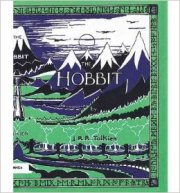
Take Tolkien’s masterpiece, The Hobbit:

the hobbitWhen Bilbo Baggins fights the giant spiders, he also faces his own cowardice and is amazed that he could do such a thing. This is only the first step in his personal arc. As the story progresses, he discovers that he has courage, which has nothing to do with the invisibility conferred on him by the ring he found earlier. Bilbo has courage, and yes, he is afraid. But he is not afraid to be courageous.

This is a core concept of this book and is the central theme of the entire Lord of the Rings series.

The theme of courage is one I find important and admirable, and it emerges in my writing. Courage is a strength beyond the physical. We’re often filled with self-doubt about our ability to do what might be needed in an emergency.

What genre are you drawn to read? That is most likely the genre in which you will write.

Some novels are set against the backdrop of a political power struggle. Political corruption, terrorism, and warfare are common themes. The characters within these stories have personal themes, voids they must overcome to resolve the situation.

Some novels focus on developing romantic relationships. The characters must have personal themes, inner voices they must overcome, as well as the external forces keeping them apart. The romance novel’s conflict and climax are devoted to the overarching theme of growing love. These novels might feature subplots that do not specifically relate to the main characters’ romantic love but enable them to overcome their voids. They must become strong enough to overcome the roadblocks to their happily ever after.

Ulysses cover 3Other novels are entirely character-driven, focusing on the protagonist of the narrative. Much thought is given to how prose is crafted stylistically, using a wide vocabulary. These novels feature thoughtful, in-depth character studies of complex, often troubled, characters. The story is in their day-to-day dealings with these issues. Action is less important than introspection, and the setting frames the characters and their arcs of growth.
The character arc is vital even if we’re writing science fiction. Yes, we want to set our characters in a realistic future based solidly on adequate knowledge of real-world science. If we intend to write hard sci-fi, we need a good understanding of the scientific method, so our plot doesn’t evolve into fantasy. Science and technology are dominant themes, but our characters are what will keep the readers reading. They will have personal voids, so sub-themes such as morality and love will arise, and the setting is only the backdrop.

Lord_of_the_Rings_-_The_Two_Towers_bookLet’s look again at J.R.R. Tolkien’s LOTR series. Personal growth and the many forms heroism can take are central themes of his stories. While many side-quests take the different characters away from the physical journey of the One Ring, Tolkien never strayed from the concept of the hero’s journey. The arcs of each character, as they go through their adventures and meet and overcome their personal void, support the overall theme of heroism in the face of death.

Any person’s fundamental fears and insecurities can become a character’s sub-theme, the thread you can expand on to shape their relationships.

On the surface, the many genres of books look widely different. However, they all have one thing in common–they have protagonists and side characters. These people will all have to deal with and react to the book’s overarching theme, but each will have their own story and personal journey.

The world in which a narrative is set is like a picture frame. It is the environment against which the story’s themes play out. The characters are shaped by a force beyond their control—the author.

The central theme of your story emerges when you are laying down the first draft. If your inspiration seems to faint somewhere in the middle, it may be that you have lost track of what you initially imagined your story was about. The characters no longer know what they are fighting for. Was it love? Was it destiny? Was it the death of hope?

AGameOfThronesWhen we are constantly prodded to make our work focus on action and events, it becomes easy to forget that characters have an internal arc. They must grow for good or ill.
Ask yourself if the action has been inserted for its shock value. Or is this scene necessary to force change and growth on the protagonist and companions? How will their fundamental ethics and ideals be challenged by this event?

  • If there is no personal cost or benefit to the characters, there is no need for that scene.

Remember, just because an idea no longer works for this novel doesn’t mean it won’t work in another. You never know when you will need those ideas, so don’t throw them away—always keep the things you cut in a separate file.

I label that file “outtakes,” and believe me, it has come in handy when I need an idea to jump-start a new story.

In many ways, writing genre fiction can become a trap. Sometimes we are so busy plotting roadblocks for our protagonist and his nemesis that the action takes over, and the main theme becomes tenuous.

  • The action should force the character to change. If you absolutely must have that action, find a way for it to force growth on or otherwise affect the characters involved in it.

When we are deep in the creative process, it’s easy to forget that characters must evolve.

WoT03_TheDragonRebornI step away from my project for a week or two or even longer when stuck. When I come back to it, the characters and their journey is new again, inspiring me to finish their story. This is why I am a slow writer.

I write for a niche market–people like me. If I’ve learned nothing else over these last few years, it’s that as an indie, I have all the time in the world to get my work as right as I can make it.

Our next post will look at ways of discovering the personal void that initially holds our characters back, and how that void shapes them.

8 Comments

Filed under writing