Tag Archives: theme

#amwriting: Theme: chaos or stability

Fall of Angels L E Modesitt JrA common theme in fantasy is the juxtaposition of chaos and stability, or order. Good versus evil is a trope of the genre, and  evil is usually portrayed by taking one or the other of these concepts to an extreme.

Author L.E. Modesitt Jr. has taken the theme of chaos and order and built his Magic of Recluce series around the comparison and contrasts of the two, with each side being given the protagonists’ POV in different books as the series progresses. He has been able to really explore the way each side’s magic is expressed, and the moral and ethical values that each side holds dear.

Both sides consider themselves morally superior, and both sides are wary of those who walk that gray path in the middle, which allows Modesitt real opportunities to put his protagonists through the wringer.

Trumps_of_doomThe late Roger Zelazney’s brilliant Chronicles of Amber series also details the distinctions between Chaos and Order, and moral and ethical challenges of those who travel from reality to reality through the shadows, with each shadow growing more radical depending on the distance from Castle Amber (which represents Order).

In several of his works, elements of each are combined freely and interchangeably. Jack of Shadows and Changeling, for example, revolve around the tensions between the two worlds of magic and technology, or order and chaos.

But what is chaos, and what is order ?

Google defines Chaos as

Chaos definition

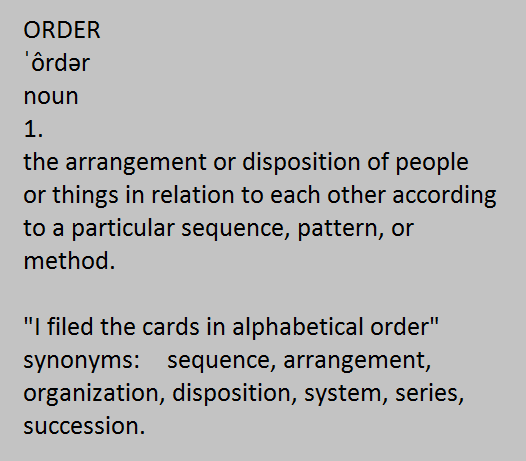
Google also defines Order as:

order definition

Either side of the coin, when taken to an extreme, can be truly evil.

Consider chaos, or Anarchy. When a culture descends into anarchy, you have an absence of government and absolute freedom of the individual. While this frequently begins as an attempt to allow for individual freedoms without state interference, history shows that what follows is the emergence of a violent culture that is beyond the reach of law.  There is no law and no one capable of enforcing it. The strongest, most violent thugs rise to the top and frequently war with each other, while the common person is caught in the middle. Followers of each warlord are rewarded with the spoils of conquest, which are often goods taken from the common citizen who must somehow survive under that tyranny.

war and peaceNow let’s look at order: totalitarianism, or total order can also be a form of tyranny: everything is static and nothing changes. There is centralized control by an autocratic authority, combined with the political concept that the citizen should be totally subject to an absolute state authority. No divergence from the norm can be tolerated, and good, obedient citizens are rewarded, while deviants who are seen to be free-thinkers, intellectuals, and artists are persecuted and imprisoned, or killed.

Anarchy=instability and a breakdown of society. Totalitarianism=lack of growth and stagnation of society. For most people’s comfort, a good society allows for both law and creativity.

In extreme types of societies, power is everything, and drawing negative attention to yourself is dangerous. Thus chaos-based societies are usually represented in literature as having an underlying order that holds them together, and order-based societies are often represented as requiring the ability to grow and change, but within certain parameters.

The theme of order and chaos can really power a story-line, and the way you perceive them will not be the way another author sees them. L.E. Modesitt, Jr. and Roger Zelazney couldn’t be more different in the way they portrayed these concepts.

If you haven’t read Zelazney’s works, I highly recommend them.

Comments Off on #amwriting: Theme: chaos or stability

Filed under Fantasy, Publishing, Uncategorized, writing

What are you #writing: Identifying your theme

herowithathousandfacescd2000When I read a book, I connect to the sense of wonder that each event or plot twist in a story evokes for the protagonists.  I am extremely partial to those books in in which the protagonist faces his/her own demons and finds a hero within themselves, a person who faces the unknown and finds the courage to do what he/she believes is morally right.

Consider J.R.R. Tolkien’s  LOTR series. He clearly knew that personal growth and the many forms that heroism can take are central themes of his stories, and while there are many side-quests taking the different characters away from the physical journey of the One Ring, Tolkien never strayed from the concept of the hero’s journey.

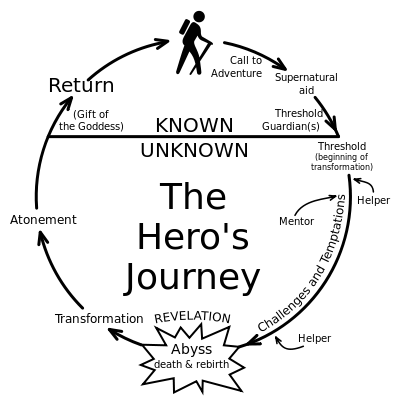
What is the “hero’s journey”?  The concept of the heroic journey was first introduced by the American mythologist, writer and lecturer, Joseph Campbell in The Hero with a Thousand Faces (published in 1949). In this ground-breaking work, he discusses the monomyth, or the hero’s journey. He describes how this motif is the common template of a broad category of tales that involve

  1. a hero going on an adventure,
  2. and who, in a decisive crisis, wins a victory,
  3. and who then returns to his home changed or transformed.

Take Tolkien’s masterpiece, The Hobbit: When Bilbo Baggins faces the giant spiders he also faces his own cowardice, and he is filled with amazement that he could do such a thing. This is the first step in his realization that he has courage apart from the invisibility conferred on him by the ring he found earlier. He has courage, and yes, he is afraid, but he is not afraid to be courageous. This is a core concept of this book, and of the entire Lord of the Rings series, set in Middle Earth.

398px-Heroes journey by Christopher Vogler

The diagram is loosely based on Campbell (1949) and (more directly?) on Christopher Vogler, “A Practical Guide to Joseph Campbell’s The Hero with a Thousand Faces” (seven-page-memo 1985). Public Domain, via Wikimedia Commons

In my own work, personal growth and the hero’s journey are often the central themes. This is because those are the stories that intrigued me most as a young reader, and they intrigue me now as an adult.

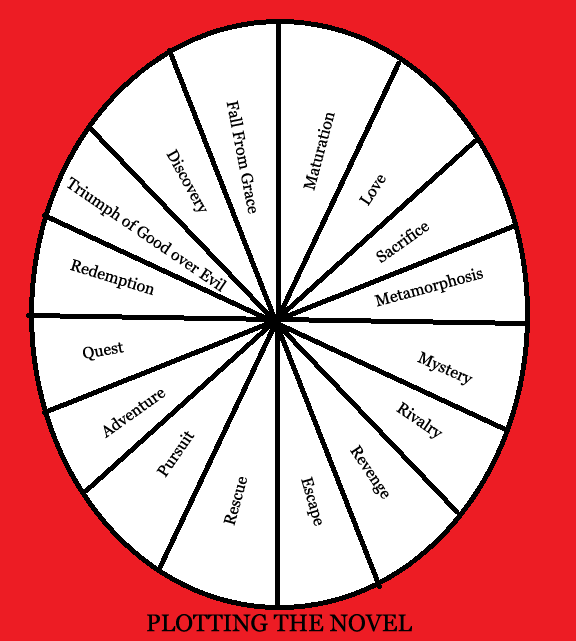
What is the central theme of your work? Here are a few themes commonly found in popular genre fiction, besides the Hero’s Journey:

Dial-a-Plot

Every one of these themes will force the protagonist to grow and change in some way. Every one of them will challenge his ideas of morality and push him to act in ways that force him to evolve. That kind of growth is what makes characters intriguing and memorable.

When we are constantly prodded to make our work focus on action instead of introspection, it becomes easy to wander way off track. Ask yourself if the action has been inserted for the sake of the shock value, or if this scene is necessary to force change and growth on the protagonist. How will her fundamental ethics and ideals be challenged by this event? If there is no personal cost, there is no need for that scene.

Caspar David Friedrich, Wanderer Above the Sea of Fog, 1818 PD|100 via Wikimedia Commons

Caspar David Friedrich, Wanderer Above the Sea of Fog, 1818 PD|100 via Wikimedia Commons

Writing these blind alleys is not a waste of time.

You never know when you will need those ideas, so never just throw them away–always keep the things you cut in a separate file. Remember, just because that idea doesn’t work for this book, doesn’t mean it won’t work in another book.

I label that file “outtakes,” and believe me, it has come in handy when I need an idea to jump-start a new story.

Keeping in mind the underlying theme of your story while you are laying down the first draft is important. If your inspiration seems to faint somewhere along the middle, it may be that you have lost track of what you originally imagined your story was about and your characters no longer know what they are fighting for. Was it love? Was it destiny? Was it the death of hope?

Sometimes we are so busy setting traps and roadblocks for our protagonist and his nemesis that the action takes over and becomes the theme. The action is there to force the character to grow, not simply for the sake of action. When we are deep in the creative process, it’s easy to forget that characters must evolve.

Remember, there was a fundamental theme in your mind when you first imagined you had a story to write, and once you identify that core concept, you may find you are no longer stuck.

5 Comments

Filed under Books, Uncategorized, writing