Tag Archives: Vincent van Gogh

#FineArtFriday:  Green Wheat Field with Cypress by Vincent van Gogh 1889

Artist: Vincent van Gogh (1853–1890)

Title: Green Wheat Field with Cypress / Green Wheat

Date: mid June 1889

Medium: oil on canvas

Dimensions: height: 73 cm (28.7 in); width: 92.5 cm (36.4 in)

Collection: National Gallery Prague


What I love about this painting:

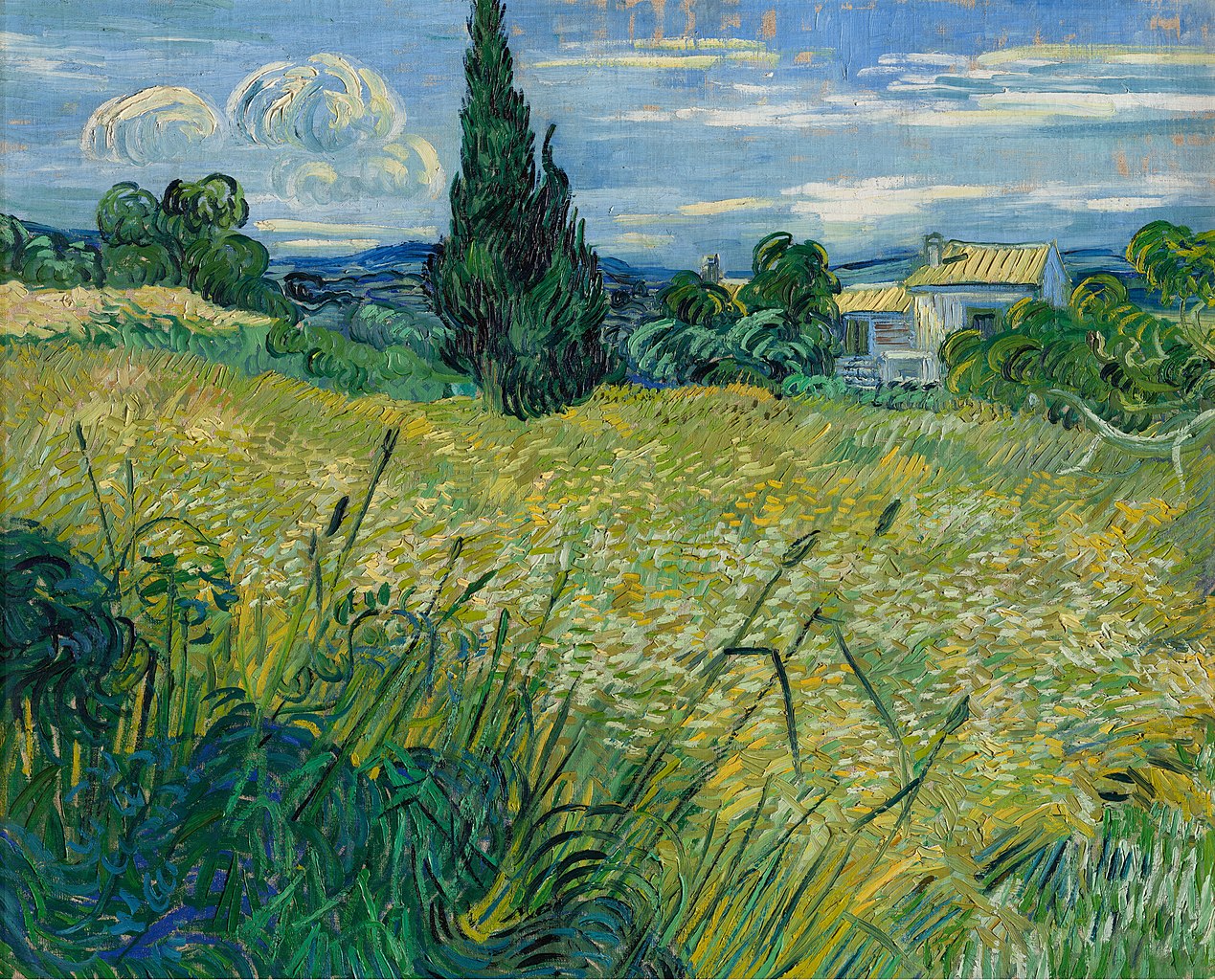
This painting is an example of the quintessential Vincent van Gogh view of his world. He shows us a sunny afternoon in swirls and strong colors, painting it the way he experienced it.

Vincent’s superpower was the ability to show us the emotions he felt as he painted a scene. In this case, I think he was feeling a sense of peace at being outdoors.

If you have stopped by this blog before, you know I am a writer. Art inspires me and I’m always imagining the story behind each painting I feature here. As a dedicated Vincent Fangirl, I can picture him having a good day, enjoying the harmony of a sunny afternoon in June, however fleeting those moments of peace were for him.

This painting was done one year before his suicide, during a brief a time when he was relatively happy, just before his final breakdown. The clouds, the blades of grass—each thing he saw that day is there, depicted with the emotions he experienced.

About this painting via Wikipedia:

The painting depicts golden fields of ripe wheat, a dark fastigiate Provençal cypress towering like a green obelisk to the right and lighter green olive trees in the middle distance, with hills and mountains visible behind, and white clouds swirling in an azure sky above. The first version (F717) was painted in late June or early July 1889, during a period of frantic painting and shortly after Van Gogh completed The Starry Night, at a time when he was fascinated by the cypress. It is likely to have been painted “en plein air“, near the subject, when Van Gogh was able to leave the precincts of the asylum. Van Gogh regarded this work as one of his best summer paintings. In a letter to his brother, Theo, written on 2 July 1889, Vincent described the painting: “I have a canvas of cypresses with some ears of wheat, some poppies, a blue sky like a piece of Scotch plaid; the former painted with a thick impasto like the Monticelli‘s, and the wheat field in the sun, which represents the extreme heat, very thick too.” [1]


Wheat fields via Wikipedia:

The wheat field with cypresses paintings were made when van Gogh was able to leave the asylum. Van Gogh had a fondness for cypresses and wheat fields of which he wrote: “Only I have no news to tell you, for the days are all the same, I have no ideas, except to think that a field of wheat or a cypress well worth the trouble of looking at closeup.”

In early July, Van Gogh wrote to his brother Theo of a work he began in June, Wheat Field with Cypresses: “I have a canvas of cypresses with some ears of wheat, some poppies, a blue sky like a piece of Scotch plaid; the former painted with a thick impasto … and the wheat field in the sun, which represents the extreme heat, very thick too.” Van Gogh who regarded this landscape as one of his “best” summer paintings made two additional oil paintings very similar in composition that fall. One of the two is in a private collection. London’s National Gallery A Wheat Field, with Cypresses painting was made in September which Janson & Janson 1977, p. 308 describes: “the field is like a stormy sea; the trees spring flamelike from the ground; and the hills and clouds heave with the same surge of motion. Every stroke stands out boldly in a long ribbon of strong, unmixed color.”

There is also another version of Wheat Fields with Cypresses made in September with a blue-green sky, reportedly held at the Tate Gallery in London. [2]


About the Artist, via Wikipedia:

Vincent Willem van Gogh, 30 March 1853 – 29 July 1890) was a Dutch Post-Impressionist painter who posthumously became one of the most famous and influential figures in Western art history. In a decade, he created about 2,100 artworks, including around 860 oil paintings, most of which date from the last two years of his life. They include landscapes, still lifes, portraits, and self-portraits, and are characterised by bold colours and dramatic, impulsive and expressive brushwork that contributed to the foundations of modern art. He was not commercially successful, struggled with severe depression and poverty, and committed suicide at the age of 37.

Van Gogh was born into an upper-middle-class family, While a child he drew and was serious, quiet and thoughtful. As a young man he worked as an art dealer, often traveling, but became depressed after he was transferred to London. He turned to religion and spent time as a Protestant missionary in southern Belgium. He drifted in ill health and solitude before taking up painting in 1881, having moved back home with his parents. His younger brother Theo supported him financially; the two kept a long correspondence by letter. His early works, mostly still lifes and depictions of peasant labourers, contain few signs of the vivid colour that distinguished his later work. In 1886, he moved to Paris, where he met members of the avant-garde, including Émile Bernard and Paul Gauguin, who were reacting against the Impressionist sensibility. As his work developed he created a new approach to still lifes and local landscapes. His paintings grew brighter as he developed a style that became fully realised during his stay in Arles in the South of France in 1888. During this period he broadened his subject matter to include series of olive trees, wheat fields and sunflowers.

Van Gogh suffered from psychotic episodes and delusions, and though he worried about his mental stability, he often neglected his physical health, did not eat properly and drank heavily. His friendship with Gauguin ended after a confrontation between the two when, in a rage, Van Gogh severed a part of his own left ear with a razor. He spent time in psychiatric hospitals, including a period at Saint-Rémy. After he discharged himself and moved to the Auberge Ravoux in Auvers-sur-Oise near Paris, he came under the care of the homeopathic doctor Paul Gachet. His depression persisted, and on 27 July 1890, Van Gogh is believed to have shot himself in the chest with a revolver, dying from his injuries two days later.  [3]


Credits and Attributions:

IMAGE: Wikimedia Commons contributors, “File:Vincent van Gogh – Green Wheat Field with Cypress (1889).jpg,” Wikimedia Commons, https://commons.wikimedia.org/w/index.php?title=File:Vincent_van_Gogh_-_Green_Wheat_Field_with_Cypress_(1889).jpg&oldid=670096634 (accessed March 13, 2025).

[1] Wikipedia contributors, “Wheat Field with Cypresses,” Wikipedia, The Free Encyclopedia, https://en.wikipedia.org/w/index.php?title=Wheat_Field_with_Cypresses&oldid=1222477822 (accessed March 13, 2025).

[2] Wikipedia contributors, “Wheat Fields,” Wikipedia, The Free Encyclopedia, https://en.wikipedia.org/w/index.php?title=Wheat_Fields&oldid=1277932418 (accessed March 13, 2025).

[3] Wikipedia contributors, “Vincent van Gogh,” Wikipedia, The Free Encyclopedia, https://en.wikipedia.org/w/index.php?title=Vincent_van_Gogh&oldid=1279502999 (accessed March 13, 2025).
2 Comments

Filed under #FineArtFriday, writing

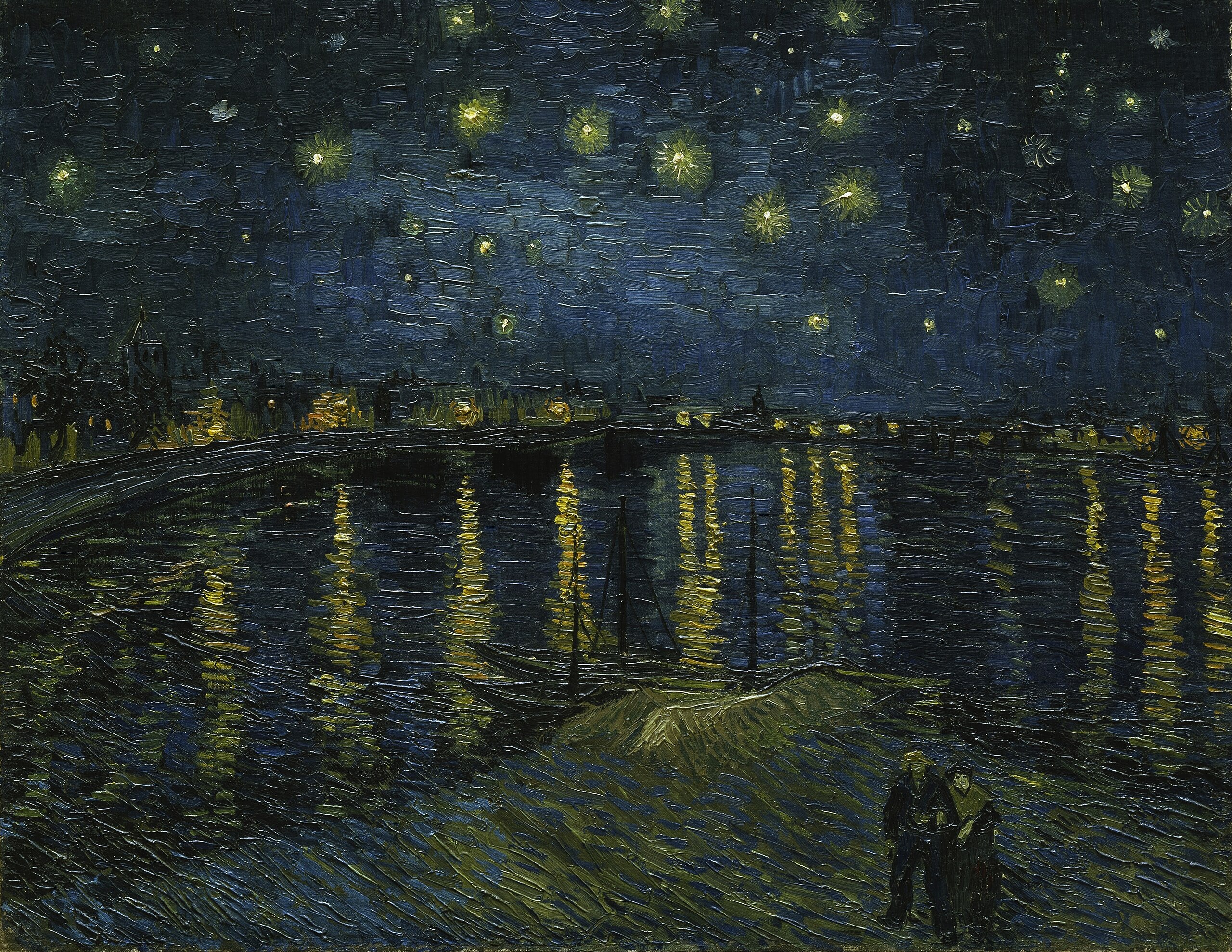
#FineArtFriday: Starry Night Over the Rhone by Vincent van Gogh 1888 

Artist: Vincent van Gogh  (1853–1890)

Title:  Starry Night Over the Rhone

Genre: landscape painting

Date:1888

Medium: oil on canvas

Dimensions: height: 720 mm (28.3 in)

Collection: Musée d’Orsay 

Exhibition history: Van Gogh and Britain, Tate Britain


What I love about this painting:

Vincent’s night sky is shown with reverence, the vault of heaven above shining the light of hope over the darkness of the world below. His colors are dark and intense, yet bright where light is needed—a kind of purity in execution that was one of his gifts.

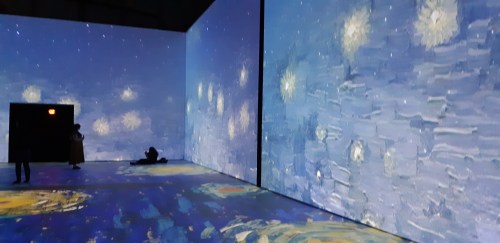
In April of 2022, Fellow writer, Johanna Flynn and Greg and I joined friends to attend an immersive exhibit of Vincent van Gogh’s life through his work. We roamed freely inside an everchanging exhibit that flowed through many of his most famous works and zoomed in on bits one wouldn’t ordinarily notice.

The classical soundtrack was the perfect accompaniment. For several hours, we were immersed in Vincent’s visions of the world he loved but didn’t fit in.

The exhibit was such a moving, emotional experience. I felt as if I had seen into the man and his art.

That day, I became a Vincent van Gogh fangirl.

Vincent’s stars are surreal, yet they show the truth of how he saw the world.

About this painting, via Wikipedia:

Van Gogh announced and described this composition in a letter to his brother Theo:

Included a small sketch of a 30 square canvas – in short the starry sky painted by night, actually under a gas jet. The sky is aquamarine, the water is royal blue, the ground is mauve. The town is blue and purple. The gas is yellow and the reflections are russet gold descending down to green-bronze. On the aquamarine field of the sky the Great Bear is a sparkling green and pink, whose discreet paleness contrasts with the brutal gold of the gas. Two colorful figurines of lovers in the foreground.

In reality, the view depicted in the painting faces away from Ursa Major, which is to the north. The foreground indicates heavy rework, wet-in-wet, as soon as the first state was finished. The letter sketches executed at this time probably are based on the original composition.

Colors of the night

The challenge of painting at night intrigued van Gogh. The vantage point he chose for Starry Night allowed him to capture the reflections of the gas lighting in Arles across the glimmering blue water of the Rhône. In the foreground, two lovers stroll by the banks of the river.

Depicting colour was of great importance to Vincent; in letters to his brother, Theo, he often described objects in his paintings in terms of colour. His night paintings, including Starry Night, emphasize the importance he placed on capturing the sparkling colors of the night sky and of the artificial lighting that was new to the era.

The Great Bear

In September 1888, when Vincent van Gogh painted this picture on the banks of the Rhône, he saw the city of Arles looking south-west. The Great Bear will never be visible in that direction. On the other hand, he only had to turn his head to the north to see the constellation in exactly the position depicted. This painting is therefore an assemblage of a terrestrial plane and a celestial plane.

The Star Flowers

In 1888, when he painted the night sky, the stars resemble flowers. By the time he painted The Starry Night in 1889, his technique has evolved, the brightness of the stars being symbolized by concentric dotted circles. [1]

About the Artist, via Wikipedia:

Vincent Willem van Gogh, 30 March 1853 – 29 July 1890) was a Dutch Post-Impressionist painter who posthumously became one of the most famous and influential figures in Western art history. In a decade, he created about 2,100 artworks, including around 860 oil paintings, most of which date from the last two years of his life. They include landscapes, still lifes, portraits, and self-portraits, and are characterised by bold colours and dramatic, impulsive and expressive brushwork that contributed to the foundations of modern art. He was not commercially successful, struggled with severe depression and poverty, and committed suicide at the age of 37.

Van Gogh was born into an upper-middle-class family, While a child he drew and was serious, quiet and thoughtful. As a young man he worked as an art dealer, often traveling, but became depressed after he was transferred to London. He turned to religion and spent time as a Protestant missionary in southern Belgium. He drifted in ill health and solitude before taking up painting in 1881, having moved back home with his parents. His younger brother Theo supported him financially; the two kept a long correspondence by letter. His early works, mostly still lifes and depictions of peasant labourers, contain few signs of the vivid colour that distinguished his later work. In 1886, he moved to Paris, where he met members of the avant-garde, including Émile Bernard and Paul Gauguin, who were reacting against the Impressionist sensibility. As his work developed he created a new approach to still lifes and local landscapes. His paintings grew brighter as he developed a style that became fully realised during his stay in Arles in the South of France in 1888. During this period he broadened his subject matter to include series of olive trees, wheat fields and sunflowers.

Van Gogh suffered from psychotic episodes and delusions, and though he worried about his mental stability, he often neglected his physical health, did not eat properly and drank heavily. His friendship with Gauguin ended after a confrontation between the two when, in a rage, Van Gogh severed a part of his own left ear with a razor. He spent time in psychiatric hospitals, including a period at Saint-Rémy. After he discharged himself and moved to the Auberge Ravoux in Auvers-sur-Oise near Paris, he came under the care of the homeopathic doctor Paul Gachet. His depression persisted, and on 27 July 1890, Van Gogh is believed to have shot himself in the chest with a revolver, dying from his injuries two days later. [2]


Credits and Attributions:

IMAGE: Wikimedia Commons contributors, “File:Starry Night Over the Rhone by Vincent van Gogh, ‘lightballs’.jpg,” Wikimedia Commons, https://commons.wikimedia.org/w/index.php?title=File:Starry_Night_Over_the_Rhone_by_Vincent_van_Gogh,_%27lightballs%27.jpg&oldid=979586430 (accessed February 21, 2025).

[1] About this Painting via Wikipedia: Wikipedia contributors, “Starry Night Over the Rhône,” Wikipedia, The Free Encyclopedia, https://en.wikipedia.org/w/index.php?title=Starry_Night_Over_the_Rh%C3%B4ne&oldid=1272866843 (accessed February 21, 2025).

[2] About the artist:  Wikipedia contributors, “Vincent van Gogh,” Wikipedia, The Free Encyclopedia, https://en.wikipedia.org/w/index.php?title=Vincent_van_Gogh&oldid=1276412810 (accessed February 21, 2025).


3 Comments

Filed under #FineArtFriday, writing

#FineArtFriday: Undergrowth with Two Figures, Vincent van Gogh 1890, a second look

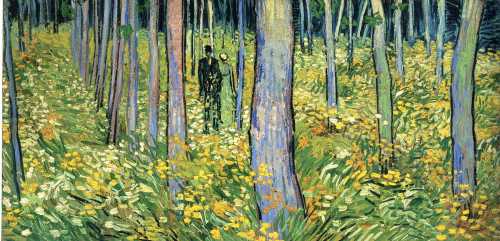
Vincent_van_Gogh_-_Undergrowth_with_Two_Figures_(F773)Artist: Vincent van Gogh (1853–1890)

Title: Undergrowth with Two Figures

Date: late June 1890

Medium: oil on canvas

Dimensions: height: 50 cm (19.6 in); width: 100.5 cm (39.5 in)

Collection: Cincinnati Art Museum

Two years ago, in April of 2022, I was privileged to attend an immersive exhibit of Vincent van Gogh’s life through his work. Viewers roamed freely inside an everchanging exhibit that flowed through many of his most famous works and zoomed in on bits one wouldn’t ordinarily notice.

I managed a few shots with my cell phone that offered some idea of what the exhibition was like, but sadly, the camera on that phone wasn’t the best. Here is the one that nearly shows what we experienced, a glimpse into van Gogh’s Starry Night:

Van Gogh immersive 1 connie j jasperson LIRF04072022

The exhibit was such a moving, emotional experience. It really brought you into touch with the man and his art. I became a Vincent van Gogh fangirl that day.

We were in, above, and surrounded by his work. The powerful soundtrack of classical music paired perfectly with the images, complementing them like fine wine does good food.

The link to what we saw at that exhibit is here: Van Gogh, The Immersive Experience.

What I love about Undergrowth with Two Figures:

This very late work was painted at the end of June 1890, a few weeks before Van Gogh’s death. It was one of several paintings in Auvers-sur-Oise, a commune on the northwestern outskirts of Paris, France. This was also the place where Vincent van Gogh died from injuries suffered in an attempted suicide.

This painting is one of several he made in the last weeks of his life using a double-square format. The double-square paintings were made on uncommonly large canvases, rectangular, twice as wide as they were tall. Vincent’s need to express his art couldn’t be contained on an ordinary canvas—he saw the world with a panoramic view.

One of the things I love about this painting is the use of violet and blue in the trunks of the poplars. They are tall, immense, like bars in a window framing the courting pair. The trees stand out against the black backdrop. They have power and are the soul of the painting, even more so than the flowers and undergrowth through which the couple walks.

I think it’s a wonderful composition, with strong brush strokes and deep, dark colors. He saw the beauty in life and painted it.

[1] About this painting, via Google Arts and Culture:

In a letter to his younger brother, Theo, dated June 30, 1890, van Gogh explained the structure and brilliant colors of “Undergrowth with Two Figures”: “The trunks of the violet poplars cross the landscape perpendicularly like columns,” adding “the depth of Sous Bois is blue, and under the big trunks the grass blooms with flowers in white, rose, yellow, and green.”

“Undergrowth with Two Figures” has a silvery tonality characteristic of van Gogh’s works from Auvers. His brushwork may be swift and visceral, his colors strong and biting, his emotion raw and visible, but the composition reveals no hint of psychological torment.

It is painted on a double square canvas, twice as wide as it is high. Van Gogh explored the artistic possibilities of this panoramic format in several of his last paintings. [1]


Credits and Attributions:

[1] Google Arts and Culture Contributors, Undergrowth with two Figures, Vincent van Gogh 1890, Accessed April 7, 2022.

Wikimedia Commons contributors, “File:Vincent van Gogh – Undergrowth with Two Figures (F773).jpg,” Wikimedia Commons, the free media repository, https://commons.wikimedia.org/w/index.php?title=File:Vincent_van_Gogh_-_Undergrowth_with_Two_Figures_(F773).jpg&oldid=618842665 (accessed April 8, 2022).

View of Vincent’s Starry Night, © 2022 Connie J. Jasperson, own work,

2 Comments

Filed under #FineArtFriday

#FineArtFriday: Street Scene in Montmartre Vincent van Gogh 1887 (a second look)

Scène_de_Rue_à_MontmartreArtist: Vincent van Gogh (1853–1890)

Title: Street Scene in Montmartre

Genre: landscape art

Date: 1887

Medium: oil on canvas

Dimensions: height: 46.1 cm (18.1 in); width: 61.3 cm (24.1 in)

Collection: Private collection

What I love about this painting:

Street Scene in Montmartre is a relatively unknown painting by Vincent van Gogh, unknown because it has been held in private collections and not exhibited to the public. It was auctioned by Sotheby’s in 2021, and the image was posted to Wikimedia Commons courtesy of that auction.

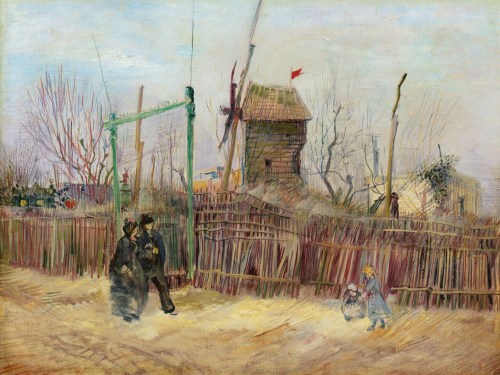
The scene feels like an afternoon scene in winter, with a man and woman walking, and two children playing.

I wanted to take a second look at this painting because I’ve been reading a great deal about Vincent’s life. His art was an attempt to show the beauty he saw everywhere, especially in the most ordinary of things.

He paid particular attention to the visual construction and texture of the fence, and also to the tangle of garden behind. This is the smaller of two windmills featured in several more well-known paintings in the subset of paintings from Van Gogh’s Montmartre series.

While there are people walking down the dirt lane in this scene, they aren’t the focus. Instead, our eye is directed to the way the windmill rises over the ramshackle fence, neglected garden, and above it all, the flag bravely flying.

The dirt lane, the fence, the winter-barren garden, and the windmill falling to ruin beneath the cold sky offer us a glimpse into Vincent’s mood. He finds beauty in the textures of life, both visual and metaphysical – in the cycle of life, of youth growing old and aging to ruin. The flag flying in the breeze and the children playing offer us the hope of brighter days and new possibilities.

About this painting, via Wikipedia:

The Montmartre paintings are a group of works that Vincent van Gogh created in 1886 and 1887 of the Paris district of Montmartre while living there, at 54 Rue Lepic, with his brother Theo. Rather than capture urban settings in Paris, van Gogh preferred pastoral scenes, such as Montmartre and Asnières in the northwest suburbs. Of the two years in Paris, the work from 1886 often has the dark, somber tones of his early works from the Netherlands and Brussels. By the spring of 1887, van Gogh embraced use of color and light and created his own brushstroke techniques based upon Impressionism and Pointillism. The works in the series provide examples of his work during that period of time and the progression he made as an artist.

In van Gogh’s first year in Paris he painted rural areas around Montmartre, such as the butte and its windmills. The colors are somber and evoke a sense of his anxiety and loneliness.

The landscape and windmills around Montmartre were the source of inspiration for a number of van Gogh’s paintings. The Moulin de la Galette, still standing, is located near the apartment he shared with his brother. Built in 1622, it was originally called Blute-Fin and belonged to the Debray family in the 19th century. Van Gogh met artists such as Toulouse-Lautrec, Paul Signac and Paul Gauguin who inspired him to incorporate Impressionism into his artwork resulting in lighter, more colorful paintings.

Windmills also featured in some of van Gogh’s landscape paintings of Montmartre.

Montmartre, sitting on a butte overlooking Paris, was known for its bars, cafes, and dance-hall. It was also located on the edge of countryside that afforded Van Gogh the opportunity to work on paintings of rural settings while living in Paris.

When Van Gogh painted he intended not just to capture the subject, but to express a message or meaning. It was through his paintings of nature that he was most successful at accomplishing his goal. It also created a great challenge: how to portray the subject and create a work that would resonate with the audience. [1]

About the Artist, via Wikipedia:

Vincent Willem van Gogh, 30 March 1853 – 29 July 1890) was a Dutch Post-Impressionist painter who posthumously became one of the most famous and influential figures in Western art history. In a decade, he created about 2,100 artworks, including around 860 oil paintings, most of which date from the last two years of his life. They include landscapes, still lifes, portraits, and self-portraits, and are characterised by bold colours and dramatic, impulsive and expressive brushwork that contributed to the foundations of modern art. He was not commercially successful, struggled with severe depression and poverty, and committed suicide at the age of 37.

Van Gogh was born into an upper-middle-class family, While a child he drew and was serious, quiet and thoughtful. As a young man he worked as an art dealer, often traveling, but became depressed after he was transferred to London. He turned to religion and spent time as a Protestant missionary in southern Belgium. He drifted in ill health and solitude before taking up painting in 1881, having moved back home with his parents. His younger brother Theo supported him financially; the two kept a long correspondence by letter. His early works, mostly still lifes and depictions of peasant labourers, contain few signs of the vivid colour that distinguished his later work. In 1886, he moved to Paris, where he met members of the avant-garde, including Émile Bernard and Paul Gauguin, who were reacting against the Impressionist sensibility. As his work developed he created a new approach to still lifes and local landscapes. His paintings grew brighter as he developed a style that became fully realised during his stay in Arles in the South of France in 1888. During this period he broadened his subject matter to include series of olive trees, wheat fields and sunflowers.

Van Gogh suffered from psychotic episodes and delusions, and though he worried about his mental stability, he often neglected his physical health, did not eat properly and drank heavily. His friendship with Gauguin ended after a confrontation between the two when, in a rage, Van Gogh severed a part of his own left ear with a razor. He spent time in psychiatric hospitals, including a period at Saint-Rémy. After he discharged himself and moved to the Auberge Ravoux in Auvers-sur-Oise near Paris, he came under the care of the homeopathic doctor Paul Gachet. His depression persisted, and on 27 July 1890, Van Gogh is believed to have shot himself in the chest with a revolver, dying from his injuries two days later. [2]


Credits and Attributions:

Image: Scène de Rue à Montmartre, Vincent van Gogh PD|100, Wikimedia Commons contributors, “File:Scène de Rue à Montmartre.jpg,” Wikimedia Commons, the free media repository, https://commons.wikimedia.org/w/index.php?title=File:Sc%C3%A8ne_de_Rue_%C3%A0_Montmartre.jpg&oldid=617922499 (accessed May 19, 2022).

[1] Wikipedia contributors, “Montmartre (Van Gogh series),” Wikipedia, The Free Encyclopedia, https://en.wikipedia.org/w/index.php?title=Montmartre_(Van_Gogh_series)&oldid=1086671125 (accessed May 19, 2022).

[2] Wikipedia contributors, “Vincent van Gogh,” Wikipedia, The Free Encyclopedia, https://en.wikipedia.org/w/index.php?title=Vincent_van_Gogh&oldid=1087073450 (accessed May 19, 2022).

3 Comments

Filed under #FineArtFriday, writing

#FineArtFriday: Street Scene in Montmartre Vincent van Gogh 1887

Scène_de_Rue_à_MontmartreArtist: Vincent van Gogh (1853–1890)

Title: Street Scene in Montmartre

Genre: landscape art

Date: 1887

Medium: oil on canvas

Dimensions: height: 46.1 cm (18.1 in); width: 61.3 cm (24.1 in)

Collection: Private collection

What I love about this painting:

Street Scene in Montmartre is a relatively unknown painting by Vincent van Gogh, unknown because it has been held in private collections and not exhibited to the public. It was auctioned by Sotheby’s in 2021, and the image was posted to Wikimedia Commons courtesy of that auction.

The scene feels like an afternoon scene in winter, with a man and woman walking, and two children playing.

Vincent paid particular attention to the visual construction and texture of the fence, and also to the tangle of garden behind. This is the smaller of two windmills featured in several more well-known paintings in the subset of paintings from Van Gogh’s Montmartre series.

While there are people walking down the dirt lane in this scene, they aren’t the focus. Instead, our eye is directed to the way the windmill rises over the ramshackle fence, neglected garden, and above it all, the flag bravely flying.

The dirt lane, the fence, the winter-barren garden, and the windmill falling to ruin beneath the cold sky offer us a glimpse into Vincent’s mood. He finds beauty in the textures of life, both visual and metaphysical – in the cycle of growth aging to ruin. The flag flying in the breeze and the children playing offer us the hope of brighter days and new possibilities.

About this painting, via Wikipedia:

The Montmartre paintings are a group of works that Vincent van Gogh created in 1886 and 1887 of the Paris district of Montmartre while living there, at 54 Rue Lepic, with his brother Theo. Rather than capture urban settings in Paris, van Gogh preferred pastoral scenes, such as Montmartre and Asnières in the northwest suburbs. Of the two years in Paris, the work from 1886 often has the dark, somber tones of his early works from the Netherlands and Brussels. By the spring of 1887, van Gogh embraced use of color and light and created his own brushstroke techniques based upon Impressionism and Pointillism. The works in the series provide examples of his work during that period of time and the progression he made as an artist.

In van Gogh’s first year in Paris he painted rural areas around Montmartre, such as the butte and its windmills. The colors are somber and evoke a sense of his anxiety and loneliness.

The landscape and windmills around Montmartre were the source of inspiration for a number of van Gogh’s paintings. The Moulin de la Galette, still standing, is located near the apartment he shared with his brother. Built in 1622, it was originally called Blute-Fin and belonged to the Debray family in the 19th century. Van Gogh met artists such as Toulouse-Lautrec, Paul Signac and Paul Gauguin who inspired him to incorporate Impressionism into his artwork resulting in lighter, more colorful paintings.

Windmills also featured in some of van Gogh’s landscape paintings of Montmartre.

Montmartre, sitting on a butte overlooking Paris, was known for its bars, cafes, and dance-hall. It was also located on the edge of countryside that afforded Van Gogh the opportunity to work on paintings of rural settings while living in Paris.

When Van Gogh painted he intended not just to capture the subject, but to express a message or meaning. It was through his paintings of nature that he was most successful at accomplishing his goal. It also created a great challenge: how to portray the subject and create a work that would resonate with the audience. [1]

About the Artist, via Wikipedia:

Vincent Willem van Gogh, 30 March 1853 – 29 July 1890) was a Dutch Post-Impressionist painter who posthumously became one of the most famous and influential figures in Western art history. In a decade, he created about 2,100 artworks, including around 860 oil paintings, most of which date from the last two years of his life. They include landscapes, still lifes, portraits, and self-portraits, and are characterised by bold colours and dramatic, impulsive and expressive brushwork that contributed to the foundations of modern art. He was not commercially successful, struggled with severe depression and poverty, and committed suicide at the age of 37.

Van Gogh was born into an upper-middle-class family, While a child he drew and was serious, quiet and thoughtful. As a young man he worked as an art dealer, often traveling, but became depressed after he was transferred to London. He turned to religion and spent time as a Protestant missionary in southern Belgium. He drifted in ill health and solitude before taking up painting in 1881, having moved back home with his parents. His younger brother Theo supported him financially; the two kept a long correspondence by letter. His early works, mostly still lifes and depictions of peasant labourers, contain few signs of the vivid colour that distinguished his later work. In 1886, he moved to Paris, where he met members of the avant-garde, including Émile Bernard and Paul Gauguin, who were reacting against the Impressionist sensibility. As his work developed he created a new approach to still lifes and local landscapes. His paintings grew brighter as he developed a style that became fully realised during his stay in Arles in the South of France in 1888. During this period he broadened his subject matter to include series of olive trees, wheat fields and sunflowers.

Van Gogh suffered from psychotic episodes and delusions, and though he worried about his mental stability, he often neglected his physical health, did not eat properly and drank heavily. His friendship with Gauguin ended after a confrontation between the two when, in a rage, Van Gogh severed a part of his own left ear with a razor. He spent time in psychiatric hospitals, including a period at Saint-Rémy. After he discharged himself and moved to the Auberge Ravoux in Auvers-sur-Oise near Paris, he came under the care of the homeopathic doctor Paul Gachet. His depression persisted, and on 27 July 1890, Van Gogh is believed to have shot himself in the chest with a revolver, dying from his injuries two days later. [2]


Credits and Attributions:

Image: Scène de Rue à Montmartre, Vincent van Gogh PD|100, Wikimedia Commons contributors, “File:Scène de Rue à Montmartre.jpg,” Wikimedia Commons, the free media repository, https://commons.wikimedia.org/w/index.php?title=File:Sc%C3%A8ne_de_Rue_%C3%A0_Montmartre.jpg&oldid=617922499 (accessed May 19, 2022).

[1] Wikipedia contributors, “Montmartre (Van Gogh series),” Wikipedia, The Free Encyclopedia, https://en.wikipedia.org/w/index.php?title=Montmartre_(Van_Gogh_series)&oldid=1086671125 (accessed May 19, 2022).

[2] Wikipedia contributors, “Vincent van Gogh,” Wikipedia, The Free Encyclopedia, https://en.wikipedia.org/w/index.php?title=Vincent_van_Gogh&oldid=1087073450 (accessed May 19, 2022).

3 Comments

Filed under #FineArtFriday, writing

#FineArtFriday: Undergrowth with Two Figures, Vincent van Gogh 1890

Vincent_van_Gogh_-_Undergrowth_with_Two_Figures_(F773)Artist: Vincent van Gogh (1853–1890)

Title: Undergrowth with Two Figures

Date: late June 1890

Medium: oil on canvas

Dimensions: height: 50 cm (19.6 in); width: 100.5 cm (39.5 in)

Collection: Cincinnati Art Museum

Today, Thursday, I was privileged to attend an immersive exhibit of Vincent van Gogh’s life through his work. I had hoped to write a post on my impressions of that exhibit when I arrived home, but frankly, words fail me, and so I hope you will forgive my settling for one of my favorites of his paintings.

We were inside an everchanging exhibit that flowed through many of his most famous works and zoomed in on bits one wouldn’t ordinarily notice. I managed a few shots with my cell phone that offer some idea of the exhibition, and here is the one that best shows what we experienced:

Van Gogh immersive 1 connie j jasperson LIRF04072022

The exhibit was such a moving, emotional experience. It brings you into touch with the man as well as his art.

We were in, above, and surrounded by his work. The powerful soundtrack of classical music was paired perfectly to the images, complementing them like fine wine does good food.

The link to that exhibit is here: Van Gogh, The Immersive Experience.

What I love about Undergrowth with Two Figures:

This very late work was painted at the end of June 1890, a few weeks before Van Gogh’s death. It was one of several paintings in Auvers-sur-Oise, a commune on the northwestern outskirts of Paris, France. This was also the place where Vincent van Gogh died from injuries suffered in an attempted suicide.

This painting is one of several he made in the last weeks of his life, in an unusually elongated double-square format. The double-square painting is a painting made on uncommonly large canvases, which have one dimension that is twice the size of the other. His need to express his art couldn’t be contained on an ordinary canvas—he saw the world with a panoramic view.

One of the things I love about this painting is the use of violet and blue in the trunks of the poplars. They are tall, immense, like bars in a window framing the courting pair. The trees stand out against the black backdrop. They have power and are the soul of the painting, even more so than the flowers and undergrowth through which the couple walks.

It is a pleasing composition, with strong brush strokes and deep, dark colors. He saw the beauty in life and painted it.

[1] About this painting, via Google Arts and Culture:

In a letter to his younger brother, Theo, dated June 30, 1890, van Gogh explained the structure and brilliant colors of “Undergrowth with Two Figures”: “The trunks of the violet poplars cross the landscape perpendicularly like columns,” adding “the depth of Sous Bois is blue, and under the big trunks the grass blooms with flowers in white, rose, yellow, and green.”

“Undergrowth with Two Figures” has a silvery tonality characteristic of van Gogh’s works from Auvers. His brushwork may be swift and visceral, his colors strong and biting, his emotion raw and visible, but the composition reveals no hint of psychological torment.

It is painted on a double square canvas, twice as wide as it is high. Van Gogh explored the artistic possibilities of this panoramic format in several of his last paintings. [1]


Credits and Attributions:

[1] Google Arts and Culture Contributors, Undergrowth with two Figures, Vincent van Gogh 1890, Accessed April 7, 2022.

Wikimedia Commons contributors, “File:Vincent van Gogh – Undergrowth with Two Figures (F773).jpg,” Wikimedia Commons, the free media repository, https://commons.wikimedia.org/w/index.php?title=File:Vincent_van_Gogh_-_Undergrowth_with_Two_Figures_(F773).jpg&oldid=618842665 (accessed April 8, 2022).

View of Vincent’s Starry Night, © 2022 Connie J. Jasperson, own work,

4 Comments

Filed under #FineArtFriday