Tag Archives: Watercolor Seascapes

#FineArtFriday: Boys in a Dory by Winslow Homer 1873

Artist: Winslow Homer (1836–1910)

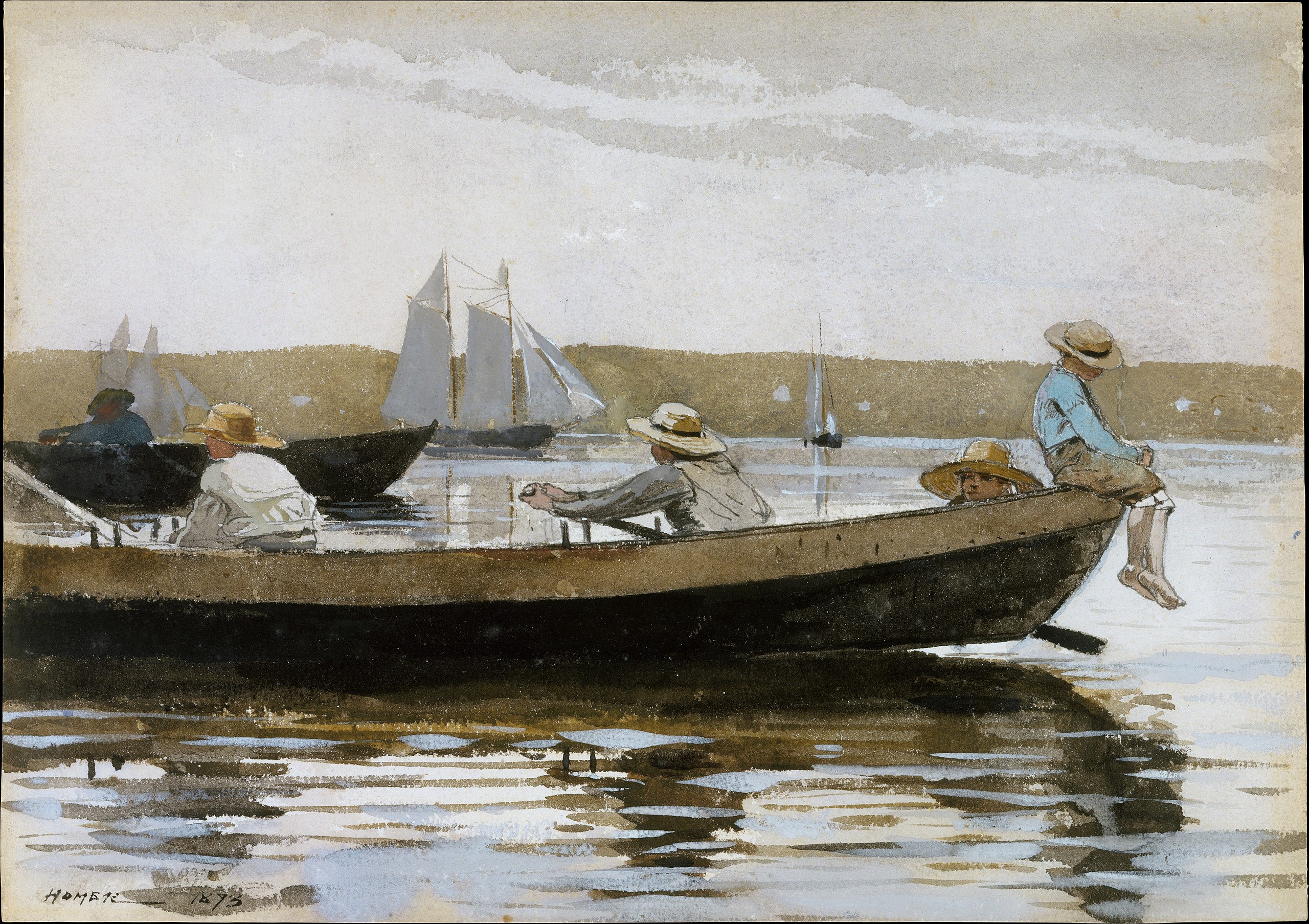
Title: Boys in a Dory

Date: 1873

Medium: Watercolor washes and gouache over graphite underdrawing on medium rough textured white wove paper

Dimensions: 9 3/4 x 13 7/8 in. (24.8 x 35.2 cm)

Collection: Metropolitan Museum of Art

Inscription: signed Homer 1873

What I love about this image:

Here we have four boys out for a summer’s day on the water. Are they brothers? They all wear similar long-sleeved lightweight cotton shirts and straw hats as protection against the sun.

The two youngest ride, while the older boys row. The water is calm, perfect for a sunny afternoon of freedom. Do they plan to fish or are they just out for the fun of it?

I especially like how Homer paints the water. He depicts the reflections perfectly, showing us how they mirror on the soft movement of the water’s surface. He shows us the sailing craft in the distance with minimal strokes, clearly showing the other boats heading out for a day’s fishing or pleasure boating.

About this painting via Wikipedia:

Boys in a Dory is one of Homer’s first watercolors. According to the Met’s description of the painting, the artist’s initial style of watercolors resulted in Boys being simple and direct.

The painting was rendered by Homer while he was in Gloucester, Massachusetts. [1]

About the dory, via Wikipedia:

The dory can be defined as a small boat which has:

  • a flat bottom, with the bottom planks fastened lengthwise (bow to stern).
  • a hull shape defined by the natural curve of a sawn plank (never steam-bent).
  • planks overlapping the stem at the front of the boat and an outer “false” stem covering the hood ends of the planks.
  • (with some exceptions) a fairly narrow transom often referred to as the “tombstone” due to its unique shape.

The hull’s bottom is transversely flat and usually bowed fore-and-aft. (This curvature is known as “rocker”.) The stern is frequently a raked narrow transom that tapers sharply toward the bottom forming a nearly double-ended boat. The traditional bottom is made from planks laid fore and aft and not transverse, although some hulls have a second set of planks laid over the first in a pattern that is crosswise to the main hull for additional wear and strength.

As the need for working dories diminished, the Swampscott or beach dory types were modified for pleasure sailing. These sailing dories became quite popular at the beginning of the 20th century around the town of Marblehead, Massachusetts. They were generally longer yet remained narrow with low freeboard and later were often decked over. Another common distinctive feature of the sailing dory was a long boom on the rig that angled up with a mainsail that was larger along the foot than the luff.  [2]

About the Artist via Wikipedia:

Winslow Homer (February 24, 1836 – September 29, 1910) was an American landscape painter and illustrator, best known for his marine subjects. He is considered one of the foremost painters of 19th-century America and a preeminent figure in American art in general.

Largely self-taught, Homer began his career working as a commercial illustrator. He subsequently took up oil painting and produced major studio works characterized by the weight and density he exploited from the medium. He also worked extensively in watercolor, creating a fluid and prolific oeuvre, primarily chronicling his working vacations. [3]


Credits and Attributions:

IMAGE: Boys in a Dory by Winslow Homer. Wikimedia Commons contributors, “File:Boys in a Dory MET DT5026.jpg,” Wikimedia Commons,  https://commons.wikimedia.org/w/index.php?title=File:Boys_in_a_Dory_MET_DT5026.jpg&oldid=928781177 (accessed April 3, 2025).

[1] Wikipedia contributors, “Boys in a Dory,” Wikipedia, The Free Encyclopedia, https://en.wikipedia.org/w/index.php?title=Boys_in_a_Dory&oldid=1249874568 (accessed April 3, 2025).

[2] Wikipedia contributors, “Dory (boat),” Wikipedia, The Free Encyclopedia, https://en.wikipedia.org/w/index.php?title=Dory_(boat)&oldid=1281846716 (accessed April 3, 2025).

[3] Wikipedia contributors, “Winslow Homer,” Wikipedia, The Free Encyclopedia, https://en.wikipedia.org/w/index.php?title=Winslow_Homer&oldid=1277975900 (accessed April 3, 2025).
Comments Off on #FineArtFriday: Boys in a Dory by Winslow Homer 1873

Filed under #FineArtFriday, writing

#FineArtFriday: revisiting After the Hurricane, Bahamas by Winslow Homer (and hurricane relief)

Artist: Winslow Homer (1836–1910)

Title: After the Hurricane

Date: 1899

Medium: Transparent watercolor, with touches of opaque watercolor, rewetting, blotting and scraping, over graphite, on moderately thick, moderately textured (twill texture on verso), ivory wove paper.

Dimensions: Height: 38 cm (14.9 in); Width: 54.3 cm (21.3 in)

Inscriptions: Signature and date bottom left: Homer 99

Current Location: Art Institute of Chicago, not on view

October 2024 has been a terrible month for the East Coast of the US. Two intense hurricanes swept up from the tropics, devastating the southern coastal region and bringing flooding inland.

The swath of death and destruction wrought by these storms is hard to describe. For those who lived through them but lost everything, life will always be defined in terms of “before the hurricane” and “after.”

In view of the deadly nature of these storms, I thought it appropriate to revisit “After the Hurricane, Bahamas” by Winslow Homer.

If you live in the US, Walmart and Kroger stores offer an option to donate a dollar or more to various hurricane relief organizations at checkout, as do many other grocery chains. Also, you can donate directly to the relief effort by going to How to help those impacted by Hurricane Helene: Charities, organizations to support relief efforts – ABC News (go.com).

About Hurricane Helene, via Wikipedia: Hurricane Helene – Wikipedia

In advance of Helene’s expected landfall, states of emergency were declared in Florida and Georgia due to the significant impacts expected, including very high storm surge along the coast and hurricane-force gusts as far inland as AtlantaHurricane warnings also extended further inland due to Helene’s fast motion. The storm caused catastrophic rainfall-triggered flooding, particularly in western North CarolinaEast Tennessee, and southwestern Virginia, and spawned numerous tornadoes. As of October 12, at least 252 deaths have been attributed to the storm. [1]

About Hurricane Milton, via Wikipedia: Hurricane Milton – Wikipedia

Ahead of the hurricane, Florida declared a state of emergency in which many coastal residents were ordered to evacuate. Preparations were also undertaken in Mexico’s Yucatán Peninsula. The hurricane spawned a deadly tornado outbreak and caused widespread flooding in Florida. As of October 14, 2024, Hurricane Milton killed at least 28 people: 25 in the United States and three in Mexico. Preliminary damage estimates place the total cost of destruction from the storm at over US $30 billion. [2]

What I love about this painting:

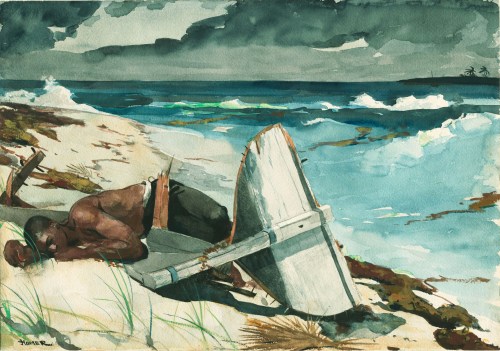
After the Hurricane, Bahamas is a watercolor painting by the American artist, Winslow Homer. It shows a man washed up on the beach after a storm, surrounded by the fragments of his shattered boat. The wreckage of the boat gives evidence of the severity of the powerful hurricane, which is retreating. Black clouds still billow but recede into the distance, and sunlight has begun to filter through the clouds.

The man may have lost his boat, but he has survived.

I love the way the whitecaps are depicted, and the colors of the sea are true to the way the ocean looks after a severe storm. Winslow Homer’s watercolor seascapes are especially intriguing to me as they are extremely dramatic and forceful expressions of nature’s power. The beauty and intensity of Homer’s vision of “ocean” are unmatched—in my opinion his seascapes are alive in a way few other artists can match.

This painting was done in 1899 and marked the end of Homer’s watercolor series depicting man against nature. That series was begun with Shark Fishing in 1885, the year he first visited the Caribbean and is comprised of at least six known paintings. The most famous of these watercolor paintings is The Gulf Stream, which was also painted in 1899. After the Hurricane, Bahamas is the last of the series.

About the artist, via Wikipedia

Winslow Homer (February 24, 1836 – September 29, 1910) was an American landscape painter and printmaker, best known for his marine subjects. He is considered one of the foremost painters in 19th-century America and a preeminent figure in American art.

Homer started painting with watercolors on a regular basis in 1873 during a summer stay in Gloucester, Massachusetts. From the beginning, his technique was natural, fluid and confident, demonstrating his innate talent for a difficult medium. His impact would be revolutionary. [3]


Credits and Attributions:

After the Hurricane, Bahamas by Winslow Homer, [Public domain], via Wikimedia Commons

[1] Wikipedia contributors, “Hurricane Helene,” Wikipedia, The Free Encyclopedia, https://en.wikipedia.org/w/index.php?title=Hurricane_Helene&oldid=1251667279 (accessed October 17, 2024).

[2] Wikipedia contributors, “Hurricane Milton,” Wikipedia, The Free Encyclopedia, https://en.wikipedia.org/w/index.php?title=Hurricane_Milton&oldid=1251634007 (accessed October 17, 2024).

[3] Wikipedia contributors, “Winslow Homer,” Wikipedia, The Free Encyclopedia, https://en.wikipedia.org/w/index.php?title=Winslow_Homer&oldid=1055649094 (accessed December 9, 2021).

IMAGE: Wikimedia Commons contributors, “File:Winslow Homer – After the Hurricane, Bahamas.jpg,” Wikimedia Commons, the free media repository, https://commons.wikimedia.org/w/index.php?title=File:Winslow_Homer_-_After_the_Hurricane,_Bahamas.jpg&oldid=428549979 (accessed December 9, 2021).

Comments Off on #FineArtFriday: revisiting After the Hurricane, Bahamas by Winslow Homer (and hurricane relief)

Filed under #FineArtFriday

#FineArtFriday: Fisherwomen, Cullercoats by Winslow Homer 1881, a second look

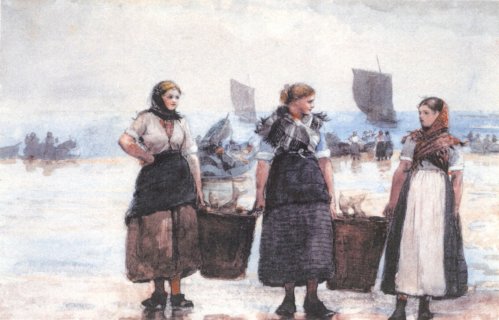
Homer,_Winslow_-_'Fisherwomen,_Cullercoats',_1881,_graphite_&_watercolor_on_paperArtist: Winslow Homer  (1836–1910)

Title: Fisherwomen, Cullercoats

Date:   1881

Medium: watercolor and graphite on paper

Dimensions: height: 34.2 cm (13.4 in); width: 49.2 cm (19.3 in)

Collection: Honolulu Museum of Art

What I love about this painting:

Homer shows us a foggy morning at the beach, capturing the quality of light on the strand at Cullercoats, Tyne and Wear, England. He paints the background with an impressionist’s eye and gives us realistic portraits of the working women whose labors fed the country.

The fish baskets are heavy, but they share the load. Their sleeves are rolled up for work, and skirts are shorter than if they were in town—no one wants wet skirts dragging around their ankles.

I love the way he shows these women as they were that day, treating them with respect. During his lifetime, Winslow Homer depicted men and women of all races, slaves and former slaves, and soldiers. He showed us people who worked hard, not giving us caricatures but painting portraits of real people.

Homer loved the sea and traveled widely, painting everywhere he went. Critics sometimes dismiss his work as “calendar art, appealing to the unschooled masses.” But think about it – calendars and magazines often were the only art poor and working-class people had in their homes. If you don’t have access to art, how can you become “schooled” in it? Some art critics are a little too schooled.

If you are interested in knowing more about the art of Winslow Homer, this documentary is excellent: FAKE OR FORTUNE SE1EO4 WINSLOW HOMER – YouTube

About the Artist, via Wikipedia:

Homer started painting with watercolors on a regular basis in 1873 during a summer stay in Gloucester, Massachusetts. From the beginning, his technique was natural, fluid and confident, demonstrating his innate talent for a difficult medium. His impact would be revolutionary. Here, again, the critics were puzzled at first, “A child with an ink bottle could not have done worse.” Another critic said that Homer “made a sudden and desperate plunge into water color painting”. But his watercolors proved popular and enduring, and sold more readily, improving his financial condition considerably. They varied from highly detailed (Blackboard – 1877) to broadly impressionistic (Schooner at Sunset – 1880). Some watercolors were made as preparatory sketches for oil paintings (as for “Breezing Up”) and some as finished works in themselves. Thereafter, he seldom traveled without paper, brushes and water based paints.

As a result of disappointments with women or from some other emotional turmoil, Homer became reclusive in the late 1870s, no longer enjoying urban social life and living instead in Gloucester. For a while, he even lived in secluded Eastern Point Lighthouse (with the keeper’s family). In re-establishing his love of the sea, Homer found a rich source of themes while closely observing the fishermen, the sea, and the marine weather. After 1880, he rarely featured genteel women at leisure, focusing instead on working women. [1]


Credits and Attributions:

Image: Fisherwomen, Cullercoats by Winslow Homer 1881. Wikimedia Commons contributors, “File:Homer, Winslow – ‘Fisherwomen, Cullercoats’, 1881, graphite & watercolor on paper.jpg,” Wikimedia Commons, https://commons.wikimedia.org/w/index.php?title=File:Homer,_Winslow_-_%27Fisherwomen,_Cullercoats%27,_1881,_graphite_%26_watercolor_on_paper.jpg&oldid=721923030 (accessed August 3, 2023).

[1] Wikipedia contributors, “Winslow Homer,” Wikipedia, The Free Encyclopedia, https://en.wikipedia.org/w/index.php?title=Winslow_Homer&oldid=1168361459 (accessed August 3, 2023).

2 Comments

Filed under #FineArtFriday

#FineArtFriday: Fisherwomen, Cullercoats by Winslow Homer 1881

Homer,_Winslow_-_'Fisherwomen,_Cullercoats',_1881,_graphite_&_watercolor_on_paperArtist: Winslow Homer  (1836–1910)

Title: Fisherwomen, Cullercoats

Date:   1881

Medium: watercolor and graphite on paper

Dimensions: height: 34.2 cm (13.4 in); width: 49.2 cm (19.3 in)

Collection: Honolulu Museum of Art

What I love about this painting:

Homer shows us a foggy morning at the beach, capturing the quality of light on the strand at Cullercoats, Tyne and Wear, England. He paints the background with an impressionist’s eye and gives us realistic portraits of the working women whose labors fed the country.

The fish baskets are heavy, but they share the load. Their sleeves are rolled up for work, and skirts are shorter than if they were in town—no one wants wet skirts dragging around their ankles.

I love the way he shows these women as they were that day, treating them with respect. During his lifetime, Winslow Homer depicted men and women of all races, slaves and former slaves, and soldiers. He showed us people who worked hard, not giving us caricatures but painting portraits of real people.

Homer loved the sea and traveled widely, painting everywhere he went. Critics sometimes dismiss his work as “calendar art, appealing to the unschooled masses.” But think about it – calendars and magazines often were the only art poor and working-class people had in their homes. If you don’t have access to art, how can you become “schooled” in it? Some art critics are a little too schooled.

If you are interested in knowing more about the art of Winslow Homer, this documentary is excellent: FAKE OR FORTUNE SE1EO4 WINSLOW HOMER – YouTube

About the Artist, via Wikipedia:

Homer started painting with watercolors on a regular basis in 1873 during a summer stay in Gloucester, Massachusetts. From the beginning, his technique was natural, fluid and confident, demonstrating his innate talent for a difficult medium. His impact would be revolutionary. Here, again, the critics were puzzled at first, “A child with an ink bottle could not have done worse.” Another critic said that Homer “made a sudden and desperate plunge into water color painting”. But his watercolors proved popular and enduring, and sold more readily, improving his financial condition considerably. They varied from highly detailed (Blackboard – 1877) to broadly impressionistic (Schooner at Sunset – 1880). Some watercolors were made as preparatory sketches for oil paintings (as for “Breezing Up”) and some as finished works in themselves. Thereafter, he seldom traveled without paper, brushes and water based paints.

As a result of disappointments with women or from some other emotional turmoil, Homer became reclusive in the late 1870s, no longer enjoying urban social life and living instead in Gloucester. For a while, he even lived in secluded Eastern Point Lighthouse (with the keeper’s family). In re-establishing his love of the sea, Homer found a rich source of themes while closely observing the fishermen, the sea, and the marine weather. After 1880, he rarely featured genteel women at leisure, focusing instead on working women. [1]


Credits and Attributions:

Image: Fisherwomen, Cullercoats by Winslow Homer 1881. Wikimedia Commons contributors, “File:Homer, Winslow – ‘Fisherwomen, Cullercoats’, 1881, graphite & watercolor on paper.jpg,” Wikimedia Commons, https://commons.wikimedia.org/w/index.php?title=File:Homer,_Winslow_-_%27Fisherwomen,_Cullercoats%27,_1881,_graphite_%26_watercolor_on_paper.jpg&oldid=721923030 (accessed August 3, 2023).

[1] Wikipedia contributors, “Winslow Homer,” Wikipedia, The Free Encyclopedia, https://en.wikipedia.org/w/index.php?title=Winslow_Homer&oldid=1168361459 (accessed August 3, 2023).

Comments Off on #FineArtFriday: Fisherwomen, Cullercoats by Winslow Homer 1881

Filed under #FineArtFriday

#FineArtFriday: Hastings: the Front by Theodore Casmir Roussel 1908 (revisited)


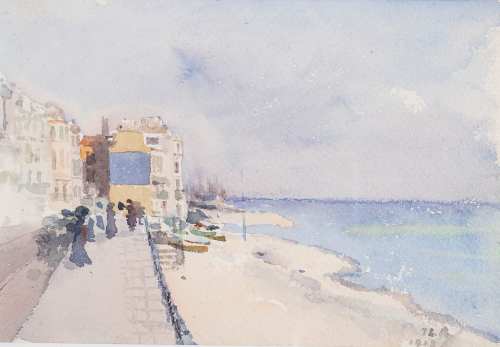
Title: Hastings: the Front.

Medium: Watercolor.

Signed and dated: Theodore Roussel 1908.

Dimensions: 6.75×10 inches. Framed: 13.75×16 inches.”

Summer is here, so today we’re taking a second look at this lovely dreamscape of Hastings, a seaside town in East Sussex on the south coast of England. It is southeast of London, and in the 19th and early 20th century, when this painting made, the railway enabled ordinary tourists and visitors to reach the town. Thus, it became a popular seaside resort.

Historically, Hastings is an ancient town. Wikipedia tell us that the start of the Norman Conquest was the Battle of Hastings, fought on 14 October 1066, although the battle itself took place 8 mi (13 km) to the north at Senlac Hill, and William had landed on the coast between Hastings and Eastbourne at Pevensey. It is thought that the Norman encampment was on the town’s outskirts, where there was open ground; a new town was already being built in the valley to the east. That “New Burgh” was founded in 1069 and is mentioned in the Domesday Book as such. William defeated and killed Harold Godwinson, the last Saxon King of England, and destroyed his army, thus opening England to the Norman conquest. [1]

What I love about this painting:

I love watercolors and especially love this scene. The medium allows for a dreamy atmosphere, and in this case, the artist has presented us with the impression of a sundrenched afternoon at the seashore. Roussel’s work grew more atmospheric as he grew older, but he was known more for his classically depicted nudes than as an impressionist. However, it’s clear he had an eye for impressionism and the ability to show a story with watercolors.

Tourists stroll along the breakwater in front of the hotels, wearing broad hats and coats. Like many days at the beach on the Washington Coast, where I live, even in summer the wind often carries a chill.

About the Artist, via Wikipedia:

Theodore Casimir Roussel (1847–1926) was a French-born English painter and graphic artist, best known for his landscapes and genre scenes. He came to painting late, in 1872, after his military service had ended, and he was entirely self-taught. His earliest works were scenes of daily life, rendered in the style of the Old Masters. In 1878, he moved to London and, two years later, married the widow Frances Amelia Smithson Bull (1844–1909), a distant collateral relative of James Smithson. In 1885, he met James McNeill Whistler, who became a lifelong friend and mentor. [2]


Credits and Attributions:

Hastings: the Front by Théodore Roussel, Public domain, via Wikimedia Commons

[1]Wikipedia contributors, “Hastings,” Wikipedia, The Free Encyclopedia, https://en.wikipedia.org/w/index.php?title=Hastings&oldid=1160573614 (accessed June 23, 2023).

[2]Wikipedia contributors, “Theodore Roussel,” Wikipedia, The Free Encyclopedia, https://en.wikipedia.org/w/index.php?title=Theodore_Roussel&oldid=896039278 (accessed December 3, 2020).

Comments Off on #FineArtFriday: Hastings: the Front by Theodore Casmir Roussel 1908 (revisited)

Filed under #FineArtFriday

#FineArtFriday: After the Hurricane, Bahamas by Winslow Homer, reprise

Artist: Winslow Homer (1836–1910)

Title: After the Hurricane

Date: 1899

Medium: Transparent watercolor, with touches of opaque watercolor, rewetting, blotting and scraping, over graphite, on moderately thick, moderately textured (twill texture on verso), ivory wove paper.

Dimensions: Height: 38 cm (14.9 in); Width: 54.3 cm (21.3 in)

Inscriptions: Signature and date bottom left: Homer 99

Current Location: Art Institute of Chicago, not on view

What I love about this painting:

After the Hurricane, Bahamas is a watercolor painting by the American artist, Winslow Homer. It shows a man washed up on the beach after a storm, surrounded by the fragments of his shattered boat. The wreckage of the boat gives evidence of the severity of the powerful hurricane, which is retreating. Black clouds still billow but recede into the distance, and sunlight has begun to filter through the clouds.

The man may have lost his boat, but he has survived.

I love the way the whitecaps are depicted, and the colors of the sea are true to the way the ocean looks after a severe storm. Winslow Homer’s watercolor seascapes are especially intriguing to me as they are extremely dramatic and forceful expressions of nature’s power. The beauty and intensity of Homer’s vision of “ocean” are unmatched—in my opinion his seascapes are alive in a way few other artists can match.

This painting was done in 1899 and marked the end of Homer’s watercolor series depicting man against nature. That series was begun with Shark Fishing in 1885, the year he first visited the Caribbean and is comprised of at least six known paintings. The most famous of these watercolor paintings is The Gulf Stream, which was also painted in 1899. After the Hurricane, Bahamas is the last of the series.

About the artist, via Wikipedia

Winslow Homer (February 24, 1836 – September 29, 1910) was an American landscape painter and printmaker, best known for his marine subjects. He is considered one of the foremost painters in 19th-century America and a preeminent figure in American art.

Homer started painting with watercolors on a regular basis in 1873 during a summer stay in Gloucester, Massachusetts. From the beginning, his technique was natural, fluid and confident, demonstrating his innate talent for a difficult medium. His impact would be revolutionary. [1]


Credits and Attributions:

After the Hurricane, Bahamas by Winslow Homer, [Public domain], via Wikimedia Commons

[1] Wikipedia contributors, “Winslow Homer,” Wikipedia, The Free Encyclopedia, https://en.wikipedia.org/w/index.php?title=Winslow_Homer&oldid=1055649094 (accessed December 9, 2021).

Wikimedia Commons contributors, “File:Winslow Homer – After the Hurricane, Bahamas.jpg,” Wikimedia Commons, the free media repository, https://commons.wikimedia.org/w/index.php?title=File:Winslow_Homer_-_After_the_Hurricane,_Bahamas.jpg&oldid=428549979 (accessed December 9, 2021).

6 Comments

Filed under #FineArtFriday

#FineArtFriday: Hastings: the Front by Theodore Casmir Roussel 1908


Title: Hastings: the Front.

Medium: Watercolor.

Signed and dated: Theodore Roussel 1908.

Dimensions: 6.75×10 inches. Framed: 13.75×16 inches.”

Hastings is a seaside town in East Sussex on the south coast of England, south east of London. In the 19th and early 20th century, when this painting made, the railway enabled ordinary tourists and visitors to reach the town, and it became a popular seaside resort.

What I love about this painting:

I love watercolors. The medium allows for a dreamy atmosphere, and in this case, the artist has presented us with the impression of a sundrenched afternoon at the seashore. Roussel’s work grew more atmospheric as he grew older, but he was known more for his classically depicted nudes than as an impressionist. However, it’s clear he had an eye for impressionism and the ability to show a story with watercolors.

Tourists stroll along the breakwater in front of the hotels, wearing broad hats and coats. Like many days at the beach on the Washington Coast, where I live, even in summer the wind often carries a chill.

About the Artist, via Wikipedia:

Theodore Casimir Roussel (1847–1926) was a French-born English painter and graphic artist, best known for his landscapes and genre scenes. He came to painting late, in 1872, after his military service had ended, and he was entirely self-taught. His earliest works were scenes of daily life, rendered in the style of the Old Masters. In 1878, he moved to London and, two years later, married the widow Frances Amelia Smithson Bull (1844–1909), a distant collateral relative of James Smithson. In 1885, he met James McNeill Whistler, who became a lifelong friend and mentor.


Credits and Attributions:

Hastings: the Front by Théodore Roussel, Public domain, via Wikimedia Commons

Wikipedia contributors, “Theodore Roussel,” Wikipedia, The Free Encyclopedia, https://en.wikipedia.org/w/index.php?title=Theodore_Roussel&oldid=896039278 (accessed December 3, 2020).

Comments Off on #FineArtFriday: Hastings: the Front by Theodore Casmir Roussel 1908

Filed under #FineArtFriday

#FineArtFriday: After the Hurricane, Bahamas by Winslow Homer

After the Hurricane, Bahamas is a watercolor painting by the American artist, Winslow Homer. It shows a man washed up on the beach after a storm, surrounded by the fragments of his shattered boat. The wreckage of the boat gives evidence of the severity of the powerful hurricane, which is retreating. Black clouds still billow but recede into the distance, and sunlight has begun to filter through the clouds.

The man may have lost his boat, but he has survived.

I love the way the whitecaps are depicted, and the colors of the sea are true to the way the ocean looks after a severe storm. Winslow Homer’s watercolor seascapes are especially intriguing to me as they are extremely dramatic and forceful expressions of nature’s power. The beauty and intensity of Homer’s vision of “ocean” are unmatched—in my opinion his seascapes are alive in a way few other artists can match.

This painting was done in 1899 and marked the end of Homer’s watercolor series depicting man against nature. That series was begun with Shark Fishing in 1885, the year he first visited the Caribbean and is comprised of at least six known paintings. The most famous of these watercolor paintings is The Gulf Stream, which was also painted in 1899. After the Hurricane, Bahamas is the last of the series.


Credits and Attributions:

After the Hurricane, Bahamas by Winslow Homer, [Public domain], via Wikimedia Commons

Comments Off on #FineArtFriday: After the Hurricane, Bahamas by Winslow Homer

Filed under #FineArtFriday