Tag Archives: working for minimum wage

Today is Labor Day in the US #writerlife

The first Monday in September is Labor Day in the US, a holiday marking the end of summer. This is the day we honor those whose labor keeps this country running. Over the years, I have worked in a wide variety of menial jobs. All were low-paying and didn’t garner much respect from those in higher-status positions or from management. But I liked my work and never did less than my best.

MyWritingLife2021BChildcare was always an issue. Sometimes, during the Carter years, I qualified for government-subsidized childcare vouchers, which was the only reason I could work such low-paying entry-level jobs. Later, my uncle cared for my youngest daughter after school until she was about ten.  Because I had that childcare subsidy when my youngest was not yet of school age, I was able to support my family relatively well.

They should bring that childcare subsidy back. Once they reached ten years of age, my kids were latchkey kids, which wasn’t uncommon in those days.

In the 1970s-80s, I worked as a bookkeeper, an automobile detailer, a field hand for a (now defunct) multi-national Christmas tree company, a photo lab tech, a waitress in a bakery, and worked in a delicatessen.

During those years, my favorite job was as a field hand for the J. Hofert Company. They grew Christmas trees of all varieties, and I absolutely loved the work. It was outdoors, paid $3.25 an hour, and was seasonal, so I usually had a month off three times a year.  I was able to work all the overtime hours I wanted during certain seasons, as field hands were as hard to get then as they are now.

coins

Coins, Microsoft content creators

Sometimes, especially during the Reagan years and up to 1996, wages were low, and jobs were scarce.  I held two, and sometimes three, part-time jobs to keep the roof over my children’s heads and food on their table. Trickledown economics never quite trickled down to my town.

In the late 1980s and through the 1990s, I worked as a hotel maid, a photographer’s assistant and darkroom technician, and as a bookkeeper/office manager for a charter bus company.

Life became easier in the 1990s. As a bookkeeper/office manager, I earned $7.50 an hour (two dollars over minimum at the time) and worked less than 30 hours a week with no benefits whatsoever. I drove for an hour each way, morning and afternoon, for that job.

As a hotel housekeeper in a union shop, on the days I wasn’t a bookkeeper, I made $8.50 (three dollars over minimum) and worked about 20 hours a week, giving me enough from the two jobs to live on and provide well for my children. I was still legally married to my 3rd husband, but he was seldom in the picture. The marriage was a shield between me and my well-meaning matchmaker friends.

fireworks via wikipedaI was divorced from hubby number three in 1997, and oddly enough, things became much easier financially. I was able to get by with only one job, even while raising my last teenager. (See? Everyone has a soap opera life, even famously unknown authors.)

For all the years I was married to my 3rd husband, no matter what other job I had, I kept my weekend job at the hotel. I kept it because I always had that to fall back on. I had risen in seniority and could work full-time whenever the other jobs went away.

My hotel was affiliated with a good union. We who did the dirty work earned far more than maids, housemen, and laundresses at other hotels. We also had benefits such as paid sick leave, up to two weeks a year of paid vacations, good health insurance, and a 401k, to which our employer matched our contributions.

In any hotel, housekeepers are considered the lowest of the low by the other employees. No one is of less social value than the person who cleans up after other people. Without the union, we would have had nothing more than the bare minimum wage and a cartload of insincere condescension from management.

Not every union is good or reasonable. But while I don’t agree with everything every union does and stands for, I am grateful that a good, reasonable organization protected my family and me during those years of struggle.

After 2000, I worked as a temp employee at Verisign, a tax preparer for H&R Block, and did data entry for LPB Energy Management. By 2010, I was thoroughly sick of corporate America and had returned to bookkeeping, this time for a local landscape company.

That job was a joy.

In my younger days, I worked every weekend and every holiday, and yes, it was not easy, but it was what it was. My kids were good and supportive, and they knew I was doing my best for them.

Every worker deserves an employer who treats them with respect and offers a fair wage in return for their labor.

The world is a different place now in many ways. Even so, someone must do the dirty jobs, the work that no one else wants. I have nothing but respect for those who work long, hard hours in all areas of the service industry, struggling to support their families.

My experiences working in the lower echelons of the labor force inform my writing. Look around you and see the people who make your life easier by being there every day doing their jobs.
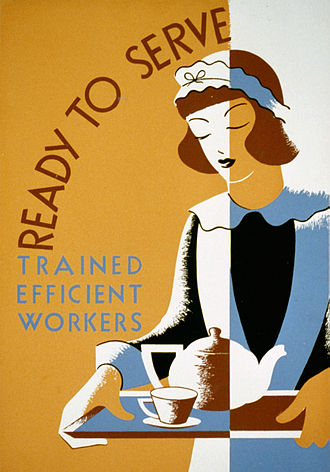
330px-Works_Progress_Administration_maid_poster_cropped

Stylized drawing of a maid on a Works Progress Administration poster via Wikipedia

Every waitress/waiter, housekeeper, laundry worker, caregiver, bartender, welder, mechanic—everyone in the service industry is a living, caring human being with hopes, ambitions, triumphs, and tragedies. Every one of them has a story and a reason to be where they are, doing the task they have been given.

Say a little thank you to all those who endure verbal abuse when a customer is stressed out and “doesn’t have time to wait” or is upset by things they have no control over and vent their anxiety at someone who can’t (or won’t) fight back.

Give a little thanks to those whose labor enables you to live a little easier.
4 Comments

Filed under writing

#FineArtFriday: The Milkmaid by Johannes Vermeer (revisited)

What I love about this painting:

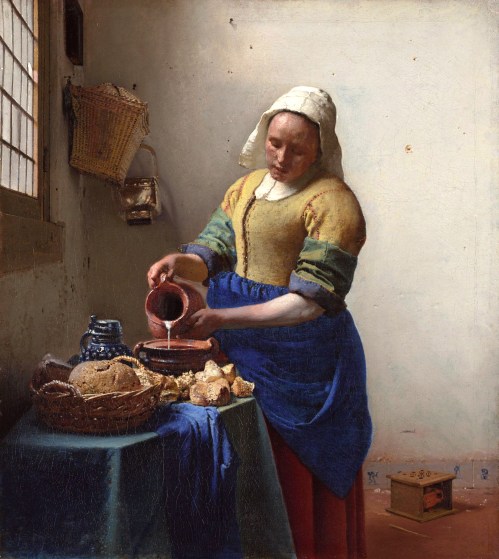
It seems like a good time to revisit Vermeer’s famous painting, known as “the Milkmaid.” This is lovely look into the past, a window into daily life of 1657 – 1658. I love the realism, the way the maid carefully pours the milk into the bread.

All of Vermeer’s known works illustrate how the quiet moments in life can be the most profound.

Wikipedia has many things to say about this painting.


About Johannes Vermeer, the Master of Light (from Wikipedia)

Johannes Vermeer (October 1632 – December 1675) was a Dutch painter who specialized in domestic interior scenes of middle-class life. He was a moderately successful provincial genre painter in his lifetime but evidently was not wealthy, leaving his wife and children in debt at his death, perhaps because he produced relatively few paintings.

Vermeer worked slowly and with great care, and frequently used very expensive pigments. He is particularly renowned for his masterly treatment and use of light in his work.

Vermeer painted mostly domestic interior scenes. “Almost all his paintings are apparently set in two smallish rooms in his house in Delft; they show the same furniture and decorations in various arrangements and they often portray the same people, mostly women.”

He was recognized during his lifetime in Delft and The Hague, but his modest celebrity gave way to obscurity after his death. He was barely mentioned in Arnold Houbraken‘s major source book on 17th-century Dutch painting (Grand Theatre of Dutch Painters and Women Artists), and was thus omitted from subsequent surveys of Dutch art for nearly two centuries. In the 19th century, Vermeer was rediscovered by Gustav Friedrich Waagen and Théophile Thoré-Bürger, who published an essay attributing 66 pictures to him, although only 34 paintings are universally attributed to him today. Since that time, Vermeer’s reputation has grown, and he is now acknowledged as one of the greatest painters of the Dutch Golden Age. [2]

About the featured painting, The Milkmaid, also from Wikipedia:

Despite its traditional title, the picture clearly shows a kitchen or housemaid, a low-ranking indoor servant, rather than a milkmaid who actually milks the cow, in a plain room carefully pouring milk into a squat earthenware container (now commonly known as a “Dutch oven”) on a table. Also on the table are various types of bread. She is a young, sturdily built woman wearing a crisp linen cap, a blue apron and work sleeves pushed up from thick forearms. A foot warmer is on the floor behind her, near Delft wall tiles depicting Cupid (to the viewer’s left) and a figure with a pole (to the right). Intense light streams from the window on the left side of the canvas.

The painting is strikingly illusionistic, conveying not just details but a sense of the weight of the woman and the table. “The light, though bright, doesn’t wash out the rough texture of the bread crusts or flatten the volumes of the maid’s thick waist and rounded shoulders”, wrote Karen Rosenberg, an art critic for The New York Times. Yet with half of the woman’s face in shadow, it is “impossible to tell whether her downcast eyes and pursed lips express wistfulness or concentration,” she wrote.

“It’s a little bit of a Mona Lisa effect” in modern viewers’ reactions to the painting, according to Walter Liedtke, curator of the department of European paintings at The Metropolitan Museum of Art, and organizer of two Vermeer exhibits. “There’s a bit of mystery about her for modern audiences. She is going about her daily task, faintly smiling. And our reaction is ‘What is she thinking?'” [1]


Credits and Attributions:

The Milkmaid, by Johannes (Jan) Vermeer ca. 1658 [Public domain or Public domain], via Wikimedia Commons.

[1] Wikipedia contributors, “The Milkmaid (Vermeer),” Wikipedia, The Free Encyclopedia, https://en.wikipedia.org/w/index.php?title=The_Milkmaid_(Vermeer)&oldid=853243011 (accessed August 31, 2018).

[2] Wikipedia contributors, “Johannes Vermeer,” Wikipedia, The Free Encyclopedia, https://en.wikipedia.org/w/index.php?title=Johannes_Vermeer&oldid=854172655 (accessed August 31, 2018).

7 Comments

Filed under #FineArtFriday, writing

#FineArtFriday: The Milkmaid, by Johannes Vermeer #laborday

In America, the first Monday in September is Labor Day, the last long weekend of summer. The weather is still warm, and many people will be enjoying the last big holiday of the summer, barbecuing or camping out. Many will be traveling long distances and staying in hotels.

Because Labor Day is a national holiday, many workers will have Monday off. But those who work in the hospitality industry and in food service will be working overtime, making the holiday good for everyone else. People in the retail industry will also be working long hours, as the last big sales before Halloween will be in effect.

Over the course of my life, I have worked in a wide variety of jobs, most of them paying a low wage. By the mid-nineties, things were easier. As a bookkeeper/office manager I made $7.50 an hour (two dollars over minimum at the time) but I worked less than 30 hours a week with no benefits whatsoever. On weekends and holidays, I worked as a hotel housekeeper in a union shop, making $8.50 (three dollars over minimum), working about 20 hours a week. That gave me enough income from the two jobs to live on and provide for my children.

While I was raising my children, no matter what job I had during the week, I kept my weekend job at the hotel, because when other jobs went away, I always had that one to fall back on.

Only hotel housekeepers with the highest seniority will work a forty hour week. The rest average twenty to thirty hours a week because people travel on weekends more than they do during the week, and certain times of the year are less traveled than others. We maids and laundry workers would have had nothing more than minimum wage without the union. Because of the union, we who did the dirty work earned a little more than those who worked at non-union hotels, and we had a few benefits such as health insurance and a 401k to set aside a little money for our retirement.

Not every union is good, and not every union is reasonable. But I have gratitude that my family and I were protected by a good, reasonable labor organization during those years that were such a struggle for me. Every worker deserves that his/her employer treats them with respect and a fair wage in return for their labor.

As we entered the new millennium, the entry-level job market had improved, and I joined the ranks of Corporate America. Working in the data entry pool for several large corporations over the next few years, I earned enough to give up my part-time job as a hotel maid.

I now have the luxury to live my dream, writing the books that I always wanted to write when I didn’t have the time. And while the world is a different place in many ways than it was in the 1980s, someone still must do the dirty jobs, the work that no one else wants. These people are heroes.

I have nothing but respect for those people who work long hard hours in all areas of the service industry, struggling to support their families. Look around you and see the people who make your life easier just by being there every day doing their job.

Every one of them is a person just like you, a living, caring human being with hopes, ambitions, triumphs, and tragedies. Every one of them has a story and a reason to be where they are, doing the task they have been given. Most love what they do and do the best job that they can.

Take the time to say a little “thank you” to all those women and men who take your unintentional abuse when you are stressed out and “don’t have time to wait,” or are upset by things you have no control over and need to vent at someone who can’t or won’t fight back. Give a little thanks to those who do the dirty work and enable you to live a little easier.


About Johannes Vermeer, the Master of Light (from Wikipedia)

Johannes Vermeer (October 1632 – December 1675) was a Dutch painter who specialized in domestic interior scenes of middle-class life. He was a moderately successful provincial genre painter in his lifetime but evidently was not wealthy, leaving his wife and children in debt at his death, perhaps because he produced relatively few paintings.

Vermeer worked slowly and with great care, and frequently used very expensive pigments. He is particularly renowned for his masterly treatment and use of light in his work.

Vermeer painted mostly domestic interior scenes. “Almost all his paintings are apparently set in two smallish rooms in his house in Delft; they show the same furniture and decorations in various arrangements and they often portray the same people, mostly women.”

He was recognized during his lifetime in Delft and The Hague, but his modest celebrity gave way to obscurity after his death. He was barely mentioned in Arnold Houbraken‘s major source book on 17th-century Dutch painting (Grand Theatre of Dutch Painters and Women Artists), and was thus omitted from subsequent surveys of Dutch art for nearly two centuries. In the 19th century, Vermeer was rediscovered by Gustav Friedrich Waagen and Théophile Thoré-Bürger, who published an essay attributing 66 pictures to him, although only 34 paintings are universally attributed to him today. Since that time, Vermeer’s reputation has grown, and he is now acknowledged as one of the greatest painters of the Dutch Golden Age.

About the featured painting, The Milkmaid, also from Wikipedia:

Despite its traditional title, the picture clearly shows a kitchen or housemaid, a low-ranking indoor servant, rather than a milkmaid who actually milks the cow, in a plain room carefully pouring milk into a squat earthenware container (now commonly known as a “Dutch oven”) on a table. Also on the table are various types of bread. She is a young, sturdily built woman wearing a crisp linen cap, a blue apron and work sleeves pushed up from thick forearms. A foot warmer is on the floor behind her, near Delft wall tiles depicting Cupid (to the viewer’s left) and a figure with a pole (to the right). Intense light streams from the window on the left side of the canvas.

The painting is strikingly illusionistic, conveying not just details but a sense of the weight of the woman and the table. “The light, though bright, doesn’t wash out the rough texture of the bread crusts or flatten the volumes of the maid’s thick waist and rounded shoulders”, wrote Karen Rosenberg, an art critic for The New York Times. Yet with half of the woman’s face in shadow, it is “impossible to tell whether her downcast eyes and pursed lips express wistfulness or concentration,” she wrote.

“It’s a little bit of a Mona Lisa effect” in modern viewers’ reactions to the painting, according to Walter Liedtke, curator of the department of European paintings at The Metropolitan Museum of Art, and organizer of two Vermeer exhibits. “There’s a bit of mystery about her for modern audiences. She is going about her daily task, faintly smiling. And our reaction is ‘What is she thinking?'”


Credits and Attributions:

The Milkmaid, by Johannes (Jan) Vermeer ca. 1658 [Public domain or Public domain], via Wikimedia Commons.

Wikipedia contributors, “The Milkmaid (Vermeer),” Wikipedia, The Free Encyclopedia, https://en.wikipedia.org/w/index.php?title=The_Milkmaid_(Vermeer)&oldid=853243011 (accessed August 31, 2018).

Wikipedia contributors, “Johannes Vermeer,” Wikipedia, The Free Encyclopedia, https://en.wikipedia.org/w/index.php?title=Johannes_Vermeer&oldid=854172655 (accessed August 31, 2018).

2 Comments

Filed under #FineArtFriday, writing