
A few years ago, about ten minutes into a NaNoWriMo write-in, I accepted a dare to write an Arthurian tale with a steampunk twist.
 I quickly regretted that decision.
Everyone was quietly typing away in that coffee shop, getting impressive word counts.
But not me.
I sat there asking myself where Arthurian and steampunk connect well enough to make a story. On the surface, they don’t. I experienced the mental blankness we all feel when a story refuses to reveal itself.
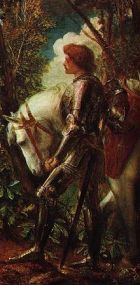 Arthur and his court originated as ordinary 5th or 6th-century warlords. But the tales featuring them were written centuries later. Their 11th-century chroniclers presented them in contemporary armor as worn by Crusaders and with medieval customs and moral values.
Over the centuries, subsequent authors continued to romanticize the story but with their own twist. Alfred Tennyson’s Idylls of the King reworked the entire narrative of Arthur’s life to fit the romantic ideals of the Victorian era.
When I agreed to the challenge, I decided my protagonists must be real people, flesh and blood. They would be subject to the same emotions and physical needs as any other person.
Galahad is traditionally portrayed as a knight errant, which means wandering. The knight-errant was a popular character in medieval romance literature. Miguel de Cervantes‘ mad knight, Don Quixote, believed he was a knight errant and lived his fantasy with hilarious abandon.
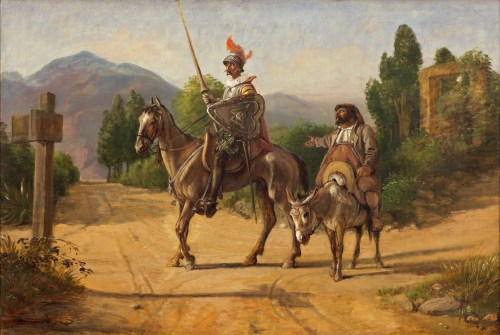
Wilhelm Marstrand, Don Quixote and Sancho Panza (after 1847) via Wikimedia Commons
The Chivalric Code was a system of values combining a warrior culture, devotion to the Christian faith, and courtly manners. Adherence to the code of chivalry ensured a knight epitomized bravery, honor, and nobility.
They roamed the land looking for heroic tasks, engaged in knightly duels, or went in pursuit of courtly love. The medieval romance of highly ritualized courtly love was a rigid literary structure. It defined the written behaviors of noble ladies and their lovers and was woven with the principles of chivalry.
Medieval and Victorian authors loved superheroes. To them, nothing was more impossible or super-heroic than a man who lived a virtuous and self-sacrificing life.
I randomly picked an Arthurian knight, Galahad, and began making notes as I pondered the problem. What kind of a person might Galahad have been had he truly existed?
The established canon dictates that Galahad isn’t attracted to women. He goes on quests to find strange and magical objects, such as the Holy Grail. Since he’s not attracted to women, how about men? I asked myself, what if Galahad and Gawain were lovers?
And what really happened after the Grail was found? With no answer to that, I moved on to the next question. Where does steampunk come into the story? Steampunk is science fiction set in Edwardian times using only technology available during the reign of King Edward VII, who reigned from 1901 to 1910.
Thinking about what steampunk really is triggered the cascade of plot points:
What if finding the Grail somehow opened a door in time?
What if all the magic in the world vanished with the Grail?
What if Galahad was marooned in Edwardian England with Merlin?
How would Galahad get back to Gawain?
I sat in the coffee shop with my friends, all of them writing their novels. The November rains pounded on the windows and drowned passers-by, but I didn’t care—I had the plot I needed.
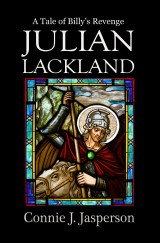 I am an abject fangirl for Don Quixote, so different versions of both Galahad and Quixote appear regularly in my work. Julian Lackland was inspired by my love of Don Quixote. they’re both insane, both deeply committed to doing good, and both have moments of hilarity mixed with the tragedy.
And Galahad–nowadays he’s considered a minor knight. However, what we regard as canon about him is taken from Sir Thomas Malory’s 1485 work, Le Morte d’Arthur, in which he and his quest have a prominent role.
Malory’s collection was a reworking of traditional tales that were hundreds of years old, even in his day. Also, he wrote it while in prison for a multitude of crimes, so we can be sure it’s not historically accurate.
Traditionally, Galahad is an illegitimate son of Lancelot du Lac. He goes on the quest to find the Holy Grail and immediately goes to heaven, raptured as a virgin.
When I began plotting the tale my friend had challenged me to write, I wondered why Malory said Galahad was raptured. Why was the notion of a virgin knight and being taken to heaven before death so important to medieval chroniclers? Why would they write a saint’s virginity and rapture as though it were factual recorded history?
People always rewrite history to suit the times in which they live.
Religion and belief in the Christian truths espoused by the Church were in the very air the people of the time breathed. All the physical and material things of this world were entwined and explained by the religious beliefs of the day.
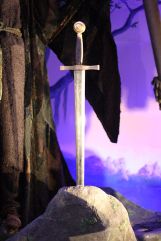
Excalibur London_Film_Museum_ via Wikipedia
Literature in those days was filled with religious allegories, the most popular of which were the virginity and holiness of the Saints, especially those deemed holy enough to be raptured.
Death was the common enemy, an inescapable event kings feared as much as beggars did. Those saints who were raptured did not experience death. Instead, they were raised to heaven, living in God’s presence for all eternity.
Galahad as written by Malory and later authors never married. But humans tend to be human, so why assume he was a virgin? Galahad’s state of virginity and grace was written to exemplify what all good noblemen should aspire to.
The High Middle Ages was the period of European history that commenced around the 10th century and lasted until the 14th century (or so). That era saw a flowering of historical-fantasy writing among the clergy and educated nobility. Medieval chroniclers detailed the people and events of 300 to 400 years prior. Their sources were the oral histories as told in well-known bardic tales and local legends.
Malory was writing during the final decades of the Crusades and trying to fit the old stories into his modern time. Rumors and stories passed down became historical truths, reshaped to justify the desire for conquest. After all, the New World was just over the horizon, vast cities of Inca gold ripe for the taking.
We 21st-century authors have excellent records of 15th and 16th-century political struggles. Yet, we make things up about the Tudors and Elizabethans, because they were interesting people. We love to imagine what they must have been like.
We all know the written records from before the time of Elizabeth I are highly questionable. Sifting medieval fact from fiction is the life’s work of many historical scholars. However, they’re entertaining fantasy reads, leaving fangirls like me free to riff on them and create our own mythologies.
So, that is how my creative process works. Someone gives me an impossible idea, and I fight with it until it beats me. Once that idea has me by the throat, I know what has to be written. That tale became a short story, Galahad Hawke.
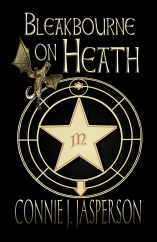 And sometimes a theme refuses to let go of me. I took Arthurian myth and the chivalric code and turned them inside out with the characters of Lancelyn and Galahad in Bleakbourne on Heath.
I feel quite sure I haven’t written my last Alternate Arthurian tale. Galahad Hawke may get an expansion into a novel–after all, he didn’t get the traditional happy ending.
Or maybe not. I do have an epic fantasy on deck so … maybe next year.
 During the 1980s and 90s, I listened to music on the stereo, writing my thoughts and ideas in a notebook while my kids did their homework. I drew dragons and fantasy landscapes and worked three part-time jobs to pay the bills.
 For most of my writing life, I was like a toddler given a package of
 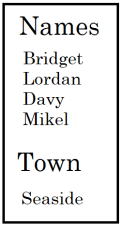 Build a glossary of words and spellings unique to your story, and be sure to list names. I use an Excel spreadsheet, but you can use anything you like to help you stay consistent in your spelling.
 The master file might be titled: Lenns_Story
 I gained a fantastic local group through attending write-ins for NaNoWriMo, the Tuesday Morning Rebel Writers. Since the pandemic, and with several of our members now on the opposite side of Washington State, we meet weekly via Zoom. We are a group of authors writing in a wide variety of genres.
 Learn about structure and pacing from successful authors. Spend the money to go to conventions and attend seminars. You will learn so much about the craft of writing, the genre you write in, and the publishing industry as a whole—things you can only learn from other authors. I gained an extended professional network by joining
  The year that followed was filled with mistakes and struggles. Legitimate publishers NEVER contact you. You must submit your work to them, and they prefer to work with agented authors.
 Short stories and micro fiction are a training ground, a way to hone your skills. They’re also the best way to get your name out there. I suggest you build a backlog of work from 100 to 5,000 words in length. Keep them ready to submit to magazines, anthologies, and contests.
 One of my favorite authors writes great storylines and creates wonderful characters. Unfortunately, the quality of his work has deteriorated over the last decade. It’s clear that he has succumbed to the pressure from his publisher, as he is putting out four or more books a year.
 This frequently happens to me in a first draft, but whoever is editing for him is letting it slide, as it pads the word count, making his books novel-length. I suspect they don’t have time to do any significant revisions.
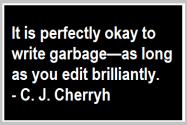
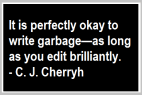 When we lay down the first draft, the story emerges from our imagination and falls onto the paper (or keyboard). Even with an outline, the story forms in our heads as we write it. While we think it is perfect as is, it probably isn’t.
 Inadvertent repetition causes the story arc to dip. It takes us backward rather than forward. In my work, I have discovered that the second version of that idea is usually better than the first.
 You see things from a different angle when you start reading the chapter from the end and work your way toward the beginning. It’s amazing how many bloopers show up when you do this, even though you have already read it aloud. When you read it aloud you were going the direction you always go, the way you know so well. The mind tricks us, and we read what should be there instead of what is.
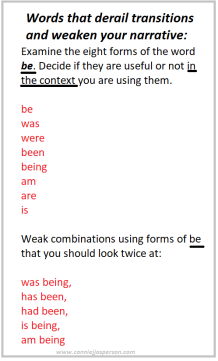 Here are a few things that stand out when I do this:
 I am fortunate to have excellent friends willing to do this for me. Their suggestions are thoughtful and spot-on.
 In my work, the suggestions offered by the beta reader (first reader) guide and speed up the revision process. My editor can focus on doing her job without being distracted by significant issues that should have been caught early on.
 Characters: Is the point of view character (protagonist) clear? Did you understand what they were feeling? Were they likable? Did you identify with and care about them? Were there various character types, or did they all seem the same? Were their emotions and motivations clear and relatable?
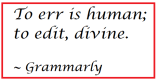 Editing is a process unto itself and is the final stage of making revisions. The editor goes over the manuscript line-by-line, pointing out areas that need attention: awkward phrasings, grammatical errors, missing quotation marks—many things that make the manuscript unreadable. Sometimes, major structural issues will need to be addressed. Straightening out all the kinks may take more than one trip through a manuscript.
 An editor is not the author. They can only suggest remedies, but ultimately all changes must be approved and implemented by the author.
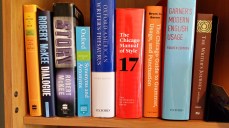 A reader won’t be familiar with it and will notice what we have overlooked.
 When observed by others, a person who is daydreaming appears lazy. Mind-wandering has no obvious purpose, but it is critical for creativity. Every groundbreaking discovery in science, every great invention we enjoy today—all were inspired by ideas that came to a person while thinking about something else or when they were mind-wandering.
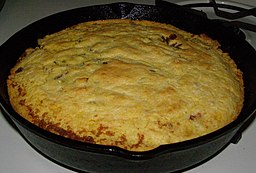 My oldest daughter, looking at our dinner, a casserole of beans with cornbread baked on top like a cobbler: “What the heck is that?”
 Perception is in the eye of the beholder. Observation and thought are seeds that inspire extrapolation, leading the viewer to come away with new ideas. When I see the story captured in a single scene by an artist, my mind always surmises more than the painting shows. I see the picture as depicting the middle of the story and imagine what came before and what happened next. Unintentionally, I put a personal spin on my interpretation, and ideas are born. I don’t mean to, but everyone does.
 This means that daydreaming is actually good for you. It boosts the brain, making our thought process more effective. Letting the mind wander allows a kind of ‘default neural network’ to engage when our brain is at wakeful rest, as in meditation, rather than actively focusing on the outside world. When we daydream, our brains can process tasks more effectively.
 You could be watching the birds, as my husband and I often do. Or maybe you’re perusing the display in a local art gallery or listening to music. I love all genres of music, but for writing I often find inspiration in powerhouse classical pieces such as Orff’s cantata,
  Today, however, I plan a long walk along the beach.
 I have no trouble selling my friends’ books – I’ve read them all and love them, and love selling them. Maybe I can sell their books because I’m not emotionally invested in their creation, but I am invested as a reader.
 Next week on this blog we will talk about the creative process and the importance of mind-wandering. We’ll also talk about why it is important to beta read for your fellow writers, and how to be a good reader, one who gives positive feedback and offers constructive suggestions.
 Some novels are character-driven, others are event-driven, but all follow an arc. I’m a poet, and while I read in every genre, I seek out literary fantasy, novels with a character-driven plot. These are works by authors like
 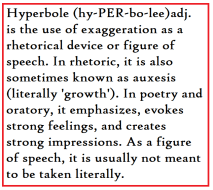 And the prose … words with impact, words combined with other words, set down in such a way that I feel silly even thinking I can write such works. Thankfully, my editor weeds out pretentious hyperbole and slaps me back to reality.
 This part of the novel is often difficult for me to get right. The protagonist must be put through a personal crisis. Their inner world must be shaken to the foundations.
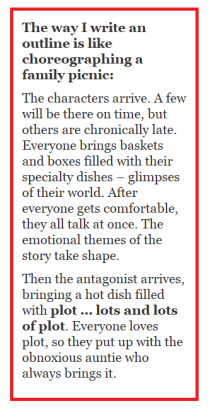 This emotional low point is necessary for our characters’ personal arcs. It is the place where they are forced to face their weaknesses and rebuild themselves. They must discover they are stronger than they ever knew.
 And what of my female protagonist? Where does her story begin?
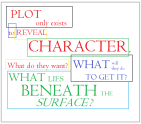 I must introduce a story-worthy problem in those pages, a test propelling the protagonist to the middle of the book. The opening paragraphs are vital. They are the hook, the introduction to my voice, and must offer a reason for the reader to continue past the first page.
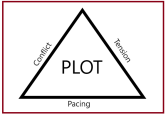
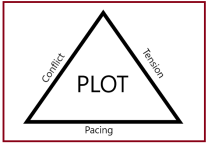 My favorite books open with a minor conflict, evolving to a series of more significant problems, working up to the first pinch point, where the characters are set on the path to their destiny.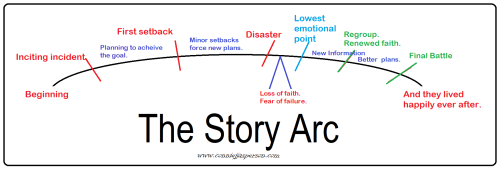
 In literary terms, this uneven distribution of knowledge is called asymmetric information. We see this all the time in the corporate world.
 Jared is hilarious, charming, naïve, a bit cocky, and completely unaware that he’s an arrogant jackass. He is a young man who is exceptionally good at everything and is happy to tell you about it. Jared has no clue that his boasting holds him back, as no one wants to work with him.
 When I started writing this story, I had the core conflict: Jared’s misguided desire to be important. I had the surface quest: rescuing the kidnapped kid. I had the true quest: Jared learning to laugh at himself and developing a little humility.
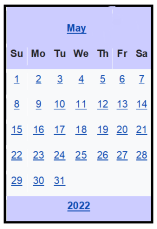 Calendar time is a layer of world-building. It sets the story in a particular era and shows the passage of time.
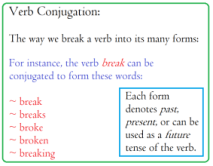 Consider the following sentences: “I eat,” “I am eating,” “I have eaten,” and “I have been eating.”
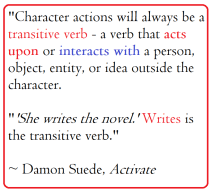 Every story is unique; some work best in the past tense, while others must be set in the present.


 Life in the Realm of Fantasy
.jpg&oldid=449104554)