Tag Archives: writing subtext

The second draft – a deeper dive into the emotional side of subtext #writing

Last week, in Monday’s post, ‘The Second Draft – Subtext,‘ we barely skimmed the surface of that aspect of our story. We discussed how it can be conveyed as part of world-building. But subtext is so much more. Subtext is emotion. It’s the hidden story, the hints, allegations, and secret reasoning.

  • Subtext is the content that supports both the dialogue and the personal events experienced by the characters.
These are implicit ideas and emotions. These thoughts and feelings may or may not be verbalized, as subtext is often conveyed through the unspoken thoughts and motives of characters. It emerges gradually as what a character really thinks and believes.

It also shows the larger picture. It can imply controversial subjects, or it can be a simple, direct depiction of motives. Metaphors and allegories are excellent tools for conveying ideas.

Subtext can be a conscious thought or a gut reaction on the part of the characters. It is imagery as conveyed by the author. A good story is far more than a recounting of ‘he said’ and ‘she said. ‘It’s more than the action and events that form the arc of the story. A good story is all that, but without good subtext, the story never achieves its true potential.

Within our characters, underneath their dialogue, lurks conflict, anger, rivalry, desire, or pride. Joy, pleasure, fear … as the author, we know those emotions are there, but conveying them without beating the reader over the head is where artistry comes into play.

When it’s done right, the subtext conveys backstory with a deft hand. When layered with symbolism and atmosphere, the reader absorbs the subtext on a subliminal level because it is unobtrusive.
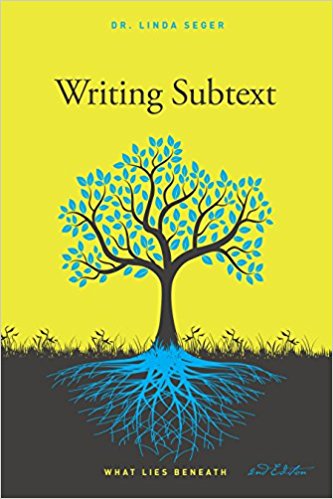
An excellent book on this subject is Writing Subtext: What Lies Beneath by Dr. Linda Seger. On the back of this book, subtext is described as “a silent force bubbling up from below the surface of any screenplay or novel.” This book is a valuable resource for discovering and conveying the deeper story that underlies the action.

Some writers assume that heavy-handed information dumping is subtext because it is often conveyed through internal dialogue,

It’s not. Descriptions, opinions, gestures, imagery, and yes – subtext – can be conveyed in dialogue, but dialogue itself is just people talking.

When characters constantly verbalize their every thought, you run into several problems. First, verbalizing thoughts can become an opportunity for an info dump. Second, in genre fiction, the accepted method of conveying internal dialogue (thought) is through the use of italics.

The main problem I have with italics is that when a writer expresses a character’s thoughts, a wall of leaning letters is difficult to decipher.

Nevertheless, thoughts (internal dialogue) have their place in the narrative and can be part of the subtext. However, I recommend going lightly with them. There are other ways to convey thoughts. In the years since I first began writing seriously, I’ve evolved in my writing habits. Nowadays, I am increasingly drawn to using the various forms of free indirect speech to show who my characters think they are and how they see their world. I rarely use italics.
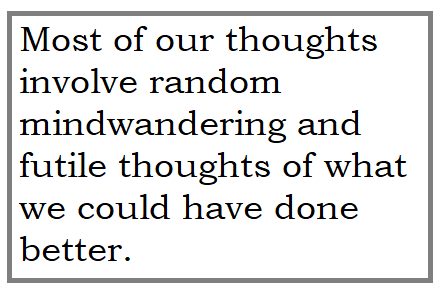
most of our random thoughts involve obsessing on what we could have done better.A character’s backstory is the subtext of their memories and the events that led them to the situation in which they find themselves. We use interior monologues to represent a character’s thoughts in real time, as they actually think them in their head, using the precise words they use. For that reason, italicized thoughts are always written in first-person present tense I’m the queen! We don’t think about ourselves in the third person, even if we really are the queen.

We think in the first-person present tense because we are in the middle of events as they happen. Our lives unfold in the “now,” so they are written as the character experiences them.

Memories are subtext and reflect a moment in the past. They should be written in the past tense to reflect that. If it was a moment that changed their life, consider rewriting it as a scene and have the character relive it.

We can combine memories and emotions in the form of free indirect speech:

Jeanne paused. The sight of that dark entrance brought a wave of memories, all of them dark and painful.

Chris, on his knees sobbing … their mother’s bloody form ….

She was too young to understand then, but now she knew why Chris seemed so emotionless at times.

Resolutely, she followed him inside.

Subtext expressed as thoughts must fit as smoothly into the narrative as conversations. My recommendation is to express only the most important thoughts through an internal monologue, which will help you retain the reader’s interest. The rest can be presented in images that build the world around the characters.
image of a question mark, asking "what was I thinking?"Information is a component of subtext. We have provided the reader with a lot of information in only a few sentences. They might think they know who a character is, and they have a clue about his aspirations.

But a good story keeps us hanging. Knowledge must emerge via subtext and through descriptions of the environment, conversations, interior monologues, and a character’s general impressions of the world around them.

Odors and ambient sounds, objects placed in a scene, sensations of wind, or the feeling of heat when the sun shines through a window. These bits of background are subtext.

I like books where the scenery is shown in brief impressions, and the reader sees exactly what needs to be there. We don’t want to distract our readers by including unimportant things, such as the exact number of ferns in a forest clearing. The ferns are there, the lost hiker thinks eating their tips is better than starving, and that is all the reader wants to know.

Subtext, metaphor, and allegory are impressions and images that build the world around and within the characters. They are as fundamental to the story as the plot and the arc of the story. As a reader, I’m always thrilled to read a novel that is a voyage of discovery, and good subtext makes that happen.

2 Comments

Filed under writing

The second draft – subtext #writing

Subtext is a complex but essential aspect of storytelling. As the word implies, subtext lies below the surface (sub) and supports the plot and the conversations (text).

It is the hidden story, an unstated knowledge embedded within the narrative.

Subtext can be inserted into the story through the layers of worldbuilding. It is conveyed by the images we place in the environment and how the setting influences our perception of the mood and atmosphere.

We all know good worldbuilding is more than simply detailing the setting. It starts there, but without the addition of mood and atmosphere, a coffee shop is just a room with a few tables and chairs. A reader’s perception of a gripping narrative’s reality is influenced by aspects of the setting that they may not consciously notice at the time.

How does good worldbuilding contribute to good subtext? The clues about mood and atmosphere combine on a subliminal level. This undercurrent shapes a reader’s emotional impressions of the story.

A brief mention of décor can convey atmosphere: Tess stood in line, looking around while Evan secured a table. Country-style furnishings lent a coziness to the room, a warm contrast to the rain pounding on the windows. Soon it was her turn to order. “Two large mochas, please.”

A view of the world from the characters’ point of view is essential, as it conveys mood.

“Why did they bother putting a sign on the dining hall? No matter what Temple you visit, every building is made of white sandstone and you always know where you are and what you are looking at.” Bryson’s scathing tones floated to the instructor, who glared at us all.

Afterward, while readers may not consciously remember details, they will remember what they felt as they read that novel. When asked who their favorite writer is, they will mention that author.

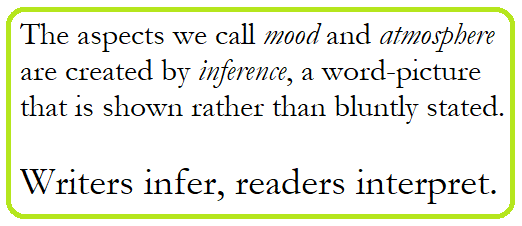
When we experience emotion, we are feeling the effect of contrasts, of transitioning from the positive (good) to the negative (bad) and back to the positive. Moodatmosphere, and emotion form the inferential layer of a story, part of the subtext. When an author has done their job well, those transitions feel personal to the reader.

Atmosphere has two aspects: overall and personal. The overall atmosphere of a story is long-term, an element of mood that is conveyed by the setting as well as by the actions and reactions of the characters.

The overall mood of a story is also long-term. It resides in the background, going almost unnoticed. Mood shapes (and is shaped by) the emotions evoked within the story.

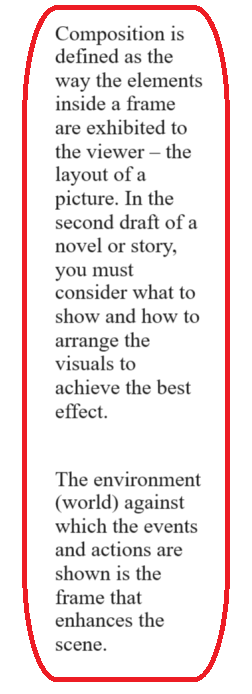
The inferential layer of a story has another component, one we must look at in the second draft. This is where another aspect of worldbuilding, scene framing, comes into play. This component has two aspects: first, it involves the order in which we stage people and visual objects, as well as the sequence of events along the plot arc. It shapes the overall mood and atmosphere, contributing to the subtext.

The second aspect of scene framing involves the plot arc and how we place the scenes and their transitions. We want them in a logical, sequential order.

Good worldbuilding can help us give backstory without an info dump, and symbolism is a key tool for this. Environmental symbols are subliminal landmarks for the reader. Thinking about and planning symbolism in an environment is crucial to developing the general atmosphere and affecting the overall mood.

For example, the word gothic in a novel’s description tells me it will be a dark, moody piece set in a stark, desolate environment. A cold, barren landscape, constant dampness, and continually gray skies set a somber tone to the background of the scene.

A setting like that underscores each of the main characters’ personal problems and evokes a general atmosphere of gloom.

Our characters’ emotions affect their attitudes toward each other and influence how they view their quest. This, in turn, shapes the overall mood of the characters as they move through the arc of the plot. And the visual atmosphere of a particular environment may affect our protagonist’s personal mood.

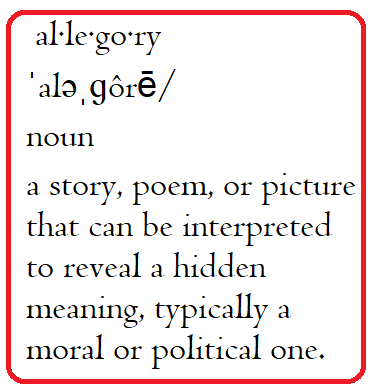
What tools in our writer’s toolbox are effective in conveying an atmosphere and a specific mood? Allegory and symbolism are two devices that are similar but different. The difference between them is how they are presented.

  • Allegoryis a moral lesson in the form of a story, heavy with symbolism.
  • Symbolismis a literary device that uses one thing throughout the narrative (perhaps shadows) to represent something else (grief).

How can we use allegory and symbolism in modern genre fiction? Cyberpunk, as a subgenre of science fiction, is exceedingly atmosphere-driven. It is heavily symbolic in worldbuilding and often allegorical in the narrative. We see many features of the classic 18th and 19th-century Sturm und Drang literary themes but set in a dystopian society. The deities that humankind must battle are technology and industry. Corporate uber-giants are the gods whose knowledge mere mortals desire and whom they seek to replace.

The setting and worldbuilding in cyberpunk work together to convey a gothic atmosphere. This overall feeling is dark and disturbing. That aspect of subtext is reinforced by the dark nature of interpersonal relationships and the often criminal behaviors our characters engage in for survival.

No matter what genre we write in, the second draft is where we expand on our ideas and fill in the gaps of the rough first draft manuscript. We find words to show the setting more clearly and use visuals to hint at what is to come. We create an immersive atmosphere by including colors, scents, and ambient sounds.

We choose our words carefully as they determine how the visuals are shown. When we have no words and feel stuck, we go to the thesaurus and find them.

Authors are painters, creating worlds out of words. We strive to create an atmosphere and mood that underscores our themes and highlights plot points without resorting to info dumps. Each word is a brushstroke that can lighten the mood as easily as it can darken it.

  • When we create a setting, intense color brightens the visuals, and gray depresses them. Those tones affect the atmosphere and mood of the scene.

In the real world, sunshine, green foliage, blue skies, and birdsong go a long way toward lifting my spirits. When I read a scene set in that kind of environment, the mood of the narrative feels lighter to me.

Worldbuilding is complex. It can feel too difficult when we are trying to convey subtext, mood, and atmosphere, using slimmed down prose and power words rather than flowery. But keep at it because the reader won’t be aware of the complexities involved.

All they will know is how strongly the protagonist and her story affected them and how much they loved that novel.

3 Comments

Filed under writing

Subtext and First Person Point of View #amwriting (revisited)

We are winding down to the  final week of NaNoWriMo. This has been a busy month, and this week, being Thanksgiving week here in the US, is even more jammed. Today’s post is on First Person Point of View, a literary mode I have found myself using more often lately. This first posted on November 26, 2018, and expands on employing good subtext, which we discussed last week.


Third-person omniscient has been my usual mode to write in, but I’m not limited to it. When we write in third-person omniscient mode, the story is told from an outside, overarching point of view. The narrator sees and knows everything that happens within the world of the story, including what each of the characters is thinking and feeling.

This works because the narrator holds much of the information back from the reader, doling it out as the protagonists need it.

But what if we want to create a sense of intimacy, of being in the character’s head? And what if we don’t want the reader to know everything that is going on until the last minute?

This is where the literary devices of point-of-view and subtext come into play. It’s fairly easy to keep the reader guessing what is going on in either narrative mode if you make good use of subtext.

The first-person point of view is fairly common and is told from one protagonist’s personal point of view. It employs “I-me-my-mine” in the protagonist’s speech, allowing the reader or audience to see the primary character’s opinions, thoughts, and feelings.

A limited first person point of view is stream of consciousness. This is a narrative mode told from a first-person perspective, showing the thought processes as well as the actions and spoken words of the protagonist.

In real life, we can’t be all-seeing and all-knowing—witnesses are notoriously unreliable. First-person point-of-view employs the unreliable narrator which I like when the author understands how to make the subtext work.

Disbelief paralyzes me, but then my emotions coalesce into one thought—Ricky…of course.

Through the use of interior monologues (thoughts), we show the inner desires and motivations of the protagonists. We also offer the reader the incomplete thoughts they express to themselves but conceal from the other characters.

At times, we see the POV character’s rambling thoughts about a situation or person, as well as witness their conversations and actions.

How do we fit subtext into our narrative if we’re using a limited first person point of view? Subtext is the hidden story, the hints and allegations, and the secret motives of the entire cast. Subtext is the content that supports the dialogue and gives private purpose to the events each character experiences.

We don’t want to just lay it all out for the reader in the first paragraphs. Just as in all other narrative modes, in a limited first person point of view we have several ways available to reveal the subtext, the hidden motives and desires of our characters.

The Double Entendre: a word or phrase open to two interpretations, one of which is usually risqué or indecent. “My, those are some plump loaves you have rising there, ma’am.” This can be too in-your-face for many readers, especially if the author is heavy-handed. Many classic Noir detective novels of the 1930s through the 1960s employed the double entendre to convey ideas and intentions that referenced sexual matters and which the censors wouldn’t have allowed to be published.

Sarcasm: the use of irony to mock or convey contempt. “I didn’t attend the funeral, but I sent a nice letter saying I approved of it.—Mark Twain.

In my writing, I sometimes use sarcasm as a way to show subtle aggression and tension. Also, sarcasm, especially that which is self-directed, can highlight the dark humor of a bad situation.

Lying: The point-of-view character may be guilty of habitually telling falsehoods. “Sorry I’m late. Traffic was a bitch.” But perhaps the first page showed the character oversleeping, so this lie is a clue that the character is not always truthful.

In a first person narrative, if the protagonist is shown lying to others in small, insignificant ways, the reader should consider that what he tells us may be a lie too.

We can also employ the use of allegory, words, and images that can be interpreted to reveal a hidden meaning, typically a moral or political one. Animal Farm, written by George Orwell, is an allegory that uses animals on a farm to describe the overthrow of the last Russian Tsar, Nicholas II, and the Communist Revolution of Russia before WW I.

Symbolism: using an object or a word to represent an abstract idea. An action, person, place, word, or object can all have a symbolic meaning. Literary Devices.net gives us these examples:

  • The dove is a symbol of peace.
  • A red rose, or the color red, stands for love or romance.
  • Black is a symbol that represents evil or death.
  • A ladder may stand as a symbol for a connection between heaven and earth.
  • A broken mirror may symbolize separation.

For me, writing is as much about rewriting as it is writing new words. Sometimes I have a story that I think might have potential, but I can’t decide if the plot should continue down the bunny trail it’s on or not. I will share it with my writing buddies to see what they think about the premise.

Usually, I get good feedback that helps me steer the narrative in the right direction when I am embarking on the second draft.

I consider all feedback good, even when the first readers of a scene or short story don’t “get” what I am trying to convey. If the readers don’t see what I mean, their comments aren’t directly helpful.

That lack of comprehension shows that the reader missed the point of the story entirely—my subtext failed to do its job. The scene or story must be completely rewritten. My protagonist’s intentions must be made clearer to the reader.

The struggle to express my ideas is just part of the process, and having good friends who are willing to read and give honest, thoughtful feedback is priceless.


Credits and Attributions:

LiteraryDevices Editors. “Symbolism” LiteraryDevices.net. 2013. http://literarydevices.net/symbolism/  (accessed November 24, 2018).

Quill Pen, PD|by author, BWCNY at English Wikipedia.

Underwood Standard Typewriter, PD|75 yrs image first published in the 1st (1876–1899), 2nd (1904–1926) or 3rd (1923–1937) edition of Nordisk familjebok.

IBM Selectric, By Oliver Kurmis [CC BY 2.5 (https://creativecommons.org/licenses/by/2.5)%5D, from Wikimedia Commons

8 Comments

Filed under writing

Creating Depth: Subtext #amwriting

NaNoWriMo is in full swing and sliding toward the finish. We have slightly less than two weeks left. My manuscript is inching toward completion. I have crossed the 50,000 word line, but the book is less than half finished. Many scenes that currently exist will likely be cut, and new scenes written that better show the story.

A lot of new authors are discovering words like “subtext” and wondering what that means. Subtext is a complicated aspect of the story, existing in the depths of the inferential layer of the Word-Pond that is Story.

Since nothing has changed since I last wrote on this subject, here is the reprise of the post Subtext, first posted here in March of 2018.


A good story is far more than a recounting of he said, and she said. It’s more than the action and events that form the arc of the story. A good story is all that, but without good subtext, the story never achieves its true potential.

Within our characters, underneath their dialogue, lurks conflict, anger, rivalry, desire, or pride. Joy, pleasure, fear—as the author, we know those emotions are there, but conveying them without beating the reader over the head is where artistry comes into play.

The subtext is the hidden story, the hints and allegations, the secret reasoning. It is the content that supports the dialogue and gives private purpose to the personal events experienced by the characters.

These are implicit ideas and emotions. These thoughts and feelings may or may not be verbalized, as subtext is most often shown as the unspoken thoughts and motives of characters — what they really think and believe. It also shows the larger picture. It can imply controversial subjects, or it can be a simple, direct depiction of motives. Metaphors and allegories are excellent tools for conveying provocative ideas.

Subtext can be a conscious thought or a gut reaction on the part of the characters. It imagery as conveyed by the author.

When it’s done right, the subtext conveys backstory with a deft hand. When layered with symbolism and atmosphere, the reader absorbs the subtext on a subliminal level because it is unobtrusive.

An excellent book on this subject is Writing Subtext: What Lies Beneath by Dr. Linda Seger. On the back of this book, subtext is described as “a silent force bubbling up from below the surface of any screenplay or novel.” This book is an important source of information on how to discover and convey the deeper story that underpins the action.

Because subtext is so often shown as internal dialogue, some writers assume that heavy-handed info dumping is subtext.

It’s not. It’s description, opinions, gestures, imagery, and yes—subtext can be conveyed in dialogue, but dialogue itself is just people talking.

When characters are constantly verbalizing their every thought you run into several problems:

  1. In genre fiction, the accepted method of conveying internal dialogue (thought) is with italics. A wall of italics is a daunting prospect to a reader, who may just put the book down.
  2. Verbalizing thoughts can become an opportunity for an info dump.

Nevertheless, thoughts (internal dialogue) have their place in the narrative and can be part of the subtext. The main problem I have with them is that when a writer is expressing some character’s most intimate thoughts, the current accepted practice for writing interior monologue in genre fiction is to use italics… lots and lots of italics… copious quantities of leaning letters that are small and difficult to decipher. I recommend going lightly with them.

A character’s backstory is subtext, their memories and the events that led them to where they are now. We use interior monologues to represent a character’s thoughts in real time, as they actually think them in their head, using the precise words they use. For that reason, italicized thoughts are always written in:

  • First Person: I’m the queen! After all, we don’t think about ourselves in the third person, even if we really are the queen. We are not amused.
  • Present Tense: Where are we going with this?

We think in the first person present tense because we are in the middle of events as they happen. Immediate actions and mental commentaries unfold in the present, so they are written as the character experiences them.

But memories are different. Memories are subtext and reflect a moment in the past. If brief, they should be written in the past tense to reflect that. If it was a watershed moment, one that changed their life, consider writing it as a scene and have the character relive it.

This will avoid presenting the reader with a wall of italics and gives the event a sense of immediacy. Having the characters relive that experience brings home the emotion and power of the event. It shows the reader why the event was so important to the character that they would remember it so clearly.

Subtext expressed as thoughts must fit as smoothly into the narrative as conversations. My recommendation is to only voice the most important thoughts via an internal monologue, and in this way, you will retain the readers’ interest. The rest can be presented in images that build the world around the characters, as in this example:

Benny watched Charlotte as she left the office. Everyone knew she was rich. The clothes, the sleek sports car she drove—these were things that could have been owned by any well-employed girl, but something about her screamed confidence and money.

These are Benny’s impressions of Charlotte, and we could put all of that into Benny’s interior monologue, but why? This way, the reader is told all that they need to know about Charlotte, without resorting to an info dump, and we aren’t faced with a wall of italics.

Some things must be expressed as an interior monologue.

Benny looked down at his mop. I’m such an idiot.

The reader has  gained a whole lot of information in only two sentences.  They think they know who Benny is, and they have a clue about his aspirations. What they don’t know yet, but will discover as the plot unfolds, is who Benny really is and why he is posing as a janitor. That, too, will emerge via subtext and through descriptions of the environment, conversations Benny has with his employer, his interior monologues, and his general impressions of the world around him.

Don’t forget the senses. Odors and ambient sounds, objects placed in a scene, sensations of wind, or the feeling of heat when the sun shines through a window—these bits of background are subtext. Scenes require a certain amount of description.

Let’s say we’re writing a short story about a grandfather fixing dinner for his grandson. He’s had to go out shopping, and now he carries his groceries home in a snowstorm, fearing he will slip and fall. How do you convey that in the least obtrusive fashion? I would write it this way:

Willard gazed at the icy stairs leading from the unshoveled walk to the front door, his bag of groceries growing heavier.

Sometimes we see the world and the larger issues through the protagonist’s eyes, and other times we see the protagonist through the setting—what is shown in the scene.

The subtext must be organic, purposeful, and not just there to dump info or fluff the word count. I like books where the scenery is shown in brief impressions, and the reader sees exactly what needs to be there. We aren’t distracted by unimportant things. When you mention a detail it becomes important, so only add elements the reader needs to know about.

Subtext, metaphor, and allegory: impressions and images that build the world around and within the characters are as fundamental to the story as the plot and the arc of the story. Getting it right takes a little work, but please, do make an effort to be subtle and deft in conveying it. As a reader, I’m always thrilled to read a novel where the subtext makes the narrative a voyage of discovery.


Credits and Attributions:

Subtext by Connie J. Jasperson was first published on Life in the Realm of Fantasy on 05 Mar 2018.

Writing Subtext: What Lies Beneath by Dr. Linda Seger © published by Michael Wiese Productions; 2 edition (March 1, 2017)

2 Comments

Filed under writing

Subtext and first person point-of-view #amwriting

Third-person omniscient has been my usual mode to write in, but I’m not limited to it. When we write in third-person omniscient mode, the story is told from an outside, overarching point of view. The narrator sees and knows everything that happens within the world of the story, including what each of the characters is thinking and feeling.

This works because the narrator hold much of the information back from the reader, doling it out as the protagonists need it.

But what if we want to create a sense of intimacy, of being in the character’s head? And what if we don’t want the reader to know everything that is going on until the last minute?

This is where the literary devices of point-of-view and subtext come into play. It’s fairly easy to keep the reader guessing what is going on in either narrative mode if you make good use of subtext.

The first-person point of view is fairly common and is told from one protagonist’s personal point of view. It employs “I-me-my-mine” in the protagonist’s speech, allowing the reader or audience to see the primary character’s opinions, thoughts, and feelings.

A limited first person point of view is stream of consciousness. This is a narrative mode told from a first-person perspective, replicating the thought processes as well as the actions and spoken words of the protagonist. In real life we can’t be all-seeing and all-knowing—witnesses are notoriously unreliable. First-person point-of-view employs the unreliable narrator which I like when the author understands how to make the subtext work.

Disbelief paralyzes me, but then my emotions coalesce into one thought—Ricky…of course.

Through the use of interior monologues, we show the inner desires and motivations of the protagonists. We also offer the reader the incomplete thoughts they express to themselves but conceal from the other characters. So, we see the POV character’s rambling thoughts, as well as witness their conversations and actions.

How do we fit subtext into our narrative if we’re using a limited first person point of view? “Subtext” is the hidden story, the hints and allegations, and secret motives of the entire cast. Subtext is the content that supports the dialogue and gives private purpose to the events each character experiences.

We don’t want to just lay it all out for the reader in the first paragraphs. Just as in all other narrative modes, in limited first person point of view we have several ways available to reveal the subtext, the hidden motives and desires of our characters.

The Double Entendre: a word or phrase open to two interpretations, one of which is usually risqué or indecent. “My, those are some plump loaves you have rising there, ma’am.” This can be too in-your-face for many readers if the author is heavy-handed. Many classic Noir detective novels of the 1930s through the 1960s employed the double entendre to convey ideas and intentions that the censors wouldn’t have allowed to be published.

Sarcasm: the use of irony to mock or convey contempt. “I didn’t attend the funeral, but I sent a nice letter saying I approved of it.—Mark Twain. I sometimes use sarcasm as a way to show subtle aggression and tension. Also sarcasm, especially that which is self-directed, can highlight the dark humor of a bad situation.

Lying: The main character may be guilty of habitually telling falsehoods. “Sorry, I’m late. Traffic was a bitch.” If the first page shows the character oversleeping, this lie is a clue that the character is not always truthful. In a first person narrative, the reader should consider that what he tells us may be a lie too.

We can also employ the use of allegory, words, and images that can be interpreted to reveal a hidden meaning, typically a moral or political one. Animal Farm, written by George Orwell, is an allegory that uses animals on a farm to describe the overthrow of the last Russian Tsar, Nicholas II, and the Communist Revolution of Russia before WW I.

Symbolism: using an object or a word to represent an abstract idea. An action, person, place, word, or object can all have a symbolic meaning. Literary Devices.net gives us these examples:

  • The dove is a symbol of peace.

  • A red rose, or the color red, stands for love or romance.

  • Black is a symbol that represents evil or death.

  • A ladder may stand as a symbol for a connection between heaven and earth.

  • A broken mirror may symbolize separation.

Writing is as much about rewriting as it is writing new words. Sometimes I have a story that I think might have potential, but I can’t decide if the plot should continue down the bunny trail it’s on or not. I will share it with my writing buddies to see what they think about the premise.

Usually, I get good feedback that helps me steer the narrative in the right direction when I am embarking on the second draft. I consider all feedback good, even when the first readers of a scene or short story don’t “get” what I am trying to convey. The readers don’t see what I mean, so their comments aren’t directly helpful as they have missed the point of the story entirely.

What that kind of feedback tells me is this: the scene or a story must be completely rewritten because the subtext failed to do its job. My protagonist’s intentions must be made clearer to the reader.

That struggle to express my ideas clearly is just part of the process.


Credits and Attributions:

LiteraryDevices Editors. “Symbolism” LiteraryDevices.net. 2013. http://literarydevices.net/symbolism/  (accessed November 24, 2018).

Quill Pen, PD|by author, BWCNY at English Wikipedia.

Comments Off on Subtext and first person point-of-view #amwriting

Filed under writing

Subtext #amwriting

A good story is far more than a recounting of he said, and she said. It’s more than the action and events that form the arc of the story. A good story is all that, but without good subtext, the story never achieves its true potential.

Within our characters, underneath their dialogue, lurks conflict, anger, rivalry, desire, or pride. Joy, pleasure, fear–as the author, we know those emotions are there, but conveying them without beating the reader over the head is where artistry comes into play. The subtext is the hidden story, the hints and allegations; the secret reasoning. It is the content that supports the dialogue and gives private purpose to the personal events.

These are implicit ideas and emotions. These thoughts and feelings may or may not be verbalized, as subtext is most often shown as the unspoken thoughts and motives of characters — what they really think and believe. It also shows the larger picture. It can imply controversial subjects, or it can be a simple, direct depiction of motives. Metaphors and allegories are excellent tools for conveying provocative ideas.

Subtext can be a conscious thought or a gut reaction on the part of the characters. It imagery as conveyed by the author.

When it’s done right, subtext conveys backstory with a deft hand. When layered with symbolism and atmosphere, the reader absorbs the subtext on a subliminal level because it is unobtrusive.

An excellent book on this subject is Writing Subtext: What Lies Beneath by Dr. Linda Seger. On the back of this book, subtext is described as “a silent force bubbling up from below the surface of any screenplay or novel.” This book is an important source of information on how to discover and convey the deeper story that underpins the action.

Because subtext is so often shown as internal dialogue, some writers assume that heavy-handed info dumping is subtext.

It’s not. It’s description, opinions, gestures, imagery, and yes–subtext can be conveyed in dialogue but dialogue itself is just people talking.

When characters are constantly verbalizing their every thought you run into several problems:

  1. In genre fiction, the accepted method of conveying internal dialogue (thought) is with italics. A wall of italics is a daunting prospect to a reader, who may just put the book down.
  2. Verbalizing thoughts can become an opportunity for an info dump.

Nevertheless, thoughts (internal dialogue) have their place in the narrative and can be part of the subtext. The main problem I have with them is that when a writer is expressing some character’s most intimate thoughts, the current accepted practice for writing interior monologue in genre fiction is to use italics… lots and lots of italics… copious quantities of leaning letters that are small and difficult to decipher. I recommend going lightly with them.

A character’s backstory is subtext, their memories and the events that led them to where they are now. We use interior monologues to represent a character’s thoughts in real time, as they actually think them in their head, using the precise words they use. For that reason, italicized thoughts are always written in:

  • First Person: I’m the queen! After all, we don’t think about ourselves in the third person, even if we really are the queen. We are not amused.
  • Present Tense: Where are we going with this?

We think in the first person present tense because we are in the middle of events as they happen. Immediate actions and mental commentaries unfold in the present so they are written as the character experiences them.

But memories are different. Memories are subtext and reflect a moment in the past. If brief, they should be written in a past tense to reflect that. If it was a watershed moment, one that changed their life, consider writing it as a scene and have the character relive it.

This will avoid presenting the reader with a wall of italics and gives the event a sense of immediacy. Having the characters relive it brings home the emotion and power of the event and shows the reader why the event was so important to the character that they would remember it so clearly.

Subtext expressed as thoughts must fit as smoothly into the narrative as conversations. My recommendation is to only voice the most important thoughts via an internal monologue, and in this way, you will retain the readers’ interest. The rest can be presented in images that build the world around the characters as in this example:

Benny watched Charlotte as she left the office. Everyone knew she was rich. The gold watch, the sleek sports car she drove could have been owned by any well-employed girl, but something about her screamed confidence and money.

These are Benny’s impressions of Charlotte, and we could put all of that into Benny’s interior monologue, but why? This way, the reader is told all that they need to know about Charlotte, without resorting to an info dump, and we aren’t faced with a wall of italics.

Some things must be expressed as an interior monologue.

Benny looked down at his mop. I’m such an idiot.

The reader has  gained a whole lot of information, in only two sentences.  They think they know who Benny is, and they have a clue about his aspirations. What they don’t know yet, but will discover as the plot unfolds, is who Benny really is and why he is posing as a janitor. That too will emerge via subtext and through descriptions of the environment, conversations Benny has with his employer, his interior monologues, and his general impressions of the world around him.

Don’t forget the senses. Odors and ambient sounds, objects placed in a scene, sensations of wind or the feeling of heat when the sun shines through a window—these bits of background are subtext. Scenes require a certain amount of description. Let’s say we’re writing a short story about a grandfather fixing dinner for his grandson. He’s had to go out shopping, and now he carries his groceries home in a snowstorm, fearing he will slip and fall. How do you convey that in the least obtrusive fashion? I would write it this way:

Willard gazed at the icy stairs leading from the unshoveled walk to the front door, his bag of groceries growing heavier.

Sometimes we see the world and the larger issues through the protagonist’s eyes, and other times we see the protagonist through the setting—what is shown in the scene.

People read the subtext and make conclusions based on what they infer is important in that scene. If it is just there for looks or shock value, it becomes an instance of Chekhov’s Gun and should be removed. Everything that is remarkable (such as a gun) must be important to the scene or serve a later purpose.

The subtext must be organic, purposeful, and not just there to dump info or fluff the word count. I like books where the scenery is shown in brief impressions, and the reader sees only what needs to be there, so we aren’t distracted by unimportant things. Detail implies importance, so choose what you detail carefully.

Subtext—metaphor and allegory. Impressions and images that build the world around and within the characters are as fundamental to the story as the plot and the arc of the story. Getting it right takes a little work, but please, do make an effort to be subtle and deft in conveying it. As a reader, I’m always thrilled to read a novel where the subtext makes the narrative a voyage of discovery.


Credits and Attributions:

Writing Subtext: What Lies Beneath by Dr. Linda Seger © published by Michael Wiese Productions; 2 edition (March 1, 2017) 

34 Comments

Filed under writing