
One of my three works-in-progress is a murder mystery set in one of my established fantasy worlds. I am currently writing the antagonist’s story and meshing each event with the protagonist’s timeline via the calendar.
 My antagonist is a woman whom we’ll call Bad Grandma for the sake of this post. She takes what she wants and damn the consequences.
I see Bad Grandma as a pirate in the truest sense of the word. I’m writing her as having a career marked by violence and brutality. She is definitely not a Jack Sparrow sort of pirate.
I’m at the midpoint of the first draft of this story and can’t go any further on my protagonist’s thread. Bad Grandma’s story has to be written, including the end. Then, I can return to my protagonist and write the scenes connecting the dots.
This woman has no conscience or moral boundaries, which makes writing her exhausting.
I’m a Good Grandma—I only murder people on paper. So, between bursts of writing this evil woman’s story, I find myself cleaning and cooking, activities that help me organize my thoughts.
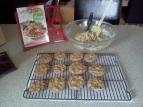 Cooking has become a primary activity for me. The weather here at Casa del Jasperson has been cold, with a layer of frigid, applied to the general iciness of the Arctic blast. As I write this post, it is a warm and balmy 18 degrees (minus 8 Celsius). It is clear and sunny, and the thin layer of snow that fell four days ago, less than an inch, is still there.
I have been making soups in my crockpot and baking all sorts of tasty delights. After all, making and serving good food is my love language. With that said, I’m a lazy chef. I rarely cook on the stovetop, so nearly everything I serve comes from the crockpot or the oven.
I made bread nearly every day for most of my adult life because it was cheaper to make than to buy, and it tasted better. But now that it’s only Greg and I, we buy it as often as we bake it.
 I’ve turned laziness into a fine art. I love my bread machine because it takes the work out of making the dough. However, I rarely bake my bread in the machine. It makes too large a loaf, and the crust can be a bit too crunchy.
Instead, I use the “dough” setting. Once the machine says the dough is made, I divide it in half and place it in prepared loaf pans. Sometimes, I make cinnamon rolls or cranberry walnut loaves once the machine has finished its part of the process. When the finished product emerges from the oven, it has the right texture and the house smells divine.
So, let’s get back to the murdering murderer. Our story is set in a riverport town. Bad Grandma is a drug smuggler who has murdered a mage, a Temple armsmaster. With the head peacekeeper in that town dead, she escapes justice for the moment, heading downriver. She stops in another port town two days later and is arrested the moment she steps off her stolen barge.
 The constable in that town is unaware that Bad Grandma has murdered a mage but knows she’s wanted for smuggling and other crimes. However, our Bad Grandma is slippery and escapes the noose by murdering the constable.
She decides to sneak back home to her long-abandoned family until things cool down, believing she has them cowed enough that they’ll hide her. But she’s been so abusive all their lives that her son throws her out and alerts the city watch that she’s back in town.
So now Bad Grandma is on the road, trying to escape justice. The only avenue of escape for her is a trail through the mountains. That road takes her back to the place where she had murdered the mage.
 At this point in my writing process, I need to know what Bad Grandma is doing because my protagonist, the mage who is investigating the murders, has to respond to her actions and plan how to catch her. I am writing the scenes that she is featured in, and soon, I will have the ending of the novel written. Bad Grandma’s meeting with karma resolves the central problem in this tale of woe. Once I have that solved, winding up the other threads will be easy to write.
Or so I hope!
 In many thrillers and cyberpunk novels, the faceless behemoth of corporate greed is the overarching antagonist. It can be represented by characters who are portrayed as utterly committed to doing their job and loyal to their employer. In many cyberpunk novels, the antagonists tend to be goons-in-suits, enforcers who work for the corporation.
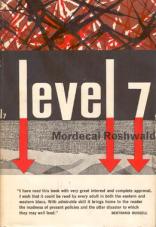 Level 7 is a 1959 science fiction novel by the Ukrainian-born Israeli writer
 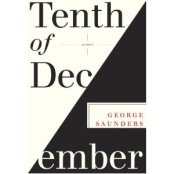 This type of psychopathic antagonist is explored exceedingly well in George Saunders’ brilliant sci-fi short story,
  When evil is a behemoth on the order of a mega-corporation or a military coup, the villains who represent it all have reasons for their loyalty. They’re like the hero; they care intensely, obsessively about something or someone. They have logical motives for supporting what we are portraying as the enemy. Our job as authors is to make those deeply held justifications the driving force behind their story.
 Who is the enemy, the true architect of that conflict? At this point, we may have a name, but who are they really?
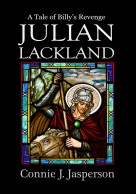 “God! You honestly believe I’m stupid.” Despite his anger, Beau kept his voice low. “There’s no reasoning with you. You’re convinced I’m besotted and Julian is barking mad. Get out of my way! I feel like hurting you.” He pushed past Huw, saying, “Go home, since you have so little faith in me.” He opened the door, intending to leave.
 In other stories, there is the nebulous antagonist. This could be the faceless behemoth of corporate greed, characterized by one or two representatives who may be portrayed as caricatures. In some
  A true villain is motivated, logical in their reasoning, and is utterly convinced of their moral high ground. They are creatures of emotion and have a backstory. As the author and their lawyer, you must know what their narrative is if you want to increase the risk for the protagonist.


 Life in the Realm of Fantasy