
I think of writing as a muscle, one that must be exercised the same as other muscles. We’re healthiest when we exercise regularly. Once writing becomes a behavioral habit, we find we can’t go very long without indulging it.
 The more frequently you write, the more confident you become. Spending a small amount of time writing every day is crucial. It develops discipline, and personal discipline is essential if you want to finish a writing project.
 Maybe you plan to write a novel “someday” but aren’t there yet. Writing random short scenes and vignettes helps develop that story without committing too much time and energy to the project. This is also a good way to create well-rounded characters.
In writing these scenes, you have the chance to identify the themes and subthemes you hope to explore in your novel. Theme is different from the subject of a work. An example I have used before, and one that most people know of, is the Star Wars franchise.
- The subject of those movies and books is “the battle for control of the galaxy between the Galactic Empire and the Rebel Alliance.”
- The major themesexplored in those films are moral ambiguity, coming of age, and the conflict between technology and nature.
- The subthemes are finding love, abuse of power, and family dynamics.
At some point, you will write something you think worthy of submitting to a contest or publisher. Your manuscript must demonstrate your understanding of what is meant by the word ‘theme,’ as well as your ability to craft clean and compelling prose.
If you do an internet search, you will find contests for drabbles and micro-fiction, some offering cash prizes. Some contests post pictures for prompts, others offer a word or sentence, and still others no prompt at all. I mentioned this site in the previous post: go to 700+ Weekly Writing Prompts if you need an idea.
 However, the Lascaux Prizes in Poetry and Flash Fiction are now open for submission and will close on March 31, 2024. The Lascaux Prize in Creative Nonfiction will reopen on April 1, 2024. The Lascaux Prize in Short Fiction will reopen on July 1, 2024.
 The Lascaux Review is one of the best contests around. It is exceptionally open to writers who are just beginning their journey. Their fee is reasonable, $15.00 in every category, and submissions are accepted through Submittable. Contest Guidelines | The Lascaux Review
For practice, try picking a theme and thinking creatively. Think a little wide of the obvious tropes (genre-specific, commonly used plot devices and archetypes). Look for an original angle that will play well to a strong theme, then go for it.
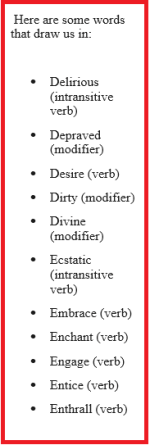
If you are choosing to write a drabble, you must use nouns and verbs with the most visual impact. Your word choices must convey an atmosphere, show a character, and tell a story.
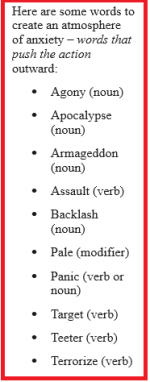 A way to get a grip on these concepts is what I think of as literary mind-wandering. For me, these ramblings hold the seeds of short stories.
I gain a different perspective on my work in progress when I write a short story detailing a side character’s background. These side characters appear in the longer manuscript as having distinct personalities because I am well-acquainted with them.
If you’re experiencing a lull in your ability to advance your novel, why not challenge yourself to write a drabble? It’s a whole story in 100 words or less.
Writing such short fiction forces me to develop an economy of words. Your narrative will be limited to one or two characters. There is no room for anything that does not advance the plot or affect the story’s outcome.
What are the nuts and bolts of writing micro-fiction?
I’ve said this before, but all writing is a time commitment, no matter the intended length of the piece. When writing a drabble, you can expect to spend an hour or more getting it to fit within the 100-word constraint.
Extremely short fiction must showcase the same essential components as a longer story:
- A setting
- One or more characters
- A conflict
- A resolution.
First, we need a prompt, a jumping-off point. For a drabble, we have 100 words to write a scene that tells the entire story of a moment in a character’s life. That’s about two paragraphs, which is the length of many scenes in longer works.
In a previous post on writing short stories, I showed how I use a loose outline to break short stories into three acts.
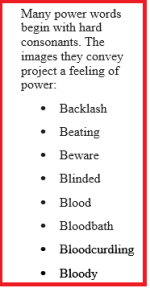 I break down the word count to know how many words to devote to each act in the story arc. I allow around 25 words to open the story and set the scene. Then, I give myself about 50 – 60 for the heart of the story. That leaves me 10 – 25 words to conclude it.
Some contests will ask for work that fits exactly into their word count parameter: if they ask for 50 words, they want exactly 50, no more and no less. Choose your words with care and intention.
That is when writing micro-fiction becomes fun.
Spend an hour to get that idea and emotion down before you forget it. The completed scene is a small gift you give yourself. I suggest you save your short work and proto scenes in a clearly labeled file for later use. Each one has the potential to be a springboard for writing a longer work or for submission to a contest.
Whether you submit a drabble to a contest or hang on to it doesn’t matter. Either way, writing micro-fiction hones your skills, and you will have captured the emotion and ambiance of a brilliant idea.
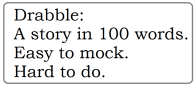 Extremely short fiction is the distilled essence of a novel. It contains everything the reader needs to know and makes them wonder what happened next.
That desire to know what happened next is why readers keep reading and why they might seek out your other work.
 I have been busy on the domestic side of things and enjoying life as a Townie. Lovely Instacart delivers my groceries from any store I choose. If we have to be out after dark and it’s raining, I can’t see well, so Uber does the driving. We are living a life of luxury and grateful for it. I have a “passel” of grandbabies and great-grandbabies, so when I have nothing to write, I have needlework projects to keep me busy.
 And speaking of fancy, we had a chance to spend time with two great-grandbabies this weekend. The best part of being a grandma is when the little one starts crying or needs changing, someone else takes over, and grandma shuffles off to the kitchen to stir the soup and make another cup of tea. Yay for old age!
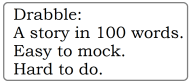 Writing drabbles means your narrative will be limited to one or two characters. There is no room for anything that does not advance the plot or affect the story’s outcome. Also, while a 100-word story takes less time than a 3,000-word story, all writing is a time commitment. I will spend an hour or more getting a drabble to fit within the 100-word constraint.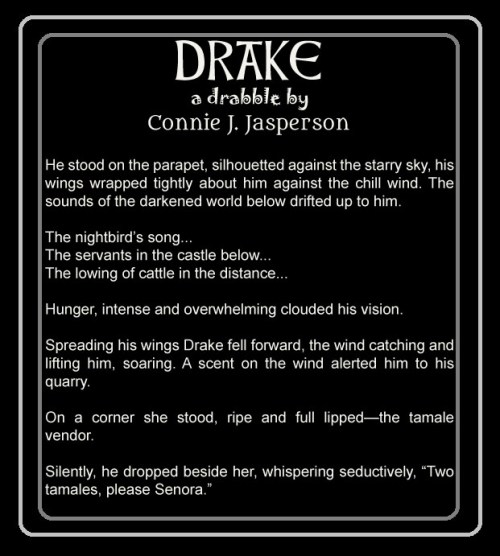
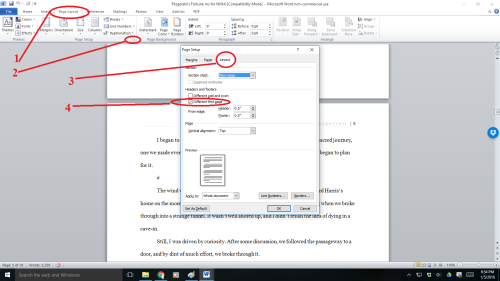
 This is the heading at the top of each page of a word-processed or faxed document. It contains page numbers, the title, and the author’s name. You won’t need one for most contests. However, if you plan to submit work to a magazine or anthology, you will want your header to follow their guidelines.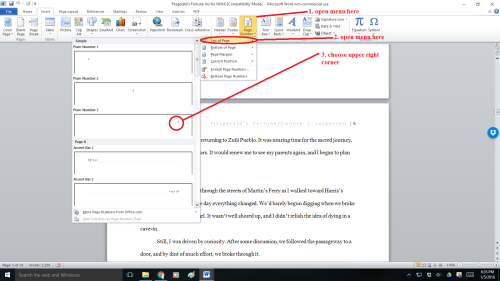
 So, what do they do if they don’t go over your work line-by-line? Magazine editors look for and bring new and marketable stories to the reading public.
 This is because they shouldn’t have to. Before submitting your work to an agent or submissions editor, you must have the technical skills down.
 When you have a story that you believe in, you must find the venue that publishes your sort of work. Read the magazines you hope to submit work to. That way, you will know what publishers are buying in your genre.
 Those who can’t afford to buy magazines can go to websites like
 For the most part, the requirements are basically the same from contest to contest, with minor differences. Most contests charge a submission fee but have a cash prize if your work is chosen. It doesn’t matter how brilliant your story is; if you don’t follow their guidelines for submission, you will have wasted your money. Non-conforming work will not be read, so follow their guidelines!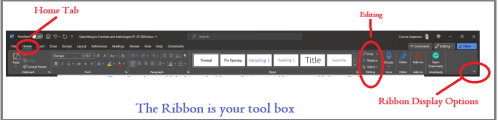
 You don’t want fancy. Stick with the industry standard fonts: Times New Roman (or rarely Courier) in 12 pt. These are called ‘Serif’ fonts and have little extensions that make letters easier to read when strung together to form words.
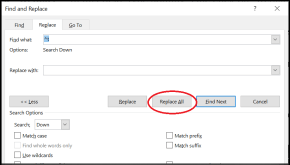 To remove tabs from a manuscript in MS Word or most other word-processing programs, open the “Find” box (right side of the ribbon on the home tab). In the “Find” field, type in ^t. (
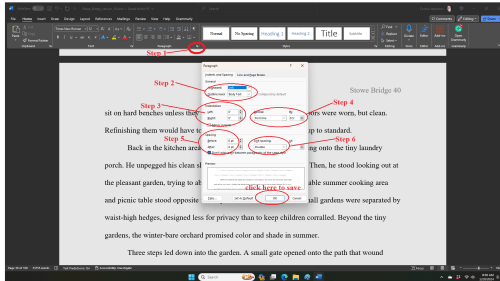 FIRST: SELECT ALL. This will highlight your entire manuscript.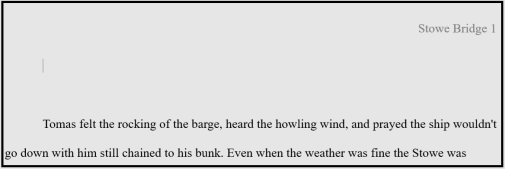
 You can get your foot in the traditional publishing house door this way. Also, if you are happy as an indie author, having work that places as a finalist in a contest (or is accepted into a paying anthology) will increase your visibility and gain readers for your other work.
 Many contests and publications use the
  First, let’s be clear–editors don’t enjoy sending out rejections. They want to find the best work by new authors because they love to read. If you have a story that was a contest winner, you may be able to sell it to the right publication.
 Each editor for an Anthology or magazine will have a slightly different idea of what they will accept than a literary contest. Literary contests focus heavily on knowledge of craft as well as the ability to tell a story.
 Some contests charge a fee for submissions. I’ve said this before, but it bears mentioning again. You have wasted time and money if you don’t follow the prospective contest or publisher’s submission guidelines, which are clearly listed on the contest page on their website.
 It’s hard to hear a critical view of something you have struggled with and labored over. We believe it to be perfect, but we don’t have an objective view of it. This is when you must step back and rethink certain aspects of a piece before you submit it. The external eye of your writing group can help you see the places that don’t work.
 My antagonist is a woman whom we’ll call Bad Grandma for the sake of this post. She takes what she wants and damn the consequences.
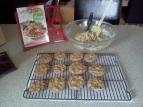 Cooking has become a primary activity for me. The weather here at Casa del Jasperson has been cold, with a layer of frigid, applied to the general iciness of the Arctic blast. As I write this post, it is a warm and balmy 18 degrees (minus 8 Celsius). It is clear and sunny, and the thin layer of snow that fell four days ago, less than an inch, is still there.
 I’ve turned laziness into a fine art. I love my bread machine because it takes the work out of making the dough. However, I rarely bake my bread in the machine. It makes too large a loaf, and the crust can be a bit too crunchy.
 The constable in that town is unaware that Bad Grandma has murdered a mage but knows she’s wanted for smuggling and other crimes. However, our Bad Grandma is slippery and escapes the noose by murdering the constable.
 At this point in my writing process, I need to know what Bad Grandma is doing because my protagonist, the mage who is investigating the murders, has to respond to her actions and plan how to catch her. I am writing the scenes that she is featured in, and soon, I will have the ending of the novel written. Bad Grandma’s meeting with karma resolves the central problem in this tale of woe. Once I have that solved, winding up the other threads will be easy to write.
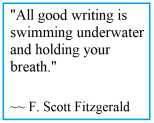 When we write about mild reactions, wasting words on too much description is unnecessary because mild is boring. But if you want to emphasize the chemistry between two characters, good or bad, strong gut reactions on the part of your protagonist are a good way to do so.
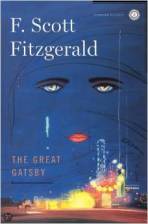 The novel was inspired by a youthful romance Fitzgerald had with
 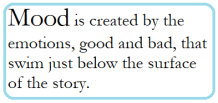 Fitzgerald shows us Nick’s emotions, AND we see his view of everyone else’s emotions. We see their physical reactions through his eyes and through visual cues and conversations.
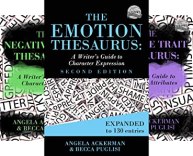 If you have no idea how to begin showing the basic emotions of your characters, a good handbook that offers a jumping-off point is
  Students taking college-level classes in literature and English are often required to read The Great Gatsby and other classic novels from that era, such as
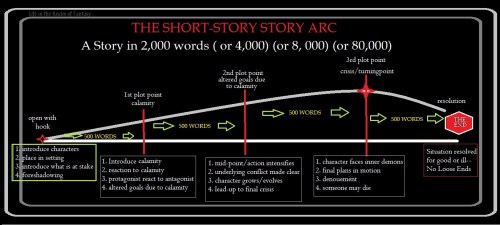
  After we survive the middle crisis, we have falling action. We receive the crucial information, the characters regroup, and we experience the unfolding of events leading to the conclusion. The protagonist’s problems are resolved, and we (the readers) are offered a good ending and closure.
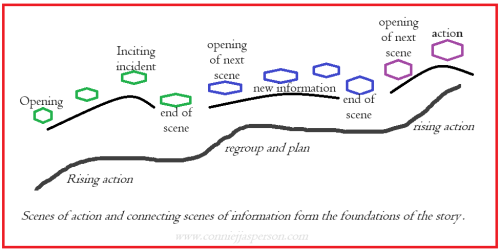 These small arcs of action, reaction, and calm push the plot and ensure it doesn’t stall. Each scene is an opportunity to ratchet up the tension and increase the overall conflict that drives the story.
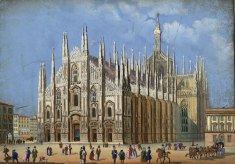 Transition scenes must also have an arc supporting the cathedral that is our novel. They will begin, rise to a peak as the necessary information is discussed, and ebb when the characters move on.
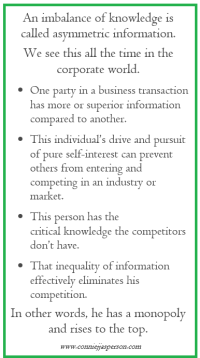 Plots are driven by an imbalance of power. The dark corners of the story are illuminated by the characters who have critical knowledge. This is called asymmetric information.
 When we write a story, no matter the length, we hope the narrative will keep our readers interested until the end of the book. We lure readers into the scene and reward them with a tiny dose of new information.
 If you have been a computer user for any length of time, you know that hardware failure, virus attacks by hackers, and other computer disasters will happen. They’re like the
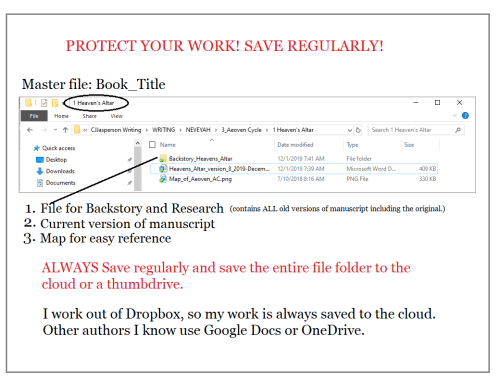
  This year, I met a young man who, being new to using a word processing program, forgot how he named his 2022 manuscript. He couldn’t find it when he decided to start writing again. I showed him how to search for files by date, taught him how to name documents, and taught him how to create a master file for all the files generated in the process of writing his book.
 I work out of Dropbox, so when I save and close a document, my work is automatically saved and backed up to
  One thing I hear from new writers is how surprised they are at how easily something that should be simple can veer out of control. The worst thing that can happen to an author is accidentally saving an old file over the top of your new file or deleting the file entirely.
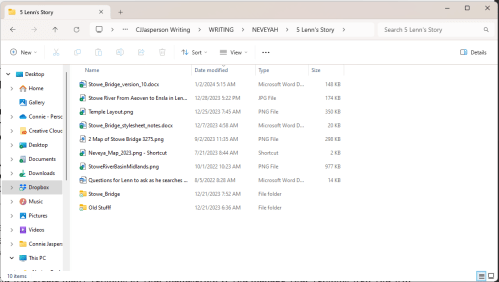 I make a separate subfolder for my work when it’s in the editing process. That subfolder contains two subfolders, and one is for the chapters my editor sends me in their raw state with all her comments: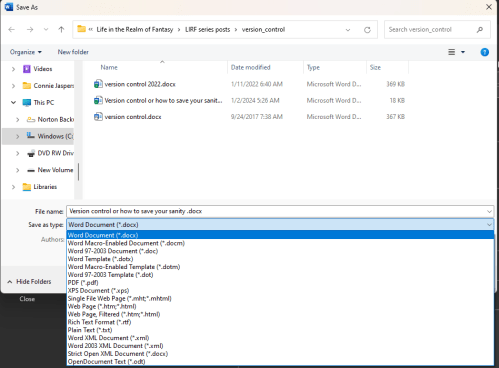
 We are at the same latitude as Paris, Zurich, and Montreal but usually get a lot more rain than those cities. The North Pacific can be wild at this time of the year, which makes for some great storm-watching.
 By the time the authors got to the meat of the matter (which was late in the second half) I no longer cared. Truthfully, when the fluff is carved away from this book, you might have 20,000 or so words of an interesting story—a novella.
 I’m planning two volumes because one will feature stories set in the world of Neveyah, and the other will be random speculative short fiction pieces.


 Life in the Realm of Fantasy