
I think of books, stories, and literature in general, as a window through which readers can see a small slice of the wider world. The scene we can view through that window is narrow because it is expressed through the eyes of the narrator: the point of view.
 If we move to a different window, the view changes. Some views are better than others.
We focus our readers’ attention on specific details by manipulating the narrative point of view. We narrate the story in one of three different ways by telling it from a first-person, second-person, or third-person narrative point of view.
Other factors will come into play, and we will get to those later, but first, let’s look at the basics.
First-person point of view is relatively common and is told from one protagonist’s personal point of view. The narrator admits they are relating the tale, using the pronouns “I-me-my-mine,” allowing the reader or audience to see their opinions, thoughts, and feelings.
It is told from the view and knowledge of the narrator and not of other characters. As such, it is that of an unreliable narrator. You, as the author, must remember that no one has complete knowledge of anything. The protagonist cannot be all-seeing and all-knowing. The reader will find out the information as the protagonist does, and that will keep them interested in the story.
Second-person point of view, in which the author uses “you” and “your,” is rarely found in a novel or short story. In fiction, it is the mode of an unreliable narrator, as “you” aren’t omniscient and can’t know everything.
It is, however, commonly used in guidebooks, self-help books, do-it-yourself manuals, interactive fiction, role-playing games, gamebooks such as the Choose Your Own Adventure series, musical lyrics, and advertisements.
I find using this narrative mode in fiction is tricky. Some authors don’t carry it off well, and it reads like a walkthrough for an RPG. That difficulty is why this mode is rarely used in fiction.
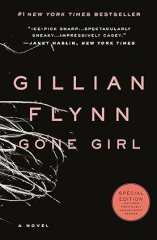 Books like “Gone Girl” by Gillian Flynn prove it can work well. (Flynn also uses first-person present tense in that book, and we’ll discuss it at length next week when we take a deep dive into voice.)
Now, we’ll move on to the third-person point of view. This is the most commonly used narrative mode in literature. It offers a wide range of flexibility because an author can zoom in close or go to a wide-angle view of the action. In this narrative mode, the characters are referred to by the pronouns “he,” “she,” “it,” or “they.”
Third-person point of view is that of an invisible person describing the events and thoughts of all the characters as they happen.
- The writer may choose the third-person omniscient mode, in which the thoughts of every character are open to the reader, or third-person limited, in which the reader enters only one character’s mind, either throughout the entire work or in a specific section.
- Third-person limited differs from first-person because while we see the thoughts and opinions of a single character, the author’s voice, not the character’s voice, is what you hear in the descriptive passages. This narrative mode is also that of the unreliable narrator.
- The Flâneur (idler, lounger, loiterer.) This is traditionally a form of third-person point of view, but I like to think of it almost as a fourth point of view. Many of you have heard of it as third-person objective or third-person dramatic. The flâneur is an unreliable narrator.
The flâneur is a voice that observes and comments but is not a character. They are the witness to the events, and they narrate the story as they see it.
- The flâneur is not reliable—he has his own personality, offering subtle judgments and unconscious opinions on the behavior of the characters. Therefore, just as in a first-person narrative, the reader cannot be sure he is telling the unbiased truth.
- The narrator tells the story without describing any of the character’s thoughts, opinions, or feelings. So, the reader can only guess at character motivations and must assume the objective observer truly is objective. We must hope he has told the truth as he discusses what he sees.
- It separates the reader from the intimacy of the action and slows the pace down. In some narratives, this mode is exactly what the story needs.
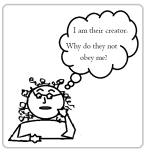 Last week, I mentioned head–hopping, a disconcerting literary no-no that occurs when an author switches point-of-view characters within a single scene. I’ve noticed it happens more frequently in third-person omniscient narratives because it’s a mode in which the thoughts of every character are open to the reader.
Head-hopping is a first-draft error. Our characters are all speaking as we write. Each character’s thoughts are important, but on paper, they can be chaotic, like a holiday dinner in my family.
Each character’s mental ruminations add something meaningful to the story, but let’s have some manners here. Thoughts are unspoken dialogue, and each scene or chapter should detail the internal dialogue of one character.
As we write, we know what every character is thinking. In the first draft, we may write passages that detail every character’s viewpoint. First, we’re in Joe’s head, and then we are in Mary’s.
Head-hopping will confuse the reader, who will no longer be able to suspend their disbelief.
We don’t want that.
When a side character has something to say that is important for the reader to know, I give that character a separate chapter, even if it is a short one.
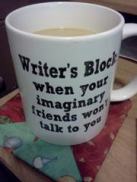 I find that when I can’t get a handle on a particular character’s personality, I open a new document and have them tell me their story in the first person.
Then, when I go back to the manuscript, I feel like I know them as a friend.
I hope this little refresher on narrative mode helps you in your work. I have written in all the above narrative modes and find myself using either first person or close third person point of view most often.
Next up, we’ll talk about narrative tense and how it can change the tone of a story.
 But how do we recognize when a moment of action has true dramatic potential? We try to inject action and emotion into our scenes, but some dramatic events don’t advance the story.
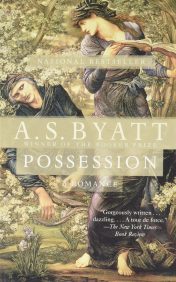 Recognizing where the real drama begins is tricky. Let’s have a look at the novel
  I admire the audacity of having Michell, a protagonist who considers his professional reputation as his most prized possession, commit such a catastrophic action as stealing those original letters. It proves there is potential for drama in the least likely places.
 I’m not a Romance writer, but I do write about relationships. Readers expecting a standard romance would be disappointed in my work which is solidly fantasy. The people in my tales fall in love, and while they don’t always have a happily ever after, most do. The other aspect that would disappoint a Romance reader is the shortage of smut.
 In his book
 When a beta reader tells me the relationship seems forced, I go back to the basics and make an outline of how that relationship should progress from page one through each chapter. I make a detailed note of what their status should be at the end. This gives me jumping-off points so that I don’t suffer from brain freeze when trying to show the scenes.
 I think our characters have to be a little clueless about Romance, even if they are older. They need to doubt, need to worry. They need to fear they don’t have a chance, either to complete their quest or to find love.
 But the scenes themselves are pictures within the larger picture of the story arc. Think of the story arc as a blank wall. We place the scenes on that blank wall in the order we want them, but without transition scenes, these moments in time appear random, as if they don’t go together.
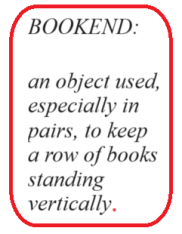 Our bookend scenes are not empty words. They should reveal something and push us toward something unknown. They lay the groundwork for what comes next.
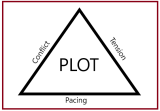 One of my favorite authors sometimes has chapters of only five or six hundred words, keeping each character thread separate and flowing well. A hard scene break with a new chapter is my preferred way to end a nice, satisfying fade-to-black.
 The second draft is where the real work begins. I set the first draft aside for several weeks and then go back to it. I look at my outline to make sure the events fall in the proper order. At that point, I can see how to write the transitions to ensure each scene flows naturally into the next.
 In a novel or story, each scene occurs within the framework of the environment.
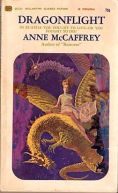 The Dragonriders of Pern series is considered science fiction because McCaffrey made clear at the outset that the star (Rukbat) and its planetary system had been colonized two millennia before, and the protagonists were their descendants.
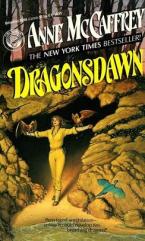
 The scenes we are looking at today have two distinct environments to frame them. In both settings, the surroundings do the dramatic heavy lifting. This chapter is filled with emotion, high stakes, and rising dread for the sure and inevitable tragedy that we hope will be averted.
 Sallah enters the shuttle just as the airlock door closes, catching and crushing her heel. She manages to pull it out so that she isn’t trapped, but she is severely injured.
 This is an incredibly emotional scene: we are caught up in her determination to seize this only chance, using her last breaths to get the information about the thread spores to the scientists on the ground.
 So, let’s take a look at theme, the thread that binds emotions and points of no return together. It’s time to take another look at how
  Saunders gives us the character of Ray Abnesti, a scientist developing pharmaceuticals and using convicted felons as guinea pigs as part of the justice system. The wider world has forgotten about those whose crimes deserve punishment, whose fate goes unknown and unlamented.
 Then there is the theme of compassion. Abnesti explores love vs. lust for his own amusement. The different drugs Jeff is given prove that both are illusionary and fleeting. Yet Saunders implies that the truth of love is compassion. Jeff’s final action shows us that he is a man of compassion.
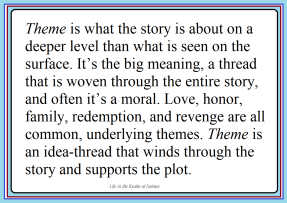 A common theme in science fiction is the use of drugs to alter people’s behavior and control them emotionally. That theme is explored in detail here, ostensibly as a means to do away with prisons and reform prisoners. But really, these experiments are for Abnesti, a psychopath, to exercise his passion for the perverse and inhumane and for him to have power over the helpless.
 This short story was as powerful as any novel I’ve ever read, proving that a good story stays with the reader long after the final words have been read, no matter the length. His questions resonate, asking us to think about our true motives.
 But what happens when a few insignificant cracks appear in that construction? What is the point of no return for the people living downstream?
 We must identify this plot point, and by mentioning it in passing, we make it subtly clear to the reader that this moment in time will have far-reaching consequences. Knowing something might be wrong and seeing the workers unaware of a problem ratchets up the tension.
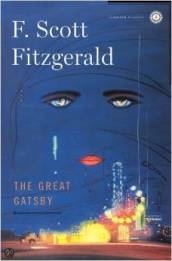 Nick Carraway, the
 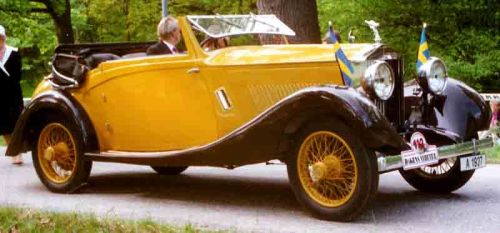 Fitzgerald is deliberately unclear if this act is deliberate or accidental—the murkiness of Daisy’s intent and the chaos of that incident lend an atmosphere of uncertainty to the narrative. If Nick had turned back at any of the above-listed points, Daisy wouldn’t have been driving Gatsby’s yellow Rolls Royce and wouldn’t have killed Myrtle in a hit-and-run accident.
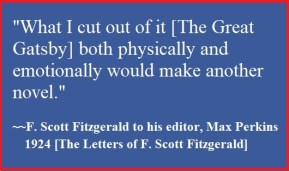 When I am writing a first draft, the crucial turning points don’t always make themselves apparent. It’s only when I have begun revisions that I see the opportunities for mayhem that my subconscious mind has embedded in the narrative.
 Then, there’s hunting down and killing the trash and recycling so that we don’t live in a slum, alongside the unlovely side-quest for a clean bathroom. I do these tasks, but they don’t “bring me joy.” I do them so I can get to the good stuff, the best part of the day—which is writing.
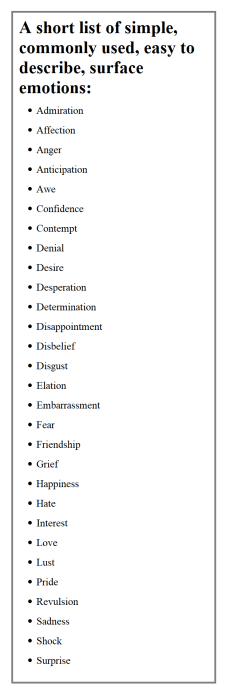
 Motivations drive emotions, and emotions drive the plot. People have reasons for their actions, and I needed to give my bad guy a good one. Now I know why he must go there.
 Sometimes, the story demands a death, and 99% of the time, it can’t be the protagonist. But death must mean something, wring emotion from us as we write it. Since the characters we have invested most of our time into are the antagonist and protagonist, we must allow a beloved side character to die.
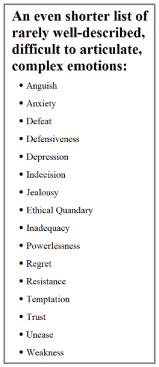 Motivations add fuel to emotions. Emotions drive the scene forward.
 Characters aren’t fully formed when you first lay pen to paper. They evolve as you go, growing out of the experiences you write for them. Sometimes, these changes take the story in an entirely different direction than was planned, which involves a great deal of rewriting. It helps me remain consistent if I note those changes on my outline because then I don’t forget them.
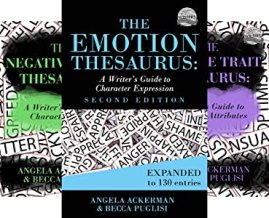 I highly recommend the
 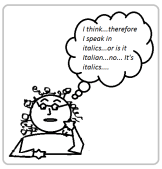 At any gathering of authors, a determined group will proclaim that thoughts should not be italicized under any circumstances. While I disagree with that view, I do see their point.
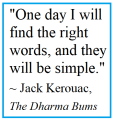 In a good story, bad things have happened, pushing the characters out of their comfortable rut. They must become creative and work hard to acquire or accomplish their desired goals.
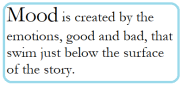 Mood is long-term, a feeling residing in the background, going almost unnoticed. Mood shapes (and is shaped by) the emotions evoked within the story.
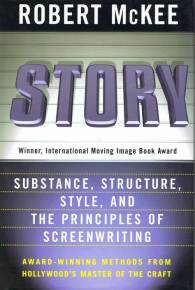 Robert McKee tells us that emotion is the experience of transition, of the characters moving between a state of positivity and negativity.
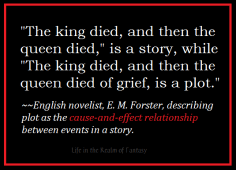
 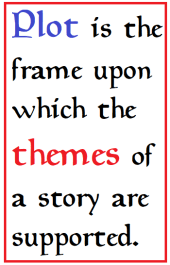 These visuals can easily be shown. Grief manifests in many ways and can become a thread running through the entire narrative. That theme of intense, subliminal emotion is the underlying mood and it shapes the story:
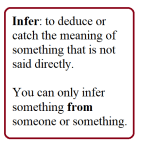 This is part of the inferential layer, as the audience must infer (deduce) the experience. You can’t tell a reader how to feel. They must experience and understand (infer) what drives the character on a human level.
 As we read, the atmosphere that is shown within the pages colors and intensifies our emotions, and at that point, they feel organic. Think about a genuinely gothic tale: the mood and atmosphere


 Life in the Realm of Fantasy