Tag Archives: writing

Structure of the Word-Pond #amwriting

Today we’re winding down my summer blogpost series, The Word-Pond. We’ve explored the myriad aspects of ‘depth,’ the wide inferential layer of Story. Depth isn’t easy to categorize, nor can we point to one aspect and say, “Get this right, and you’ve got a story with depth.”

I’ve described Story as a pond filled with words and discussed the three layers:

Surface: The Literal Layer; the what-you-see-is-what-you-get layer. Characters live, and events happen. These are reflected in the surface of the story. The ways in which we play with the surface layer are by choosing either Realism or Surrealism, or a blend of the two.

Middle: The Inferential Layer, where Inference and Implication come into play. This is an area of unknown quantity filled with cause and effect: the reasons why these lives are portrayed, and why events happened. This is where emotions muddy the waters.

Bottom: The Interpretive Layer. This level is not only foundational; it contains and shapes the story:

  • Themes
  • Commentary
  • Messages
  • Symbolism
  • Archetypes

The words in this pond behave like the waters of a pond in nature. While close scrutiny reveals that the waters of a pond are separated into layers by temperature, salinity, microbial life, or by the sheer weight and pressure of the volume of water, the overall structure is one large, important thing: a hole filled with water.

Without water, a pond is a depression in the ground filled with possibilities only.

In our word pond, the one large thing containing our words is “story.” So now we want to form these layers into a coherent, meaningful story. We need a container for our words, the hole in the ground for the story to flow into.

This container is the story arc.

Many people say they have a book in them, one they’d love to write. They begin, get a chapter or so into it, and lose the thread. They can’t see how to get the story from the beginning, to the crisis, to the resolution.

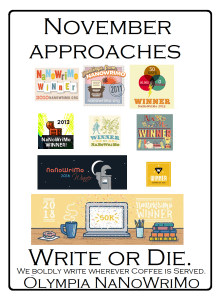
This is where the skills I’ve developed through my years of participating in National Novel Writing Month (NaNoWriMo) has paid off.  If you want to write a novel, it’s best to sit down and get that first draft out of you while the story is fresh in your mind. You’ll spend a year or more rewriting it, but if you don’t get the original ideas down while they’re fresh, you’ll lose them.

A story begins with an idea for a character. That character usually comes to me along with a problem. This is the seed from which the story grows.

I sit down and draft a story plan in four acts. First, I tell myself how I believe the story will go. This only takes half an hour and gives me finite plot points to write to. Once I have the four acts, I know where the turning points are, and what should happen at each. This ensures there is an arc to both the overall story and to the characters’ growth.

I’m going to use the original plot idea for a work in progress as my example. My WIP is a short story, 5000 words in length, but you can plot any length of story.

The story: Our Protagonist is a courier, transporting a valuable artifact. This artifact brings her to the attention of the Antagonist who intends to seize it, no matter the cost.

You must know what the surface of the Story looks like before you can explore the depths. A good way to discover what you are writing is to “think out loud.” Divide the story into four acts:

Act 1: the beginning: We show the setting, the protagonist, and the opening situation.

  1. Setting: a village near a crossroads.
  2. The weather is unseasonably cold.
  3. The protagonist is carrying a jewel reputed to enable a mage to control the weather.
  4. The protagonist must travel alone, as her partner was killed.
  5. Unbeknownst to her, a traitor in her employer’s court has designs on the artifact. By possessing it, the Antagonist will have the power to usurp the throne.
  6. She is wary, knowing the danger of traveling alone. She conceals the artifact by sewing it inside her shirt.

Act 2: First plot point: The inciting incident.

  1. The Antagonist’s hired thugs capture her.
  2. She is thrown into prison.
  3. A fellow prisoner has overheard that her partner was murdered to ensure she would be traveling alone.
  4. This fellow prisoner believes he has a plan to enable their escape.
  5. The protagonist isn’t sure she should trust him but refuses to let the artifact fall into the Antagonist’s hands.

Act 3.: Mid-point: We show their dire condition and how they deal with it.

  1. Seeing no other way, our Protagonist agrees to the Sidekick’s plan.
  2. He is on the verge of managing an escape but needs help with one last thing.
  3. By working together for several days, they manage to complete the escape route.
  4. Timing the rotation of their guards is critical to the success of their plan.
  5. Just as they are about to make their escape, the Antagonist makes a surprise visit to the dungeon and roughs up our Protagonist. He batters her physically and mentally, attempting to force her to tell him the whereabouts of the jewel, but she manages to keep her secret. When he leaves, her shirt is torn, but the jewel is still safe.

Act 4: Resolution:

  1. They must wait for another rotation of the guards, giving the Protagonist a chance to rest. She is injured but can still do what she must.
  2. The two make their escape but find themselves emerging near the kennels.
  3. The Sidekick gives the watchdogs the food he had saved for their journey, distracting the dogs and allowing them to escape over the walls.
  4. The Protagonist and the Sidekick manage to keep ahead of their pursuers and arrive back at court, where she delivers the artifact and reveals the identity of the traitor.
  5. The Employer is grateful, and the Protagonist and her Sidekick are all set for another adventure—perhaps a novel.

You have an idea for a story. Take a moment to analyze and plan what needs to be said by what point in the story arc. This method works for me because I’m a linear thinker.

If you know the length of a book or story you intend to write, you know how many words each act should be. Once you have the map, you can get to the nitty-gritty of turning that far-fetched tale of woe into a good story.

As you write each event and connect the dots, the plot will evolve and change. You begin to explore the deeper aspects of the story. Emotions, both expressed and unexpressed, secrets withheld, truths discovered—all these details that emerge as you write will shape how the characters react to each other. In turn, these interactions will alter the shape of the larger story.

This is why we never really know how a story will go, even if we begin with a plan. The plan serves to keep us on track with length and to ensure the action doesn’t stall.

Draft a short plan for a 50,000 word manuscript. 50,000 words is the industry standard for a novel. Write 1,667 words a day that connect those events together, and in thirty days you will have written a 50,000 word first draft of your novel.

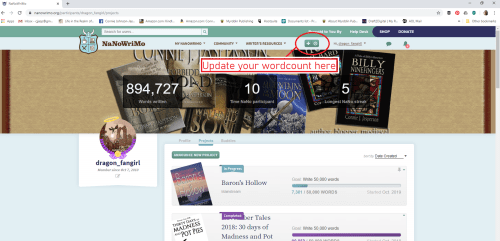
To see more of what National Novel Writing Month is all about, go to: www.nanowrimo.org

I am dragon_fangirl there. Look me up and become a writing buddy!

3 Comments

Filed under writing

Transitions #amwriting

We love reading dramatic stories. However, in order for the events of the drama to be meaningful, we need to see it in context to understand what is going on. We need just enough artfully inserted exposition to show us what is really going on.

Within the narrative, moments of transition are critical, yet they are often done clumsily. These linking scenes can be too long, conveying far too much unneeded information. Conversely, they can be nearly omitted.

Neither of  those well-meaning faux pas serves the story.

Good transitions establish many things. The opening paragraphs are a critical transition. They show us

  • the general location (Alternate world, London, Seattle, a space station, etc.)
  • the setting (the immediate environment),
  • the era (past, present, future) in which the narrative takes place.

These first paragraphs are the doors through which the reader takes the first tentative steps from their real world and enters our invented world.

When a reader opens the book, they are a visitor, but they’re searching for something, questing for a good story. They hope you have supplied whatever it is they are looking for in the pages of that book.

Good opening paragraphs sink the hook and suck your reader into your world.

As the narrative moves beyond the opening scene, more transitions come along. These are the places where we must end one dramatic scene and open another—and do it gracefully. Sometimes it’s a moment where we must show the passage of time between events. Whatever the case, with each transition, we want the reader to remain engaged.

Transitions are more doors for the reader, portals that open at the end of the dramatic scene. By moving through them, we arrive at the next event.

Transitions are critical. Without good transitions, dramatic scenes have no context. Instead of progressing in an arc, the narrative leaps and falls along to a conclusion that may make no sense.

But transitions can be fraught with danger for me as a writer because this is where the necessary information, the exposition, is offered to the reader. This is the “how much is too much” moment.

In my first draft, the narrative is sometimes almost entirely exposition. This is because I am telling myself the story, trying to get the events down before I forget them.

In the second draft, I look at words like “went.” In my personal writing habits, “went” is a code word for the transition. In fact, all passive phrasing is code for the author. It is the code laid down in the first draft that indicates to the author that the characters are in the process of transition. They, or their circumstances, are undergoing a change. Is this change something the reader must know?

For example, when I see the word “went,” I immediately know someone goes somewhere.

I ask myself, “How did they go?” Went can be changed to

  • they walked (to the next room, or down the street, or to Mordor.)
  • they drove (a car, a wagon, a space ship.)
  • they rode (a horse, donkey, motorcycle, or dragon.)
  • they took a plane (bus, ferry, space shuttle, or sleeping pill.)
  • they teleported (vanished into the ether)

You get the idea. I have to find the “telling” paragraphs that connect my dramatic scenes together and decide what will stay and what should be cut. If the necessary information requires a paragraph, I have to consider how to rewrite it so that it is interesting and not a mind-numbing wall of words.

Many times, a transition can be cut to only a sentence or two because the necessary information it imparts can be consolidated.

This is where being a part of a writing group is most beneficial. Within the writing group, you will find a person you can bounce ideas off, someone you can trust and who will say, “This is not needed as it doesn’t advance the story” or “this scene seems to come out of nowhere. It needs more foreshadowing.”

Consolidating the transition into a sentence or two is optimal but isn’t always possible.

If it takes more than a paragraph to make the transition, I must be vigilant in my revision, and if I must give information, I must find and change all the passive code words to active prose. To that end, I look for these codes:

  • All forms of To be (see my post on subjunctives)
  • basically
  • Too many emdashes
  • Exclamation points (usually not needed)
  • Finally
  • I think
  • -ing
  • Its / it’s
  • –ize –ization (global search)
  • just
  • Like
  • -ly (global search)
  • now
  • Okay
  • Only
  • Really
  • Said (decide if speech tags can be eliminated and shown by actions)
  • Seem
  • Still
  • Suddenly
  • That (often not needed)
  • The
  • Then (often not needed)
  • There was (a subjunctive)
  • –tion (global search)
  • Very (usually not needed)
  • Which (not a substitute for ‘that’)

We know that each scene can be a chapter, or a chapter can consist of several scenes. In this regard, each author constructs the layout of the story the way they feel works best. The reader gets into the swing of it and rarely notices the overall structure. Whether a chapter or a series of scenes, dramatic passages have universal commonalities:

  • All scenes have an arc to them: rising action, climax, reaction.
  • These arcs of action and reaction begin at transition point A and end at transition point B.
  • Each scene will end at a slightly higher point of the overall story arc.
  • Each scene must blend so smoothly to the one that follows that the reader doesn’t notice the transition.
  • Pacing is the rise and fall of the action, drama and transition, the ebb and flow of conversations.

Conversations make great transitions. Inserting the necessary information into conversations and then fading to black and beginning a new chapter/scene can be the key to making the transition unobtrusively.

When we rewrite something, we are making revisions. Think about that word, revision.

re vision = to envision again.

Transitions are small connections that are woven into the larger narrative. When we begin revising them, we are looking at small passages of our work with new eyes and seeing how they might be changed to better fit the story—usually condensed, but sometimes expanded.

On the surface, it’s a daunting task, but it’s one of the most important parts of the writing process.


Credits and Attributions

Tavern of the Crescent Moon by Jan Miense Molenaer [Public domain or Public domain], via Wikimedia Commons

Wikimedia Commons contributors, “File:Jan Miense Molenaer 003.jpg,” Wikimedia Commons, the free media repository, https://commons.wikimedia.org/w/index.php?title=File:Jan_Miense_Molenaer_003.jpg&oldid=302686494 (accessed November 9, 2018

Wikimedia Commons contributors, “File:David Teniers de Jonge – Peasant Wedding (1650).jpg,” Wikimedia Commons, the free media repository, https://commons.wikimedia.org/w/index.php?title=File:David_Teniers_de_Jonge_-_Peasant_Wedding_(1650).jpg&oldid=225700063 (accessed November 2, 2018).

Autumn on Greenwood Lake, ca. 1861, by Jasper Francis Cropsey [Public domain], via Wikimedia Commons


Comments Off on Transitions #amwriting

Filed under writing

The Inferential Layer: Drama #amwriting

Whether you are writing a screenplay, a short story, or a novel, you are writing something that you hope will resonate with the reader and move them. A lesson that screenwriters learn early on is that each scene must be viewed as a mini-story; a complete story within the larger story. They learn this early because they don’t have the luxury of space that we who write novels have. The entire story of a screenplay must be told within a finite framework of time, so the writer must wring the most emotional impact out of the least amount of words.

I’m still working on this, myself. But I’m getting there.

So, where do we start? We begin with the most fundamental reason people purchase books or go to plays and movies—drama. The inferential layer of the Word-Pond we call Story is all about the drama, and I’m not talking over-the-top hysterics here. We combine emotional highs and lows with action and reaction in each passage to create dramatic scenes that leave a mark on the reader.

Of course, we understand large, emotionally charged, outwardly noisy dramatic scenes. They impact us and leave us reeling. But the only way those events have power is if they have context. They must be balanced by quieter, more introspective moments.

Drama can happen in the mildest of scenes, places where it looks as if nothing important is happening. The follow-up/regrouping scenes are places where you have the opportunity to waylay the reader with something unexpected. This is where you show the reader what is happening beneath the surface, the inner demons and fears the characters now face.

Consider  The Two Towers by J.R.R.Tolkien. Let’s look at the emotional impact of the scene that takes place in Shelob’s Lair. Frodo and Sam have survived incredible hardships and have made it to Cirith Ungol.  The passage is an excellent example of the dramatic story within a story that advances the overall plot.

Drama is the hope we feel in the moment when Frodo faces Shelob with the Phial of Light. Drama is the moment Frodo fails, the moment he is stung.

It is the shock, the horror, the moment where Sam reluctantly takes up Frodo’s sword, Sting.

It is triumph when Shelob impales herself on Sting, a weapon made of Mithril and a sword in the hands of a hobbit. But really, Sting is only a long-knife, and despite its mythic properties, it is not long enough to kill the giant arachnid, Shelob.

Still, she is wounded and scuttles away.

Drama is in the despair, the quiet moment afterward, where Samwise realizes that everything they have just endured was for nothing.

Drama is the moment of sharp introspection, the internal conversation when Sam fears his own weakness; the moment when his faith is not just shaken—it is lost. It is that moment of profound despondency in Shelob’s Lair, the dark night of the soul where Sam believes the spider has killed Frodo.

What about love? Few emotions have as much dramatic potential as that of love. It has many shades, from friendship to affection, to desire, to passion, to obsession, to jealousy, to hate.

Let’s look at the Pulitzer Prize winning short story, Brokeback Mountain, by Annie Proulx (synopsis via Wikipedia):

In 1963, two young men, Ennis del Mar and Jack Twist, are hired for the summer to look after sheep at a seasonal grazing range on the fictional Brokeback Mountain in Wyoming. Unexpectedly, they form an intense emotional and sexual attachment, but have to part ways at the end of the summer. Over the next twenty years, as their separate lives play out with marriages, children, and jobs, they continue reuniting for brief liaisons on camping trips in remote settings.

Ennis and Jack are tied to each other, but they love their wives and children. They are products of their society, and their personal reactions to the intensity of their relationship are both hurtful and understandable in the context of their time and situation. People have love affairs in books all the time, and we often find them forgettable. It is the complexity of external societal pressure and deep, confusing emotion that makes Ennis and Jack’s attachment memorable.

Then there is the novel, Possession, by A.S. Byatt, winner of the 1990 Booker prize. This is a complex relationship that begins in a rather boring manner – it opens in a library when Roland Michell, a scholar and professional man of high morals commits a crime: he steals the original drafts of letters he has come across in his research. This act has the potential of becoming his professional suicide. The synopsis via Wikipedia:

(Roland Mitchell) begins to investigate. The trail leads him to Christabel LaMotte, a minor poet and contemporary of Ash, and to Dr. Maud Bailey, an established modern LaMotte scholar and distant relative of LaMotte. Protective of LaMotte, Bailey is drawn into helping Michell with the unfolding mystery. The two scholars find more letters and evidence of a love affair between the poets (with evidence of a holiday together during which – they suspect – the relationship may have been consummated); they become obsessed with discovering the truth. At the same time, their own personal romantic lives – neither of which is satisfactory – develop, and they become entwined in an echo of Ash and LaMotte. The stories of the two couples are told in parallel, with Byatt providing letters and poetry by both of the fictional poets.

Love, whether unacknowledged or returned, physical or platonic, is complicated. The sections of movies, books, and short stories where the arc of the scene showcases true emotional complexity stick with me. I find myself contemplating them long after the story has ended.

In all three literary examples, The Lord of the Rings, Brokeback Mountain, and Possession, it is the interpersonal relationships entwined with the action that illuminates the drama. Action scenes require some sort of emotion to give them context, to shape them into an arc:

  1. Opening, the linking point where we introduce our characters and their situation.
  2. Rising Action, where we introduce complications and emotional responses.
  3. Climax, the high point of the action, the turning point of the scene.
  4. Falling Action, the “what the hell just happened” moment where we regroup.
  5. Closing, in which the problems encountered by the protagonist are resolved as best as can be expected, and we move on to the next scene.

The resolution of one scene is the linking point to the next, the door that takes us further into the story. The dramatic arc of each scene ends at a higher point in the overall story arc.

The emotions surrounding the drama in our literature attracts us, captivates us, keeps us interested. In every story, drama is the moment you, the reader, realize you must take up the hero’s task; you must carry the evil One Ring to Mount Doom.

Drama done well can take the reader from joy to despair to resignation and back to hope within the arc of the scene. This is good pacing and urges the reader to keep turning the page to see what is coming next.


Credits and Attributions:

Wikipedia contributors, “Brokeback Mountain (short story),” Wikipedia, The Free Encyclopedia, https://en.wikipedia.org/w/index.php?title=Brokeback_Mountain_(short_story)&oldid=902058091 (accessed August 24, 2019).

Wikipedia contributors, “Possession (Byatt novel),” Wikipedia, The Free Encyclopedia, https://en.wikipedia.org/w/index.php?title=Possession_(Byatt_novel)&oldid=909067002 (accessed August 24, 2019).

The Two Towers, by J.R.R. Tolkien, first edition cover, Publisher George Allen & Unwin, © 11 November 1954, Fair Use.

Possession by A.S. Byatt, first edition cover, Publisher Chatto and Windus, © 1990, Fair Use.

Comments Off on The Inferential Layer: Drama #amwriting

Filed under writing

The Inferential Layer: Motives #amwriting

We talk a lot about motivation, in rather general terms. We ask what the characters want most and what they’re willing to do to obtain it. As an overview, that’s a good place to start.

Motivation is sometimes defined as the overall quest. Motives are more intimate, secrets held closely by the characters.

Consider the quest to destroy the One Ring. Every person in the Fellowship is motivated by the need to keep the One Ring from falling into Sauron’s hands. This is the acknowledged reason for their accompanying Frodo and is the core plot point around which the story unfolds.

Yet they each have secret thoughts and desires, some of which are subconscious. Some have plans that are left unspoken.

Each member of the Fellowship has personal reasons for volunteering to accompany Frodo to Mordor. In the end, those secret motives are the undoing of some and the making of others.

Samwise is a loyal friend who refuses to leave Frodo’s side. Fear that Frodo will need him forces him to insist on being included. Pippin and Merry have similar but different reasons—they don’t want to be left out if Frodo and Sam are going to have an adventure. Their motives are simple at the outset but become more complicated as their stories diverge and unfold. Pippin and Merry are separated from Frodo and Sam at Amon Hen. In the process, these four young hobbits lose their youthful naiveté and become leaders, warriors to be counted on when the going is rough.

Boromir desires the ring for what he believes is a noble purpose, and intends to take it to Minas Tirith. This is evident at the beginning of the Council of Elrond, but he soon sees he won’t achieve his overall goal unless he agrees to join the quest to destroy it. He tells himself he wants it so he can preserve Gondor. In reality, he knows the power of the ring and believes that by his possessing it, Gondor will return to its former glory and be safe forever. He will rule the world with a just hand. His true motive is a quest for personal power.

When we design the story, we build it around a need that must be fulfilled—a quest of some sort. For the protagonist, the quest is the primary goal, but he/she also must have secret, underlying motives not specifically stated at the outset. Each of the supporting character’s involvement in that storyline is affected by their personal ambitions and desires.

The Antagonist must also have motives both stated and unstated. He/she has a deep desire to thwart the protagonist, but there are reasons for this, a history that goes beyond the obvious “they needed a bad-guy and I’m it” of the cartoon villain.

Motivation is a major current in the inferential layer of the story. The hints of backstory, combined with clues, information delivered via conversation, should show each character as an individual. They must have underlying personal reasons that have nothing to do with acquiring the object or achieving the goal. These secret motives may or may not be important enough to be stated.

The hints and clues can be divulged both in conversation with the character in question or about them. Either way, snippets of dialogue are a useful tool for offering the protagonist and the reader information as needed.

No one goes through life acting on impulses for no reason whatsoever. On the surface, an action may seem random and mindless. The person involved might claim there was no reason, or even be accused of it—but that is a fallacy, a lame excuse.

The fundamental laws of physics, the rules that govern the universe are in force here: Nothing that occurs happens for no reason whatsoever. There is always a causative factor. Without a cause, there is no effect. Cause is motivation. Effect becomes cause, which becomes motivation. Motivation is a chain reaction of cause and effect, which becomes the story.

And it’s all traceable back to the character’s first idea, their first secret desire to do or have something.

When we look at things this way, we see that motivation must be a multilayered thing if we are to have well-rounded characters, people the reader can believe in.

Characters that feel too shallow sometimes lack sufficient personal motivations for buying into the larger quest. If we have supplied each character with a secret backstory, those hinted-at motives can sometimes push the story into newer, more original waters.

And isn’t that what we readers are looking for? We read because we are searching for a story that feels new, offers us a fresh view of the world through the characters’ eyes.

Comments Off on The Inferential Layer: Motives #amwriting

Filed under writing

The Inferential Layer: Building Characters #amwriting

When a character pops into my head, it’s usually a brief glimpse at first. Sometimes the character arrives unannounced, and I must build a story around them. Other times, sometimes in the same story, the plot demands a character, and I must build them.

In the beginning stages, we see a large picture, and the details are not too clear. We have an overall idea of what the story could be.

Readers always pick up on mushy characterizations. Characters must be as individual as the people we know. Every now and then a manuscript comes to me for editing where the characters talk and sound the same. They ring false, and I know what happened.

The author became so involved with creating the plot and circumstances that characterizations were overlooked.

In your mind, you have the basics:

  • Sex and age
  • Physical description—coloring, clothes
  • Overall personality—light or dark, upbeat or a downer

You can tell me all these things, but unless I see it, I don’t believe it. Good characterization shows those things but also offers me hints of:

  • An individual’s speech habits.
  • An individual with history.
  • An individual’s personal style.
  • An individual with or without boundaries—things they will or will not do.
  • Someone with secrets they believe no one knows.
  • Someone with secrets they will admit to.
  • And someone with secrets they will deny to the grave.

This is a key component of the inferential layer of the Word-Pond we call Story. As the narrative progresses, we offer a few more clues about each character, maintaining the mystery, yet giving the reader a small reward.

We begin to see the details buried in the noise of the larger picture.

In real life, people who accost you and dump their whole life on you in a ten-minute monologue immediately lose your interest. In fact, you avoid them, fearing you will be subjected to more of their history.

Don’t make it too easy for the reader because the sense of reward is a ‘found’ thing. The ‘ah-hah!’ moment of discovery is what we readers want to experience. We enjoy the ‘oh, my god’ moment of shock when a deeply personal secret is hinted at, and only we, the reader, suspect the truth.

In the books I love and refer back to, great characters dominate. They behave and react to the inciting incident the way their established personality would. As each subsequent event unfolds, they continue to behave as individuals. No one acts out of character.

We want to read about characters with secrets because they are a mystery, and we love to work out puzzles.

Certain tricks of plotting work across all genres, from sci-fi to romance, no matter what the setting is:

  • One or more characters is a “fish out of water,” in that they are immediately thrust into an unknown and possibly dangerous environment.
  • Every character projects an obvious surface persona.
  • Early on, the reader sees glimpses of weaknesses and fears; the sorrows and guilts that lie beneath their exterior personas.
  • Each character has emotions and thoughts they conceal from the others. Perhaps they are angry and afraid, or jealous, or any number of emotions we are embarrassed to acknowledge.
  • Maybe they hope to gain something on a personal level—if so, what?

Our task is to ensure that each of our characters’ individual stories intersects seamlessly. In order to do that, motivations must be clearly defined.

  • You must know how the person thinks and reacts as an individual.
  • What need drives them?
  • What lengths will they go to in the effort to achieve their goal? Conversely, what will they NOT do?
  • What are their moral boundaries, and what is out of character for them?

Write nothing that seems out of character, unless there is a good, justified reason for that behavior or comment.

We know the obstacles our characters face and the choices they make in those situations are the story. In literary terms, agency is the power of an individual character to act independently, to choose their own path. When we give the protagonist/antagonist agency, we allow them to make their own free choices, and they will take the narrative in new directions, surprising even you, the author.

When they have unique personalities, it becomes easy to give our characters an active role. And yet they still harbor secrets that surprise and shock me. We see the smallest details hiding in the background, nearly obscured by the distractions in the foreground.

We see what is hidden in the shadows.

When I am first writing any story, giving my characters agency is difficult to do. At this point in the first draft of my manuscripts, the motives of my protagonist haven’t quite come into focus for me.

I tend to allow a character’s choices to push their personal growth, so I have to create a personnel file for them. I make each character known to me as an individual, down to their taste in clothing.

I am privy to what secrets they will consent to share with me. Those secrets propel their story-line. But they don’t tell me everything.

Within the plot outline, the individuality of the characters drives the story as a whole. Allowing them agency makes it unexpected. When characters are portrayed as truthfully as possible, they will feel real.

In real life, smart people reveal their secrets only at the right time, or they keep them forever. If they don’t, we will do anything to avoid those people, fearing they will spew too much information, stuff we don’t need or want to know. When they get on the bus, we avoid making eye contact and put our possessions on the seat beside us so they can’t sit there, pretending we don’t see them.

In a gripping story, characters keep their secrets close, revealing them only at the one moment when the protagonist and the reader must have the information.

Now, if only I can write this story that I woke up thinking about. If only I can pry loose who they are, learn their secrets. It’s easy to talk the talk, but walking the talk is the difficult part of writing. This is where writing become work.


Credits and Attributions:

Wikimedia Commons contributors, “File:George Henry Durrie – Winter Scene in New Haven, Connecticut – Google Art Project.jpg,” Wikimedia Commons, the free media repository, https://commons.wikimedia.org/w/index.php?title=File:George_Henry_Durrie_-_Winter_Scene_in_New_Haven,_Connecticut_-_Google_Art_Project.jpg&oldid=249454341  (accessed December 14, 2017).

Details sections from Wikimedia Commons contributors, “File:George Henry Durrie – Winter Scene in New Haven, Connecticut – Google Art Project.jpg,” Wikimedia Commons, the free media repository, https://commons.wikimedia.org/w/index.php?title=File:George_Henry_Durrie_-_Winter_Scene_in_New_Haven,_Connecticut_-_Google_Art_Project.jpg&oldid=249454341  (accessed December 14, 2017).

Don Quijote de La Mancha and Sancho Panza, 1863, Gustave Doré [Public domain], via Wikimedia Commons (Accessed October 22, 2017).

Comments Off on The Inferential Layer: Building Characters #amwriting

Filed under writing

Depth – creating reality #amwriting

We have been talking about ways to create depth in our writing for the last month, and we still have areas of the Word-Pond we call Story to explore.  One aspect of depth that we can’t skimp on is setting.

Setting is a surface element but it also has a subliminal role in creating depth.

The problem is, many people believe that world-building requires a massive amount of effort.

It does take some work up front, but  once begun, worlds grow as we write them.

Perhaps you have an idea for your story and characters who have great chemistry. However, while you might know how the plot will go, you feel like you can’t quite get a grip on the story. This is because the world is still mostly unformed.

At this early point in the process you don’t yet know their world. So, the setting is the literary equivalent of an empty apartment with a chair and a table but nothing else. You have an idea of what you want it to be when it is fully furnished, but aren’t sure how to make that vision real.

I have a method of building worlds that works for me, and I will share it with you, but you must keep it an absolute secret. This is just between you and me and the internet at large.

I move in and live there, mentally.

I picture the opening scene, and in a separate document labeled something like (story title)_worldbuilding.docx, I begin writing, answering questions about this world as I think of them.

What is the name of the place the story opens?

Does it take place on earth in a real place? On earth in an alternate time/place? Or is it set on some other world entirely?

Where is my protagonist? Does the environment work against him/her?

Looking through their eyes, are they indoors or outdoors?

What does s/he see at that opening moment?

How does the air feel and what scents and odors are common to that place?

How is the lighting both indoors and out? If they are out of doors, what is the weather like?

On this world-building document, write every single detail, from the largest down to the insects. Keep adding to it whenever you think of something new as you are writing the first draft. The act of designing this scenery builds the world in your mind. I go with the world that is familiar to me, with some unfamiliar creatures thrown in for fun.

The Tower of Bones series began life as the story line for an anime-based RPG that never went into production. The world of Neveyah is an alien environment, yet it’s familiar to me because it’s based on the world I live in, the Pacific Northwest. The plants and the way they fit into the geography are directly pulled from the forested hills of Southern Puget Sound and Western Washington State.

I created the maps, so I knew the topography. I had to first build and then destroy the ecology for the game because the dangerous environment and elemental creatures are a core plot point in the story, a threat with which the protagonist must learn to coexist. So, when I began writing the book, all the hard work was done. Ten years of writing work set in Neveyah is why the world seems so solid from the opening paragraphs.

You say you can’t picture a place you haven’t been. But what does that really mean? Open your eyes and look around. At this moment, inside your room and outside your door, you have all the elements you need to create an alien or alternate world. These elements could exist before your eyes, or they exist in your memory. I say, use what you know, reshape it, reuse it and make it yours.

Everyone has a place they want to be more than anywhere else. For me, one place on earth represents my serenity, my creative happy place, and it exists in the real world but is a four-hour drive from my home. Yet, when I need to, I can pull that place up in my mind. By visualizing it, I recharge my serenity-batteries.

Think about a place you love but are parted from. What is the strongest memory about that place, the one that calls to you, lingers in your heart and makes you happy?

If you can describe that feeling, that memory, you can create a world.

The fact is, unless we are there physically, other places don’t really exist for us. We see them on the news, or read about them, but until we visit them, they are distant, merely rumors.

Our consciousness is contained in the packet of water and flesh we call our bodies. For this reason, the only world that really exists in this incarnation is the space we physically occupy as individuals. The only true reality is the space we can see, hear, smell, and touch.

Everywhere else is only a daydream or a memory. When you aren’t there, it doesn’t exist.

However, you can go there in your mind if you picture it strongly enough. We build worlds every day just by planning our next move. We do it by thinking about where we are going next, and where we have just come from. If you can visualize stopping at the mini-mart on your way home after work, you can visualize the convenience store on a space station.

It does take time, but not a lot. Consider spending an evening building the framework of the world for your novel. Use your best, most colorful words to show that place in a word-picture that is just for you.

Get fluffy in your writing—it’s only a practice piece, and no one will see it but you. The smells, the sounds, the way certain doors creak are all good things to know. Draw maps and floor plans. List the furniture the characters interact with and know where it’s placed.

Use all the descriptive words you can think of to build that world in your mind–this research document is where adverbs and adjectives should be used.

Once the world in which the story opens is solid in your mind, rewrite that opening scene again. Allow the world to unfold through the characters’ experiences and interactions. Show us the world your characters inhabit in that scene.

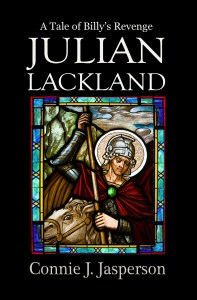
The following passage is from the opening page of my forthcoming novel, Julian Lackland, the third and final installment in the Billy’s Revenge Series. In the opening scene, this is how I show the world my protagonist inhabits.

All the world-building was done ten years ago. Building an RPG world taught me to visualize and describe heavily in my background notes. I used the same method when plotting Huw the Bard and Billy Ninefingers as I did for Tower of Bones.

Now, ten years on, I’m a leaner writer, so those images are condensed into a only few words, a picture to show where he is on day one of our story. As the novel progresses, his environments change, but it’s my task to keep the word-pictures concise and yet as visual as possible.


Credits and Attributions:

All photography in this post is from Connie J. Jasperson’s portfolio

2 Comments

Filed under writing

The Depths of the Word-Pond – Word Choice #amwriting

The depths of the Word-Pond we call Story are clouded and visibility is poor. Who knows what creatures prowl down here, waiting for their next meal?

Exposition, the Kraken of the Deep is down here somewhere, lurking. How will we get out of here alive?

In a balanced narrative, some exposition is essential in order to provide context. How much is inserted and how it is delivered is what makes or breaks a story. The same goes for those subversive packets of inadvertent exposition: adverbs.

Some newly converted zealots loudly repeat mantras uttered by their personal gurus, whispering prayers to the demi-god Elmore Leonard– an author whose advice was good, but who would be surprised to learn he’s been elevated to such heights, his short list of advice turned into a holy text. The crusaders can be recognized from a distance because they’re all standing on soapboxes shouting, “If it sounds like writing, rewrite it. Kill every Darling who uses an adverb!”

That kind of devotion is short-sighted. Words like “later,” or “everywhere,” or “never” or “alone” are adverbs. Do these well-meaning fanatics really believe they can write decent prose with no adverbs whatsoever?

As with all religious cults, there is a solid kernel of truth to that arrogant fixation, but to think you can ban exposition and adverbs from the narrative completely is a delusion. Chuck Wendig, in his post The Danger of Writing Advice from Industry Professionals, says,

“And so the advice really should be, don’t use adverbs or adjectives when they sound awkward, or when they fail to tell us something that we need to know.” [1]

Other Word-Choice Mantras bring discord to the ranks of the newly converted. The word ‘very’ comes in for a lot of abuse in writing groups and writers’ chat rooms.

Suppose you decide to simply eliminate every instance of the word “very” because you have discovered you overuse it. You are savvy—you understand your word-processing program well and know all the shortcuts. You open the navigation pane and bring up the advanced search dialog box. In the ‘Replace With’ box you don’t key anything, because you know this will delete the word and are convinced this will eliminate the problem and tighten your prose.

Before you click ‘replace all’ consider three common words that have the letters v-e-r-y in their makeup:

  • Every
  • Everyone
  • Everything

Deleting every instance of ‘very’ could mess things up on an incredibly large scale. Context is everything. Take the time to look at each example of the offending words and change them individually. You’ve already spent a year or more writing that novel, so why not take the time to do it right?

“Actually” is another word to look at individually. Perhaps you have been told it is a ‘weed word,’ and, feeling mocked by the more experienced authors in your writer’s forum, you experience a nearly uncontrollable gut reaction to eliminate it entirely in a scorched earth campaign. Before you obey that compulsion, examine the context.

Have you used the word “actually” in a conversation? If so, you may want to keep it, as dialogue must sound natural, and people use that word in conversation.

Just as the laws of physics break down at the center of a Black Hole, the inviolable laws of grammar break down in conversations. And, just as gravity still rules, keeping chaos constrained in the singularity, punctuation still reigns in conversation, holding our sentences together.

Now that we have adverbs and religious zealots out of the way let’s continue on with word choice. Words, carefully chosen and used properly, have power. Choosing your words with care and binding them into small packets inserted into conversations is how you distribute your exposition (backstory) without resorting to a blatant info dump. Dole it out in small portions, delivered only when the reader needs to know it.

We choose words with power. In English, words that begin with hard consonants sound tougher and therefore carry more power.

Verbs are power words. Fluff-words and obscure words used too freely are kryptonite, sapping the strength from our prose.

  • Placement of verbs in the sentence
    1. Moving the verbs to the beginning of the sentence makes it stronger.
    2. Nouns followed by verbs make active prose.
      1. I ran toward danger, never away.
  • Parallel construction
    1. When two or more ideas are compared in a sentence, each part of the sentence uses the same grammatical structure.
    2. What parallelism means can be shown by a quote attributed to Julius Caesar, who used the phrase “I came; I saw; I conquered.” in a letter to the Roman Senate after he had achieved a quick victory in the Battle of Zela. Caesar gives equal importance to the different ideas of coming, seeing, and conquering.
  • Contrast
    1. In literature, we use contrast when we describe the difference(s) between two or more things in one sentence.
    2. The blue sun burned like fire, but the ever-present wind chilled one to the bone.
  • Simile
    1. Similes show the resemblances between two things through the use of words such as “like” and “as.” They are different from metaphors, which imply that something “is” something else.
    2. The blue sun burned like fire.
  • Deliberate repetition.
    1. Repetition of the last word in a line or clause.
    2. Repetition of words at the start of clauses or verses.
    3. Repetition of words or phrases in the opposite sense.
    4. Repetition of words broken by some other words.
    5. Repetition of the same words at the end and start of a sentence.
    6. Repetition of a phrase or question to stress a point.
    7. Repetition of the same word at the end of each clause.
    8. Repetition of an idea, first in negative terms and then in positive terms.
    9. Repetition of words of the same root with different endings.
    10. Repetition both at the end and at the beginning of a sentence, paragraph, or scene.
    11. It can also be a construction in poetry where the last word of one clause becomes the first word of the next clause.

Every book is a quotation, and every house is a quotation out of all forests, and mines, and stone quarries; and every man is a quotation from all his ancestors.”  Ralph Waldo Emerson, Prose and Poetry. [2]

  • Alliteration
    1. The occurrence of the same letter (or sound) at the beginning of successive words.
      1. Peter Piper picked a peck of pickled p
      2. Once upon a midnight dreary, while I pondered, weak and weary, (The Raven, by Edgar Allan Poe 1845) [3]
  • When I see birches bend to left and right

Across the lines of straighter darker trees, (Birches, by Robert Frost 1916) [4]

Poets know and use all the above word choice concepts to convey large ideas and entire stories with a minimum of words.

How we add depth to our prose without adding kryptonite involves verb placement and using ordinary words that most people know and don’t have to look up in a dictionary. Craft happens when you combine those common words in unexpected ways, forming extraordinary passages.


Credits and Attributions:

[1] The Danger of Writing Advice from Industry Professionals, by Chuck Wendig, Terribleminds,  The Ramble, http://terribleminds.com/ramble/2017/12/12/the-danger-of-writing-advice-from-industry-professionals/  ©2017. Accessed 31 July 2019.

[2] Ralph Waldo Emerson, The Complete Works. Published in 1904. Vol. VIII. Letters and Social Aims, VI. Quotation and Originality, Bartleby.com, accessed (31 July 2019)

[3] Wikipedia contributors, “The Raven,” Wikipedia, The Free Encyclopedia, https://en.wikipedia.org/w/index.php?title=The_Raven&oldid=908701892 (accessed July 31, 2019).

[4] Wikipedia contributors, “Birches (poem),” Wikipedia, The Free Encyclopedia, https://en.wikipedia.org/w/index.php?title=Birches_(poem)&oldid=886359747 (accessed July 31, 2019).

Images

Wikimedia Commons contributors, “File:Print, Three ships surrounded by monsters, ca. 1590 (CH 18553601).jpg,” Wikimedia Commons, the free media repository, https://commons.wikimedia.org/w/index.php?title=File:Print,_Three_ships_surrounded_by_monsters,_ca._1590_(CH_18553601).jpg&oldid=276506077 (accessed July 31, 2019).

Wikimedia Commons contributors, “File:Black hole – Messier 87.jpg,” Wikimedia Commons, the free media repository, https://commons.wikimedia.org/w/index.php?title=File:Black_hole_-_Messier_87.jpg&oldid=359992100(accessed July 31, 2019).

Wikipedia contributors, “Childe Hassam,” Wikipedia, The Free Encyclopedia, https://en.wikipedia.org/w/index.php?title=Childe_Hassam&oldid=831999910 (accessed April 6, 2018).

4 Comments

Filed under writing

The Inferential Layer of the Word-Pond – Symbolism #amwriting

The Word-Pond is dark, and near the bottom the waters are murky. It’s hard to find your way, but knowing the theme gives us a diver’s guide-rope to hold onto.

We’ve identified the theme, but we need to strengthen it. We want to add depth to our narrative, but wonder how. This becomes easier when we remember that theme, mood, and atmosphere work closely together.

An important tool in our writer’s toolbox is Symbolism. It is an aspect of Story that helps create mood, atmosphere, and supports and strengthens the theme. When a little thought is applied to how you place it, symbolism becomes a subtle tool that speaks subliminally to the reader.

Intentionally placing symbolic objects in the setting influences the characters’ emotional mood. It represents the theme and will help reinforce the desired atmosphere without your having to resort to an info dump.

Words can have subtle meanings beyond the obvious, when used as allegories. Using allegory in the narrative offers images for the reading mind to see and understand.

So, what is an allegory? An allegory is an essential tool of the author who wants to convey important ideas with the least amount of words.

The storytelling in The Matrix series of movies is a brilliant example of employing heavy allegory in both the setting and conversations to drive home the multilayered theme of humankind, machine, fate, and free will. The theme is represented with heavy symbolism in:

  • The names of the characters,
  • The words used in conversations
  • The androgynous clothes they wear

Everything on the set or mentioned in conversation underscores those themes, including the lighting. Inside The Matrix, the world is bathed in a green light, as if through a green-tinted lens. In the real world, the lighting is harsher, unfiltered.

In the movie, everything that appears or is said onscreen is symbolic and supports one of the underlying concepts. When Morpheus later asks Neo to choose between a red pill and a blue pill, he essentially offers the choice between fate and free will.

Neo chooses the red pill—real life—and learns that free will can be unpleasant. Cypher regrets choosing the red pill and ultimately chooses to return to the Matrix.

The reader/viewer infers the mood and atmosphere by virtue of embedded symbolic clues, hints that also strengthen the theme.

One of my works-in-progress that is in its infancy is a contemporary novel. I want to convey a Gothic atmosphere in this piece and yet maintain the setting and time-frame of a novel set squarely in the  21st century. I can only do this through the use of allegory. I will have to approach writing a scene as it would be portrayed in a movie, keeping the symbolism in mind.

In this novel’s case, I have several character threads that converge in the large themes of trust and fidelity. It’s a multilayered piece, and each layer has its own sub-theme

  • Social responsibility.
  • Ethics and the lengths we will go to achieve a goal.
  • What constitutes family, nurture or nature?

Making good use of symbolism and allegory will be critical if I want to convey the mood and the atmosphere without resorting to an info dump.

Just to be clear, a plan is not always required because sometimes the flash of inspiration we begin with is a strong theme in itself.

If you are lucky, the theme develops as you write, and immediately, you see what it is. This strong theme will whisper suggestions and symbols to you as you create the world and the visual environment.

In my case, I need a plan fifty percent of the time.

Whatever the case, once you have identified the main theme, you can write the story in such a way that it is shown through:

  • Actions
  • Symbolic settings/places
  • Allegorical objects in the setting
  • Conversations

We try to picture conversations, clothing, settings, and wider environments as if they were scenes in a movie. As you do so, consider how you can insert small allegories and symbols to support your theme.

The casual reader doesn’t notice symbolism on a conscious level. However, dedicated readers will, and that is what will keep them reading. Dedicated readers love work that holds up on closer examination, enjoying work that has layers of depth.

Yet, for the casual reader, it is all there, making the imaginary surface look and feel real, solid, and concrete.


Credits and Attributions

The Matrix movie poster, © 1999 Warner Bros. Entertainment Inc. (US, Canada, Bahamas and Bermuda); © 1999 Village Roadshow Films Limited. (All Other Territories) Fair Use

The Temptation of St Anthony, Joos van Craesbeeck ca. 1650 [Public domain], via Wikimedia Commons

Comments Off on The Inferential Layer of the Word-Pond – Symbolism #amwriting

Filed under writing

The Interpretive Layer of the Word-Pond: Theme

Deep within the narrative, mingling with other heavier aspects of Story and sinking to the bottom of the Word-Pond is theme. A fundamental underpinning of the story, theme can be a tricky fish to get a grip on. Theme is a subtle aspect of any written work. It is rarely stated in a bald fashion, but even if it isn’t obvious, theme is a unifying thread that goes through the story from beginning to end.

According to Wikipedia:

A theme is different from the subject of a work. For example, the subject of Star Wars is “the battle for control of the galaxy between the Galactic Empire and the Rebel Alliance.”

The themes explored in the films might be “moral ambiguity” or “the conflict between technology and nature.” [1]

In other words, theme is what the story is about on a deeper level than what is seen on the surface. It’s the big meaning, a thread that is woven through the entire story, and sometimes it is an unstated moral for the reader to infer.

I’ve said this elsewhere, but theme is an idea-thread that winds through the story, supports and gives meaning to the plot. On the surface, each of the different commercial literary genres looks different. Each genre is deliberately tailored to fit a wide variety of niche readers. Yet, from shelf to shelf, we will find commonalities, themes that all stories tell in one way or another.

Genre is the bookstore label guiding a reader to the shelf containing books they are most likely to enjoy.

But some aspects of Story are universal and independent—they roam through all the genres from children’s books to literary fiction and connect them.

Theme is a universal feature of Story.

We all recognize Romance as a theme. It can be the major theme or a supporting theme. Romantic love is a defining feature of the genre of Romance. But what are some different aspects of love that can be found in every genre from fantasy to sci-fi, to horror, to crime fiction?

  • Love gained (the fairytale romance)
  • Love lost
  • Tragic love
  • Selfish love
  • Passion
  • Brother/Sisterly love
  • Dangerous Attraction
  • Friendship
  • Parental love

Love is only one theme despite the fact an entire genre has been built around it. Others abound, large central concepts that build tension within the Story.

Here is a brief list, just a small jumping off point for your creative mind. Some are large themes that entire genres have been built around, and others are good supporting themes:

  • Separation and reunion
  • Grief
  • Nostalgia for the good old days
  • Ambition
  • Fall from Grace
  • Rebellion and revolution
  • Redemption
  • Coming of age
  • Crime and Justice
  • Midlife crisis
  • Alienation/loneliness
  • The hero’s journey
  • Humanity in jeopardy
  • War
  • General dehumanization of society
  • Conspiracy
  • Good vs. Evil
  • Plagues
  • Religious intolerance
  • Abuse

Again, Wikipedia, the fount of all knowledge, offers us wisdom:

(Theme) can often be summed in a single word (e.g. love, death, betrayal). Typical examples of themes of this type are conflict between the individual and society; coming of age; humans in conflict with technology; nostalgia; and the dangers of unchecked ambition. A theme may be exemplified by the actions, utterances, or thoughts of a character in a novel. An example of this would be the theme loneliness in John Steinbeck‘s Of Mice and Men, wherein many of the characters seem to be lonely. It may differ from the thesis (hypothesis; idea)—the text’s or author’s implied worldview. [2]

Sometimes we can visualize a complex theme but can’t explain it. If we can’t explain it, how do we show it? Consider the theme of “grief.” It is a common theme that can play out against any backdrop, sci-fi, or reality based, where there are humans interacting on an emotional level. When you see a dog grieving the loss of her mistress, or a husband grieving for his wife—what do you see? You can’t read their mind, so you must look for clues. What behaviors inspire empathy for their sorrow in you, the observer?

Highlighting a strong theme can be a challenge if you begin without a plan. A plan is not always required because, in some stories, the flash of inspiration we begin with is a strong theme. The theme develops as you write, and immediately, you see what it is. In my case, I need a plan fifty percent of the time.

Whatever the case, once you have identified the main theme, you can write the story in such a way that it is shown through:

  • Actions
  • Symbolic settings/places
  • Allegorical objects deliberately placed within the setting
  • Conversations

Other times, it is difficult to decide what the underlying theme is, and the story is weak. It has no legs and won’t ring true until you find out what the underlying theme is. This requires a little mind-wandering on your part. You must ruminate on the character’s quest or dilemma. Ask yourself what the root cause of the issue is—if it is a crime, why is crime rampant. Is it a societal problem? If the core dilemma is unrequited love, what are the roadblocks to a resolution?

Themes exist in every story. However, when we are first laying down the story, themes are like your drunk uncle—they hang out in the bar until closing time when they have to weave their way home through dark alleys and the neighbor’s shrubs. When you have finished your first draft (closing time), if you still haven’t found the defining theme, look in the local bar in the first chapters for clues your subconscious mind has sprinkled throughout the story. If you still haven’t got a theme, pick one and develop it.

At the surface level of the Word-Pond, each genre looks widely different. But when you go deeper, you find that all literary genres have one thing in common: they have protagonists and side-characters who all must deal with and react to the underlying theme of the book.


Credits and Attributions:

[1] Wikipedia contributors, “Theme (arts),” Wikipedia, The Free Encyclopedia, https://en.wikipedia.org/w/index.php?title=Theme_(arts)&oldid=848540721 (accessed July 27, 2019).

[2] Wikipedia contributors, “Theme (narrative),” Wikipedia, The Free Encyclopedia, https://en.wikipedia.org/w/index.php?title=Theme_(narrative)&oldid=765573400 (accessed July 27, 2019).

Images:

Photograph, McLain Pond in July, © 2018 by Connie J. Jasperson, from the author’s private photos.
Worked to Death, H. A. Brendekilde. Wikimedia Commons contributors, “File:H. A. Brendekilde – Udslidt (1889).jpg,” Wikimedia Commons, the free media repository, https://commons.wikimedia.org/w/index.php?title=File:H._A._Brendekilde_-_Udslidt_(1889).jpg&oldid=355191092 (accessed July 16, 2019).

3 Comments

Filed under writing

The Depths of the Word-Pond: Archetypes #amwriting

Down at the bottom, lodged in the mud of the Word-Pond we call Story are the foundations, the underpinnings. One of these foundations is archetype.

An archetype is an ancient pattern, describing a type of character that exists across different cultures and eras of human history. In ancient times, we had no communication with different cultures, yet our myths and legends share these common, recognizable characters we call archetypes.

I am a great fan of both Joseph Campbell and Christopher Vogler, and the hero’s journey is central to much of my work. In his book, The Hero With a Thousand Faces, Campbell discusses his theory of the journey of the archetypal hero found in world mythologies.

Quote from Wikipedia, the fount of all knowledge:

In his 1949 work, The Hero with a Thousand Faces, Campbell described the basic narrative pattern as follows:

A hero ventures forth from the world of common day into a region of supernatural wonder: fabulous forces are there encountered, and a decisive victory is won: the hero comes back from this mysterious adventure with the power to bestow boons on his fellow man.

There are other archetypal characters that we find in all sorts of guises. Consider the “wise old man/woman/mentor.” This character exists in the stories of all ancient cultures, offering advice, and pushing the protagonist to achieve the goal. The mentor is Obi-Wan Kenobi, Glenda the Good Witch—or even a small, green dispenser of wisdom called Yoda.

Psychology says that an archetype is a recognizable behavioral pattern. In a story, the archetypal character is the embodiment/reflection of that familiar pattern of behavior.

The Writer’s Journey, Mythic Structure for Writers, by Christopher Vogler, details the various traditional archetypes that form the basis of most characters in our modern mythology, or literary canon.

The following is the list of character archetypes as described by Vogler:

  1. Hero: someone who is willing to sacrifice his own needs on behalf of others
  2. Mentor: all the characters who teach and protect heroes and give them gifts
  3. Threshold Guardian: a menacing face to the hero, but if understood, they can be overcome
  4. Herald: a force that brings a new challenge to the hero
  5. Shapeshifter: characters who constantly change from the hero’s point of view
  6. Shadow: a character who represents the energy of the dark side
  7. Ally: someone who travels with the hero through the journey, serving a variety of functions
  8. Trickster: embodies the energies of mischief and desire for change

Christopher Booker, author of The Seven Basic Plots: Why We Tell Stories, tells us that the following basic archetypes underpin the plots of all stories:

  1. Overcoming the Monster
  2. Rags to Riches
  3. The Quest
  4. Voyage and Return
  5. Comedy
  6. Tragedy
  7. Rebirth

We feel comfortable with these basic recognizable plots, no matter how differently they are presented to us. They are peopled with characters we feel we know, friends who occupy the familiar traditional roles. Even in a non-heroic story, we have these archetypes:

Take The Maltese Falcon, by Dashiell Hammett. The archetype of the plot is a Quest.

On the surface, this is a detective novel, a thriller, nothing at all like The Hobbit, which is an obvious quest tale. However, The Maltese Falcon most definitely is a quest tale.

Yes, it’s a quest with a twist.

The object of the quest is a black statuette of significant value. However, the statue itself is a classic example of a MacGuffin. The MacGuffin’s importance to the plot is not the object or goal itself, but rather the effect it has on the characters and their motivations—in this case, the quest changes Sam’s life. The sole purpose of the MacGuffin is to move the plot forward.

The object of the quest was not the purported “Maltese Falcon” after all, despite the obvious quest to acquire it and the lengths the characters must go to in the process. The true core of the story is the internal journey of both Sam Spade (the hero) and Brigid O’Shaunessy (the shapeshifter/trickster), two people brought together by the quest, and whose lives are changed by it.

So, The Hobbit and The Maltese Falcon begin with the same character archetype of the unintentional hero. Bilbo (the hero) is hired to steal the Arkenstone back from a Dragon for Thorin (the trickster) and the dwarves, and Sam Spade is hired to obtain the Maltese Falcon for Brigid O’Shaunessy.

In both tales, another archetypal role that appears is that of the mentor: Bilbo has Gandalf the Wizard, and Sam Spade has Caspar Gutman. Despite their very different personalities and reasons for offering wisdom, both are mentors.

The fundamental stories are the same: the hero endures hardship to acquire an object (the Maltese Falcon or the Arkenstone) but finds that the object is no longer that important. Sam never acquires the true Maltese Falcon but finds out who really killed his business partner. He loses much in the process and emerges a different man.

Bilbo also loses his naïveté, and after all the work of finally finding it, he hides the Arkenstone because of Thorin’s uncharitable actions toward the Wood-elves and the Lake-men who have suffered from the Dragon’s depredations.

Despite the similarities on the level of archetypes, these are radically different novels.

And that is the beauty of the deeper level of the story. Something so fundamentally similar as plot archetypes and character archetypes can be written so differently that the same story emerges completely unique and wildly dissimilar from others based on that archetype.

I highly recommend this book for anyone interested in learning more of what archetypes are and how they fit into the story:

The Writer’s Journey, Mythic Structure for Writers, by Christopher Vogler


Credits and Attributions:

Wikipedia contributors, “Archetype,” Wikipedia, The Free Encyclopedia, https://en.wikipedia.org/w/index.php?title=Archetype&oldid=906671691 (accessed July 23, 2019).

Christopher Booker (2004). The seven basic plots: why we tell stories. London: Continuum. ISBN 978-0826452092. OCLC 57131450.

Wikipedia contributors, “The Writer’s Journey: Mythic Structure for Writers,” Wikipedia, The Free Encyclopedia, https://en.wikipedia.org/w/index.php?title=The_Writer%27s_Journey:_Mythic_Structure_for_Writers&oldid=804454608  (accessed July 23, 2019).

Wikipedia contributors, “Trickster,” Wikipedia, The Free Encyclopedia, https://en.wikipedia.org/w/index.php?title=Trickster&oldid=811022016  (accessed July 23, 2019).


Comments Off on The Depths of the Word-Pond: Archetypes #amwriting

Filed under writing