Tag Archives: writing

Identifying Genre, revisited #amwriting

Some of you have been following my advice to build a backlog of short pieces to enter in contests and submit to various publications. But where should you try to sell your work?

When you open the Submittable App and begin shopping for places to submit your work, you may find the list of open calls confusing. Many times contests, publications, and anthologies are genre specific.

When your work is nonfiction, it’s no problem because your work is targeted to a magazine with a specific readership, so the sub-genre will be clear and where you should submit it was likely evident the day you decided to write it.

When you write short fiction with no specific contest or magazine in mind you can run into problems of where to send it. If you are like me, some of your work may straddle genres, and in that case, how do you decide who will be most receptive to it? Spur-of-the-moment stories may be widely different from your normal work, and perhaps are not in a genre you can easily identify.

This list of genres and what they represent has appeared on this blog before. Genre is defined by setting and content, the author’s intention, their approach, and the way resolutions happen. The ideas explored within the setting are the provinces of these industry-wide distinctions.

Mainstream (general) fiction—Mainstream fiction is a general term publishers and booksellers use to describe works that may appeal to the broadest range of readers and have some likelihood of commercial success. Mainstream authors often blend genre fiction practices with techniques considered unique to literary fiction. It will be both plot- and character-driven and may have a style of narrative that is not as lean as modern genre fiction but is not too stylistic either. The prose of the novel will at times delve into a more literary vein than genre fiction, but the story will be driven by the events and action that force the characters to grow.

Science fiction—Futuristic settings, futuristic science and technology, space travel, time travel, faster than light travel, parallel universes and extraterrestrial life are the core of science fiction. You should be aware that the internet is rife with purists and impurists ranting on what does or does not constitute  sci-fi. If you use magic for any reason you are NOT writing any form of sci-fi.

  • Hard Sci-fi is characterized by rigorous attention to accurate detail in the physics, chemistry, and astrophysics. Emphasis is placed on accurately depicting worlds that more advanced technology may make possible.
  • Soft Sci-fi is characterized by works based on social sciences such as psychology, economics, political science, sociology, and anthropology.
  • Other main sub-genres of Sci-fi include Space-operasCyberpunk, Time Travel, Steampunk, Alternate history, Military, Superhuman, Apocalyptic, and Post-Apocalyptic.

The main thing to remember is this–Science and Magic cannot coexist in the Genre of Science Fiction. The minute you add magic to the story, you have Fantasy.

Fantasy is a genre of fiction that commonly uses magic and other supernatural phenomena as a primary plot element, theme, or setting.  Like sci-fi and literary fiction, fantasy has its share of snobs and damn fools when it comes to defining the sub-genres:

  • High fantasy–High fantasy is defined as fantasy fiction set in an alternative, fictional world, rather than the real, or “primary” world, with elves, fairies, dwarves, dragons, demons, magic or sorcery, wizards or magicians, constructed languages, quests, coming-of-age themes, and multi-volume Often the prose is literary and the primary plot is slowed by many side quests. Think William Morris and J.R.R. Tolkien.
  • Epic Fantasy–These stories are often serious in tone and epic in scope, dealing with themes of grand struggle against supernatural, evil forces.Epic fantasy shares some typical characteristics of high fantasy includes fantastical elements such as elves, fairies, dwarves, dragons, demons, magic or sorcery, wizards or magicians, constructed languages, quests, coming-of-age themes, and multi-volume narratives. Tad Williams’s Memory Sorrow and Thorn is classic Epic Fantasy.
  • Paranormal Fantasy–Paranormal fantasy often focuses on romantic love and includes elements beyond the range of scientific explanation, blending together themes from all the speculative fiction genres. Think ghosts, vampires, and supernatural.
  • Urban Fantasy–can take place in historical, modern, or futuristic periods, and the settings may include fictional elements. The prerequisite is that they must be primarily set in a city.

Horror—Horror fiction  shocks or frightens the reader. Some horror induces a feeling of repulsion or loathing – people who read horror like to be challenged by their fears.

Romance—Novels of this type of genre fiction place their primary focus on the relationship and romantic love between two people and must have an emotionally satisfying and optimistic ending.

(07 Mar 2019) Edited to add Mystery and Mystery/Adventure. Mystery is a genre with several subgenres.

  • “Who Dunnit” mysteries, cozy (think Agatha Christie)
  • Mystery, true crime
  • Mystery, hardboiled detective
  • Political thrillers
  • Legal thrillers
  • Medical Thrillers
  • Supernatural Mysteries
  • Romantic Mysteries

I mention Literary Fiction last because it is the most complicated and least understood genre of all.

Literary fiction can be adventurous with the narrative. The style of the prose has prominence and may be experimental, requiring the reader to go over certain passages more than once. Stylistic writing, heavy use of allegory, the deep exploration of themes and ideas form the core of the piece.

I have discussed the following  three books before, but they illustrate the problem of perception—the question of what constitutes Literary Fiction.

Alexander Chee’s The Queen of the Night is a historical fantasy. However,  the style and voice in which it is written makes it a powerful literary work.
The same goes for George Saunders work. Tenth of December is technically sci-fi, and Lincoln in the Bardo is historical fantasy, but it is his style and voice that makes George Sanders literary.

Neil Gaiman’s book, Stardust, is a magnet for the “that’s not literary/yes it is” debate. The prose is literary, the narrative has a relaxed, thought provoking style to it. I consider it literary.

Be careful of how you present yourself and your work. Never submit anything that is not your best work, and do not assume they will edit it because they won’t.  No publisher will accept work that is poorly written, sloppily formatted, and generally unreadable.

Choose carefully who you submit your work to and be scrupulous in following their submission guidelines. Read a sample of what they publish and only submit the work you have that best fits their publication.
12 Comments

Filed under writing

Conflict, Tension, and Pacing #amwriting

When we sit down to read a book, most readers don’t consciously look for certain key elements, but we know when something is missing. Unfortunately for most authors, I am not most readers. I can’t just read a book anymore. I must dissect it to see what makes it tick. When a story works well, I  want to know why. Then, as needed, I hope to incorporate that bit of author-magic into my writing.

Consider conflict—What pushes the characters? What element drives and forces the momentum of the story?

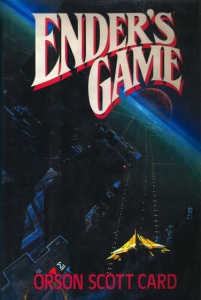
My book reading group just finished Ender’s Game by Orson Scott Card. I had read it in 1985 when it was first published, re-read it for a book review five years ago, and re-read it again for the group’s February book. I don’t like the book, but I admire it.

I know–that doesn’t make sense. But it does, because I admire it in a purely mechanical, technical way.

From Wikipedia:

Ender’s Game is a 1985 military science fiction novel by American author Orson Scott Card. Set at an unspecified date in Earth’s future, the novel presents an imperiled mankind after two conflicts with the Formics, an insectoid alien species which they dub the “buggers”. In preparation for an anticipated third invasion, children, including the novel’s protagonist, Andrew “Ender” Wiggin, are trained from a very young age through increasingly difficult games including some in zero gravity, where Ender’s tactical genius is revealed.

Even though I had read it before, I became involved in Ender’s story on this third read primarily because the author did all the right things.

This, despite the fact I don’t care for Card’s writing style. His ability to convey both character and story outweighs the irritation I have with the prose and style of his work.

  • The plot is always moving forward.
  • There is no overuse of backstory.
  • Showing is well-balanced with telling—it’s not obnoxiously in-your-face with descriptions of minute facial expressions but has enough active prose to keep the reader involved in the narrative.
  • The characters are shown to have a believable internal/external struggle, even though the book is about training children to kill.

Card explores the theme of “Compassion vs. Ruthlessness,” and the book has some exceedingly violent scenes. The three Wiggins children are the primary characters, with Ender being the main protagonist.

Ender is compassionate, and yet ruthless. One thing I found disturbing is that in the book, Ender was 6 when he leaves Earth for Battle School and 11 by the time of the final examination battle. During that time, he has killed (in self-defense) two boys who were bullying him, and untold numbers of the enemy, although he never learns that he caused their deaths until much later.

Valentine, Ender’s older sister, is compassionate, but without the power of ruthlessness both Ender and Peter demonstrate. She becomes Peter’s accomplice.

Peter, the oldest of the Wiggin children, is ruthlessness embodied and is utterly without compassion—a sociopath. His one ambition is to rule the world, and he will stop at nothing and use anyone to achieve that end. Yet, despite his personal lack of compassion, he turns out to be a good ruler. Evil in this book is represented by his acting for the wrong reasons, regardless of the outcome.

I may not like his style, but I have a great appreciation for Card’s ability to reveal a character, and I admire the way he paced the narrative.

The resolution of one conflict leads to another, which is resolved and turns into another—the author keeps the pressure on, raising the tension by always raising the stakes. Yet, he gives both Ender and the reader a chance to rest a little and regroup before flinging them into the (slightly more intense) action again. In these less intense moments, the story is still moving because we are learning something we didn’t know, and that knowledge is crucial to what may follow.

The serious topics of genocide and Western expansionism are explored. These actions are justified or regretted depending on the character in this book. Also, we see lessons in training methodology, leadership, and ethics acted out in a Military environment by bright young children.

The eternal problem of intention and morality is explored. Ender is able to strike and kill his enemies yet remain morally clean.

Those themes fuel the narrative and push the story when the physical action has temporarily calmed. They drive the conflict, create a constant raising of tension, and allow the pacing of the book to hard and fast but not overwhelming.

It is easy to unbalance a narrative by not allowing the reader to rest between scenes of intense violence and action. A scene that is all action is confusing if it has no context. Conversations are crucial because they give context to whatever action follows.

In any story, the crucial underpinnings of conflict, tension, and pacing are bound together. Go too heavily on one aspect of the triangle and the story fails to engage the reader. Balance the three, and the story works even if the reader doesn’t care for the writer’s style or prose.

The book group is going to read The Tattooist of Auschwitz next, for the May meeting. This is a book I haven’t read yet, so I’m looking forward to it. I will be looking at how characters are portrayed, what makes them compelling,  and how the pyramid of conflict, tension, and pacing pushes their growth.


Credits and Attributions:

Cover art, Ender’s Game by Orson Scott Card, published 1985 by Tor Books,  Fair Use.

Wikipedia contributors, “Ender’s Game,” Wikipedia, The Free Encyclopedia, https://en.wikipedia.org/w/index.php?title=Ender%27s_Game&oldid=880941502 (accessed February 25, 2019).

2 Comments

Filed under writing

Characters: the Legalities Rant #amwriting

Reality is stranger than anything I could write. This is why I write fiction—I put reality into more palatable chunks so I can digest it better.

Drawing on the real world to help design the unreal is where good world building comes  into play. However, we shouldn’t use the real names and exact situations of people we are acquainted with in our work. Don’t thinly disguise them with a different name—they can sue us.

Consider the late Betty MacDonald, whose first published book was picked up by J.B. Lippincott. The Egg and I is a fictionalized account of Betty’s life as a chicken farmer. It was set in Chimacum, a small community in rural Washington State. The book was a success, selling well over a million copies and spinning off several movie adaptations.

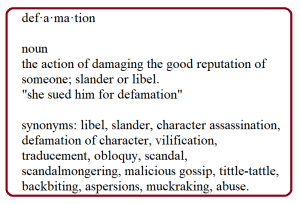
It also spun off several lawsuits for defamation of character. Although the book was a critical and popular success at publication, in the 1970s it fell into disfavor because of the clichéd treatment and lack of understanding of the culture of our local Native people. The book did give rise to a perception of Washington State as a place full of eccentrics.

We are different, but every part of the country has its oddballs.

From Wikipedia:

Post-publication lawsuits

Following the success of the book and film, lawsuits were filed by members of the Chimacum community. They claimed that characters in The Egg and I had been based on them, and that they had been identified in their community as the real-life versions of those characters, subjecting them to ridicule and humiliation. The family of Albert and Susanna Bishop claimed they had been negatively portrayed as the Kettles. Their oldest son Edward and his wife Ilah Bishop filed the first lawsuit, which was settled out of court for an undisclosed amount.

The second lawsuit was filed against MacDonald, publisher J. B. Lippincott Company, and The Bon Marché (a Seattle department store which had promoted and distributed the book) for total damages of $975,000, as sought by nine other members of the Bishop family ($100,000 each) and Raymond H. Johnson ($75,000), who claimed he had been portrayed as the Indian “Crowbar.” The case was heard before a jury in Judge William J. Willkins’ (who was also one of the presiding judges at the Nuremberg Trials) courtroom in King County Superior Court beginning February 6, 1951. MacDonald testified that the characters in her book were composite sketches of various people she had met. The defense produced evidence that the Bishop family had actually been trying to profit from the fame the book and movie had brought them, including testimony that son Walter Bishop had had his father Albert appear onstage at his Belfair, Washington, dance hall with chickens under his arm, introducing him as “Pa Kettle.” On February 10, 1951, the jury decided in favor of the defendants.[3]

Some ideas will come to us from real life, but if we are writing fiction, we must never detail people too closely. If you become a success, some people may see that as their ticket to a little extra money at your expense. This, despite the disclaimer we put on the copyright page:

This is a work of fiction. Names, characters, places, and incidents are products of the author’s imagination or are used fictitiously and are not to be construed as real. Any resemblance to actual events, locales, organizations, or persons, living or deceased, is entirely coincidental.

We can and will, however, draw impressions from them.

A common “coffee shop” game is a good way to develop characters for your stories and won’t get you sued. When you go to a coffee shop that you don’t normally frequent, sit and watch your fellow patrons. Observe their behavior, their speech habits and unconscious mannerisms. It’s easy to imagine who they might be and build a whole fantasy about them.

That character sketch is the kernel that can be the start of a short story or even a novel–and all of it is fiction.

You don’t actually know a thing about them other than they like a Double Tall Vanilla Soy Latte with cinnamon sprinkles. The idiosyncrasies you see in strangers will give rise to a character you can use without risking your financial security and your reputation.


Credits and Attributions:

Wikipedia contributors, “The Egg and I,” Wikipedia, The Free Encyclopedia,https://en.wikipedia.org/w/index.php?title=The_Egg_and_I&oldid=878829393 (accessed February 20, 2019).

8 Comments

Filed under writing

The Apostrophe #amwriting

Today we’re looking at the sometimes confusing apostrophe. It has many uses, but I will only delve into the most common ways we use it in creative writing today.

In creative writing, the apostrophe is a small morsel of punctuation that, on the surface, seems simple. However, certain common applications can be confusing, so as we get to those I will try to be as concise and clear as possible.

First up, we all know that we use the apostrophe to denote possession:

  • This is George’s cat. (George owns this cat.)
  • This is Jorgensen’s cat. (A person who is going by the surname of Jorgensen owns the cat.)

Where this gets a little tricky is in the possessive form of a surname when it refers to the whole family. In this case, you insert a grammatical article (the) and make the name plural, and then add the apostrophe:

  • This is the Jorgensens’ cat. (The Jorgensen family owns the cat.)

If the Jorgensen family have a sign made for their front porch, they would have it made to read “The Jorgensens’ Home” (not “The Jorgensen’s Home,” as that would imply that only one Jorgensen lives there, and his legal name is “The Jorgensen.”)

When two or more people (or other entities such as businesses) are described as separately owning something, each name should be in the possessive form:

  • “Ralph’s and Janet’s cars are the same model.”

However, if Ralph and Janet share possession, include an apostrophe and an s after the last name only:

  • “Ralph and Janet’s car is a Prius.”

In some cases, we need to use plurals of abbreviations. In a military thriller, you might need to say, “They disarmed several IEDs.” (We would not use an apostrophe: IED’s.)

Writing a year numerically has been an area of confusion for me. This is because I rarely have had to write years in this way until recently and the use of an apostrophe for this is now considered outdated. However, this is how they should be written:

  • The tavern culture of the 1600s was flourishing. (1600’s would not be considered incorrect, just old fashioned.)
  • Dresses in the 1960s were shorter than in previous years.

An apostrophe should follow a number only if it is possessive.

  • It was 1985’s worst storm. (Some editors feel this is awkward, but I let it stand when I see it in a manuscript.)

Numbers are frequently written numerically when writing books for middle grade and YA readers, as these stories often center around schools and sports.

A single digit, such as 7, is made plural with the addition of an s: 7s

Insert an apostrophe to denote possession when you must use a number to stand in for a person in an article, such as when an athlete is identified by a uniform number:

  • Number 8’s tackle won the day.

Contractions can be confusing. Two words made into one word are joined by an apostrophe:

  • Do not = don’t
  • We are = we’re
  • You are = you’re
  • They are = they’re

And so on. A list of contractions to watch for can be found at the fount of all knowledge, Wikipedia: Wikipedia: List of English contractions

Conjunctions also can be tricky.  Simply add an s, such as in the phrase “There are no ifs, ands, or buts about it” or “A list of dos and don’ts follows.” We do keep the contractive apostrophe in don’t and simply add an s to make it plural.

Sometimes a single letter looks awkward when we just use an s to indicate plurality.

“How many h’s do you spell shh with?” (hs would look very odd.)

When pluralizing capital letters, we don’t use an apostrophe: Mike earned three Ds in English this year but still passed the class.

In a narrative, the two most common missions apostrophes have are to denote possession or indicate a contraction.

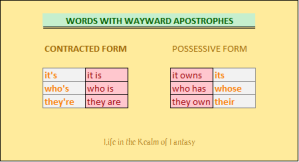
  • Who’s is the contraction of “who is” or, less commonly, “who has.”
  • Whose is the possessive of “who” or, somewhat controversially, “which.”
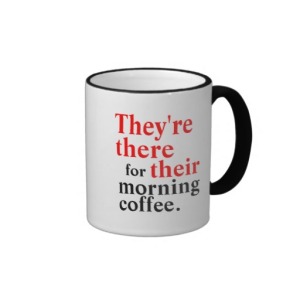
  • Their(s) is the possessive of “they.” (They’re proud to own it, it’s theirs, and it’s not there.)
  • Its is the possessive of “it,” and “it’s” is a contraction of it is.

Note that for both they and it, there is no apostrophe in the possessive form.

  • The texture of the wall —it’s rough. ( contraction: it is rough.)
  • I scratched myself on its surface. (possession: the wall’s surface.)

In most English words an apostrophe indicates possession but can also indicate a contraction. The difficulty arises in the fact that both it and they are frequently part of contracted words.

In the effort to standardize English usage, early linguists made a choice to eliminate the apostrophe in the possessive form. They did this in the (futile) hope of ending confusion.

  • It’s is the contraction of “it is” and sometimes “it has.”
  • Its denotes possession: It owns it.
  • Their: they own it
  • They’re: they are

As with so many things that “seemed like a good idea at the time,” its and it’s will always cause problems for new and beginning writers. Inadvertent misuse happens even for old hands like me when I’m zipping along laying down the first draft of a manuscript, especially during NaNoWriMo.

We have to be vigilant and ensure we have looked for proper usage of its and it’s during revisions. Even the big traditional publishing houses admit sneaky errors like those like to go unnoticed until after publication.

In closing, the most common uses of the apostrophe aren’t too difficult once we learn the rules. Remember, apostrophes are integral parts of the traffic control system, signals that keep your words moving along at the right rate. Using them the way they are intended (and which readers expect) keeps the reader from throwing your book away.

I always suggest you set some time aside for writing new words every day, even if only for fifteen minutes. When we force ourselves to think about and use the basic rules of grammar regularly, we retain what we have learned.

26 Comments

Filed under writing

The Em Dash— #amwriting

Over the years, I have seen many books written by wonderful authors who overuse em or en dashes.

I also tend to do that in blogging and in Facebook posts, and my first drafts can be peppered with them. Em dashes are a kind of author’s crutch because it is easy to rely on them.

Trust me, readers find it distracting to see an em dash in every paragraph. Some editors don’t want to see one on every page. Their point of view is that the em dash is like any other repetitive word in a manuscript. As a tool, it’s useful as a way to emphasize certain ideas, and can also be used to good effect in the place of a semicolon. In my opinion, the em dash should be used sparingly to be most effective.

So, what is the difference between the hyphen and the em dash? Aren’t they the same thing?

Not at all. Hyphens are used to join two words to create a compound word. Never use a hyphen in the place of an em dash or en dash.

  • Time-saving
  • Twenty-one

Hyphens are not always necessary. If the meaning of a compound adjective is perfectly clear when written as two separate words, a hyphen is not necessary. If its meaning is understood when written as one word and common usage writes it as one word, again, a hyphen is not necessary.

Dashes are not hyphens and are used in several ways. One kind of dash that is frequently used is the ‘en dash,’ which is the width of an ‘n.’ UK usage frequently employs the en dash in the place of the em dash.

In US usage, En dashes join two numbers that are written numerically, not spelled. To insert an en dash in a Word document: type a single hyphen between two words, with a space on either side of it:

1994 – 1996 (1994SpaceHyphenSpace1996) Once you hit the space key after the second word, the hyphen will form an en dash.

The dash we are discussing today is the ‘em dash,’ which is the width of an ‘m.’

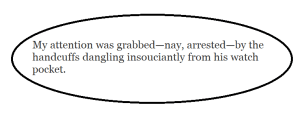
An em dash (—)   is a versatile punctuation mark. It is the width of an ‘m,’ hence the name. An em dash can serve as a comma. It does the same task as parentheses and serves the same purpose as a colon when used in the narrative.

Misty Barnett—my dog walker—loves to tango.

Tonight’s featured dances—the foxtrot, the waltz, and the Basque Sword Dance.

Used in these situations, the em dash feels less formal than a colon. This shift in usage is all about economics. The reading public drives our written language. Their preference for books with narratives light on formality is why colons are no longer used in narrative prose.

To insert an em dash in a Word document: type two hyphens next to each other without any space between the words or hyphens:

A—B (LetterHyphenHyphenLetter) Once you hit the space key after the second word, the two hyphens will form an em dash.

The em dash can be more emphatic than a comma, yet not as firm a stop as the period. It sets apart any clause bracketed by them—such as this clause—which can easily be overdone.

Their main use in my work is in dialogue. Most editors will agree that current accepted practice for fiction is to not use semicolons in dialogue. Instead, we use the em dash to join short related independent clauses. Used wisely, they can smooth a choppy conversation and make it more normal sounding. A good writer will not pepper their manuscript with them.

In the rush of getting a first draft committed to paper, we use certain words and symbols as a kind of shorthand to ourselves for later, and the emdash can be one of them. When we are making revisions, we need to be alert and reword as much as we can to do without them. Used too exuberantly, they can create a mish-mash of run-on sentences where brevity would be a better choice.

So, what are these alternative forms of punctuation to create that dramatic pause? Be creative with your word choices, phrase things carefully, and see if one of these will work as well or better:

  • PERIOD = a full stop. End of Sentence. That’s all folks.
  • SEMICOLON: Use a semicolon in place of a period to separate two sentences where the conjunction has been left out.Call me tomorrow; we’ll go dancing then. (The AND has been left out.) As I said, the semicolon has fallen out of favor with many editors for dialogue. Also, many people don’t understand how to use them. However, I have nothing against them when they are used properly.
  • COMMA:  We purchased apples, oranges, and bananas.

Authors and editors become habituated to using emdashes without thinking. After a while, the little finger just hits that hyphen key twice whenever the mind pauses.

I have mentioned this wonderful quote before, which is from a blog post called “The Case—Please Hear Me Out—Against the Em Dash.”  The post was written by the witty Noreen Malone, staff writer for The New Republic:

“What’s the matter with an em dash or two, you ask?—or so I like to imagine. What’s not to like about a sentence that explores in full all the punctuational options—sometimes a dash, sometimes an ellipsis, sometimes a nice semicolon at just the right moment—in order to seem more complex and syntactically interesting, to reach its full potential? Doesn’t a dash—if done right—let the writer maintain an elegant, sinewy flow to her sentences?”

Write the way you want to, use em dashes where you think they work best, and rely on proper punctuation for the rest of your narrative.

Happy writing!


Credits and Attributions:

“The Case—Please Hear Me Out—Against the Em Dash”  by Noreen Malone, staff writer for The New Republic 24 May 2011 (accessed 11 March 2018).

10 Comments

Filed under writing

The Ellipsis #amwriting

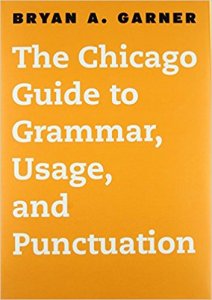
Today we’re continuing my series of handy one-page reference guides for the struggling author. The information I am imparting to you is drawn from my reference manual of choice, Bryan A. Garner’s The Chicago Guide to Grammar, Usage, and Punctuation. It takes the relevant parts of the Chicago Manual of Style and puts them into an understandable form.

On deck today is the ellipsis, that symbol of omitted words so beloved and so misused by the new, uninformed author. A signifier of things left unsaid, the ellipsis does many things, but is not punctuation in itself.

In my opinion, some people rely too heavily on the ellipsis in their prose. Used too freely, the narrative becomes halting…stuttering…gasping to a near stop.

However, just as adverbs and other descriptors are, the ellipsis is a tool and we must know how and when to use it to the greatest effect.

Quote from Wikipedia:

The Chicago Manual of Style suggests the use of an ellipsis for any omitted word, phrase, line, or paragraph from within but not at the end of a quoted passage. There are two commonly used methods of using ellipses: one uses three dots for any omission, while the second one makes a distinction between omissions within a sentence (using three dots: . . .) and omissions between sentences (using a period and a space followed by three dots: . …)

The ellipsis is a symbol, and as such, requires punctuation, even if it is at the end of a sentence of dialogue. Again, Wikipedia makes this clear:

More commonly, a normal full stop (period) terminates the sentence, then a separate three-dot ellipsis is used to indicate one or more subsequent elided sentences before continuing a longer quotation. Business Insider magazine suggests this style,[10] and it is also used in many academic journals. Even the Associated Press Stylebook[11] – notably hostile to punctuation that journalists may consider optional and removable to save newsprint column width – favors this approach. It is consistent in intent if not exact form with the agreement among those in favor of a fused four-dot ellipsis that the first of them is a full stop terminating the sentence and the other three are the ellipsis.

You can create one two different ways.

  1. Hit the period key three times in a row: …
  2. If you are using Word and have a number pad on your keyboard, press Alt 0133, which gives you the …

Bryan A. Garner, on page 396 of The Chicago Guide to Grammar, Usage, and Punctuation lists five uses and two misuses of the ellipsis.

First, we’ll talk about the uses, listed with examples on page 396.

  1. Use an ellipsis when an unfinished sentence trails off.

  2. Use an ellipsis to signal rumination, musing, or hesitant continuation of thought.

  3. Use three ellipsis dots to signal that you’ve omitted one or more words within a sentence you are quoting.

  4. Use four dots—an ellipsis and a period—when you’ve omitted one or more words at the end of a sentence. A space goes before the first ellipsis dot.

  5. Use four dots—an ellipsis and a period—when you’ve omitted material within a quoted sentence, but the quotation continues. No space goes before the first dot (the period).

On page 398, Garner lists two misuses.

  1. Don’t use the ellipsis dots without the equivalent of a letter space between each pair, and don’t allow the string of dots to be split between consecutive lines.

  2. Don’t begin a quotation with an ellipsis.

What I have discovered in my quest for enlightenment is that it is easy to misread and misinterpret rules as laid down by those who have a lot of knowledge. As I frequently say, I am always learning new things and unlearning the errors of my writing past.

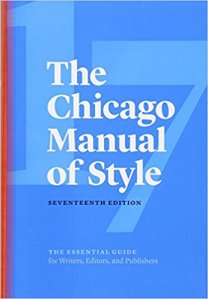
Editors and publishers rely on the Chicago Manual of Style for all questions of grammar and punctuation. Indies and small presses should too, but it is a massive tome and is enormously difficult to understand, even by the most dedicated editors.

Garner’s rules are drawn from the CMoS and phrased in ways that are simple and easy to understand. If you’re serious about the craft, I urge you to do yourself a favor and invest in the Chicago Guide to Usage and Punctuation to see his explanations and examples.

Bryan A. Garner has taken the big, blue, and expensive Chicago Manual of Style and boiled it down to the things that the average writer needs to know about the grammar aspects of our craft and placed it in an affordable package.


Credits and Attributions:

“Ellipses defined”The Chicago Manual of Style Online (16th ed.). 2010.

Wikipedia contributors, “Ellipsis,” Wikipedia, The Free Encyclopedia, https://en.wikipedia.org/w/index.php?title=Ellipsis&oldid=880964812 (accessed February 3, 2019).

Bryan A. Garner, The Chicago Guide to Grammar, Usage, and Punctuation, pages 396 – 399. © 2016 Bryan A. Garner, published by University of Chicago Press.

Cover illustration, The Chicago Guide to Grammar, Usage, and Punctuation. © 2016 Bryan A. Garner, published by University of Chicago Press. Fair use.

Cover illustration, The Chicago Manual of Style, © 2017 by University of Chicago Press. Fair use.

10 Comments

Filed under writing

Sound-alike words #amwriting

The large number of common homonyms, or sound-alike words, in our everyday usage are what makes English so tricky to learn as a second language. But even those of us who claim it as our native language get confused. Authors must learn how to recognize and use them properly.

Consider whether or not you want to use the word “ensure.” This word is so commonly abused that many native speakers don’t know which word to use in what context.

Three words could work, and they are quite similar to each other. Even worse, they have similar but different meanings.  This is when we go to the dictionary for a little research. All you have to do is use the dictionary that comes with your word processing program. (In Word, you type the word, right click on it, and when the menu opens, click on ‘look up.’)

Assure: promise, as in I assure you the house is clean.

Ensure: confirm, as in Ensure that you have set the burglar alarm before going on a long trip.

Insure: protect with an insurance policy, as in Insure your home for your peace of mind.

One of the worst failings for new authors is the word “it.” If problems appear in a manuscript, this word will likely be a major culprit. In my own work, I try to do a global search for every instance, and make sure the word is correctly used:

  • The texture of the wall—it’s rough. (It is rough.)
  • I scratched myself on its surface. (The wall’s surface.)

Its… it’s… which is what and when to use it?

The trouble here can be found in the apostrophe. In most English words an apostrophe indicates possession, but once in a while, it indicates a contraction.

  1. It’s is the contraction of “it is” and sometimes “it has.”
  2. Its denotes possession: It owns it

Some words jump right out at you as a reader:

  • they’re,
  • their,
  • there.

But others are more sneaky:

  • accept
  • except

Accept and except are so frequently confused and misused in our modern dialect that, if you doubt yourself, it is best to simply look it up. If you search for these now, you will save your editor having to do this for you, and your edit will be much more productive.

6 Comments

Filed under writing

Naming Characters #amwriting

I have mentioned (several times) one of my mistakes in naming characters. In the Tower of Bones Series, I have a main character named Marya. She is central to the series. Also, in the first book, a side character was important enough to have a name. My mind was in a rut when I thought that one up because I named her Marta.

You can see why this is bad—the two names are nearly identical.

To really confuse things, halfway through the first draft of the second book in the series, Marta suddenly was a protagonist with a major storyline. She actually becomes Marya’s mother-in-law in the third book. Fortunately, I was in the final stage of editing book one, Tower of Bones, for publication, and immediately realized I had to make a major correction: Marta was renamed Halee.

In my family, “Robert” is a name with a great deal of repetition. My father was named Robert, my two brothers are both named Robert (with different middle names), and my mother’s younger brother is named Robert. My younger brother’s son is named Robert, as is his son. We have a Bob, a Little Bob, a Rob, a Bobby, a Robby, and a Quatro.

I took this absurdity to an extreme in Billy Ninefingers. In Waldeyn, every third boy is named William, which is why Billy MacNess embraces the name his mercenaries give him after the injury. In that novel, “Williams” generally go by their last names.

Other than Billy Ninefingers where it was intentional and integral to the story, my personal rule is to NEVER name two characters in such a way that the first and last letters of their names are the same. To avoid that circumstance, I try to never have two that even begin with the same letter.

But who should go and who should stay? What is the optimal number of characters for a book? Some say only four, others fifteen.

I feel an author should introduce however many characters it takes to tell the story but should also use common sense.

A name implies a character is an important part of the story. Ask yourself if the character is an example of “Chekhov’s Gun.” Does the person return later in the story or does he or she act as part of the setting, showing the scenery of, say, a coffee shop, or a store? Is it someone the reader should remember? Even if this character offers information the protagonist and reader must know, it doesn’t necessarily mean they need to be named.

Some throw-away characters will give us clues to help our protagonist complete his/her quest or show us something about the protagonist. Their comments could offer us a clue into the protagonist’s personality or past. Other random people are in the scene purely for the ambiance, part of the world-building. A woman smoking in an alley outside the back door to an office needs no name, but she serves as a visible clue about the world the main character is walking in.

Even if they do speak a few lines, if they are just part of the scenery, they don’t need a name.

In an excellent article on screenwriting, Christina Hamlett of the Writer’s Store writes:

In a screenplay, the rhythm you’re attempting to establish–along with the emotional investment you’re asking a reader to make–is disrupted whenever you devote more than two lines of introduction to a character who is simply there to take up space. In order to justify their existence, each player in your script should perform a unique function or deliver a specific line that:

  1. Advances the plot,
  2. Thwarts the hero’s objectives,
  3. Provides crucial background, and/or
  4. Contributes to the mood of the scene.

If you’ve included characters who don’t fulfill one or more of these jobs, they’re probably not critical to the storyline and can be deleted.

While she is speaking of screenplays, this is true of a novel or short story.

We want the reader to stay focused on the protagonist(s) and their story. The desire to make every character a memorable person must be ignored. When we begin revising second draft of our manuscript, we must find and resolve the distractions we inadvertently introduced in our first draft.

My current work in progress has a passage that takes place in an inn and involves a conversation overheard from a table adjacent to my two protagonists and their sidekicks. Despite the fact the merchant and his sons give my protagonists information they needed, they are in that scene for only one purpose. They are to be overheard and don’t appear again. For this reason, only my main characters are named in the full transcript of this scene.

Finding that we have too many named characters is an easy one to fix, once we decide how important that character is to the story. If they don’t appear again, the reader will move on and forget about them. The information they imparted will remain.

I have found that a great use for my extra walk-on characters is the short story. The world is already built, and they have a story, albeit a short one. Use them to your advantage.

I now keep in mind simplicity of spelling and ease of pronunciation when I name my characters. How will that name be pronounced when it is read out loud? You may not want to get too fancy with the spelling, so that the narrator can easily read that name aloud. You may not think this is important, but it is.

My advice is to keep it simple. Don’t confuse your readers by giving unimportant walk-on characters names. Be vigilant when choosing names—don’t give two characters names that are nearly identical.

Do make your spellings of names and places easily pronounceable. You may decide to have your book made into an audio book, and the process will go more smoothly if you’ve considered this in advance. I only have one book that is an Audio book and the experience of making that book taught me to spell names simply.


Credits and Attributions:

Minor Characters Don’t Need Major Introductions, Christina Hamlett, Copyright © 1982 – 2017 The Writers Store ® Incorporated, accessed Mar. 11, 2017.

14 Comments

Filed under writing

The sound of the narrative #amwriting

Reading aloud is a great way to quickly discover the places I want to revise. I have always read portions of my work aloud, a page or two at a time. The places where I stumble are usually always the places that need ironing, so to speak.

In the past, I have only gone to this trouble with sections that I felt had some indefinable thing wrong with them. But lately, I’ve been printing out each chapter in its entirety a day or two after I finish writing it, trying to hear where the prose doesn’t work. I use a yellow highlighter on the places that feel rough.

I’m a slow writer, but I have several looming deadlines for contests and anthologies. This seemed like a good way to speed up development, getting short stories from rough draft to finished in a timely fashion.

As anyone who regularly reads this blog knows, I rarely have a piece that is perfectly clean. I am the only eye that sees it before posting. Despite my best efforts, I catch many things the day after something was posted. I always check through my work on the computer screen, and I catch a lot there, but the eye sees what I intended to write.

This bleeds over into my other work. But if I wait a day or two and then read the paper printout with fresher eyes, I find repeated words, dropped words, and all sorts of typos. Even better, reading the printout aloud exposes the rough areas, the places where the words “fight with each other.”

When you are trying to pronounce the words, run-on sentences really stand out, and clunky prose won’t flow well. The narrative reads well for a long stretch, and then it hits a stumbling point.

That yellow highlighter of mine really gets a work out—maybe I’ll have to buy a case of them.

Another thing I have discovered by reading the entire chapter rather than just a page here and there—I can see where I am repeating entire ideas. This is a common problem for me in the first draft.

Having Natural Reader or another reading program do the reading for you helps, and I have made use of that many times. But this experience has shown me that while these wonderful programs are incredibly useful, they don’t do the job quite as well as a human voice does. They often mispronounce words that are heteronyms—words that are spelled the same as another word, but which are pronounced differently and have different meanings.

  • Read (pronounced reed) as in the act of reading
  • Read (pronounced red) as in having already finished reading the book.

Natural Reader rarely guesses those sorts of words correctly. The cadence and rhythm of the narrative is not as clearly heard when the mechanical voice does the reading, even if you are reading along silently. It tends to be rather flat, a monotone.

I’m not talking poetry here, but good prose has movement when it is read out loud. Sometimes it’s fast, sometimes slow, but it should have no rough spots for the reader to stumble over.

What I love about listening to audio books is the way prose sounds when it’s read aloud by an experienced narrator. Some narratives are beautiful when read aloud, and some are not.

If you intend to have your work made into an audio book, you want to make your work easy for the narrator to read without faltering.

So, now I will add ‘printing out and reading entire chapters aloud and marking places that need correction with a yellow highlighter’ as a regular tool in my writer’s toolbox. As long as the old printer keeps limping along, doing its job, this should speed things up.

21 Comments

Filed under writing

The Proofreader #amwriting

I see the process of getting a manuscript ready for publication as a four-part process.

  1. Writing the first draft.
  2. Beta Reading and revising the manuscript to your satisfaction.
  3. Sending it to the editor and making suggested revisions.
  4. Having the edited manuscript proofread.

Proofreading is done after the final revisions have been made. Even though an editor has combed your manuscript and you have made thousands of corrections, both large and small, there will be places where the reader’s eye will stop.

It is best if this task is done by someone who has not seen the manuscript before. That way, they will see it through new eyes, and the small things hiding in your otherwise-perfect manuscript will stand out.

Some things your proofreader must understand:

  • The proofreader should not try to hijack the process and derail an author’s launch date by nitpicking his/her genrestyle, and phrasing.
  • The proofreader must understand that the author has been through the process with a professional line editor. At this point, they are satisfied that the story arc is what they envisioned, and the characters are believable with unique personalities. The author worked with an editor to ensure the overall tone, voice, and mood of the piece is what the author envisioned.

You will note that I have used the word envisioned twice in the above list. If a proofreader can’t restrain their unasked-for editorial comments, you should find a different reader.

The edited manuscript is the author’s creation, a product of his/her vision, and by the time we arrive at the proofing stage, it is intentional in the form it is in.

This is why a professional proofreader is a good investment. The proofreader must realize that the author and his/her editor have considered the age level of the intended audience. A proofreader does not go through a manuscript with a red pen and mark it up with editorial comments. They do not critique the author’s voice or content because that is not their job.

A proofreader does highlight places where typos and other proofing errors exist and ruin the narrative.

A proofreader understands that every typo and error is different. These little landmines are insidious and may not leap out at first glance, which is why they aren’t always caught during the editorial process. Any number of small, hard-to-detect things can occur during the process of making even minor revisions.

In case you didn’t see it when I mentioned it above, I will say it again: proofreading is not editingEditing is a process that I have discussed at length elsewhere.

At the outset, the proofreader must understand that no matter how tempting it may be, they have not been invited to edit the manuscript for content. If they cannot refrain from asking for large revisions regarding your style and content, find another proofreader.

The proofreader should look for misspelled words, and homophones (words that sound the same but are spelled differently). Spell-checker may or may not catch these words, so a human eye is critical for this.

  • Wrong:  Cissy wint out the door, slamming the screen.
  • Right:  Cissy went out the door, slamming the screen.
  • Wrong: There dog escaped, and he had to chase it
  • Right: Their dog escaped, and he had to chase it.

The proofreader must also look for repeated words and cut-and-paste errors. These are the kind of error frequently introduced into a manuscript when a tired author is making revisions. When we are pushing ourselves, even the most meticulous of authors unknowingly introduce errors when cutting and moving entire sections, rearranging portions of the narrative for a more logical flow.

You must rememberthe editor won’t see any errors you introduce when you implement their editorial suggestions. Once an editor has made their recommendations and returned your manuscript to you, they are done and won’t see the book again until it is published. You will have to make those revisions, and that is where many typos and errors occur.

Cut and paste errors are insidious and difficult to spot, and spell-checker won’t always find them. But a proofreader will notice them because the prose will contain unusually garbled sentences, and sometimes, two periods (full stops) at the end of a sentence.

  • Wrong: It is is accepted practice to italicize thoughts.
  • Wrong: Itis accepted practice to thoughts.
  • Wrong: First of all, it is accepted to ot thoughts..
  • Right: It is accepted practice to italicize thoughts.

Dialogue that is missing quotes can be a problem for many authors. When they are in a hurry, they sometimes don’t hit the quote key at the end of a sentence. Also, for US authors, they must be closed (double) quotes rather than single quotes.

  • Wrong: “Doctor Mendel, you’re new to the area,’ said Officer Shultz. “What do you know about the dead man?
  • Right: “Doctor Mendel, you’re new to the area,” said Officer Shultz. “What do you know about the dead man?”

Numbers that are digits are acceptable to use when writing notes and emails. They can also be used if you are writing a blogpost, but ask any bookkeeper – digits are as easy to accidentally mess up as words.

  • Wrong: There will be 3000 guests at the reception.
  • Wrong: There will be 003 guests at the reception.
  • Right: There will be 300 guests at the reception.
  • Right: There will be three hundred guests at the reception. (In literature, we write it out.)

Dropped and missing words will make the prose seem garbled and hard to follow.

  • Wrong: Officer Shultz sat at my table, me gently.
  • Right: Officer Shultz sat at my table, grilling me gently.

Something you must be aware of if you have paid for someone to proofread for you—each time you tweak the phrasing or create a new passage in your edited manuscript, you run the risk of creating another undetected error. Never make revisions when you are tired or not fully on your toes.

If you are happy with the way your manuscript was edited, I suggest you do not ask a different editor to proofread your manuscript, as they may be unable to resist suggesting larger changes. Each editor sees things differently and editing is their nature and their job.

The problem is that this can go on forever, and you run the risk of ironing the life out of your manuscript and losing the feeling of spontaneity, making it feel contrived. You also risk publishing a manuscript that looks unedited because of the flaws that were introduced in the proofing process.

Before you publish your book, do yourself a favor and have it proofread by an intelligent reader. Find someone who understands what you are asking them to do and who is willing to do only that. If you are a member of a writing group, you have a good resource of readers there.

13 Comments

Filed under writing