Tag Archives: writing

#amwriting: Commas

Commas and their usage have arisen in my conversations with clients again lately, so I felt it was time to dust off a piece I wrote  last year on managing them. If you have seen this post already, there is nothing new here–commas and their usage don’t evolve with our changing language.

Since the usage of commas is slow to evolve,  why are they so difficult to figure out? And conversely, why do some people get so jacked up over misplaced commas?

The rules are a little confusing at first because there are several exceptions. Remember, for the casual reader, misplaced commas are like road signs gone rogue–one minute everything is fine and the next you are going the wrong way down a one way street and don’t know how you got there.

Commas and the rules for their use exist for a reason, and if we want the reading public to understand our work, we need to follow them.

I am a decent structural editor, but I don’t claim to have any special knowledge about commas.

However, I do know some things:

  1. Never insert commas “where you take a breath” because everyone breathes differently.
  2. Do not insert commas where you think it should pause, because every reader sees the narrative differently.
  3. Do not put a comma after a conjunction. If needed, commas go before conjunctions.

Commas are the rules of the road for writing. They are the universally acknowledged pausing and joining symbol. Readers expect to find their pauses between clauses and commas are sometimes the signifiers of those pauses.

One rule I had to unlearn the first time I sent my work to a professional line editor:

  1. Do not place a comma before ‘because’ unless the information that follows is necessary to the sentence.

What? That’s not what I was taught in school!

The Chicago Manual Online gives this example (and I quote):

He didn’t run, because he was afraid.

He didn’t run because he was afraid.

In the first sentence, “because he was afraid” isn’t necessary. The main thing is that he didn’t run, and the reason is incidental. The second sentence, which omits the comma, is unclear. It might mean that he ran, but fear was not the reason he did so.

Mignon Fogarty, the Grammar Girl, explains this well. “You don’t automatically put a comma before the word because, but sometimes you need a comma there to make sure your meaning is clear.”

We do use commas to set off introductory clauses:

  1. In the first sentence, “because he was afraid” isn’t necessary.

I italicized the introductory clause in the above sentence to show that it is not a stand-alone sentence. This clause introduces the clause that follows it, and its meaning is dependent on that following clause.

A comma should be used before these conjunctions: and, but, for, nor, yet, or, and so to separate two independent clauses. They are called coordinating conjunctions.

However, we don’t always automatically use a comma before the word “and.” This is where it gets confusing.

Compound sentences combine two separate ideas (clauses) into one compact package.

A comma should be placed before a conjunction only if it is at the beginning of an independent clause. So, use the comma before the conjunction (and, but, or) if the clauses are actually standalone sentences. If one of them is not a standalone sentence, it is a dependent clause, and you do not add the comma.

Take these two sentences: She is a great basketball player. She prefers swimming.

  1. If we combine them this way we add a comma: She is a great basketball player, but she prefers swimming.
  2. If we combine them this way, we don’t: She is a great basketball player but prefers swimming.

I hear you saying, “Now wait a minute! Mrs. Downing very clearly taught us to use commas to join clauses, and she was right.”

I’m sorry, but Mrs. Downing probably explained that. It just didn’t stick in your memory.

Two complete ideas can be joined with ‘and.’ Did I just contradict myself?

Sort of.

Think of it like a list: if there are only two things (or ideas) in a list, they do not need to be separated by a comma. If there are more than two ideas, the comma should be used to separate them, with a comma preceding the word ‘and’ before the final item/idea.

Dogs, cats, rabbits, and birds.

Oh YES, we DO use serial commas to prevent confusion! You’ve all seen the meme: I love cooking my pets and my family. On a personal level, I do love cooking, my pets, and my family. (But not in the same pot.) They’re happy that I use serial commas.

One of my favorite personal failings is the notorious comma splice. Apparently, it’s bad form to join two independent clauses with a simple comma. This error is called a comma splice.
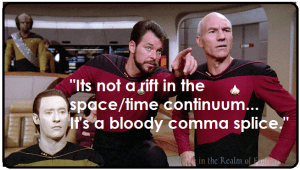
I have it on good authority that a comma splice will not cause a tear in the space-time continuum. But since this breach of humanity occasionally sends commacentrics into a frothing frenzy, we will use the conjunction and give these poor wretches a break.

From Wikipedia, the fount of all knowledge: “A comma splice is the use of a comma to join two independent clauses. For example: It is nearly half past five, we cannot reach town before dark. Although acceptable in some languages and compulsory in others (e.g., Bulgarian or French), comma splices are usually considered style errors in English.”

Commas and their proper use can drive you crazy when you are trying to get your work in order. And quite frankly, the rules are a little confusing.

Consistency is critical. UK usage can vary from US usage in some ways. Find a style guide that you can understand and consult it. Once you have a guide you can work with, use those suggestions consistently in all your work.

I use the Chicago Manual of Style for my work because I am a US citizen, and for creative writing, this is the most comprehensive manual and is what publishers and editors use. If you are strapped for cash, you can often buy secondhand copies of this manual through Amazon.

Commas can easily get out of control for me because I tend to hit the comma key whenever I pause in my thinking when I am in the first draft phase. At that point, I am more concerned with just getting the words down than I am form and style.

However, proper form and style must come into play when we get into the later drafts. Using established protocols for punctuation is important if you want your readers to understand what you meant when you wrote that amazing piece of literature.


Sources and Attributions:

Large portions of this post were first published by Connie J. Jasperson © 2016-2017 under the title, Commas, Morsels of madness or necessary evils? on Life in the Realm of Fantasy on January 25, 2016. It has been re-edited and recycled.

Commas, The Chicago Manual of Style Online, ©  http://www.chicagomanualofstyle.org/qanda/data/faq/topics/Commas/faq0018.html accessed 08-02-2017 The Chicago Manual of Style 15th edition text © 1982, 1993, 2003 by The University of Chicago. The Chicago Manual of Style 16th edition text © 2010 by The University of Chicago. The Chicago Manual of Style Online © 2006, 2007, 2010 by The University of Chicago. The Chicago Manual of Style is a registered trademark of The University of Chicago.

The Grammar Girl, Mignon Fogarty, Commas, ©2010-2017 http://www.quickanddirtytips.com/search/site/commas accessed 08-02-2017

9 Comments

Filed under writing

#amwriting: the third quarter of the novel and the character arc

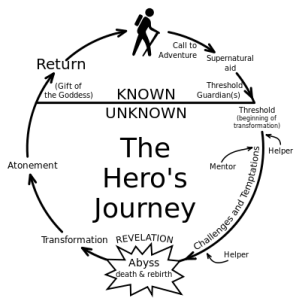
Lately, I’ve had many discussions on the hero’s journey and how we structure a story that follows that most traditional of story arcs.

Usually, the first half of the book is easy for me to write, but beginning at the midpoint of my first, very rough draft, I begin to struggle.

The rough draft is challenging because we are pulling the story out of the ether. Once the first draft is finished, we can get down to actually writing the book.

The first draft is where we take an idea, a “what if” moment and give it form on paper. When it is finished, the rough draft is basically made of sections of brilliance interspersed with a catalogue of events: who did what, where they did it, and why.  We are beginning to know our characters, but in the original version, we may not have a handle on how to portray their reactions so they are organic and true. The character arc is uneven and making the story seem real becomes a challenge.

The term character arc is used to describe the personal growth and transformation of a character/protagonist over the course of a story. Stories that interest me have a strong character arc:  the protagonist begins as one sort of person, and through the events he/she experiences, they are transformed, frequently changing for the better, but sometimes they change for the worse.

The third quarter section of your story begins with the midpoint crisis. From there we are barreling toward the final showdown that begins the final scenes, and from there we are racing toward the conclusion. The third quarter of the story is crucial because the seeds planted by the events of the first half must bear fruit here, forcing a visible change (usually a positive change) in the behavior and outlook of the protagonist and his/her friends. Sadly, some books fail to live up to their promise when they arrive at this point, and the reader gives up.

In a book where the storyline follows the hero’s journey, at some point in this third section, the protagonists may lose their faith or have a crisis of conscience. This is your opportunity to learn who they really are as human beings. The events leading to this place have combined to break the character down to their lowest emotional state. They must emerge from this section remade as a stronger person, ready to meet whatever awaits them at the final showdown.

And you must make it believable, done in such a way that it feels natural to the reader.

If you are stuck with a character you can’t figure out, ask yourself what personal revelations come out about the protagonist, or conversely what does he discover about himself?

As I said, for me this part of the rough draft is often difficult to write because often in the first attempt to just write the story down, the protagonist and his motives are still somewhat unformed. But if you are following the hero’s journey, by the end of this section, your main character has been put through a personal death of sorts. Their world has been shaken to the foundations, and they no longer have faith in themselves or the people they once looked up to.

  • How is he/she emotionally destroyed by the events?
  • How was her/his own personal weakness responsible for this turn of events?
  • How does this cause the protagonist to question everything she ever believed in?
  • What makes him pull himself together and just keep on going?
  • How is she different after this personal death and rebirth event?

This low point is a crucial part of the hero’s journey, the place during which he is taken down to his component parts emotionally, and rebuilds himself to be more than he ever believed he could be.

By the time you finish writing this part, you should have come to know your character and how they will react in any given situation.

Paying close attention to making this section emotionally powerful in your first draft will pay off when you begin the second draft. In the rewrite, the story always evolves into a greater, more polished version of the original.

Taking the rough draft and rewriting it is absolutely the most important thing you can do.  It is when you are deep into the second draft that you realize some plot twists don’t work as you devised them, and they must be reworked. Also, you begin to find and smooth out grammatical errors and awkward prose.

I write my work in four drafts. The first, rough draft rarely is seen by other eyes than mine. It is me thinking out loud through my keyboard and is not ready to be seen by anyone else but me, so if I ask you to look at a section and tell me if I have gone off the rails or not, feel honored! Few are ever offered that privilege.

The second draft is what goes to my beta readers.

The third draft is what emerges after the first readers’ comments have been taken into consideration.

The fourth draft is what goes to my editor.

While your story will have serious issues in the rough draft stage, at least by time you are finished with it you will know your characters. They and their motives will be clear, offering up the ideas you will need to shape the second draft of your manuscript, making it into the believable story of a real person’s journey through life-changing events.


Attributions:

Image: the Hero’s Journey, by scan from an unknown publication by an anonymous poster, in a thread, gave permission to use it. Re-drawn by User:Slashme [Public domain], via Wikimedia Commons

6 Comments

Filed under writing

#amwriting: sit down and write

This last weekend, I attended the 2017 PNWA Conference. I had the chance to connect with friends whom I rarely get to see in person elsewhere, and met many, many new friends.

I immersed myself into four days of seminars on writing craft, with the intention of kickstarting the rough draft of the one manuscript which has stalled for the last two months.

Let’s be clear—I always have three or four projects in various stages of completion, so I always have one novel in the first, rough draft. Usually, I have no difficulty getting my idea onto the paper but, as I have mentioned before, life sometimes throws us curve balls. When that happens, I have no trouble writing blog posts or making revisions on finished manuscripts as requested by my intrepid beta readers and editor. But it is then that completing whatever story is in the rough draft form becomes a struggle for me.

So, let’s talk about getting past that mysterious thing some people call writer’s block, the horrible nightmare that is only a temporary lull in the creative process. This is when you hear those voices mocking you, “you claim to be a writer but you haven’t written a new word in days.” (Or weeks, or months.)

First, you must understand that this is not a permanent, career killing disability. It is a fleeting, dry period where the project you want to work on is not moving forward. But other writing can and should happen!

My recommendation is to sit down and write your way through it—don’t abuse yourself over whatever project you have that is stalled. Clear your mind of those little mental voices of doom and guilt because they are the carrion birds whose songs of despair lure you along the path to failure.

Focus on writing something completely unrelated instead.

In a seminar I attended this last weekend, taught by the award-winning sci fi/fantasy author and current SFWA president, Cat Rambo, she admitted that rather than beat herself up for a momentary lapse of creativity, she works her way through the rough patches with timed stream-of-consciousness writing sessions. She does this every day and shoots for 2000 new words a day, whether they are good words or not.

The way I interpreted her comments, she does this in the NaNoWriMo style, where you set a timer and write whatever nonsense comes into your head for a certain length of time and do not stop writing for any reason whatsoever until the timer goes off.

Cat’s advice? If all you can do when you sit down for that timed writing session is to write “I can’t think of anything” repeatedly, just write that. She said (and she is right) that after a few minutes of that sort of boredom, your creative mind will rebel, your subconscious mind will take over and push you in new directions. When I do this, I usually end up with some of my best ideas embedded in those long strings of rambling words.

Those nuggets of good writing and ideas are straw I can spin into gold.

My personal advice is to not set absurdly unrealistic goals for your work. Target goals are good, but in my opinion, setting too a high wordcount for new words on your rough draft each day is a good way to set yourself up to fail, as you can’t sustain it. I find that when I am involved in NaNoWriMo, which is a different kind of writing, I can put down 2000 to 4000 words each morning–but that kind of output is not sustainable over more than just the month of November. My usual output is 1000 to 2000 new words per writing session.

Consider setting your minimum goal of writing for at least one fifteen-minute increment per day, working straight with no stopping.  Repeat the fifteen-minute sessions as many times as you like each day, if you are really fired and inspired to write.

I am a fulltime author, but even when I was holding down three part-time jobs, I still managed to write every evening. When my children were still at home, I wrote when they were doing homework, or I wrote after they went to bed. I made my time to write by choosing to only watch the TV shows that meant the most to me and ditching the rest. That meant that most evenings I had at least one hour (but sometimes two or three) of good writing time after dinner was done and the kitchen was clean.

I understand if you are emotionally invested in some TV shows, but you must choose to make time to write—choose your entertainment wisely and don’t waste what could be writing time on shows you don’t absolutely love.

So, what about multiple projects? I find that having multiple projects in the works is good for me, as switching from one to another allows me to rest my writing mind. I am fortunate, in that writing is my full-time career.  Because it is my job, I always have three or four projects going, so I do have a certain, inviolable time of the day that I will work no matter what. On Sundays, I write all the blog posts I might need for that week, both for this blog and for several other websites where I have a regular column.

I need to keep regular office hours to be productive, so the morning hours of 6:00 a.m. to 12:00 p.m. are divided like this:

6:00 to 8:00, I work on adding new words to the current rough draft.

8:00 to 9:00, if I don’t have a writing group to attend, I handle my social media stuff—a nasty but necessary task that is part of the job if you don’t have a personal PR person but hope to connect with both readers and other writers.

I don’t have a PR person.

9:00-10:00, (again if I don’t have a writing group) I take a break from writing and make a stab at cleaning my house.

10:00 – 12:00 I do revisions on other projects as my editors ask for them or I edit for clients.

I always take a break at noon and either take a walk or sit on my back porch and just watch the world go by.

In the afternoon, I make maps or do other support work that may be required for one or another of my projects, depending which is firing my mind most intensely, or if I have a client’s manuscript to edit I will go back to that.

I’m no different than any other writer—I do have times when the well of creativity runs dry. But I have the support of other authors, and I have the mental tools I need to pull me out of those rocky spots. I hope this post offers you some idea of how to jumpstart your creativity, and remember–I am always here to talk you off the ledge.

5 Comments

Filed under writing

#amwriting: regaining the mojo

Events in my family during May, June, and most of this month have hampered my mojo, stalling my creative mind. Many projects and plans have fallen by the way and I don’t really mind. This year I will not have my books in the bookstore at the PNWA conference (which kicks off on Thursday), as I just had no time and no way of getting them to the right people by the due date. But that isn’t a big deal, really—I will go to the signing event and visit my friends’ tables and buy their books, so all will be well.

Now, with my son on the mend and back in his own home, I am somewhat at sea. For four weeks, I spent two hours every morning doing wound care on his injured hand, and the rest of the day cooking, cleaning, and entertaining a houseguest. That became my schedule, and writing took the back seat, limited to writing blog posts on the fly—writing if and when I had the time.

Now, I have no demands on my time, no rigid schedule to adhere to. In a way, it’s like suddenly finding myself retired again, only this time I’m not killing time by painting flowerpots. (The last time, it looked like a Mexican pottery stand exploded on our front steps.)

Things have settled back to normal here, and I am struggling to get back into the habit of creative writing. While I have been inspired to write technical posts on writing craft for this blog, and do revisions on my finished novel as my editors ask for them, the rough draft of my new work in progress has languished, receiving erratic, haphazard attention.

Once again, just as I did years ago when I first challenged myself to ‘win’ NaNoWriMo, I am forcing myself to sit down and write from 6:00 am until noon. For me this kind of self-discipline is critical—other people may work better with a less rigid schedule, but I need to keep office hours to be productive.

I work “back and forth” when writing, rather than writing in a linear fashion, although each manuscript starts out in linear way. Each section is written when I am inspired to work on that part of the tale. Like assembling a quilt, I write connecting scenes to ‘stitch’ the sections together when the draft is complete. This is why I make a detailed outline, so I won’t get lost. Now  am revisiting what I have already done on the first draft of this book, finding that I have written the framework for a pretty good story. My notes are all detailed, and the backstory is on file in a separate file so I can access it or update when I have questions. This ensures I will know why certain things are happening.

The maps are drawn, and cover art has been selected—all these things were done in May. The first 50,000 words are written; the book is at the ½ point. The story arc has pretty much followed the original outline with only a few major divergences. The stylesheet is up to date because each change to the originally outlined story was noted as the changes were made. This means I know exactly where I left off in May, and what must happen to these characters to complete this book.

I am itching to get back to it as I want this first draft finished before November, if possible.  I need to have it done by then because November is NaNoWriMo, a month of divine madness—each year I write a patchwork of short stories, novellas, and doggerel, all of which become fodder for the rest of the year.

As an author, I am self-employed. This means I succeed or fail by my own efforts. I choose to succeed, and for me, that means finishing each book to the best of my ability. I am inherently lazy, a self-confessed slacker who would rather read a book or play video games than work—thus I must enforce the puritan work ethic my ancestors brought to America and which somehow passed me by.

10 Comments

Filed under writing

#amwriting: lay, lie, laid

A few days ago, a discussion in an  author’s’ online chat room raised a question, “Is it lay, lie, or what?”

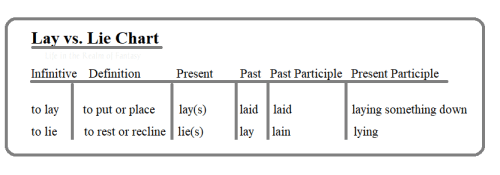
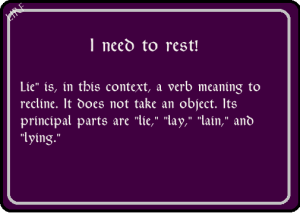
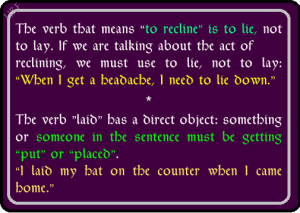
Thus, it’s time to revisit my post on one of the more misused verbs in the English language: the verb lay.’ In my own work, I often have to stop and make sure I am using it correctly. Do I mean to lay down or lie down? It boils down to a simple concept: is the object of the verb RECLINING  or was it PLACED THERE?

“Lay” is a verb meaning to put or place something somewhere. It has a direct object. Its principal parts are “lay,” “laid,” “laid,” and “laying.”

What the words refer to is the action: If you set it (object) there, it is laying there. Lay it there. Lay it on the pillow.

If it is resting or reclining, it is lying there. Lie down. Lying down. Lie down, Sally. (Clapton had it wrong? Say it isn’t so!)

The internet is your friend. Quote from the wonderful website Get it Write: The verbs to lie and to lay have very different meanings. Simply put, to lie means “to rest,” “to assume or be situated in a horizontal position,” and to lay means “to put or place.” (Of course, a second verb to lie, means “to deceive,” “to pass off false information as if it were the truth,” but here we are focusing on the meaning of to lie that gives writers the most grief.)

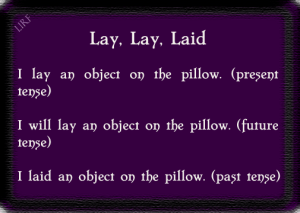
This is where things get tense: present, past, and future.

A ring lay on the pillow. 

But I needed to rest:

So what this all boils down to is:


But just to confuse things:

A living body lies down and rests as is needed.

A dead body is cleaned up and laid out by other people if said corpse was important to them. However, after having been laid out the corpse is lying in state to allow mourners to pay their respects.


Attributions and Credits:

This post first appeared on Life in the Realm of Fantasy on July 15, 2015, as Lay, Lie, Laid, © 2015-2017 by Connie J. Jasperson, all rights reserved.

Quote from: To Lie, or To Lay, Get it Write online, http://www.getitwriteonline.com/archive/051402lielay.htm, accessed July 11, 2017

4 Comments

Filed under writing

#amwriting: it’s #magic

Once magic enters your story, you must do some foot work, or your premise won’t be believable. It’s critical that you have finite rules for limiting how magic works. If your magic rules are too elastic, or you imbue too many amazing abilities into your main character, you will make them too good to be true. Readers won’t be able to relate to their story.

When I sit down to write a fantasy story, there will be magic, and I will have planned carefully for it. I have three worlds with three radically different systems of magic.

  1. In my serial, Bleakbourne on Heath, sorcerers use incantations sung to certain melodies.
  2. In Huw the Bard people can purchase magic (majik) amulets and potions.
  3. In the Tower of Bones series, magic and religion are intertwined. Aeos, the goddess, has decreed that all children who begin to show healing-empathy, or the ability to use the magic of the elements must be brought to the Temple and trained, for the protection of society in general. There are rules, certain things which can and can’t be done. As in real life, there are certain exceptions, but they too have limitations. No one is all-powerful.

Each time you make parameters and frameworks for your magic you make opportunities for conflict within your fantasy world. Remember, conflict drives the plot.

First, you must consider who has magic? What kind of magic–healing or offensive or both? What are the rules for using that magic and why do those rules exist? Magic is an intriguing tool in fantasy, but it should only be used if certain conditions have been met:

  • if the number of people who can use it is limited
  • if the ways in which it can be used are limited
  • if not every mage can use every kind of magic
  • if there are strict, inviolable rules regarding what each kind magic can do and the conditions under which it will work.
  • if there are some conditions under which the magic will not work
  • if the learning curve is steep and sometimes lethal

What challenges does your character have to overcome when learning to wield magic?

  • Is he unable to fully use his own abilities?
  • If that is so, why is he hampered in that way?
  • How does that inability affect his companions and how do they feel about it?
  • Are they hampered in anyway themselves?
  • What has to happen before your hero can fully realize his abilities?

Even if this aspect does not come into the story, for your own information, you should decide who is in charge of teaching the magic, how that wisdom is dispensed, and who will be allowed to gain that knowledge.

  • is the prospective mage born with the ability to use magic or
  • is it spell-based and any reasonably intelligent person can learn it if they can find a teacher?

Magic and the ability to wield it usually denotes power. That means the enemy must be their equal or perhaps their better. So, if they are not from the same school, you now have two systems to design. You must create the ‘rules of magic.’  Take the time to write them out.

In creating both social and magic systems, you are creating a hidden framework that will support and advance your plot. Within your magic system, there can be an occasional exception to a rule, but there must be a good reason for it, and it must be clear to the reader why that exception is acceptable.

Another important point to take note of is this: the only time the reader needs to know these systems exist is when they affect the characters and their actions. Dole this information out in conversations or in other subtle ways and it will become a natural part of the environment rather than an info dump.

It is a fact that sometimes books that were outlined to a certain storyline sometimes go off in their own directions, and the story is better for it. I haven’t experienced the sudden influx of magic into the story as that plot twist is always planned for, but I have had other random events throw a curveball at me.


Attributions:

Portions of this post have previously appeared here on Life in the Realm of Fantasy and also in my column on writing craft for the Northwest Independent Writers Association (NIWA).

Comments Off on #amwriting: it’s #magic

Filed under writing

#amwriting: the ‘e’ word #epilepsy

As many of my regular readers know, my husband and I share five children, all adults, two of whom have a seizure disorder.

Both my daughter and son were diagnosed with epilepsy when they were well into adulthood. Both have been hospitalized with severe injuries, but while our daughter’s journey with the seizure disorder has been relatively trouble free for the last ten years, our son has not had such luck.

Daughter 1 responds well to the medication and rarely has issues. Son 2 has had trouble getting his medication regulated, and his high stress lifestyle has often interfered with his ability to stay on track.

In conversation, as soon as folks hear the word ‘epilepsy’ they begin armchair prescribing cannabis, as the new cure-all for seizure disorders, and while the CBD end of the cannabis spectrum does have a miraculous effect for some patients, it is like any other medicine—it is not useful for everyone. My children are among those who do not benefit from it.

A ketogenic diet may help, but again, not every type of seizure disorder responds to this diet. However, it doesn’t hurt to try it, and so we are.

Surgery is an option when a cause for the seizures is clear and operable, but for most patients, there is no discernable cause. My children fall into this group, and until a more efficient type of brain scan is available, MRIs and EEGs remain inconclusive.

Epilepsy is caused by a range of conditions that are not well understood, and it is one of the less popular afflictions for research. The way it is treated is to throw medication at it until they happen on one that works, rather like Edison trying to invent the lightbulb.

At times, epilepsy rears its ugly head like Cthulhu rising from the depths, and when that happens life goes sideways for a while. The last two months have been difficult in many ways. I have been unable to focus on creative writing, although writing for this blog has been a lifesaver.

Revisions on Billy Ninefingers (a novel set in the same world as Huw the Bard) are going slowly, although I still hope to publish him in September. The first draft of my new (and as yet unnamed) series, set in the World of Neveyah (Tower of Bones), is on and off—sometimes more off than on.

This is just life, just the way stuff happens.  All is not lost. The creative muse will return as it always does.

Three weeks ago, my son had a partial seizure while cooking, and burned his right hand. He then spent four days in Harborview, the regional burn center for the Pacific Northwest. The burns are situated in such a way they are not good candidates for skin grafts, so they are healing slowly. In the process, I have developed some mad wound care skills. For perhaps another week or so, my son is staying with us as he is right handed and the wounds are in tricky places. Soon, he will be healed enough to tend to his own wounds and will go back to his own home.

The real story is, despite the wounds and temporary setbacks, life has been amazingly good. Healing is progressing. We have spent many hours playing Stardew Valley and sitting on the back porch talking and laughing about everything imaginable. This has been a good experience in ways we have found surprising. We have discovered we are not only family, but we are also friends with so many things in common.

This is why the old saying about clouds and silver linings is true—with every ill wind, something good has come along to offset the bad.

1 Comment

Filed under Epilepsy, writing

#amwriting: Drawing on Life Experience

Writers, even dedicated, passionate ones, have lives outside the confines of their craft, and while it frequently derails our ability to write, it is also where we find the realism we need to inject into our work. Life must come before writing because writing doesn’t pay the bills unless you are one of the fortunate few.

I have several family members with serious health issues. Sometimes, I must step away from the keyboard and be the wife, niece, mother, or grandmother they need and you know what? My writing is better for it.

I nursed my mother, with whom I had a complicated relationship, through the last year of her life. She had smoked until the age of 42, and was addicted to perfumes and air-fresheners. She was a self-described clothes-horse who loved expensive cologne and used it liberally.

Even after her death, after they had been laundered and dry cleaned, her clothes still smelled strongly of her brand of Estee Lauder’s cologne.  In her home, she had a Glade plug-in in every outlet, and the spray bottle of Febreze in her hand at all times.

She died of lung cancer.

During her last year, we spent four days a week at the cancer center, and the rest of our time with me caring for my frail mother as if she were my baby. It was difficult mostly because watching someone you love slowly die is the worst. My sanity during that difficult year was made possible because of writing. I wrote 260,000 words during that year, some of it good, some of it off the rails. Much of the experiences of that year are unconsciously referenced in my current writing. It is the part of me that goes into each tale.

It was a devastating year made more difficult by my brother’s mental illness and drug addiction. Yet, that same year was made richer by the strange friendship that developed between me and my mother. All the many things that had stood between us and which had seemed so important were set aside and never addressed. This was because, in the face of her final battle, the hurts of the past just did not seem that important to me. We began to enjoy being in each others’ company, enjoy the quiet of an afternoon, or the bustle of a Starbucks. The ‘F’ word that some of us find so hard to say, forgiveness, became such an easy thing, and when she died, I had lost a friend as well as a mother.

On this blog, I’ve discussed the way epilepsy has affected my two of my adult children, and how our lives are affected by witnessing their struggle. Many hours have been spent writing in hospitals, and this last weekend was no different. I am there when they need me, and when they are ready to stand on their own, I allow them the space they need to do just that.

I have also mentioned how having an eccentric father with battle related PTSD forged my need to escape into books and inspired my writing. Some of us have survived the alcoholic parents who did their best, but dealt with an addiction they denied having. Every writer deals with family issues and experiences, both good and bad, and we are a composite of all of them.

Every time our heart is broken, every time we feel that glorious rush of infatuation, and every time we stick our foot in our mouth or must eat humble pie—these moments should find their way into our work and emerge as characters with real emotions, people who live and breathe and feel real to the reader.

Life in all its glorious beauty and ugliness fuels my writing, and I am not alone. We authors take what we know and reformulate it into something we can live with. In some ways, hope drives my writing. The fact I have hope allows me to write about things that are painful. I find that the fullness of life and the occasional emptiness of despair are easier written about when I set them in an alternate universe, and wrap it in a story that embraces the emotions, even though the story doesn’t parallel my life directly.

I’m like the character in a long, brilliant and sometimes bad, novel. My life is a mix of great joy, romance, helpless sorrow, extreme anger, and faith in the future. I hope your life is balanced as well as mine is, with the good outweighing the bad. This maelstrom of life experience is the well we draw from when we are creating our characters.

4 Comments

Filed under Epilepsy, writing

#amwriting: demystifying the semicolon

Semicolons are misunderstood and misused bits of punctuation. Some people believe they are extra-long pauses, halfway between a comma and a (full stop) period. With that in mind, they litter their work with instances of typographical madness.

Semicolons are NOT extra-firm pauses. When writing genre fantasy, em dashes (or hyphens if you are British) serve that function. Semicolons have a different place in the universe. So now we’re going to examine the semicolon and discover what it is that they actually do.

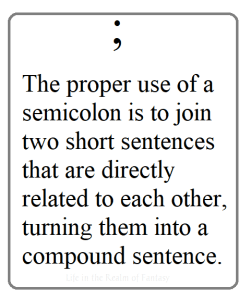
The proper use of a semicolon is to join two short sentences that are directly related to each other, turning them into a compound sentence.

No one enjoys reading a choppy narrative because too many short sentences can be distracting and hard to get into. The way we smooth the narrative is to join short sentences into longer, compound sentences. But frequently, that creates run-on sentences. (I am the queen of those.)

SEMICOLON: Use a semicolon in place of a period to separate two complete, stand alone sentences where the conjunction has been left out. These sentences MUST be directly related to each other.

Incorrect: Call me tomorrow; if it rains. (The semicolon is not needed because “if it rains” is not a stand alone sentence. This sentence should be written: Call me tomorrow, if it rains.)

Incorrect: Call me tomorrow; the car is running in the driveway. (Each clause can stand alone but they have no relation at all to each other. They are separate thoughts completely.)

Correct: Call me tomorrow; we’ll make the arrangements then. (The conjunction and has been replaced by the semicolon.)

The key to understanding semicolons is to understand what a stand alone sentence is. A stand alone sentence consists of a subject and a verb, and expresses a complete thought:

Vera walked carefully across the rough ground.

Dogs and their owners came from all over to play in that park.

If you have sentences that express complete thoughts but make the narrative choppy, you can connect them with a conjunction: Rain had fallen. The yard was flooded. We were trapped.

Rain had fallen, and the yard was flooded, so we were trapped.

Alternatively, we could rewrite the sentences in such a way they aren’t choppy:

Rain had fallen, flooding the yard. We were trapped.

If you don’t want to use a conjunction and you absolutely must use a semicolon, or you will burst into flames, you have the legal right to do so.

Rain had fallen, flooding the yard; we were trapped.

Authors who truly believe in themselves and their work will go out of their way to learn the proper use of punctuation. Once we know the mechanics of the English language, we will use it in ways that define our vision for our work.

When we learn how punctuation functions in making our sentences flow for the reader, we begin to develop our sense of style. We begin to craft our work with intention.

As a result, our work ceases to be uneven, with occasional flashes of brilliance. It becomes engrossing, something our readers can get lost in.

However, there are some considerations for each author to ponder when it comes to the use of the infamous semicolon. For general fiction or literary fiction, semicolons are no big deal. Used properly, readers and reviewers won’t even notice them.

If you are writing in genres such as paranormal fantasy or hard science fiction, I suggest you use conjunctions or rewrite the sentences in such a way they aren’t choppy, rather than resorting to using semicolons. Some reviewers in those genres seem to despise semicolons, saying they are “archaic.” These reviewers will criticize work sprinkled with semicolons as being “too literary” (whatever that means).

Maybe they are archaic, but I doubt it. When I first began writing, I used to employ semicolons far too frequently and improperly. I had the good fortune of having an editor who was patient and happy to explain how they actually function. I bought a copy of the Chicago Manual of Style and that book is what I refer back to when I have questions about how punctuation works.

While I rarely use them myself nowadays, the semicolon is a legitimate punctuation mark, and when used correctly, it has a specific task. I suspect the many haters of this little morsel of madness are simply confused by the proper use of it, and therefore they consider it unnecessary.

8 Comments

Filed under writing

#amwriting: getting lost in translation

The question about using foreign languages in dialogue recently arose again, so it seemed appropriate to revisit a situation from one of last year’s posts.

The quote that started it all was posted in a writers forum: “I have a main character in a fantasy novel who speaks no English. She speaks several other languages, though. Should I put the translations for her dialogue in italics or in parentheses?”

The answer to both options is a resounding no. We write in our native language for people who read in that language.

We can add a slightly foreign flair, but translations should not be necessary at all. We don’t put the reader through that kind of torture, wading through a language they don’t understand, and then giving them the translation in italics. (Or large chunks of whatever in parentheses.)

The writer whose question had begun this was writing a fantasy novel, and there are certain conventions readers expect authors to adhere to in this genre. When writing genre fantasy it’s a generally accepted practice that thoughts are set off with italics, not parentheses (aka Virginia Woolf), and so brackets have no place in the fantasy narrative.

Too many brackets clutter up the narrative just as much as large blocks of italics. In fantasy, the em dash or ellipsis has the function of setting portions of the narrative aside or giving it emphasis.

Italics, parentheses, and foreign dialogue are like cayenne—a little goes a long way. It’s all right to include an occasional foreign word or phrase, as long as it is done in such a way that the reader who most likely does not speak that language is not completely thrown out of the book.

My next thought when I was told about this particular conversation was, does the writer speak the languages she is writing, or is she getting her Russian (or Spanish or German) from Google Translate?

If that is the case, this author has a hot mess on her hands and her readers aren’t likely to finish her book.

Original sentence in English: “It appears as if my dog may have fleas.”

Google translation in French: “Il semble que si mon chien peut avoir des puces.”

Re-run that French phrase through Google translator: “It seems as if my dog can have fleas.”

Note the slight change in the translation—one word has been shifted, “may” becomes “can.” While these words are sometimes interchangeable in English, they don’t always mean the same thing:

  • May sometimes means might or perhaps; or sometimes may gives permission.
  • Can gives permission or enables.

That slight switching out of the word “can” for “may” changes the meaning of the sentence. The first sentence with “may” suggests it is possible the dog has fleas. The second translation to French assumes the word “may” is permission and gives the dog permission to have fleas.

These are two entirely different concepts.

English originally developed from a set of Anglo-Frisian or North Sea Germanic dialects originally spoken by Germanic tribes traditionally known as the Angles, Saxons, and Jutes.  So, modern English is an offshoot of Frisian, as is Dutch. Basically, we speakers of English speak a version of Dutch.

I hear you now: “But I don’t understand Dutch!”

This is because even though we share the same roots, we have widely different syntax.  English is heavily influenced by Latin, thanks to the Roman Conquest of Britain. In linguistics, syntax is the set of rules, principles, and processes that govern the structure of sentences in a given language, specifically word order.

How do you know that the Google translator understands syntax? The answer is: it doesn’t.

Imagine this situation: Your character from Amsterdam has bent a spoke on his bicycle wheel. He speaks Dutch. Filtered through the translator, it goes like this:

English: “Oh no. My bicycle has a bent spoke. How can I fix it?”

1st Dutch translation: “Oh nee. Mijn fiets heeft een gebogen sprak. Hoe kan ik dat op?”

2nd English translation: “Oh no. My bike needs an bent. How can I fix it?”

Note the misplaced words: When we retranslate it back to  English, the second translation makes no sense.

Google Translate is an extremely useful tool, but it is not intended to be used to translate an entire book into a foreign language. You need to hire a translator for that.

So, now we know that texts translated via Google Translate often emerge slightly twisted and make no sense, which is not what we want. If you do use the occasional foreign word or phrase, it’s no big deal as long as it is used appropriately and in a context that will be understandable to readers who don’t speak that language. It lends a certain realism when done with a deft and sparing hand.

Just don’t rely on Google Translate to help you write your Russian spy novel’s love scene.

13 Comments

Filed under writing